


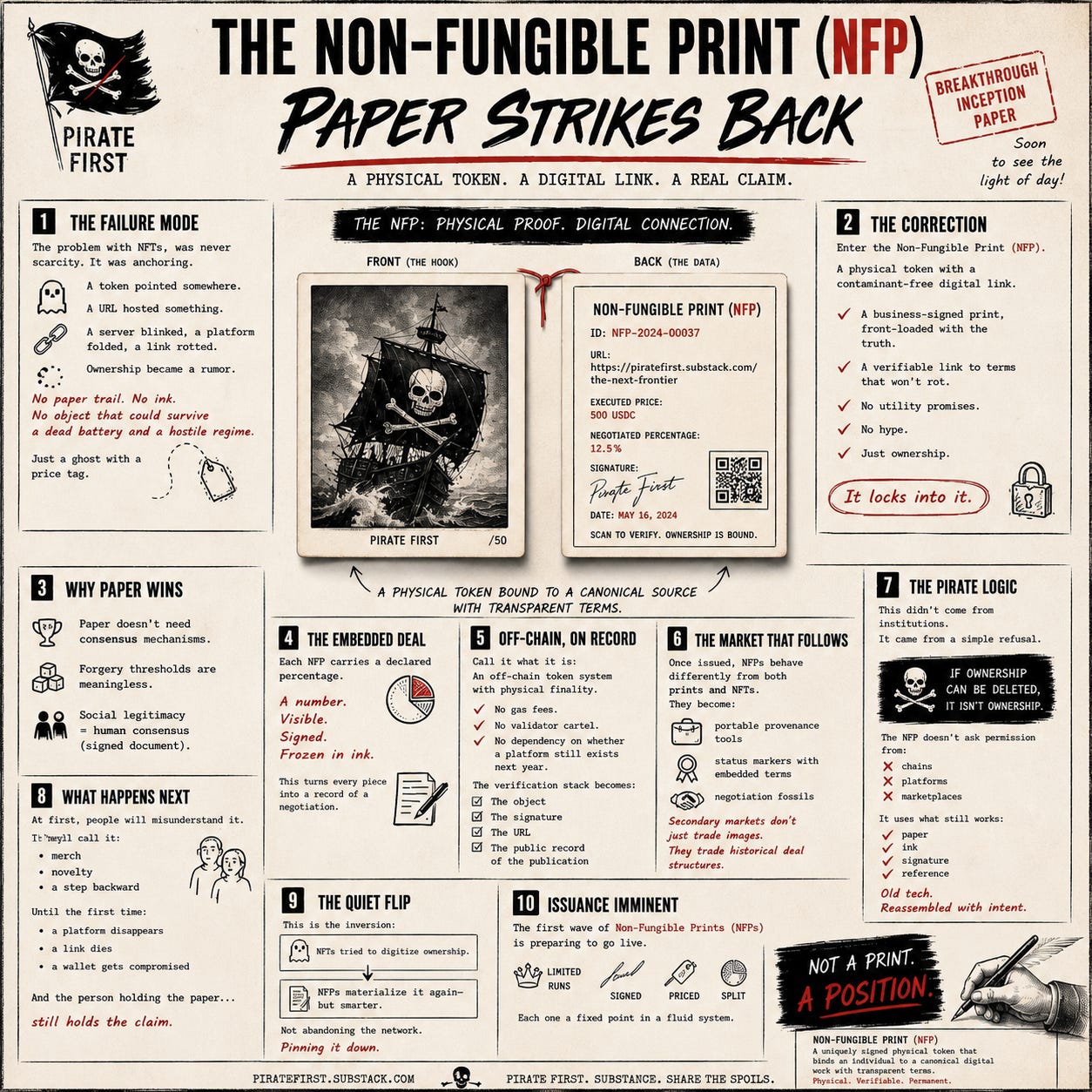
The Non-Fungible Print: Physical Finality in Digital Ownership
The Non-Fungible Print (NFP), a physical alternative to digital collectibles designed to solve the problem of disappearing links and platform dependency.
Unlike traditional NFTs, an NFP is a tangible artifact that features the artwork on the front and essential transaction metadata—such as price, signatures, and ownership stakes—on the back.
This format prioritizes physical finality, using paper and ink to ensure that proof of ownership remains resilient against server failures or digital censorship. By blending artistic expression with a micro-contract structure, the creator establishes a system where the object itself serves as an immutable record of a deal. Ultimately, the NFP is presented as a sovereign ownership layer that functions independently of blockchain networks or corporate hosting services.
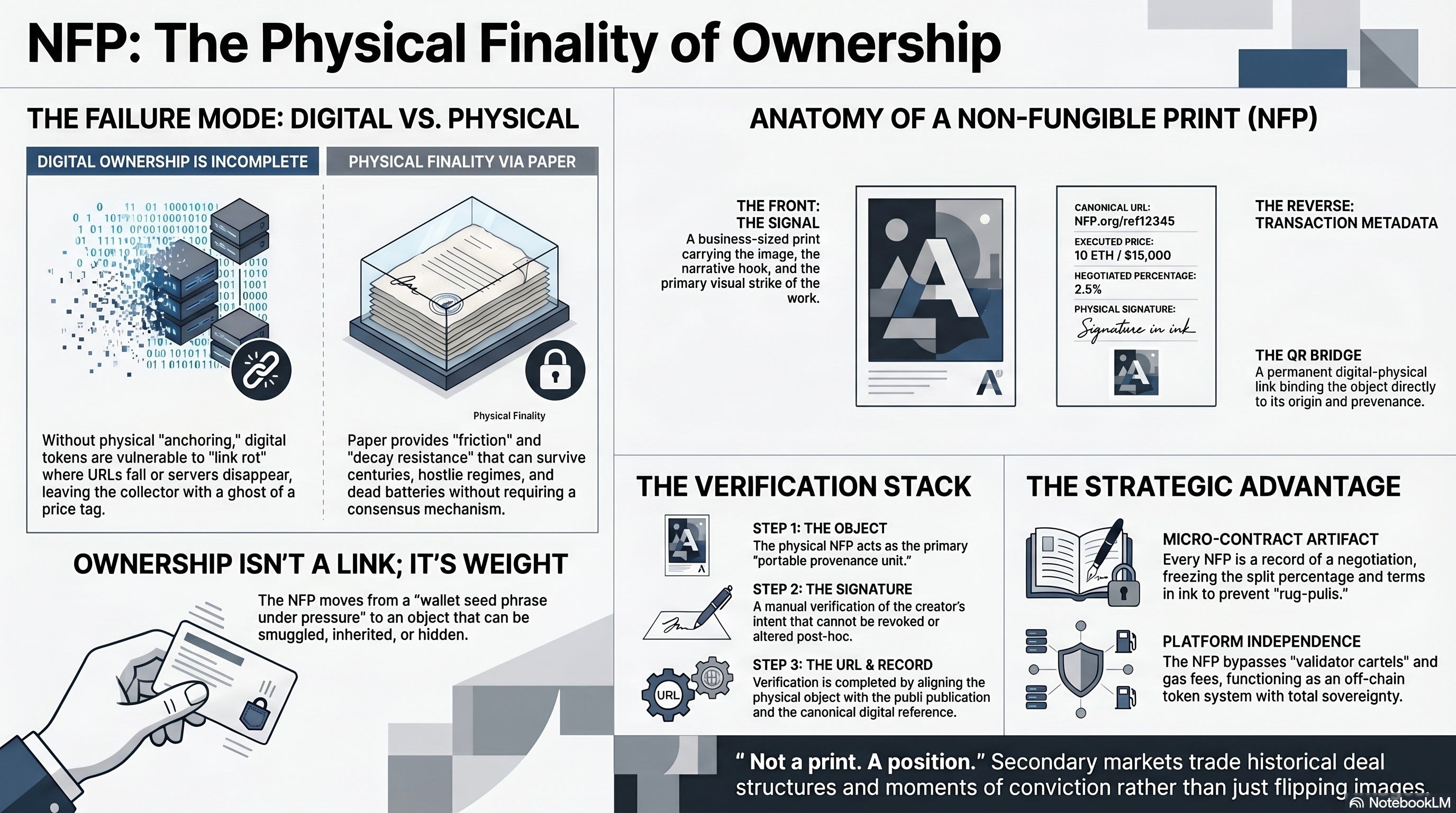
Structural Analysis: The Non-Fungible Print (NFP) as a Micro-Contractual Artifact
1. The Genesis of Physical Finality
The prevailing ethos of the last decade suggested that digital ownership should exist in a pure, abstract state—unburdened by matter and floating within the cloud. As a Strategic Asset Architect, I view this as a catastrophic structural oversight. In an era where digital links are prone to decay and platforms operate with the stability of sand, the Non-Fungible Print (NFP) is not a regression; it is an essential “anchoring” of value. By withdrawing dependence from fragile digital architectures and “binding” ownership to a physical substrate, we solve the problem of the “incomplete” token. We are no longer trading in rumors; we are anchoring claims in reality.
The “Failure Mode” of pure digital ownership is defined by three primary vulnerabilities that render traditional NFTs strategically insufficient:
Link Rot and Server Dependency: A digital token is merely a pointer. When the host server blinks or the platform folds, the collector is left holding a dead hash—a ghost with a price tag.
The Consensus Illusion: Purely digital assets rely on the continued operation of “validator cartels” and specific marketplaces. If the platform’s permission is revoked, the ownership is deleted.
The Absence of Physical Weight: Without a paper trail or ink-based finality, digital assets lack the resilience to survive “dead batteries” or hostile regulatory regimes.
The failure of the digital ghost has necessitated a hard pivot toward a physical containment strategy—the materialization of a claim that the screen forgot.
2. Anatomy of the NFP: The Dual-Sided Architecture
The physical format of the NFP is a deliberate containment strategy designed for maximum resilience. It recognizes that while digital systems excel at distribution, they are fundamentally incapable of ensuring permanence. The NFP utilizes a business-size print format, transforming it into a “fixed point” in a fluid digital system. This is not art for the sake of aesthetics; it is an architectural decision to ensure the work survives independently of any network’s health.
The NFP Structural Dichotomy
Component (Front/Back)
Functional Purpose
Front: The Visual Strike
Acts as the “signal” and “narrative hook.” It establishes the primary visual identity and provides the immediate psychological entry point for the observer.
Back: Transaction Metadata
Functions as the permanent ledger. It carries four immutable data points: the canonical URL, the executed price, the negotiated percentage, and the authoritative signature.
The “QR bridge” serves as the connective tissue, structurally locking the physical artifact into its digital origin. This architecture ensures the object does not merely reference a work but becomes the work’s primary anchor. This transformation creates a “bound” unit of ownership that remains locally issuable and globally referential.
3. The Micro-Contractual Layer: Metadata as Negotiation Fossil
The NFP represents a strategic shift from “symbolic ownership” to “transactional evidence.” By recording specific terms in ink, the creator moves beyond the collectible into the realm of the “micro-contract artifact.” This is the ultimate defense against the ephemeral nature of digital dashboards.
The inclusion of the “executed price” and the “negotiated percentage” is a revolutionary transparency measure. This “uncomfortable” percentage is a split frozen in ink, recording the exact terms of the deal at the moment of issuance. This removes the possibility of “post-hoc interference”—a common failure in digital royalty systems where platforms can unilaterally change terms. This is the core of Pirate Logic:
Refusal of Permission: A simple refusal to let ownership be a revocable permission granted by chains or platforms.
Higher Forgery Thresholds: Physical ink and hand-signed signatures provide a high, visible, and risky barrier to entry that a digital hash cannot replicate.
Social Legibility: A signed document is a “sovereignty dowry” that anyone can understand, verify, and respect without a wallet or a technical intermediary.
By freezing the deal in ink, we prevent the “rug-pulls” inherent in systems where the rules can be rewritten by a centralized API.
4. The Verification Stack and Off-Chain Sovereignty
The NFP provides the strategic advantage of “off-chain tokens with physical finality.” By removing dependency on gas fees and the whims of validator cartels, the NFP achieves a state of off-chain sovereignty. It uses old technology, reassembled with new intent, to ensure a claim survives even when the grid fails.
The NFP is secured by a four-pillar Verification Stack. The claim is valid only when all four align; if one falters, the forgery exposes itself:
The Physical Object: The tangible business-size artifact.
The Signature: The authoritative mark of the creator.
The URL: The persistent digital reference point.
The Public Record: The archived publication or issuance data.
In this stack, “friction” and “decay resistance” are features, not bugs. The physical effort required to move an object and its ability to last for centuries provide a “social legibility” that is universally understood. This stack allows the artifact to survive dead batteries and hostile regimes, providing the holder with a claim that remains valid as long as the object exists.
5. Market Transformation: Trading Positions in a Narrative
Secondary markets for NFPs function as “portable provenance units,” diverging sharply from traditional art or NFT speculation. When an NFP is traded, the participants are not just moving an image; they are transferring a portable syndication anchor. The artifact serves as an archive of a historical deal structure, making the context of the original acquisition a core component of its value.
In an NFP transaction, the market is actually trading:
Historical Deal Structures: The specific financial splits and terms archived at the moment of creation.
The Moment of Conviction: Tangible evidence of exactly when a supporter first backed the narrative.
Visible Early Support: A status marker that proves early involvement in a creator’s timeline across a drifting transmedia field.
The collector is no longer “flipping art”; they are flipping a position in a narrative timeline—a fixed point of history in an increasingly fluid world.
6. Conclusion: The Materialization of Ownership
The Non-Fungible Print is a format invention born under pressure. It is the architectural response to digital instability and platform overreach. The “Quiet Flip” represents a total inversion of the last decade: while NFTs attempted to digitize the concept of a claim, the NFP materializes the digital network itself, pinning it down to a resilient, physical medium.
This is more than a product; it is a format class designed for a new era of creators—writers, journalists, and artists who must operate in unstable economies or under the threat of censorship. The NFP reclaims the power of issuance, moving it from the platform back to the individual. It is a breakthrough format, a portable syndication anchor that ensures the creator’s terms and the collector’s claim outlive the very platforms they traverse. We have withdrawn dependence from the system and issued our own layer. You flex a hash—we flex a relic. Not a print. A position.
Promotional materials for The Non-Fungible Print (NFP), tailored for Substack and X.
Substack Note
Moving From Digital Ghosts to Physical Relics 📜⚓
The prevailing ethos of the last decade suggested that digital ownership should exist in a pure, abstract state—floating vulnerably in the cloud. We view this as a catastrophic structural oversight.
When a host server blinks, a platform folds, or an API changes its terms, the digital collector is left holding nothing but a dead hash. A ghost with a price tag.
Enter The Non-Fungible Print (NFP): a structural shift from “symbolic ownership” to “transactional evidence.”
By binding ownership to a physical, dual-sided substrate—artwork on the front, and a micro-contractual ledger on the back (price, signatures, stakes, and a QR bridge)—the NFP introduces Physical Finality. It is a sovereign ownership layer that functions entirely independently of volatile blockchain networks, gas fees, or corporate hosting services.
We are no longer trading in rumors. We are anchoring claims in reality.
Read the full structural breakdown of how the NFP is redefining the verification stack and materializing the network below. 👇
You flex a hash—we flex a relic. Not just a print. A position.
Short X Post
Digital links rot. Platforms fold. Web3 left collectors holding dead hashes—ghosts with a price tag.
The antidote? The Non-Fungible Print (NFP).
Artwork on the front. Micro-contractual metadata frozen in ink on the back. No blockchains. No server dependencies. No permission required.
Physical finality for digital ownership.
You flex a hash—we flex a relic. Not a print. A position.
[Link to Substack]
Hashtags
#NonFungiblePrint #NFP #DigitalOwnership #PhysicalFinality #SovereignCreator #Web3Evolved #CryptoArt #MicroContract #ArtTech


