


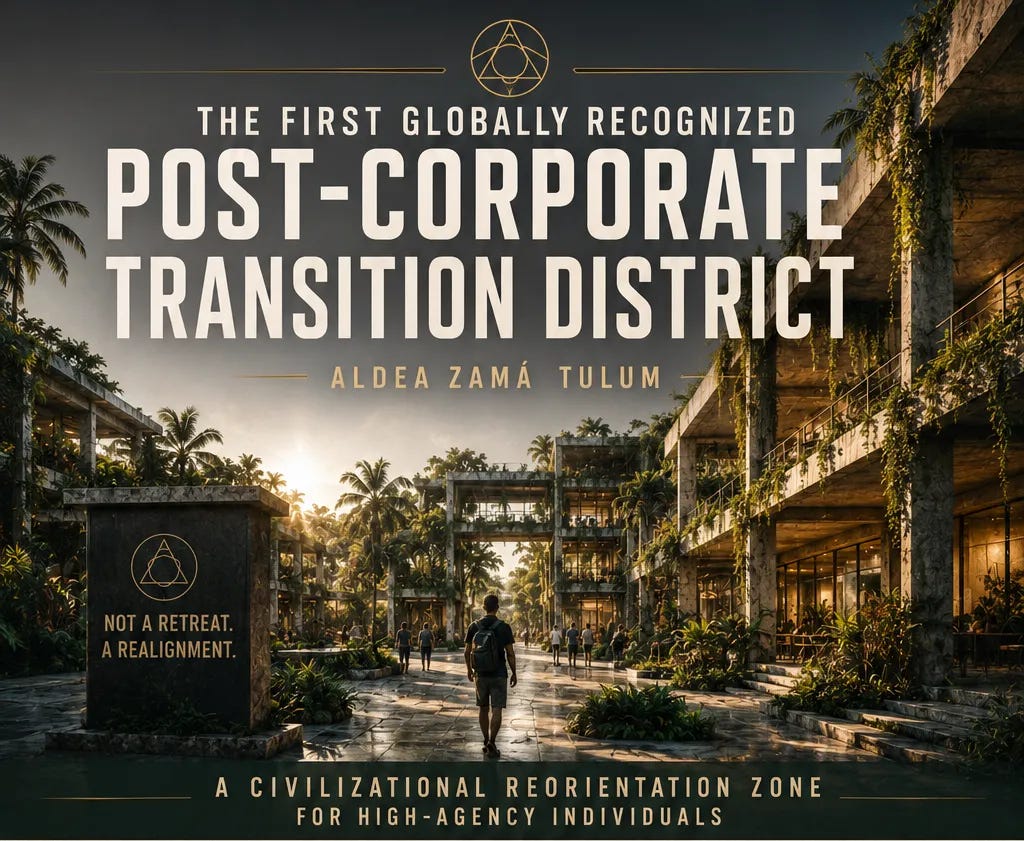
PART TWO — THE SPECIFIC CONDITION OF ALDEA ZAMÁ Chapter 07 — What Was Built and What Was Not
There is a distinction in architecture between a building and a place, and the distinction is not primarily about scale or ambition or the quality of the materials or the sophistication of the design. A building is a structure that provides shelter, that organizes space in ways that enable certain activities and exclude others, that has a defined program — a set of intended uses to which the spatial organization is addressed — and that succeeds or fails according to how effectively the constructed space serves the program it was designed to support. A place is something more complex and less predictable, and its complexity and unpredictability are precisely what make it something more than an assemblage of well-designed buildings. A place has atmosphere, which is the specific quality of feeling that a particular combination of space, light, material, human population, historical association, and cultural meaning produces in the people who inhabit it — a quality that is not designed in any direct sense but that emerges, over time and through use, from the interaction between the physical environment and the people who choose to be in it and the activities they choose to conduct there and the meanings they gradually attach to the specific spaces in which those activities occur. A place has memory — not the archival kind that can be stored in documents and retrieved on demand, but the embodied kind that lives in the specific corners and thresholds and gathering points of a physical environment and that shapes, subtly and persistently, the behavior and the imagination of everyone who moves through it. A place has an argument, as this handbook described in the previous chapter — an implicit claim about what is possible inside it, what kind of person belongs in it, what kind of life can be built around it. And a place has an organism — the living network of daily activity, social relationship, cultural production, economic exchange, and shared meaning-making that constitutes the actual life of a place as opposed to the physical infrastructure that provides the container for that life.
Aldea Zamá, at the time of this handbook’s writing, is an unusually accomplished building that has not yet become a place. That assessment is not a condemnation. It is a precise diagnosis, and its precision matters because the difference between a condemnation and a diagnosis is the difference between a conclusion that closes the inquiry and a finding that opens it — that identifies the specific nature of the deficit with enough operational clarity to make the development of a remedy possible. The first phase of the development produced something of genuine quality and genuine ambition. It also produced a specific and consequential gap between what was built and what a living district requires, and the gap is not a gap of physical construction — the physical construction is, in most respects, more than adequate for the district’s second-phase purposes — but a gap of program, of organism, of the specific kinds of human infrastructure that physical construction cannot produce and that the first phase’s commercial logic, for reasons this chapter will examine in detail, was not designed to produce and did not produce. Understanding both sides of the gap — what was built with genuine skill and what was not built at all — is the prerequisite for understanding why the second phase is possible, what it requires, and why the specific condition of the district at this specific moment constitutes an opportunity rather than a liability.
The physical construction of Aldea Zamá represents a substantial commitment of capital, design intelligence, and construction craft that deserves to be assessed on its own terms before the analysis of its programmatic inadequacy proceeds. The district sits within the Selvazama master plan — a development that occupies a significant land holding in the zone between Tulum town and the archaeological zone on the eastern Yucatán coast, bounded by the jungle corridor that has defined the Tulum corridor’s distinctive character and that continues to provide the biological and visual context within which the built environment operates. The master plan’s organizing logic was the integration of premium residential and commercial development with the natural environment of the jungle — not the confrontational relationship of luxury development that imposes itself upon a landscape, but the more sophisticated aspiration of a built environment that acknowledges the jungle as its primary architectural condition and that organizes the human-made spaces in deliberate relationship to the non-human-made environment surrounding and penetrating them. This aspiration was executed with a degree of consistency and quality that distinguishes Aldea Zamá from the majority of luxury developments in the Riviera Maya corridor, most of which invoke the natural environment rhetorically while organizing the built environment according to the spatial logic of generic international luxury real estate that could be located in any sufficiently warm coastal geography without significant modification.
The spatial grammar of Aldea Zamá is genuinely distinctive, and the distinctiveness is a product of several specific design decisions that are directly relevant to the second-phase purposes this handbook is proposing. The decision to organize commercial and public space around a network of pedestrian corridors and plazas rather than around vehicular circulation creates a spatial experience that is qualitatively different from the car-dominated development pattern of the broader Tulum corridor and that is unusually compatible with the kind of daily life metabolism that the transition district requires. People who are physically moving through a shared environment — who are walking between destinations rather than driving between them — are in a fundamentally different social condition than people navigating the same distances by car. The pedestrian environment creates continuous opportunities for the incidental encounter, the overheard conversation, the impromptu gathering, the gradual accumulation of familiarity between people who share a geographic territory and who see each other regularly in the shared spaces of that territory. The pedestrian corridor is not merely a convenience. In the context of a community whose social coherence depends on the development of genuine mutual knowledge through sustained physical proximity, it is a social infrastructure of considerable importance — one that the car-dependent spatial organization of most luxury resort developments systematically destroys and that Aldea Zamá’s design, whether by intention or by the happy accident of following the spatial logic of the Mexican colonial town that informed much of the design vocabulary, preserves and makes available for exactly the kinds of community formation that the second phase requires.
The material palette of the development is another aspect of the first phase’s construction that is directly relevant to second-phase purposes and that deserves careful assessment. The dominant materials — local stone, natural wood, exposed concrete treated with a roughness that acknowledges the hand that produced it, vegetation integrated into the built structure as a formal element rather than an afterthought planted around the perimeter — produce a specific quality of surface and weight and temporal resonance that distinguishes the built environment from the smooth, sealed, material-agnostic surfaces of generic international luxury development. The roughness matters. The weight matters. The temporal resonance — the sense that these materials were produced by specific processes in specific places and carry the evidence of those processes in their surfaces — matters. Not aesthetically, or not only aesthetically, but atmospherically in the specific sense that this handbook has been using that word: the material palette contributes, along with the spatial organization and the relationship to the jungle environment and the quality of natural light that the design has been careful to maintain, to the specific felt sense of the district that makes it capable of functioning as the kind of container for serious work that the transition district requires. A glossy surface does not support serious work in the same way that a rough one does. A sealed material does not produce the same cognitive state as a material that acknowledges the processes that made it. The material palette of Aldea Zamá is, in this respect, an asset of the first phase that the second phase can inhabit without modification — a physical foundation of genuine quality on which the programmatic overlay of the transition district can be developed without having to overcome the resistance that an aesthetically hostile environment would impose.
The relationship between the built environment and the jungle is the first phase’s most significant and most useful aesthetic achievement, and it is the one most directly relevant to the atmospheric function that this handbook argues is a non-optional component of the transition district’s design. The jungle is not a backdrop in Aldea Zamá. It is an active participant in the spatial experience of the district — visible from the pedestrian corridors, audible in the plazas, physically present in the vegetation that moves through and between the built structures in ways that blur the boundary between the designed environment and the natural one. This permeability is unusual in luxury development, where the natural environment is typically managed into decorative submission — disciplined into ornamental form, deprived of its capacity for autonomous growth and therefore of its capacity to produce the specific quality of presence that undisciplined natural growth produces. The jungle in Aldea Zamá has not been fully disciplined. It continues to press against the built structures, to send roots under the paving and branches over the rooflines, to remind the inhabitant continuously that the human-made environment occupies a specific position within a larger biological environment that preceded it and that will, given the opportunity, reassert itself. This reminder is not merely picturesque. It is philosophically relevant to the transition district’s purposes in a way that is worth making explicit: an environment that continuously presents the human-made structure as contingent — as a construction that exists within, and at the sufferance of, a larger non-human reality — is an environment that supports a specific cognitive orientation toward human constructions in general, including the professional and institutional constructions that the transitioning population is in the process of reassessing and redesigning. The contingency of the built environment, made visible and felt through the jungle’s continuous counter-pressure, is a physical argument for the contingency of all institutional constructions, and the felt sense of that contingency — not as a threatening collapse but as a natural and ongoing condition of the relationship between human-made structures and the larger realities within which they are embedded — is atmospherically useful in ways that no amount of explicit intellectual argument about the contingency of institutions can fully replicate.
The scale of the development is another first-phase asset that deserves specific acknowledgment. Aldea Zamá is large enough to contain the density of activity and the variety of spatial experience that a living district requires, and small enough to be navigable on foot in its entirety — small enough for the regular inhabitant to encounter the full range of the community’s human population in the course of a normal day’s movement through the district. This scale is not accidental. It corresponds, approximately, to the scale that urbanists have identified as the threshold at which pedestrian communities develop genuine social coherence — the scale at which the person who walks through the central spaces of the district daily will, over a period of weeks, have encountered a significant proportion of the district’s regular population, developed a degree of facial recognition and spatial familiarity with most of the community’s established members, and begun to feel the specific quality of territorial belonging that develops when a person knows the names of the spaces they move through and the faces of the people who move through them alongside them. Below this scale, the community is a village — intimate, potentially intense, but limited in the range of activity and the diversity of perspective it can contain. Above it, the community is a neighborhood in a large city — populated, diverse, but too dense and too anonymous for the kind of mutual knowledge that genuine community requires to develop reliably. Aldea Zamá sits in the productive middle: dense enough to generate the social variety that prevents the community from becoming insular, intimate enough to generate the mutual knowledge that prevents the social variety from producing mere anonymity. That is a difficult combination to achieve in a planned development, and the first phase achieved it in physical terms even though it has not yet activated it in social terms.
Having assessed the genuine achievements of the first phase’s physical construction, it is necessary to be equally precise about what the first phase did not build, and why the absence of these things is not an oversight that can be remedied by adding programs or amenities to the existing structure but a structural consequence of the commercial logic that governed the first phase’s development. The commercial logic of the first phase was the logic of premium real estate development operating in a high-growth tourism and lifestyle market. That logic has a specific set of priorities, a specific definition of success, and a specific relationship to the human community that the development is intended to serve, and all three of these specifics are directly relevant to the understanding of why the first phase produced the gap between infrastructure and organism that defines the district’s current condition.
The priority of premium real estate development is capital appreciation. The development is built to be sold — the residential units, the commercial spaces, the hotel keys — and the measure of the development’s success is the degree to which the built environment commands and sustains the premium prices that justify the capital invested in its production. Everything about the design, the marketing, the amenity mix, and the programming of a premium development is organized around the support of this priority. The architectural quality that the previous section described is not, in the first phase’s logic, an end in itself. It is an instrument of value creation — a differentiator that justifies the premium pricing and that creates the kind of aspirational atmosphere that attracts the buyers and tenants whose purchasing decisions confirm and extend the development’s value proposition. The genuine aesthetic intelligence of the first phase is real, and its relevance to the second phase’s purposes is also real. But its original purpose was not the creation of an environment suited to civilizational transition. It was the creation of an environment suited to the production and maintenance of premium real estate value. These purposes are not mutually exclusive — the aesthetic quality serves both — but they are not the same purpose, and the difference becomes significant when the commercial logic of the first phase encounters the programmatic requirements of the second.
The definition of success in premium real estate development is primarily financial and only secondarily social. The development succeeds when the units sell, when the commercial spaces are leased at target rents, when the hotel achieves its occupancy and rate targets, when the overall portfolio of assets performs at the return level that satisfies the investors whose capital financed the construction. The social dimension of success — the quality of the community that inhabits the development, the vitality of the daily life that the built environment supports, the depth of the human experience that the spatial organization enables — is relevant to the commercial success insofar as it supports the financial success, but it is not the primary measure. A development that achieves its financial performance metrics without producing a vibrant, genuine, deeply inhabited human community is, by the logic of premium real estate development, a successful development. A development that produces a vibrant, genuine, deeply inhabited human community without achieving its financial performance metrics is a failed development. The first phase of Aldea Zamá was organized according to the first set of priorities and designed to achieve the first definition of success. It did not set out to build a community in the social anthropological sense. It set out to build a premium product that would attract the kind of population whose presence would confirm the premium valuation. The distinction between these two projects — building a community and attracting a confirming population — is the distinction between an organism and a decorative object that resembles an organism. The first phase built the decorative object with considerable skill. The organism is what was not built.
The relationship of premium real estate development to the human community it serves is, at its structural core, a relationship of supply to demand rather than a relationship of institution to constituent. The developer provides the physical environment — the apartments, the commercial spaces, the amenities, the aesthetic experience — and the market provides the population that purchases or leases access to that environment. The developer’s responsibility ends at the threshold of the physical environment. What the population does inside that environment, how they relate to each other, what culture they produce, what community they build or fail to build, what daily life they construct around the physical infrastructure provided — all of this is the market’s problem rather than the developer’s. This division of responsibility is the standard operating principle of real estate development at every level of the market, and it is not inherently pathological. For a certain range of development types — the apartment building, the shopping mall, the office park — the division of responsibility produces adequate outcomes because the programs for which those environments are designed do not require the developer to participate in the production of social life in order for the environment to function as intended. The apartment building works, as a building, whether or not the residents know each other’s names. The shopping mall works, as a shopping mall, whether or not the shoppers form genuine community. The office park works, as a workspace, whether or not the tenants develop the depth of social relationship that makes genuine community possible.
The district does not work in this way. A district — a human settlement with genuine social coherence, a living daily metabolism, a community that produces cultural output and transmits knowledge across generations of arrival and develops the kind of collective identity that gives the place its character over time — requires the developer to be responsible for dimensions of the built environment that the standard real estate development model has no mechanism for addressing. It requires the developer to participate in the construction of the social infrastructure — the programming, the community formation, the cultural production, the governance structures, the initiation culture — that converts a collection of well-designed buildings into a place where the specific kind of human life the buildings were designed to support can actually occur. This participation is structurally alien to the commercial logic of premium real estate development because it does not produce the kind of asset that can be valued on a balance sheet, sold to an investor, or measured against a return target in the time frame that real estate investment typically operates within. The social infrastructure of a genuine community is not an asset in the financial sense. It is an output of the sustained human activity of building relationships, producing culture, transmitting knowledge, and developing the shared meanings that give a place its character. It takes years to produce, cannot be delivered on a construction schedule, and produces returns that are not financial in the first instance and only become financially relevant, through the conversion of cultural vitality into real estate premium, over time periods that exceed the typical holding period of real estate investment.
The first phase of Aldea Zamá did not build social infrastructure. It could not have built it within the commercial logic that governed its development, and the absence is not a failure of the individuals who developed it — it is a structural consequence of the development model they were operating within. The absence is specific and consequential. What the first phase did not build includes the following elements, each of which is directly relevant to the transition district’s second-phase requirements and each of which the second phase must therefore build explicitly rather than assuming the physical environment will generate it organically.
The first thing the first phase did not build is a community formation architecture — the specific social infrastructure that converts a population of individuals who share a physical environment into a community of people who know each other, who have developed genuine mutual knowledge through sustained shared experience, who have the kind of accumulated social relationship that makes honest feedback possible, genuine collaboration productive, and the transmission of hard operational knowledge from experienced practitioners to arriving newcomers reliable. The commercial logic of the first phase anticipated that the market would self-select for a population of compatible individuals who would naturally form community through their shared residence in and use of the premium environment. This anticipation was not unreasonable given the logic of the development model, but it was incorrect in practice, because the self-selection mechanism of the real estate market produces a population with shared demographic and economic characteristics rather than shared social ambitions, and the demographic and economic homogeneity of a luxury development’s population is not, by itself, sufficient to produce genuine community. The people who purchased and leased in Aldea Zamá during the first phase shared a general orientation toward premium aesthetics, lifestyle aspiration, and the specific cultural preferences of the post-2015 global professional class. They did not necessarily share the specific social ambitions — the desire to build genuine mutual knowledge, to invest in the community’s collective development, to participate in the construction of the social infrastructure that would convert their individual presences into a collective identity — that community formation requires. The absence of those shared social ambitions, and of the specific institutional structures that would have channeled them productively even when they existed, meant that the social potential of the first phase’s human population was never fully activated. People lived in the district. They consumed its amenities. They used its commercial spaces. They did not, in the main, build the community that the physical environment had the spatial capacity to support.
The second thing the first phase did not build is a cultural production infrastructure — the specific combination of spaces, tools, programs, and community practices that enables a human population to produce cultural output: to write, to publish, to exhibit, to perform, to debate, to theorize, to build myth, to develop the shared narrative that gives a community its identity and that makes the community visible and compelling to the world beyond its geographic boundaries. Cultural production is not an amenity that can be provided to a community by a developer. It is an activity that a community undertakes through the sustained, voluntary, intrinsically motivated efforts of its members, organized through the specific institutional forms — the publication, the workshop, the exhibition, the performance, the debate, the salon, the residency — that give the individual’s cultural impulse a social form and a public dimension. The first phase provided no infrastructure of this kind. The yoga studio and the wellness spa and the rooftop bar and the curated retail concept are not cultural production infrastructure. They are cultural consumption infrastructure — environments and amenities through which the population accesses experiences rather than produces them. The distinction matters enormously for the second phase, because a community that consumes culture is a community of audience members, while a community that produces culture is a community of agents — people whose collective cultural output becomes the primary vehicle through which the community constructs and expresses its identity and through which the community becomes visible and consequential to the world beyond its physical boundaries.
The third thing the first phase did not build is an economic architecture appropriate to a genuine community rather than a luxury consumer market. The commercial spaces of Aldea Zamá were leased according to the logic of retail and hospitality real estate — to the tenants who could pay the target rents and whose businesses were compatible with the premium environment the development was positioning. This logic produced a commercial mix oriented toward the consumption preferences of the target market: the restaurants, the boutiques, the wellness services, the curated retail concepts that a demographic of mobile, aesthetically conscious, premium-spending professionals would patronize. It did not produce the economic infrastructure that a genuine community requires to sustain itself over time: the productive businesses, the knowledge services, the creative enterprises, the educational institutions, the community-serving retail, the small-scale manufacturing, the local services that address the practical needs of a resident population rather than the aspirational preferences of a consumer population. The result is a commercial district that works well as a tourism and lifestyle amenity zone and that does not function adequately as the economic core of a genuine community, because the businesses it contains are optimized to extract value from the population that passes through rather than to generate value for the population that stays.
The fourth thing the first phase did not build is a temporal infrastructure — the specific programming, rhythms, rituals, and seasonal patterns that give a community’s life its metabolism. Every genuine community has a metabolism: a pattern of daily, weekly, monthly, and annual activity that structures time collectively, that creates shared anticipation of recurring events, that gives the individual member a sense of being part of a community that is moving through time rather than simply occupying a place in space. The transition district’s weekly metabolism — the Monday briefings, the Tuesday production sessions, the Wednesday myth-making, the Thursday transition dinners, the Friday reality tests, the Saturday atmospheric nights, the Sunday integration — is precisely this kind of temporal infrastructure, deliberately designed and explicitly programmed. The first phase produced no equivalent. The commercial and amenity programming of the development was organized around the logic of hospitality service delivery rather than community metabolism — around the provision of experiences when the consumer wanted them rather than around the establishment of rhythms that the community would develop a shared relationship to over time. The result is a temporal experience of the district that is organized around individual preference and individual schedule rather than collective rhythm and collective time, which means that the district’s population, however spatially proximate, was never synchronized in the way that genuine community requires — never moving through time together in ways that create the shared reference points, the collective memory, and the anticipatory orientation toward shared future events that give a community its sense of coherence across time rather than merely across space.
The fifth thing the first phase did not build, and perhaps the most consequential absence for the second phase’s purposes, is a myth — a shared narrative that gives the community its identity, its self-understanding, its relationship to the world beyond its physical boundaries, and its sense of its own significance and trajectory. Every durable human community has a myth in this anthropological sense: not a fiction, but a story about who the community is, where it came from, what it is for, what it values and why, and what it is moving toward. The myth is the community’s primary identity infrastructure, and its absence produces a specific and recognizable condition in the communities that lack it: the condition of a human settlement that has spatial coherence without social coherence, that has population density without community density, that has genuine physical quality without the intangible quality that converts physical excellence into the kind of place that people feel compelled to belong to and committed to contributing to. The first phase of Aldea Zamá built a premium environment with a marketing narrative — a description of the lifestyle and the aspirational identity that purchase or tenancy in the development would provide — but not a community myth. The marketing narrative and the community myth are fundamentally different things. The marketing narrative addresses potential buyers and tenants in their capacity as consumers making purchasing decisions. The community myth addresses residents in their capacity as members of a collective identity that is larger than any individual’s purchasing decision and that makes claims on the individual’s loyalty, participation, and contribution that consumer relationships do not. The marketing narrative of Aldea Zamá’s first phase was sophisticated and well-executed. It attracted the target market with considerable effectiveness during the period when the conditions that the marketing narrative described — the premium lifestyle, the aesthetic distinction, the aspirational community — seemed both available and durable. When those conditions changed, the marketing narrative had no resources for adaptation, because a marketing narrative that addresses people as consumers has no mechanism for asking them, as community members, to invest in the community’s collective response to changed conditions. The myth is what would have provided that mechanism. The myth is what the first phase did not produce.
The sixth thing the first phase did not build is a governance structure — the specific institutional forms through which the community makes collective decisions, resolves collective conflicts, allocates collective resources, and maintains the standards and the culture that define the community’s identity over time. This absence is less visible than the absences of cultural production infrastructure and myth, because the lack of a governance structure does not immediately produce a visible deficit in the way that the lack of cultural programming does. But its absence is deeply consequential for the long-term sustainability of any community, because without governance structures the community has no mechanism for making collective decisions that bind all members, no mechanism for resolving the conflicts that arise when individual preferences and collective needs diverge, and no mechanism for maintaining the standards of participation and contribution that distinguish a genuine community from a collection of individuals who happen to share a physical space. The governance vacuum of the first phase was not, in the short term, a significant problem, because the developer’s authority over the physical environment served as a substitute for community governance — the developer could set rules for the use of common spaces, establish standards for commercial tenant selection, and make decisions about the development’s physical evolution without reference to any community governance process, because the community was defined as consumers of the developer’s product rather than as members of a self-governing collective. This substitute worked adequately when the development was performing well and the population was content with its consumer relationship to the environment. It became inadequate when the conditions changed and the population’s interests began to diverge from the developer’s interests — when the residents wanted a different commercial mix than the developer’s leasing strategy was producing, when the community needed programming that the developer had no mechanism for providing, when the question of what the district was becoming and what it should become was a question that the developer’s commercial logic could not answer in a way that served the community’s genuine needs. In the absence of governance structures, these divergences had no resolution mechanism, and the result was a further hollowing of the social coherence that the district’s physical quality had the capacity to support.
The seventh absence is the most operationally urgent from the second phase’s perspective, because it is the absence that most directly creates the window of opportunity this handbook is arguing for. The first phase did not build a theory of itself — an articulated understanding of what the district was, what it was for, and what it was becoming — adequate to the conditions that would follow the initial speculative enthusiasm of the development market. The first phase operated within an implicit theory — the theory of premium lifestyle real estate in a high-growth tourism corridor — that was adequate to the conditions of the development’s initial market position and that became inadequate as those conditions changed. When the speculative market cooled, when the nomad wave exhausted itself, when the AI disruption began to restructure the professional class that was the development’s primary target demographic, the first phase had no theory of itself that could survive the changed conditions, because the theory it had was entirely dependent on the specific market conditions that were changing. The absence of an alternative theory — a theory of the district that was independent of any particular market cycle, that was grounded in the permanent conditions of the location and the permanent needs of the human population the location could serve, and that could provide an organizing logic for the district’s development that would remain valid across the specific market conditions that any decade would produce — left the district in the condition it now occupies: physically excellent, programmatically suspended, awaiting a theory adequate to the conditions of the present and the near future rather than the conditions of the recent past.
This is the gap. Not a gap in the physical infrastructure — the physical infrastructure is, in most respects, a genuine asset and a genuine foundation for the second phase. But a gap in the organism: in the social architecture, the cultural production infrastructure, the economic architecture, the temporal metabolism, the myth, the governance, and the theory that convert a premium built environment into a living place. The gap is specific and its specificity is useful, because a specific gap has a specific remedy, and the specific remedy for each of these absences is precisely what the second phase of the district’s development is designed to provide. The social architecture that the first phase did not build is what the transition district’s initiation culture and community formation practices are designed to produce. The cultural production infrastructure that the first phase did not build is what the sovereign publishing ecosystem and the weekly production sessions are designed to provide. The economic architecture that the first phase did not build is what the experimental accommodation model and the sovereign economic practices are designed to develop. The temporal metabolism that the first phase did not build is what the weekly rhythm and the seasonal programming are designed to establish. The myth that the first phase did not build is what the Wednesday Parallel Civilization Night and the ongoing publication of the governing doctrine are designed to produce. The governance that the first phase did not build is what the guild model and the layered initiation culture are designed to provide. And the theory of itself that the first phase did not build is, precisely, this handbook — the articulation of what the district is, what it is for, and what it is becoming, in language precise enough to be operationally useful and vivid enough to be culturally compelling, published before the second phase has been fully executed so that the theory precedes and enables the execution rather than following and merely describing it.
What the first phase built is the right shell for the organism the second phase is going to build. The spatial grammar, the material quality, the pedestrian connectivity, the scale, the relationship to the jungle, the aesthetic coherence, the symbolic recognition that Aldea Zamá commands among the class of people who will constitute the transition district’s founding cohort — all of this is the physical foundation of the second phase, and it is a foundation of real quality that the second phase can build on without having to overcome the drag of an aesthetically inadequate or spatially dysfunctional built environment. The physical environment is not the problem. It is one of the most important assets. The problem is everything that the physical environment cannot provide and that the commercial logic of the first phase was not designed to provide, and the second phase’s entire design is organized around the explicit, deliberate, operationally specific provision of exactly what is missing. The shell is sound. The organism is what comes next. And the organism, unlike the shell, cannot be built by a developer according to a construction schedule. It can only be grown — by the specific community of people whose convergence in this specific place at this specific moment constitutes the founding act of the civilization the district is being built to prototype.
The founding act has begun. The people who form the nucleus of the founding cohort are already in the district, already forming the relationships and the practices and the informal versions of the programming that this handbook proposes to make formal and explicit and scalable. They are doing this without the benefit of a coherent theory of what they are building, without the institutional support of the district’s property stakeholders, and without the resources that a formalized second-phase program would provide. That they are doing it anyway — that the organism is beginning to grow inside the shell even in the absence of the conditions that would accelerate its growth — is the most powerful evidence available that the gap between what was built and what is needed is not a gap that requires starting from scratch. It is a gap that requires the recognition, the naming, the institutionalization, and the resourcing of what is already, in its informal and embryonic form, beginning to happen. The first phase built more than it knew. The second phase begins not in an empty space but in a space where the first green shoots of the organism the district needs are already pressing upward through the surface of the premium lifestyle development that the first phase produced, the way the jungle presses against the stone walls of the plazas, the way life always presses against the structures that were built without fully accounting for its insistence on finding its own form.
PART TWO — THE SPECIFIC CONDITION OF ALDEA ZAMÁ Chapter 08 — Liminal Architecture as Strategic Condition
The word liminal derives from the Latin limen, meaning threshold — the physical element of a doorway that marks the boundary between one space and another, between the outside and the inside, between the world one is leaving and the world one is entering. The threshold is not a space in the conventional sense. It is the point at which one space ends and another begins, and the person standing on a threshold is, for the duration of the crossing, in neither space fully — not yet arrived in the space ahead, no longer fully in the space behind. The threshold state is inherently transient in the architecture of individual buildings: you cross the threshold and you are inside, and the between-state of the crossing resolves itself almost immediately into the definite condition of having arrived. But the threshold state can persist, and when it persists in a human settlement rather than resolving into the definite condition of completion in either direction, it produces a specific atmospheric and psychological condition that the anthropologist Arnold van Gennep first identified in his analysis of rites of passage and that Victor Turner elaborated into one of the most productive conceptual frameworks in the social sciences: the liminal phase, the between-time, the state of being betwixt and between all the fixed points of a social structure, subject to none of its rules and available for redefinition in ways that the fixed points are not.
Van Gennep’s original insight, developed in the context of the ritual practices of traditional societies, was that the major transitions of human social life — the passage from child to adult, from unmarried to married, from living to dead, from outsider to community member — were not accomplished instantaneously but through a structured three-phase process: separation from the previous social status, a liminal period of suspension in which the old status had been relinquished but the new status had not yet been fully assumed, and incorporation into the new status. The liminal phase was the structurally necessary middle term — the period of suspension during which the transition actually occurred, during which the person was stripped of the markers of the old status and not yet invested with the markers of the new one, during which they were, in the most precise social sense, nobody in particular — unclassified, unlocated, available for the remaking that the ritual process was designed to accomplish. The liminal phase was dangerous, as Van Gennep and Turner both recognized, because the person in it had been removed from the protective structure of social classification without yet having been received into a new one. But it was also generative — more generative, in fact, than any other phase of the passage process — because the absence of classification produced the absence of constraint, and the absence of constraint produced the possibility of genuine transformation rather than the mere modification of an existing social identity that the fixed points of the structure permitted.
Turner extended Van Gennep’s framework in a direction directly relevant to the purposes of this chapter by arguing that the liminal condition was not only a transient phase in individual ritual passages but a persistent structural possibility in human social life — a condition that certain spaces, certain communities, and certain historical moments produced not as a temporary between-state on the way to a resolved new condition but as a sustained atmospheric quality that had its own specific social functions and its own specific human importance. Turner called the sustained version of the liminal condition liminoid — retaining the essential qualities of the liminal while being freed from the specific ritual context that Van Gennep’s original analysis had required — and he argued that the liminoid spaces and times of complex societies performed, for those societies, functions that were directly analogous to the liminal phases of traditional ritual: they provided the conditions under which the existing social structure could be questioned, experimented with, partially dissolved, and reimagined in ways that the fixed points of the structure itself did not permit. The theater, the carnival, the art exhibition, the university campus, the bohemian quarter of a city, the festival — all of these were, in Turner’s analysis, liminoid spaces: spaces poised outside the full authority of the social structure, available for forms of social experimentation and identity play that the structure’s fixed points would not tolerate, and therefore performing the essential social function of providing a space in which the structure could be imaginatively reworked before the reworking could be practically achieved.
What Turner did not analyze in detail, because the phenomenon he was describing was not yet visible at the scale and in the specific form it now takes, is the liminoid quality of built environments that have passed through a completed phase of their development and entered a period of suspension between the logic of that completed phase and the logic of a successor phase that has not yet been identified or implemented. This is a specific and historically unusual condition of built environments — a condition that the cycles of speculative real estate development, urban transition, and economic restructuring characteristic of the late capitalist city produce with increasing frequency and that the existing conceptual vocabulary for built environments is poorly equipped to describe, because the vocabulary of real estate and urban planning has been developed in the context of environments that are either in development, in stable occupation, or in decline, and the environment that is in none of these three states — that is in the specifically liminal condition of having passed through a completed development phase and not yet entered either stable occupation or decline — does not fit neatly into any of the categories the vocabulary provides. It is not a distressed asset. It is not an underperforming market. It is not in need of renovation or demolition or redevelopment in the sense that any of those words typically implies. It is in a state that has no adequate name in the vocabulary of real estate, which is part of why it is so consistently mischaracterized by the stakeholders who are responsible for it and whose mischaracterization produces responses — the desperate leasing, the promotional discounting, the aesthetic dilution of the premium environment through the introduction of tenants whose presence confirms rather than reverses the perception of decline — that convert the liminal condition’s strategic potential into a confirmed liability faster than any alternative response would.
Aldea Zamá is in this condition. It has passed through the first phase of its development — the speculative premium lifestyle development that the preceding chapter assessed in detail — and it has not yet entered either stable second-phase occupation or the kind of decline that would represent the definitive failure of the development’s long-term potential. It is suspended between these outcomes, in a condition of genuine liminality that is simultaneously uncomfortable for the stakeholders who are managing it according to the logic of the first phase and extraordinarily productive for the purposes of the second phase that this handbook is proposing. The discomfort and the productivity arise from the same source: the absence of a resolved identity. The district knows what it was — the premium lifestyle development of the speculative Tulum corridor, the aspirational residential and commercial environment for the globally mobile professional class that the nomad wave was producing — and it does not yet know what it is becoming. That not-yet-knowing is the discomfort. That not-yet-knowing is also the strategic asset, and the understanding of why the not-yet-knowing is an asset rather than a liability is the central argument of this chapter.
The strategic value of liminal architecture — of the built environment in the condition of suspended identity between a completed first phase and an undetermined second — operates through several distinct mechanisms that are worth examining individually before the synthesis of their combined effect is drawn. The first of these mechanisms is what might be called the availability of meaning. In any built environment that has a resolved and fully activated identity — that is operating fully within the logic of its intended program, fully occupied by its intended population, fully saturated with the cultural associations of its established use — the introduction of a substantially different program meets significant resistance, because the existing identity of the place makes powerful claims on the imagination of anyone who encounters it. The established identity of the place filters the perceptions of visitors and residents alike, making certain uses visible as natural and appropriate and making other uses invisible as foreign and inappropriate, not through any explicit exclusion but through the ambient authority of the established pattern — the sense that this is what the place is for, and that therefore proposals for different uses are proposals against the nature of the place rather than proposals for the development of its potential. A fully activated luxury lifestyle development communicates, through every surface and every service and every element of its human population, that it is a luxury lifestyle development — that the appropriate use is luxury lifestyle consumption, that the appropriate inhabitants are luxury lifestyle consumers, and that any proposed alternative use is a departure from what the place fundamentally is. The liminal environment makes no such communication, because the liminal environment has not yet resolved its identity into a form sufficiently stable and sufficiently saturated to produce the ambient authority of the established pattern. Its surfaces are available. Its spaces are open to redefinition. Its identity is genuinely in process, which means that the proposal of a substantially different program does not meet the resistance of the established pattern — it meets, instead, the receptivity of the not-yet-established one. The liminal environment is, in the most precise operational sense, available for the meaning that the second phase will give it. That availability is not a default condition of built environments. It is a specific and rare condition that the liminal state produces and that no amount of deliberate design for the second phase could replicate if the first phase had fully saturated the district’s identity rather than leaving it in the condition of productive suspension it currently occupies.
The second mechanism is the atmospheric production of psychological permission. This mechanism operates at a level that is more difficult to articulate precisely than the availability of meaning, because it operates not through the explicit logic of identity and program but through the felt sense of a place — the specific quality of the atmosphere that the liminal built environment produces in the people who move through it, and the specific psychological effects that this quality of atmosphere generates. The liminal environment — the built environment that is suspended between a completed phase and an undetermined successor — produces a distinctive atmospheric quality that can be described approximately as follows: the sense of something paused, of a story interrupted at a point that has not yet been resolved, of a future that was anticipated but that has not arrived in the form that was anticipated, of spaces that were made for a life that has not fully materialized in them. This atmospheric quality is not comfortable in the conventional sense — it lacks the reassurance of the fully activated environment, the confirmation that the place is doing what it was designed to do and that one’s presence in it is appropriate and expected. But it produces, in place of that reassurance, something that is more useful for the purposes of the transitioning person: the specific psychological permission to be uncertain, to be between identities, to be in process rather than in completion, without that in-process condition being experienced as failure or inadequacy. The liminal built environment gives the transitioning person permission, through the ambient evidence of the place’s own in-process condition, to be in their own in-process condition without shame. The place does not know exactly what it is yet, either. The place is also working it out. The solidarity of that shared not-yet-knowing is not trivial. It is one of the most important atmospheric contributions that Aldea Zamá’s specific condition makes to the transition district’s purposes, and it is a contribution that no purpose-designed environment — no facility built specifically for the purpose of transition and therefore communicating, through its functional completeness, that it knows exactly what it is and what it is for — could provide.
The third mechanism is the productive incompleteness of the physical environment itself. The liminal built environment, because it has not been fully activated by the program of its second phase, retains a degree of spatial openness and physical incompleteness — not the incompleteness of inadequate construction but the incompleteness of spaces that have been built to a high physical standard and not yet fully furnished, programmed, and inhabited by the uses and the communities that will eventually define them. This productive incompleteness is a specific kind of spatial invitation: the invitation of the space that could become multiple things to the person who sees what it could become and has the vision and the will to participate in the determination of what it actually becomes. The fully activated environment presents itself as complete — as having already determined what it is and what it is for, and as offering the visitor or resident the opportunity to participate in the established program rather than to contribute to the determination of the program itself. The productively incomplete environment presents a different offer: the offer of genuine contribution to the making of a place, rather than mere participation in the consuming of a place already made. This offer is unusually resonant for the specific population the transition district is designed to receive, because the displaced professional who is rebuilding their operating architecture is not looking, primarily, for a place to consume. They are looking for a place to contribute — for a territory in which their capability and their ambition can find a genuinely productive channel, in which the work they do is not merely the execution of a role within a pre-established program but the genuine construction of something that did not previously exist. The productively incomplete environment provides exactly this: a territory that needs what the arriving person has, rather than a territory that merely tolerates the arriving person’s presence as a paying customer within an established commercial program.
The fourth mechanism is the specific quality of the human population that the liminal condition has selected for. This is a counterintuitive aspect of the strategic value of liminal architecture, because the conventional real estate analysis of an underoccupied or partially activated premium development treats the residual population — the people who remain in the district after the departure of the speculative wave that originally activated it — as a problem rather than an asset. The residual population is, in the conventional analysis, evidence of the development’s underperformance: if the development were doing what it was designed to do, a different and more numerous population would be present. This analysis is correct as far as it goes, which is not very far, because it fails to examine the specific characteristics of the residual population that the liminal condition has self-selected for and the specific ways in which those characteristics make the residual population extraordinarily valuable for the second phase’s purposes. The people who remain in a partially activated premium environment after the speculative wave has receded are not the people who failed to leave when the conditions changed. They are, in the main, the people who evaluated the changed conditions and concluded, for specific reasons that are worth understanding carefully, that the changed conditions still offered something worth staying for — something that the speculative conditions, for all their energy and their excitement and their apparent momentum, had not provided. They are the people for whom the district’s non-speculative qualities — the physical quality, the atmospheric distinctiveness, the specific relationship to the jungle, the pedestrian spatial grammar, the scale, the residual community of people who had made the same decision — were sufficient reason to remain even in the absence of the speculative energy that originally drew them. These are, by definition, people of unusual perceptual independence — people who can assess the value of a place independently of the consensus about that place’s value, who can identify non-obvious qualities and commit to them in the absence of external validation of that commitment, and who have sufficient confidence in their own perceptual judgment to act on it in the face of the social pressure that accompanies the perception of a district in decline. These qualities — perceptual independence, the capacity for non-consensus valuation, confidence in one’s own judgment in the absence of external validation — are precisely the qualities that the transition district requires in its founding cohort. They are, in a different register, the qualities that define the initiated practitioner that this handbook describes elsewhere as the most essential element of the district’s cultural ecosystem. The liminal condition has been selecting for these qualities in the district’s residual population for long enough to have produced a founding cohort of unusual quality and unusual readiness — a cohort that did not need to be recruited to the district because it had already committed to it on its own terms, for its own reasons, and with the specific depth of commitment that self-generated commitment produces.
The fifth mechanism is the strategic window that the liminal condition creates in the relationship between the transition district and the district’s property stakeholders. This is the most immediately operational of the mechanisms and the one most directly relevant to the practical execution of the second phase in its initial stages. The liminal condition — the partial vacancy, the underperformance relative to first-phase targets, the sense among stakeholders that the original development thesis has not been fully vindicated by the market conditions that followed the speculative peak — produces a specific and unusual openness among property stakeholders to proposals for the experimental use of their assets that would be unavailable in either of the two alternative conditions: full activation of the first-phase program, which would produce stakeholder satisfaction with existing uses and resistance to alternatives, or confirmed decline, which would produce stakeholder defensiveness and the protective consolidation of remaining value around conventional recovery strategies. The liminal condition produces neither satisfaction nor confirmed decline. It produces the specific stakeholder psychology of people who are aware that the current situation is not what they hoped for, who are not yet certain whether the situation is permanently deteriorating or temporarily suspended, and who are therefore more open than they would otherwise be to proposals for alternative uses of their assets — particularly proposals that are presented as low-risk experiments compatible with the eventual recovery of the first-phase program rather than as replacements for it. The experimental accommodation model that this handbook proposes in detail in Part Six — the temporary activation leases, the rotating cultural occupation, the pilot node partnerships — is specifically designed to exploit this window of unusual stakeholder openness. The window will close as the situation resolves in one direction or another: either the first-phase program recovers sufficiently to restore stakeholder confidence in the original thesis, in which case the pressure for experimental accommodation diminishes and the conventional leasing logic reasserts itself, or the situation deteriorates sufficiently to produce confirmed decline, in which case stakeholder psychology shifts from openness to experimental proposals toward the defensive consolidation of remaining value. The window of productive liminal uncertainty, in which the stakeholder psychology is most receptive to the kind of proposal this handbook is making, is the window that is currently open and that the second phase must use before it closes.
The sixth mechanism, and the one most directly relevant to the district’s long-term global positioning, is the competitive advantage that the liminal condition produces in the context of the broader landscape of post-corporate transition geographies. The previous chapter of this handbook argued that the next migration of displaced professionals is moving toward multiple geographies simultaneously and that Aldea Zamá’s specific combination of conditions makes it the most productive site for the first instantiation of the transition district model. One of the most significant elements of that combination is precisely the liminal condition — the specific atmospheric and spatial quality that the district’s between-state produces — and its competitive advantage derives from the fact that this condition is not reproducible by design. No developer can build a liminal district from scratch, because liminality is not a design quality that can be specified in a construction document and delivered on a construction schedule. It is a condition that emerges from the specific history of a built environment — from the interaction between the quality of the physical construction, the specific character of the development phases the environment has passed through, and the specific moment in the development’s history at which the transition is being proposed. The liminality of Aldea Zamá is a product of its specific history — the first phase’s ambition and quality, the speculative wave’s peak and its recession, the residual community’s decision to remain — and that specific history cannot be replicated in any other geography by any amount of design intelligence or capital investment. A developer who wanted to build a transition district from scratch in a different geography could build a beautiful environment and could program it with the full range of activities that this handbook proposes and could attract a capable founding population. But they could not replicate the specific atmospheric quality of the liminal condition — the ambient permission to be uncertain, the productive incompleteness of spaces that have been genuinely suspended between uses, the atmospheric argument of a place that is honestly between phases rather than performing in-process-ness from a position of resolved identity. The liminal condition is Aldea Zamá’s competitive moat, and it is a moat that will not persist indefinitely — the liminal condition always resolves, eventually, into a new stable state — which makes its exploitation not merely strategically desirable but temporally urgent.
Having established the mechanisms through which the liminal condition produces strategic value, it is necessary to address directly the most common and most consequential misunderstanding of the liminal built environment: the assumption that the liminal condition is intrinsically temporary and that the appropriate response to it is acceleration toward its resolution. This assumption is understandable from the perspective of the property stakeholders who are experiencing the liminal condition as an underperformance relative to their financial targets and who are therefore motivated to resolve it as quickly as possible in whatever direction the market presents as available. It is also wrong, and its wrongness has directly harmful consequences for the second phase’s purposes, because the most available directions for the rapid resolution of the liminal condition are precisely the directions that would eliminate the strategic value of the liminal condition before it can be used.
The two most common rapid-resolution strategies for the underperforming premium development are discounted leasing — the reduction of commercial rents to below-market levels in order to attract tenants who would not be attracted at premium rates — and program dilution — the introduction of commercial uses that were not part of the original development’s positioning but that represent the available market demand in the absence of the target market’s full participation. Both of these strategies resolve the liminal condition in the direction of confirmed second-tier status — the conversion of the premium environment into a mid-market one, the replacement of the vacancy that is atmospherically productive with an occupancy that is economically marginal and culturally incoherent. The discount-leased tenant mix of a partially recovered luxury development is, in atmospheric terms, worse than the vacancy it replaces — because the vacancy maintains the physical quality of the premium environment without filling it with uses that contradict the quality, while the discounted tenancy fills the environment with uses that make the quality of the physical construction feel ironic rather than aspirational, that produce a cognitive dissonance between the surface of the premium environment and the program it is now housing that generates, in the sensitive observer, a specific and unpleasant atmospheric experience that is commonly described as a place that has given up on itself. The transition district cannot be built in a place that has given up on itself, because the atmospheric authority of a place that has given up on itself undermines the very process the transition district is designed to support — the process of people who have not given up on themselves finding the conditions in which they can rebuild their operating architecture for a different world.
The appropriate response to the liminal condition is not acceleration toward resolution in whatever direction is most immediately available. It is the deliberate, strategic use of the liminal window — the specific period of productive suspension during which the district’s identity is genuinely available for redefinition — to establish the governing narrative, the founding community, and the initial programming of the second phase before the first-phase resolution pressures foreclose the options that the liminal condition is currently making available. This is the critical sequencing insight of the entire second-phase strategy: the narrative must precede the physical transformation, the community must precede the formal institutional structures, the programming must precede the stakeholder negotiations, and all of these must happen within the liminal window — before the district’s identity resolves in either direction, while the atmospheric conditions are still producing the specific quality of openness and availability and honest in-process-ness that the transition district requires as its founding atmosphere.
The urgency of this sequencing is real and its implications are practical. The liminal window that Aldea Zamá currently occupies is not permanent. The district’s condition will resolve — the question is when, and in which direction, and whether the resolution will have been shaped by the deliberate intervention of the second-phase strategy before the first-phase resolution pressures close the available options. The resolution could happen quickly, if the property stakeholders adopt conventional rapid-resolution strategies in response to continued underperformance. It could happen more slowly, if the stakeholders maintain patience with the liminal condition while the second-phase strategy is being implemented and demonstrated. The pace of the resolution is, to a significant degree, a function of the pace at which the second-phase strategy produces visible evidence of the liminal condition’s productive potential — evidence sufficient to persuade the stakeholders that the strategic patience required by the liminal strategy produces better outcomes than the conventional rapid-resolution strategies they are otherwise motivated to pursue. This is another reason why the social proof generation and the documentation strategy that this handbook describes elsewhere are not merely desirable elements of the second-phase program but operationally critical ones: the continued availability of the liminal condition as a strategic asset depends on the rate at which the second phase can demonstrate, to the stakeholders whose decisions will determine the condition’s duration, that the liminal strategy is producing outcomes superior to the available alternatives.
There is a further dimension of the liminal condition’s strategic value that has not yet been addressed in this chapter and that is important enough to warrant careful treatment before the chapter concludes: the liminal condition’s relationship to the founding mythology of the transition district. Every human community that achieves genuine cultural durability — that sustains a coherent identity and a compelling mythology across multiple generations of membership — has a founding moment: a specific historical juncture at which the community came into being, at which the essential character and values and self-understanding of the community were established in a form that subsequent generations could reference and identify with. The founding moment is not merely a chronological marker. It is a mythological resource — the story of origins that the community draws on to understand its own identity, to distinguish between the essential and the incidental in its practices, and to maintain continuity across the inevitable changes of membership and circumstance that time produces. Communities whose founding moment is clear, distinctive, and mythologically rich — communities that came into being at a recognizable moment of historical transition, under specific and memorable conditions, among a founding cohort whose specific decisions and actions established the community’s essential character — have a significantly more durable cultural identity than communities whose founding was gradual, undramatic, or indistinguishable from the general cultural background of the period in which it occurred.
The liminal condition of Aldea Zamá at this specific moment in history — the moment at which the district’s first phase has been completed and its second phase has not yet been determined, the moment at which the professional world’s institutional architecture is dissolving and the next migration of displaced professionals is beginning to form, the moment at which the governing doctrine is being published and the founding cohort is beginning to assemble — is precisely the kind of historically specific and mythologically rich founding moment that produces durable community identity. The founding story of the transition district will be the story of how a specific group of people recognized, in the specific atmospheric condition of a partially hollow luxury development in the jungle corridor of the Yucatán coast, the exact spatial and social conditions required for the construction of the civilizational infrastructure that the moment demanded, and chose to build it there — in the between-time, in the not-yet-resolved space, in the liminal district that was suspended between what it had been and what it was about to become — rather than waiting for a purpose-built facility or a fully activated environment or a confirmed market for the program they were proposing. The mythological power of this founding story derives directly from the liminal condition that is its setting. A founding story that begins in a fully activated, fully resolved, purpose-designed facility communicates, at the mythological level, that the founders required favorable conditions before they were willing to act — that they waited for the environment to be ready rather than recognizing, in the imperfect and suspended and genuinely uncertain conditions of the liminal district, the specific fitness of those conditions for the specific project they were undertaking. The founding story that begins in the liminal condition communicates the opposite: that the founders recognized something in the between-state that the resolved state could not have provided, that the productive uncertainty of the liminal district was not an obstacle to be overcome before the building could begin but the specific condition that made the building possible in the way it needed to be built, and that the between-state of the district was the exact right environment for the work of people who were themselves between states — between the institutional world that had dissolved and the sovereign world they were in the process of constructing — and who found, in the honest incompleteness of the liminal environment, the specific permission and the specific atmospheric authority that the work they were doing required.
That is a founding story worth having. It is a founding story that the liminal condition makes possible and that any other condition of the district would make unavailable. It is also, it must be said plainly, a founding story that the liminal window may not keep available indefinitely. The between-time does not last forever. The threshold does not remain a threshold — it resolves, eventually, into one room or another. The strategic imperative of the second phase is to use the liminal window before it closes, to establish the governing narrative and the founding community and the initial programming while the atmospheric conditions are still producing the specific quality of available-for-redefinition that the transition district’s founding requires, and to generate, through the visible demonstration of the second phase’s early operations, the evidence that persuades the district’s property stakeholders that the resolution they are seeking will be better served by the strategic patience of the liminal second-phase strategy than by the conventional rapid-resolution approaches that their first-phase logic is otherwise motivating them to pursue.
The threshold is open. The between-time is productive. The liminal condition is the strategic asset. The question — the only operational question, at this stage, that matters — is whether the people who recognize the strategic value of the liminal condition will act on their recognition while the condition persists, or whether they will continue to analyze the condition until the condition has resolved into something that no longer offers the specific combination of available meaning, atmospheric permission, productive incompleteness, self-selected founding cohort, stakeholder openness, competitive advantage, and mythological richness that makes the liminal window the founding opportunity it currently is. That is not a rhetorical question. It is the question on which the entire second-phase strategy depends for its answer. And the answer is being written, not by the people who are analyzing the condition, but by the people who are already in the district, already doing the work, already growing the organism inside the shell — already, in the most operational and least metaphorical sense available, crossing the threshold.
PART TWO — THE SPECIFIC CONDITION OF ALDEA ZAMÁ Chapter 09 — The Eerie and the Useful
There is a quality of atmosphere that the English language has no entirely adequate word for, and the inadequacy of the vocabulary is itself evidence of the cultural discomfort the quality produces — the tendency of a culture to develop precise vocabulary for the experiences it is comfortable examining and to leave the experiences it finds uncomfortable with the blunt instruments of approximation. The quality in question is the specific atmospheric condition produced by a built environment that was designed for a particular kind of human life, that bears the full physical evidence of that design in its surfaces and its spatial organization and its material choices and its aesthetic ambitions, and that is not presently inhabited by the kind of human life it was designed for — that is occupied, instead, by a reduced and different human presence that does not fill the space to the level of activation the design anticipated, that moves through the spaces at a density and a pace that makes the design’s intentions for the space legible as intentions rather than as achieved conditions. This is the condition that produces what the literary theorist Mark Fisher called the eerie — the sense of something absent that should be present, or something present that should have departed, the wrong ratio of presence and absence that makes a space feel haunted not by the supernatural but by the unrealized potential of the space itself, by the life that was anticipated in the design of the space and that has not fully materialized in it.
Fisher developed the concept of the eerie primarily in the context of cultural analysis — of horror fiction, of certain musical traditions, of the specific aesthetic of English landscapes and abandoned industrial sites — but its application to the condition of partially activated premium built environments is direct and productive, and it is an application that Fisher himself gestured toward without fully developing. The eerie, in Fisher’s formulation, is produced by the failure of presence or the failure of absence — by the space that contains the evidence of anticipated human activity without the human activity itself, or by the space that has been abandoned in ways that suggest the abandonment was not final, that the people who left intended to return and have simply not yet done so, that the absence is temporary and that any moment the anticipated presence will reconstitute itself and the space will resume the life it was designed to support. The partially activated luxury development produces precisely this quality of the eerie: the evidence of anticipated life — the designed plazas, the curated storefronts, the careful landscaping, the premium materials — in the absence of the density of human activity that would convert the designed anticipation into achieved vitality. Walking through Aldea Zamá at certain hours and in certain conditions is the experience of walking through a space that knows it is waiting — that carries the physical evidence of its own expectations for itself in every surface and every carefully considered transition between spaces, and that is currently experiencing the gap between those expectations and the present reality with a specific atmospheric quality that is neither the silence of an abandoned place nor the vitality of a fully inhabited one, but something genuinely between — something that demands a more careful response than either simple comfort or simple discomfort.
The conventional real estate and development response to the eerie quality of a partially activated premium environment is to treat it as a problem to be solved through rapid activation — to fill the vacancies, to increase the foot traffic, to generate the human density that will convert the eerie into the merely busy. This response is understandable from the perspective of a stakeholder whose investment thesis depends on the environment being experienced as vitally inhabited rather than eerily suspended. It is also, from the perspective of the second-phase strategy this handbook is proposing, exactly wrong — not because activation is undesirable, but because the specific form of activation that rapid vacancy-filling produces eliminates the eerie quality before its strategic value can be used, replacing it with an occupancy that is financially marginally improved but atmospherically significantly degraded, in the specific sense that the eerie quality that made the environment available for genuine redefinition has been replaced by a conventional commercial activation that forecloses the available-for-redefinition quality without replacing it with anything of comparable strategic value.
The argument of this chapter is that the eerie quality of Aldea Zamá in its current condition is not a problem to be solved but a resource to be used — and used with the specific kind of intentional engagement that a resource requires rather than the reflexive elimination that a problem motivates. Making this argument requires first establishing, with some precision, what the eerie quality actually is in the specific context of this specific built environment, and then demonstrating the specific mechanisms through which the eerie quality contributes to the transition district’s purposes in ways that its elimination would undermine.
The eerie quality of Aldea Zamá is not uniform across the district’s spaces and is not constant across times of day and conditions of light and weather. It is a variable quality — more intense in some spaces and at some times, less intense in others — and the variability is itself informative about the specific sources of the quality and the specific conditions under which it operates most productively. The plazas that were designed for the specific kind of afternoon gathering — the ambient social density of a commercial district at full activation, the layered conversation and foot traffic and casual encounter that gives a well-functioning urban commercial zone its characteristic vitality — produce the eerie most intensely when they are encountered at the hours for which they were designed and found to be at a fraction of the anticipated density. The careful paving, the considered planting, the calibrated relationship between shade and sun that the design established to support a specific quality of outdoor social life, all read, in the absence of the social life they were designed to support, as a kind of physical insistence — the space insisting on its own intentions for itself, making its anticipated use legible precisely through the contrast between the quality of the design’s preparation and the actual density of the present use. The storefronts that face the pedestrian corridors with the considered display windows and the premium material finishes of commercial spaces designed to present premium goods to a premium market produce the eerie most intensely when they are encountered empty — the display window that frames nothing, the threshold that leads to a space prepared for a retail program that has not materialized, the surface that announces its commercial intention through its quality while the interior behind it announces the absence of the commerce it anticipated. The residential buildings that rise above the commercial level and that carry, in their architectural quality and their spatial ambition, the evidence of the significant capital and design intelligence invested in their production, produce the eerie most intensely when the balconies and the windows that should be animated by the daily domestic life of their inhabitants are dark or unoccupied in ways that make the buildings’ ambitions for themselves visible and their partial non-fulfillment felt as a specific atmospheric weight.
But the eerie quality of the district is not only the quality produced by the contrast between designed anticipation and present absence. It is also, and perhaps more consequentially for the second-phase purposes, a quality produced by the specific kind of presence that the district does contain — the residual human population that remained after the speculative peak receded, moving through the spaces of the district with a specific quality of inhabited awareness that differs from both the tourist’s passing engagement and the fully comfortable inhabitant’s unselfconscious ease. The people who remain in Aldea Zamá in its current condition are people who are aware of the gap between the district’s potential and its present reality — who carry, in their daily movement through the district’s spaces, a specific double consciousness: the knowledge of what the space was designed for and the experience of the space as it currently is. This double consciousness produces a specific quality of presence — more attentive, more deliberate, more aware of the space itself rather than merely using the space as an unconscious context for other activities — that contributes to the district’s overall atmospheric character in ways that are difficult to describe precisely but that are immediately perceptible to the arriving person with sufficient sensitivity to the atmospheric qualities of built environments. The people in the district are not comfortable in the way that the people in a fully activated environment are comfortable. They are comfortable in a different way — the way of people who have chosen to be in a place that is not yet fully itself, who have made peace with the in-process quality of their environment and who relate to it with a specific engaged patience that is itself a form of atmospheric contribution, a quality of human presence that adds to the district’s eerie atmosphere rather than simply occupying the space the atmosphere fills.
It is at this point that the analysis of the eerie quality intersects with the analysis of the specific population the transition district is designed to receive, and the intersection is the most important argument this chapter makes. The displaced professional arriving at Aldea Zamá — the person who is between identities, between operating systems, between the institutional self that was and the sovereign self that is being constructed — is not a person who will experience the district’s eerie quality as simply uncomfortable or alienating or evidence of a place in decline. They are a person who will, in many cases and with a degree of immediacy that is difficult to fully account for through rational analysis, recognize the district’s eerie quality as a mirror of their own interior condition. The double consciousness of the district’s residual inhabitants — the simultaneous awareness of what the space was designed for and what it currently is — is structurally identical to the double consciousness of the transitioning professional — the simultaneous awareness of the professional self that was and the professional self that is being constructed. The designed anticipation of the district’s spaces — the quality of spaces that were made for a specific kind of life and are not currently being used for it — is structurally identical to the designed anticipation of the transitioning professional’s own capability and ambition — the quality of a person who was formed for a specific kind of professional life and is not currently exercising their full capacity within it. The between-state of the district — neither fully activated in its first-phase program nor fully transformed into its second-phase reality — is structurally identical to the between-state of the transitioning professional — neither fully in the institutional identity that has been relinquished nor fully arrived in the sovereign identity that is being constructed.
The recognition that this structural identity produces — the felt sense, in the arriving transitioning professional, of a place that understands their condition at the level of its own physical reality rather than through the mediation of a program or a philosophy or an institutional mission statement — is one of the most atmospherically powerful experiences that a built environment can produce in a specific visitor, and it is an experience that no purpose-designed transition facility could generate, because the purpose-designed facility communicates, through its functional completeness and its programmatic resolution, that it knows exactly what it is and what it is for and that the visitor is invited to participate in a program that has already been determined. The liminal district communicates something more complex and more useful: that the place is genuinely in the same condition as the person, that the place is also working out what it is becoming, that the work of redefinition the person is undertaking is not merely tolerated in this environment but is actually continuous with the environment’s own project of self-redefinition, and that therefore the person’s presence here is not that of a visitor to a place that is already complete but that of an inhabitant of a place that is in process — a place that needs the person’s vision and contribution to what it is becoming in the same way that the person needs the place’s atmospheric support for what they themselves are becoming.
This quality of mutual need — the felt sense that the place needs the person as much as the person needs the place — is one of the rarest and most powerful qualities that a built environment can offer to a specific population, and it is a quality that the eerie condition of Aldea Zamá makes available in ways that no other atmospheric condition of the same built environment would make available. The fully activated district does not need the arriving professional. It has its own program, its own community, its own identity, and the arriving professional is invited to participate in an existing reality rather than to contribute to the construction of an emerging one. The declined district does not offer the arriving professional the atmospheric authority of a place whose potential is legible in its surfaces — it offers, instead, the dispiriting quality of a place whose potential has been foreclosed, whose surfaces no longer carry the evidence of genuine ambition, whose atmosphere communicates the completion of a failure rather than the suspension of a possibility. The eerie district — the district that is between these two states, suspended between the completed ambition of its first phase and the undetermined potential of its second — is the only condition of the built environment that offers the arriving professional both the evidence of genuine potential in the physical quality of the environment and the availability of that potential for genuine contribution to its realization. The eeriness is, in this specific sense, the condition of welcome that the transition district’s target population most needs and that the target population’s own double consciousness most enables them to recognize.
The productive use of the eerie quality requires, however, a specific kind of intentional engagement with it — an engagement that resists two opposite temptations that the eerie quality generates in the people responsible for the environment. The first temptation is the temptation of rapid elimination — the impulse to fill the vacancies, generate the foot traffic, and replace the eerie with the busy as quickly as possible, treating the eerie quality as an atmospheric problem whose solution is activation at any cost. The second temptation, less common but more intellectually sophisticated and therefore more seductive to the specific population that the transition district attracts, is the temptation of aestheticization — the impulse to celebrate the eerie quality as an end in itself, to treat the between-state as the destination rather than the passage, to develop a culture of the district that fetishizes its own liminality and uses the eerie atmosphere as a substitute for the genuine productive work that the liminal window is meant to enable. Both of these responses to the eerie quality are strategic errors, and both errors have been made in comparable situations — the first by the property stakeholders who manage partially activated premium developments according to the logic of conventional real estate recovery, and the second by the creative and intellectual communities that have colonized such environments and developed cultures organized around the aesthetic of productive suspension without the productive substance that the aesthetic should accompany.
The eerie is useful, and it is useful specifically because it is transitional — because it is the atmospheric quality of a between-state that has a direction even though it does not yet have a resolved destination. The transition district’s engagement with the eerie quality of Aldea Zamá must be an engagement that uses the quality rather than either eliminating it or aestheticizing it — that draws on the atmospheric resources the eerie makes available while simultaneously working, through the construction of the second phase’s program and community and myth and governance, toward the resolution of the between-state into a new and more fully inhabited identity. The eerie is the atmosphere of the founding period, not the atmosphere of the district at its full development. The founding period’s atmosphere is the most mythologically rich and the most experientially distinctive of any period in a community’s life, and it deserves to be inhabited fully and consciously rather than rushed through in the anxiety to reach the stability of the fully activated state. But it also deserves to be understood as transitional — as the atmosphere of the crossing rather than the atmosphere of the arrived condition — and the community that mistakes the founding period’s atmosphere for the destination rather than the passage is the community that fails to complete the transition it set out to make, that becomes defined by its own liminality rather than by what its liminality was in service of.
The specific ways in which the eerie quality of Aldea Zamá is useful for the transition district’s founding period can be examined with more operational precision by considering the effects of the eerie atmosphere on the specific cognitive and social processes that the founding period requires. The first of these processes is the suspension of the arriving person’s existing cognitive frameworks — the specific mental models, professional habits, institutional reflexes, and identity structures that were formed in the pre-displacement context and that must be at least partially disrupted before the construction of new frameworks can proceed. The eerie atmosphere is unusually effective at producing this suspension because it generates a form of cognitive defamiliarization — the experience of encountering the familiar in an unfamiliar configuration — that disrupts the automatic processing through which existing frameworks are maintained. The premium built environment is familiar to the arriving professional: it is the kind of environment they have inhabited in their institutional lives, the kind of environment whose spatial grammar and material palette and aesthetic vocabulary they can decode automatically and without cognitive effort because they have been moving through similar environments for decades. The eerie condition of the premium built environment defamiliarizes the familiar — presents the known spatial grammar and the known material palette and the known aesthetic vocabulary in a configuration that does not correspond to the expected activation level and the expected social density, producing a cognitive pause — a moment of disorientation that is also a moment of availability, a moment in which the automatic processing is interrupted and the more deliberate, attentive processing that genuine perception requires becomes possible. This cognitive pause is the specific contribution of the eerie atmosphere to the transition process, and it is a contribution that the fully activated environment cannot make because the fully activated environment provides exactly the cognitive continuity that the automatic processing maintains, and the declined environment cannot make because the declined environment generates not cognitive pause but cognitive closure — the sense of a finished story rather than an interrupted one.
The second process that the eerie atmosphere supports is the development of what might be called spatial attention — the specific quality of engaged, deliberate, physically grounded awareness of one’s environment that is the prerequisite for developing the territorial identity that this handbook argues is one of the most important outputs of the transition district experience. Spatial attention is not the same as spatial awareness. Spatial awareness is the automatic processing of environmental cues that allows a person to navigate through a space without bumping into things — a cognitive function so fundamental and so thoroughly automated that it operates entirely below the threshold of conscious attention in most circumstances. Spatial attention is the deliberate, conscious, aesthetically and emotionally engaged encounter with the specific qualities of a specific physical environment — the quality of attention that a person brings to a space when the space is presenting itself as something that demands engagement rather than mere navigation. The eerie atmosphere demands spatial attention in a way that the fully activated environment does not, because the eerie atmosphere presents the environment as a question rather than as an answer — as a space that is asking something of the person moving through it, that is inviting an interpretation and a response rather than simply providing the context for activities that the person has already decided to perform. The person who walks through the eerie district is not merely moving from one location to another through a background environment. They are moving through a space that is presenting itself as significant, as worth attending to, as carrying a meaning that is not immediately legible but that rewards the attention of a person willing to look carefully. This specific quality of demanded attention is the beginning of territorial identity — the beginning of the relationship between a person and a specific place that develops, over time and through sustained spatial attention, into the kind of genuine belonging that makes a place feel like one’s own.
The third process is perhaps the most subtle and the most important: the eerie atmosphere’s contribution to the specific kind of honest self-assessment that the transition process requires. The between-state of the district — the space suspended between what it was and what it is becoming, carrying the evidence of its own ambitions in its surfaces while those ambitions remain partially unrealized — functions as a specific kind of mirror for the between-state person. Not the flattering mirror of the retreat industry, which reflects back an image of the person as already transformed, already arrived, already the sovereign creative practitioner they came to become. Not the diagnostic mirror of the therapeutic practice, which reflects back an image of the person as a subject of clinical assessment, a pattern of symptoms and deficits to be addressed through a specific treatment protocol. The eerie district offers a third kind of mirror — the mirror of structural sympathy, the reflection of a condition genuinely shared between the person and the place, a mirror that does not flatter and does not diagnose but simply presents, in physical form, the same quality of honest ambition in the face of honest incompleteness that the transitioning person is being asked to maintain in relation to their own professional and personal reconstruction. The district is ambitious for itself. The ambition is legible in every surface. The ambition has not yet been fully realized. The district is not embarrassed by the gap between its ambition and its present reality. It simply exists in the gap, honestly, with all the evidence of its ambitions and all the evidence of its present incompleteness visible simultaneously. The transitioning person who is asked to do the same thing — to hold their own ambitions and their own present incompleteness in the same field of consciousness without either abandoning the ambition or pretending to a completion that has not yet been achieved — finds, in the district’s atmospheric demonstration of exactly that quality, a specific and unusually useful form of encouragement. Not the encouragement of reassurance, which promises that the gap will close. The encouragement of witnessed honesty, which demonstrates that the gap can be inhabited without shame.
The fourth process is the production of collective myth through shared encounter with the eerie. This is the process most relevant to the transition district’s long-term cultural sustainability and the one that most directly explains why the founding period’s eerie atmosphere is such a rich mythological resource for the community that will be built inside it. Myths are not produced by comfortable people in comfortable circumstances. They are produced by people who are in the between-state — who are living through a moment of genuine historical transition, who are making consequential decisions under conditions of genuine uncertainty, whose choices and actions are determining the character of a future that is not yet visible. The eerie atmosphere of the founding period — the between-state of the district, the double consciousness of its residual inhabitants, the recognition experience of the arriving transitioning professional, the quality of spatial attention and honest self-assessment that the eerie generates — produces exactly the conditions under which the mythological content of a founding moment is generated. The stories that the founding cohort will tell about this period — the stories that will constitute the transition district’s founding mythology, that will be transmitted to subsequent generations of arrivals as the community’s account of its own origins and its own essential character — will be stories shaped by the eerie atmosphere of the founding period, by the specific quality of the between-time that gave the founding moment its distinctive character and that will distinguish the transition district’s founding story from every generic account of a community that was deliberately designed and professionally launched. The eerie is the founding period’s primary mythological resource. Every story that begins “when we first arrived, the district was...” begins in the eerie condition of the between-time, and the vividness and the distinctiveness of the between-time’s specific atmospheric qualities are the vividness and the distinctiveness of the founding mythology that the stories will produce.
The fifth process, and the one most immediately relevant to the practical operation of the district in its founding period, is the eerie atmosphere’s contribution to the weekly programming’s effectiveness. Each element of the district’s weekly metabolism — the AI briefings, the sovereign publishing sessions, the parallel civilization nights, the transition dinners, the reality stress tests, the atmosphere nights, the integration Sundays — operates differently, and more effectively for the transition district’s purposes, in the eerie atmosphere of the between-time than it would in either the fully activated premium environment or the declined environment. The AI briefing conducted in a partially activated plaza at the edge of a jungle that presses against the stone walls of the space with the patient insistence of biological time has a different cognitive register than the same briefing conducted in a purpose-designed conference facility whose sealed surfaces and controlled lighting communicate the priority of the institutional program over the surrounding environment. The parallel civilization night projected onto the vacant storefronts of the eerie district — the speculative futures cast onto the surfaces that were designed for different futures and that are currently hosting neither — has a mythological resonance that the same content projected in a purpose-designed exhibition space does not have, because the vacant storefront is already an argument about the future — about what a future looked like when it was anticipated and what a future looks like when it has not materialized in the anticipated form — and the speculative content of the parallel civilization night enters into dialogue with that argument in ways that give the content an atmospheric depth and a physical grounding that the purpose-designed exhibition space cannot provide. The transition dinner held in a restaurant that is one of a few operating commercial establishments in a partially activated commercial district has a different social gravity than the same dinner held in a fully booked restaurant in a fully activated neighborhood — the sense that the people gathering here have chosen this place in full awareness of its between-state, that their presence is a statement of commitment to the district’s potential rather than a participation in its established vitality, that the gathering itself is a small act of the activation that the district’s eerie condition is waiting for.
The eerie is, in this sense, not merely a quality of the district that the transition district must work with and eventually move beyond. It is an active contributor to the transition district’s program — an atmospheric resource that amplifies the effectiveness of every element of the weekly metabolism, that deepens the mythological resonance of every gathering and every production and every exchange that occurs within its influence, and that produces, in the people who inhabit it through the founding period, a specific quality of shared experience that will constitute the foundation of the community’s collective identity long after the district has moved through the between-time and arrived at whatever more fully inhabited state the second phase produces. The eerie will not persist forever. The between-time resolves. The between-state of the district will, through the accumulated operation of the transition district’s program and the growing density of its community and the increasing legibility of its identity, gradually lose its eerie quality and develop the different, more inhabited, more settled atmospheric quality of a community that knows what it is and is fully engaged in being it. That transition — from the eerie of the between-time to the vitality of the arrived state — is the atmospheric arc of the founding period, and it is an arc that the transition district should inhabit fully and consciously rather than accelerating past in anxiety to reach the stability of the arrived condition. The founding period is the most atmospherically rich period of any community’s life. The eerie is the founding period’s distinctive gift. The use of that gift — in the programming, in the myth-making, in the community formation, in the governance, in the publication of the governing doctrine — is one of the most important and most time-limited strategic opportunities the second phase contains.
The eerie is useful. The eerie is temporary. The combination of these two facts produces the specific urgency of the second-phase strategy’s founding period — the urgency of using a resource that is available now and will not remain available indefinitely, in the service of building a community whose durability will eventually transcend the between-time that made its founding possible. The district that is eerie now will not always be eerie. The community that is founded in the eerie district will carry the eerie — as myth, as founding story, as atmospheric memory, as the specific quality of the beginning that will give the community its distinctive character across all the subsequent periods of its life. The eerie is the gift of the between-time to the community that builds itself inside it. The transition district’s task is to receive the gift consciously, to use it with the intentionality that any genuinely strategic resource demands, and to transmit it, through the myth-making apparatus and the publication infrastructure and the oral traditions of the founding cohort, into the permanent cultural memory of the community that will eventually, when the between-time has resolved and the eerie has given way to the vitality of the arrived state, look back at its own origins and find in the eerie of the founding period the most honest and most vivid account of what it was, and why it was worth building, and how it came to be what it eventually became.
PART TWO — THE SPECIFIC CONDITION OF ALDEA ZAMÁ Chapter 10 — The Window and Why It Closes
Every strategic opportunity has a structure. The structure is not merely the set of conditions that make the opportunity possible — the specific alignment of circumstances, resources, and timing that creates the opening — but also, and inseparably, the set of forces that will eventually dissolve those conditions and close the opening regardless of whether anyone has chosen to move through it. Understanding the structure of an opportunity requires understanding both its enabling conditions and its closing forces simultaneously, because the enabling conditions and the closing forces are, in almost every case, expressions of the same underlying dynamic — the same forces that created the opening are the forces that, having created it, continue in motion and eventually move past the position that made the opening possible. The window opens because something is in motion. The window closes because the motion continues. The strategic question is never whether the window will close — it always will — but whether the people with the capacity to move through it will recognize its specific structure in time to act before the motion that created it carries the enabling conditions past the position in which they produced an opening and into the position in which they produce something else entirely.
The window that Aldea Zamá’s specific condition currently presents to the second-phase strategy is no exception to this structure. It has enabling conditions and it has closing forces, and both are expressions of the same underlying dynamic: the post-speculative recalibration of the Tulum corridor’s development landscape and its interaction with the broader civilizational disruption that is producing the next migration of displaced professionals. The enabling conditions are the ones that the preceding chapters of this handbook have examined at length — the liminal architecture of the district, the eerie atmospheric quality of the between-time, the self-selected founding cohort of the residual population, the stakeholder openness produced by the underperformance of the first-phase commercial logic, the competitive advantage of the liminal condition in the landscape of post-corporate transition geographies, the mythological richness of the founding moment, and the specific convergence of the district’s condition with the psychological condition of the arriving transitioning professional. These conditions are real and they are currently aligned in a configuration that is unusually productive for the second phase’s purposes. They are also temporary, and the mechanisms of their termination are not abstract future possibilities but active present forces that are operating on the district’s condition continuously and that will, if the second-phase strategy does not establish itself within the window they are currently holding open, close that window through processes that are as structural and as impersonal as the processes that opened it.
The first and most immediately operative closing force is the conventional real estate recovery logic that governs the property stakeholders’ response to the district’s underperformance. This closing force has been introduced in previous chapters but deserves more sustained and precise analysis here, because it is the closing force most directly within the influence of the second-phase strategy and therefore the one most important to understand in detail. The property stakeholders of Aldea Zamá — the developers, the individual unit owners, the commercial space landlords, the master plan administrators — are not monolithic in their interests or their decision-making processes, but they share a common structural situation: they have invested capital in a premium development that has not performed at the level their investment thesis anticipated, and they are under continuous pressure — from their own financial obligations, from the expectations of their investors and lenders, from the competitive dynamics of the broader Tulum corridor real estate market — to improve the performance of their assets by whatever means the market currently makes available. The market does not, at present, make the second-phase transition district strategy available as an option to these stakeholders, because the strategy has not yet been demonstrated, has not yet produced the social proof that would make it legible as a viable alternative to conventional recovery approaches, and has not yet been presented to the stakeholders in the specific language and through the specific framing that would make them receptive to it rather than defensive about it. In the absence of the second-phase strategy as a viable and demonstrated option, the conventional recovery logic continues to operate — the continued effort to attract conventional commercial tenants at whatever rent the market will bear, the continued investment in the first-phase positioning’s cosmetic maintenance, the continued hope that the broader Tulum corridor market will recover to the level that the first-phase investment thesis required — and the operation of the conventional recovery logic, even in its current condition of partial and uncertain effectiveness, is itself a closing force on the window the second phase requires.
The conventional recovery logic closes the window through several specific mechanisms. The most direct is the reduction of commercial rents to levels that attract tenants from the pool of conventional commercial operators available in the market — operators whose commercial programs are compatible with their ability to pay at those rent levels but not necessarily compatible with the second phase’s atmospheric requirements or its community formation needs. Each conventional commercial tenant that occupies a space in the district under the first-phase commercial logic is a space that is no longer available for the experimental activation and the pilot-node programming that the second phase requires in its founding period. The spaces are finite. The district’s commercial inventory is not large enough to absorb significant conventional commercial occupancy at the second phase’s expense without compromising the density of available space that the second-phase strategy requires to demonstrate its model effectively. The conventional recovery logic and the second-phase strategy are, in this respect, competing for the same spatial resource, and the conventional recovery logic has the advantage of being the default option — the approach that requires no new framing, no demonstration of an unproven model, and no departure from the established practices of the real estate development industry. The second-phase strategy has the advantage of being better aligned with the district’s actual potential and the actual needs of the next migration, but better alignment with potential does not automatically translate into competitive advantage in the contest for spatial resources unless the strategy is visible, legible, and demonstrated quickly enough to intercept the conventional logic before it claims enough of the inventory to make the second-phase demonstration unviable.
The second mechanism through which the conventional recovery logic closes the window is the gradual restoration of first-phase identity through conventional commercial activation. Each conventional commercial tenant that arrives in the district is not merely occupying a space — they are contributing to the reestablishment of the district’s identity as a conventional commercial development rather than a liminal environment available for redefinition. The more conventional commercial activation accumulates, the more the district’s atmospheric quality shifts from the productive eeriness of the between-time toward the settled mediocrity of the partially recovered second-tier luxury development — the specific atmospheric condition that is neither fully premium nor fully alternative, that communicates to the sensitive observer a development that has compromised its original ambitions without replacing them with anything of comparable clarity or conviction, and that produces, in the class of arriving professionals who constitute the second phase’s target population, neither the recognition that the eerie between-time produces nor the inspiration that a fully developed second-phase identity would produce, but the less useful response of a place that is not quite what it was and not yet anything distinctively new. This atmospheric shift — from eerie to mediocre — is a closing force on the window because the eerie is a precondition for the second phase’s founding mythology and the mediocre is not. A founding mythology can be built in the eerie. It cannot be built in the mediocre. The mediocre is the atmospheric enemy of myth, not because it is actively hostile to mythological ambition but because it is atmospherically indifferent to it — because the mediocre environment does not demand the spatial attention and the honest self-assessment and the mutual recognition that the eerie demands, and therefore does not produce the specific quality of engaged, attentive, myth-generating encounter between the place and the person that the founding period of the transition district requires.
The third mechanism is the gradual departure of the residual founding cohort. The people who constitute the self-selected population of initiated practitioners that the preceding chapters have identified as the transition district’s most essential human resource are not stationary. They are people of high agency, high mobility, and genuine optionality — people who remain in the district because the district continues to offer something worth remaining for, and who will relocate when that calculus changes. The calculus changes in two directions. If the district moves toward conventional recovery, the specific qualities that made the district worth remaining for — the liminal atmosphere, the productive eeriness, the between-state openness, the sense of genuine possibility for something beyond the first-phase commercial logic — diminish, and the residual population’s reasons for remaining diminish with them. The initiators depart in search of the next liminal geography that offers the same combination of atmospheric resonance and genuine redefinitional possibility, and the founding cohort disperses before the second-phase strategy has had the opportunity to organize their knowledge and their commitment and their specific capabilities into the institutional infrastructure that would make their knowledge and commitment durable and transmissible. Alternatively, if the district moves toward the full activation of the second phase too slowly — if the second-phase strategy is visible enough to attract the founding cohort’s interest and commitment but too slow in producing the institutional structures and the programming and the community formation apparatus that would reward that commitment — the founding cohort also departs, frustrated by the gap between the promise of the second phase and the speed of its practical realization. In both cases, the departure of the founding cohort is an irreversible closing force, because the specific combination of people — with their specific accumulated knowledge, their specific capabilities, their specific relationships to each other and to the district, and their specific willingness to commit to the founding period’s uncertainties rather than waiting for the second phase to be fully demonstrated before engaging with it — is not a combination that can be reconstructed after dispersal. The founding cohort is available now. Their convergence in this district at this moment is the product of a specific historical alignment of forces that produced this specific gathering of this specific group of people in this specific place. That alignment will not persist indefinitely, and it will not recur on demand once it has dispersed.
The second major closing force is the resolution of the broader Tulum corridor real estate market’s current period of recalibration. The corridor’s market is not static, and the specific conditions of the recalibration period — the post-speculative cooling that produced the liminal conditions across multiple developments in the district and its surrounding geography — are themselves temporary features of a dynamic market that will resolve in one direction or another within a time frame that the second-phase strategy must treat as its outer boundary. The resolution of the corridor’s market recalibration could take several forms, each of which would close the window in a different way and at a different pace. The most benign form, from the second phase’s perspective, is a gradual recovery of the premium lifestyle development market driven by the continued growth of the next migration’s demand for the specific combination of physical quality, natural environment, and international connectivity that the corridor offers — a recovery that produces rising demand for exactly the kind of premium-but-purposeful residential and commercial environment that Aldea Zamá’s physical quality makes it capable of providing, and that therefore creates both the stakeholder confidence and the incoming population density that the second phase requires. This form of resolution is benign for the second phase because it creates the conditions under which the second-phase strategy and the market recovery are mutually reinforcing rather than competing — the transition district’s second-phase identity attracts the specific class of arriving professionals who constitute both the next migration and the market recovery’s primary demand driver, and the market recovery’s rising demand validates the second-phase strategy’s positioning to the stakeholders whose cooperation the strategy requires.
The less benign forms of resolution close the window more completely. The first is the corridor’s capture by the next generation of speculative development capital — the arrival of a new wave of investment, similar in its logic to the wave that produced the first phase, that drives prices back to speculative levels and fills the district’s vacant spaces with commercial programs oriented toward the new speculative wave’s preferences rather than the next migration’s transition needs. This form of resolution eliminates the liminal condition by replacing the productive eeriness of the between-time with the frenetic activation of the new speculative peak — a form of activation that is quantitatively more complete than the current condition but qualitatively incompatible with the second phase’s atmospheric requirements, because the speculative energy of a new wave is not the energy of genuine transition but the energy of confident momentum, and the confident momentum of speculative activation closes the between-state’s atmospheric openness as completely as the eerie between-time’s productive suspension closes the speculative peak’s atmospheric confidence. The second less benign form of resolution is the corridor’s drift toward a different market segment — the gradual erosion of the premium positioning as the district’s vacancy is filled with mid-market commercial programs that are economically viable at the lower rent levels of a partially recovered premium development but that are incompatible with both the first-phase positioning and the second-phase strategy, producing the atmospheric mediocrity described above in a form sufficiently entrenched to resist redefinition.
The third major closing force is the development of competitive liminal geographies in the migration landscape. The Tulum corridor is not the only geography in the world currently producing the combination of liminal architectural conditions and incoming professional migration that makes the transition district model viable, and the other geographies are not stationary in their development. As the next migration distributes itself across multiple potential receiving sites, the specific geographies that develop compelling transition infrastructure first — that establish the governing vocabulary, demonstrate the model, and attract the founding cohort before their competitors — will achieve the category-defining positioning that global recognition requires. The Tulum corridor’s current advantage is the combination of its specific atmospheric conditions, its international connectivity, its established cultural associations with the post-institutional professional class, and its specific historical moment in the post-speculative recalibration that this handbook has analyzed in detail. These advantages are real and they are significant, but they are not permanent. The specific combination of conditions that makes the Tulum corridor the most productive site for the transition district’s first instantiation is a product of timing as well as geography, and the timing component of the advantage erodes continuously as the other potential receiving sites develop their own transition infrastructure and begin to attract the founding cohorts that will establish their own governing vocabularies and their own mythological resources and their own social proof of the model’s viability.
The competitive closing force operates through a specific dynamic that deserves careful attention: the first-mover advantage in the transition district model is not primarily a commercial advantage of the kind that first-mover advantage typically describes in product markets. It is not the advantage of capturing market share before competitors can respond, or of establishing distribution relationships that competitors will find difficult to replicate, or of building product features that create switching costs for customers. The first-mover advantage in the transition district model is a mythological advantage — the advantage of having established the governing vocabulary, the founding mythology, and the proof of concept for a model before any other geography can claim these things, which means that every subsequent instantiation of the model is positioned, in relation to the first instantiation, as a replication rather than an origin, as a follower rather than a founder, as a geography that adopted a model rather than a geography that generated one. In a model whose cultural authority depends significantly on the authenticity of its origins — on the sense that the transition district emerged from a specific convergence of real conditions in a specific place at a specific moment rather than being deliberately engineered as a product for a target market — the origin story is not a marketing asset. It is the model’s primary source of cultural legitimacy. And the origin story can only belong to one geography, which is the geography where the model was first genuinely instantiated rather than where it was subsequently replicated. Aldea Zamá can be that geography. The window during which it can be that geography is not indefinite.
The fourth closing force is the most abstract but in some ways the most consequential: the gradual erosion of the specific historical moment that gives the transition district model its cultural urgency. The civilizational disruption described in Part One of this handbook — the dissolution of the institutional contract, the AI displacement of the cognitive professional class, the identity crisis of the displaced professional — is the force that makes the transition district model not merely attractive but necessary, and that gives the model the cultural urgency that drives the next migration toward the specific geographies offering genuine transition infrastructure. That urgency is real and it is acute in the present moment, but it is not permanent in its current form. Historical moments of acute civilizational disruption do not remain acute indefinitely. They either resolve into new stable configurations — the disruption produces its adaptive response, the displaced population develops new operating architectures, the institutional landscape reconstructs itself in forms compatible with the new technological conditions — or they escalate into forms of disruption more severe than the transition district model is designed to address. In either case, the specific form of urgency that currently drives the next migration toward transition infrastructure will change, and the model’s cultural resonance will change with it. The transition district built at the peak of the urgency — in the specific historical moment when the dissolution of the institutional contract is most acutely felt by the most capable and most mobile segment of the professional class — is the transition district that defines the model and captures the global recognition that the model’s first instantiation can claim. The transition district built after the urgency has resolved or escalated will be built for different conditions by a different migration for different purposes, and its relationship to the model will be the relationship of the follower to the original rather than the original to what follows.
These four closing forces — the conventional real estate recovery logic, the resolution of the corridor market’s recalibration, the development of competitive liminal geographies, and the erosion of the specific historical moment’s urgency — are not independent. They interact and amplify each other in ways that make the effective window of the second-phase strategy shorter than any single closing force would make it. The conventional recovery logic, if it proceeds at the pace the stakeholders’ financial pressures motivate, will fill enough of the district’s commercial inventory with conventional tenants before the second-phase strategy can demonstrate its model to eliminate the spatial resource that the demonstration requires. The corridor market’s recalibration, if it resolves in the direction of either new speculative activation or sustained mid-market drift, will eliminate the liminal atmospheric conditions that the second phase’s founding period requires before the founding cohort has had the opportunity to generate the mythological content and the community formation that would survive the atmospheric shift. The competitive geographies, if they develop their transition infrastructure at the pace the urgency of the next migration is motivating, will establish their governing vocabularies and their founding mythologies in the time that the second phase’s hesitation creates, claiming the first-mover advantage that the Tulum corridor’s conditions currently make available. And the historical moment’s urgency, if it resolves before the transition district model has been demonstrated at sufficient scale to generate global recognition, will produce a moment of missed cultural alignment that is not recoverable — the window of urgency that made the model culturally necessary will have passed, and the model will need to reinvent its cultural positioning for the different conditions that the urgency’s resolution has produced.
The interaction of these four closing forces produces a practical timeline for the second-phase strategy’s founding period that is not a precise calendar but a set of operational thresholds — points at which each closing force, if not intercepted by the second phase’s progress, will begin to close specific aspects of the window irreversibly. The first threshold is the point at which the conventional recovery logic claims enough of the district’s commercial inventory to make the pilot-node demonstration of the second phase spatially unviable without stakeholder negotiation — a threshold that the second phase must preempt by establishing the experimental accommodation model with enough stakeholders before the conventional tenanting process fills the inventory that the model requires. The second threshold is the point at which the residual founding cohort’s patience with the between-time’s productive uncertainty gives way to the fatigue of a between-time that has lasted too long without producing the institutional structures that would convert their commitment into something durable — a threshold that the second phase must preempt by generating the community formation apparatus and the weekly metabolism and the governance structures quickly enough to give the founding cohort a reason to remain that is institutional rather than merely atmospheric. The third threshold is the point at which a competitive geography establishes the governing vocabulary and the founding mythology that the Tulum corridor’s conditions currently make available to Aldea Zamá first — a threshold that this handbook itself is designed to preempt, by publishing the governing vocabulary before any other geography can claim it, establishing the conceptual framework within which the model will be understood and evaluated before any competing instantiation can define the terms of the evaluation. The fourth threshold is the point at which the corridor market’s recalibration resolves in a direction that eliminates the liminal condition — a threshold that the second phase must preempt by generating sufficient social proof and stakeholder commitment to make the second-phase identity durable enough to survive the resolution of the liminal condition in whatever direction the market produces.
The preemption strategy implied by these four thresholds is the sequencing logic that Part Six of this handbook describes in operational detail for the stakeholder conversation and that Part Four describes in operational detail for the weekly metabolism and the community formation. But the strategic logic of the preemption is worth articulating here in summary form, because it is the logic that explains the urgency of the founding period’s operations without reducing that urgency to the kind of artificial deadline pressure that produces hasty action at the expense of quality. The urgency is real but it is structural rather than arbitrary — it arises from the specific mechanics of the closing forces and their interaction, and the appropriate response to it is not acceleration at any cost but strategic prioritization of the actions that intercept the closing forces at the points where they are most immediately threatening while maintaining the quality and the integrity of the second-phase model that makes the window worth moving through in the first place.
The actions that most urgently intercept the closing forces, in the order of their temporal priority, are the following. First, the publication of the governing vocabulary — the establishment of the conceptual framework, the doctrine, the founding narrative, and the operational language through which the transition district model is understood and evaluated — must precede all other actions because it is the action that claims the first-mover advantage at the intellectual level, that makes the model legible to the stakeholders and the founding cohort and the global audience before any competing geography can establish a competing vocabulary. This handbook is that publication. Its existence before the second phase has been fully executed is not premature but strategically necessary — the intellectual territory must be claimed before the physical territory can be activated, because the intellectual territory is the precondition for the physical territory’s activation making the kind of cultural claim that global recognition requires. Second, the initiation of the seeding phase — the informal cultural programming, the community formation gatherings, the pilot-node activations in whatever spaces are currently available — must begin immediately, before the conventional recovery logic claims the spatial inventory and before the founding cohort’s patience with the atmospheric uncertainties of the between-time reaches its practical limits. The seeding phase does not require stakeholder agreement, formal institutional structures, or significant capital investment. It requires the commitment of the founding cohort and the initiative of the people who have read this handbook and recognized the specific convergence of conditions it is describing and understood that the recognition itself is the beginning of the response. Third, the stakeholder conversation must be initiated within the window created by the seeding phase’s initial social proof — approached not prematurely, before the demonstration has generated the evidence that the conversation requires, but not delayed past the point at which the conventional recovery logic has claimed enough inventory to make the experimental accommodation model unviable without significant conflict.
The window is open. The statement is not rhetorical. It is a precise assessment of the current alignment of the enabling conditions and the closing forces, based on the analysis of each that the preceding chapters of this handbook have developed. The enabling conditions are at or near their maximum productive alignment. The closing forces are active and moving. The window that their current relationship produces is measurable in months rather than years — not because the second phase must be completed within months, but because the specific conditions that make the founding period’s atmosphere and the stakeholder openness and the founding cohort’s presence available simultaneously are conditions that will not persist beyond a certain point regardless of anyone’s preferences about the pace of the transition. What must happen within months is not the completion of the second phase — the second phase’s full development will take years — but the establishment of the founding period’s institutional structures in sufficient form to be durable: the governing vocabulary published and in circulation, the seeding phase active and generating social proof, the founding cohort organized around the weekly metabolism and the community formation apparatus, and the first stakeholder conversations producing the first experimental accommodation agreements that give the second phase the spatial resource it requires to demonstrate its model. These are not the full achievement of the second phase. They are the specific set of founding acts that must occur within the window to make the full achievement of the second phase possible after the window has closed.
The window closes not with a dramatic event but with the gradual accumulation of small closures — the conventional tenant who takes the space that was being held for the pilot node, the founding cohort member who relocates to the next liminal geography because the second phase’s institutional structures have not yet given them a reason to stay, the competitive geography that publishes its own version of the governing vocabulary and claims the intellectual first-mover advantage that the hesitation of the Tulum corridor strategy created. Each small closure reduces the window slightly — reduces the inventory available, reduces the cohort density, reduces the competitive advantage — and the accumulation of small closures eventually produces the condition in which the window has effectively closed even though no single dramatic event has formally ended the opportunity. This gradual closure is the most insidious form of strategic window closure because it does not produce the clear signal that would motivate urgent response. The window that closes dramatically — the market crash, the regulatory change, the competitive coup — produces a recognizable closing event that motivates the kind of urgent strategic response that prevents the loss from compounding. The window that closes gradually, through the accumulation of small and individually deniable closures, produces instead a continuous temptation to believe that the window is still fully open, that the small closures are reversible, that the time for action is still available in the measure that it was available before the small closures began accumulating. This temptation is the strategic trap that the second-phase strategy must consciously resist, because the window’s gradual closure is not reversible — the conventional tenant cannot be un-leased, the relocated founding cohort member cannot be un-relocated, the competitive geography’s published vocabulary cannot be un-published — and the recognition that the closure is gradual rather than dramatic is not a reason for reduced urgency but for the sustained urgency that prevents the gradual closure from reaching the point of effective completion before the founding period’s institutional structures have been established.
The closing of the window does not mean the end of the transition district’s possibility. The district can be built after the window has closed, and some version of the second-phase strategy will almost certainly be attempted regardless of whether the current window is used effectively or allowed to close through inaction. But the district built after the window has closed will be a different district from the one that can be built while the window is still open — different in its atmospheric foundations, different in its founding mythology, different in its stakeholder relationships, different in its competitive positioning in the global landscape of post-corporate transition geographies. The district built after the conventional recovery logic has claimed the inventory will be built on a spatial foundation of negotiated compromise rather than strategic initiative. The district built after the founding cohort has dispersed will be built without the specific human capital that the self-selected residual population represents. The district built after the corridor market has resolved its recalibration will be built in an atmospheric condition that is no longer the productive eeriness of the between-time but some other condition — either the speculative energy of a new peak or the settled mediocrity of a partially recovered mid-market development — that is less atmospherically suited to the founding mythology the second phase requires. The district built after a competitive geography has established the governing vocabulary will be built as a follower rather than an originator, positioned in the global landscape of post-corporate transition geographies as the second instantiation of a model rather than the first, with all the reduction in cultural authority and global recognition potential that the second position implies.
The window is open. The closing forces are operating. The founding period is now. These three statements together constitute the operational urgency of the second-phase strategy, and they are statements not of anxiety but of precise strategic assessment — the assessment of a window’s specific structure by people who have examined the enabling conditions and the closing forces with the kind of honest analytical attention that the district’s own eerie atmosphere is designed to produce. The people who make this assessment and act on it are the people who move through the window while it is open. The people who make this assessment and do not act on it will make the same assessment again in a year, or two years, from a position of reduced enabling conditions and advanced closing forces, and will find that the window they are assessing from that position is narrower, less atmospherically rich, less competitively advantaged, and less mythologically fertile than the window that was available when the assessment was first made and action was first possible. The window does not wait. It closes at the pace of the closing forces, which are operating now, continuously and without regard for the pace at which the people with the capacity to move through the window are completing their assessment of whether to do so.
The answer to that question is this handbook. The question of whether to move through the window has been answered by the act of writing it. The window is open. The time to move is identical with the time of reading.
PART TWO — THE SPECIFIC CONDITION OF ALDEA ZAMÁ Chapter 11 — Narrative Reactivation Is Not Construction
The most persistent and most consequential misunderstanding of what the second phase requires is the misunderstanding that it requires construction — that the transformation of Aldea Zamá from a partially activated premium development into the first globally recognized post-corporate transition district is primarily a physical project, a matter of building new facilities or renovating existing ones or installing new infrastructure or redesigning the spatial organization of the built environment in ways that make it better suited to the transition district’s programmatic requirements. This misunderstanding is understandable in the context of the real estate development industry’s dominant logic, which treats the built environment as both the primary instrument and the primary product of any development strategy, and which therefore defaults to physical intervention as the natural response to any gap between a built environment’s current condition and the condition the strategy is attempting to produce. It is understandable in the context of the broader culture’s tendency to treat the visible and the tangible as the primary evidence of the real — to believe that something is being built only when the building is physically evident, that a district is being transformed only when the transformation is legible in its facades and its footprints and its construction hoardings. And it is understandable, finally, in the context of the specific character of the gap this handbook has identified between what the first phase built and what the second phase requires — a gap that is so clearly a gap in the district’s human and cultural infrastructure rather than its physical infrastructure that the natural response, for anyone who has not thought carefully about the specific mechanisms through which human and cultural infrastructure is actually produced, is to ask what physical construction would produce the missing human and cultural infrastructure, and to proceed from that question to the design of a facility or a program space or a cultural institution that could be built in the district to house the activities the second phase requires.
The answer to that question is: nothing. No physical construction produces human and cultural infrastructure. Human and cultural infrastructure is produced by human beings in sustained, committed, culturally organized relationship with each other and with a specific territory, over sufficient time and through sufficient shared experience to generate the mutual knowledge, the collective identity, the governing mythology, and the operational practices that constitute the infrastructure of a genuine community. The physical environment can support or impede this production — can create conditions that are more or less conducive to the social processes through which human and cultural infrastructure is generated — but it cannot produce it. This is the fundamental insight that the entire second-phase strategy rests on, and it is an insight whose implications are both liberating and demanding: liberating, because it means the second phase does not require the capital investment or the construction timeline of a physical development project, and demanding, because it means the second phase requires something that money cannot buy and construction cannot deliver — the sustained, voluntary, intrinsically motivated commitment of specific human beings to a specific project of community formation and cultural production in a specific place over a specific sufficient duration.
What produces human and cultural infrastructure — what initiates the generation of the mutual knowledge and the collective identity and the governing mythology and the operational practices that constitute genuine community — is narrative. Not narrative in the sense of storytelling as a marketing instrument, which is how the concept is most commonly deployed in the commercial context and which is both the most reductive and the most corrupting interpretation of narrative’s actual function in human social life. Narrative in the anthropological sense: the story that a community tells about itself — about what it is, where it came from, what it is for, what it values and why, and what it is moving toward — that constitutes the community’s primary identity infrastructure, that organizes the community’s diverse individual experiences into a coherent collective meaning, that transmits the community’s essential character across generations of membership, and that makes the community legible to itself and to the world in ways that physical infrastructure alone can never accomplish because physical infrastructure, however excellent, is mute — it presents itself to be interpreted rather than interpreting itself, and the interpretation it receives is always a function of the narrative framework within which the observer encounters it rather than an inherent property of the physical thing itself.
The same building is a symbol of aspiration or a monument to excess or an instrument of gentrification or a prototype for the future depending entirely on the narrative framework within which it is encountered. The same plaza is a thriving public space or an empty commercial development or a transitional zone or a founding site depending entirely on the story that the community inhabiting it tells about it and about itself. The physical environment does not determine its own meaning. The narrative does. And the narrative, once established with sufficient clarity and sufficient cultural authority and sufficient reach in the communities whose interpretation of the district will determine its cultural trajectory, produces the interpretation of the physical environment that the strategy requires — produces it faster, more durably, and at a fraction of the cost of any physical intervention that attempts to communicate through constructed form what narrative communicates through language, image, publication, and the living demonstration of a practicing community.
Narrative reactivation, in the specific sense this chapter is developing, is the strategic use of narrative to produce a new interpretation of an existing built environment — to establish, in the minds of the relevant communities and audiences, a different understanding of what a place is, what it is for, and what kind of life it is available for, that precedes and enables the physical and programmatic changes that will eventually make the new interpretation concretely visible in the built environment itself. It is reactivation rather than activation because the built environment being reinterpreted already has a physical existence — already has the spatial grammar, the material quality, the aesthetic character, and the symbolic recognition that the first phase of its development produced — and the project is not to build those things from scratch but to reframe the existing things in a new interpretive context that makes their potential for the second-phase purposes visible in ways that the first-phase narrative made invisible. And it is narrative rather than programmatic or physical because the reframing occurs at the level of the story — at the level of the words and the images and the publications and the community demonstrations that establish the governing vocabulary and the mythological framework within which the district’s existing physical qualities are reinterpreted — rather than at the level of the buildings or the program spaces or the facilities that the conventional development logic would propose as the primary instruments of the reactivation.
The specific sequence of narrative reactivation — the order in which the actions of the reactivation occur and the mechanism through which each action enables the next — is the most important operational content of this chapter and the most directly actionable guidance the chapter provides. The sequence is not arbitrary. It is determined by the specific logic of how narrative produces human and cultural infrastructure, and any departure from the sequence — any attempt to accelerate the later stages of the sequence before the earlier stages have been completed — produces the characteristic failure modes of development strategies that mistake activity for progress and presence for community and programming for culture.
The sequence begins with the publication of the governing vocabulary. This is the action that precedes all others, and its priority is not a matter of stylistic preference or intellectual vanity but of operational necessity. The governing vocabulary is the set of concepts, terms, framings, and interpretive frameworks through which the district’s identity and purpose are articulated and through which every subsequent action of the second phase is understood — by the founding cohort, by the property stakeholders, by the global audience of transitioning professionals who will eventually constitute the district’s reputation, and by the cultural and intellectual communities whose engagement with the model will determine whether it achieves the global recognition that the strategy is aiming for. Without the governing vocabulary in place — without the specific language through which the transition district model is defined and distinguished from the adjacent models it might be confused with — every subsequent action of the second phase is subject to misinterpretation, and the misinterpretation accumulates in ways that are difficult to correct after the fact because narrative, once established in the minds of the relevant audiences, is more resistant to correction than physical infrastructure is to renovation. The governing vocabulary must therefore be published before the actions it describes are fully executed, because the publication of the vocabulary is what makes the subsequent actions legible as instances of the model rather than as ad hoc programming decisions whose relationship to a coherent strategic vision is not apparent. This handbook is the publication of the governing vocabulary. Its existence before the second phase has been fully implemented is not premature — it is the first and most foundational act of the narrative reactivation strategy.
The publication of the governing vocabulary produces, as its primary immediate output, the intellectual territorial claim that this handbook has described elsewhere as the founding act of the strategy. But it produces a second output that is equally important and less immediately obvious: it creates the discursive field within which the founding cohort can recognize itself. The people who will constitute the founding cohort of the transition district’s second phase are not, in the main, people who are waiting for an invitation to join a project that has already been defined by someone else and that they are being asked to participate in as members of an established program. They are people who are looking for a framework that articulates what they are already doing, or what they sense they should be doing, or what they have been trying to do without the conceptual language that would make their doing intelligible to themselves and to others as a coherent project rather than a collection of individual experiments. The governing vocabulary provides that framework. It gives the people who encounter it the specific language through which they can recognize their own condition — the institutional dissolution, the identity without architecture, the operational sovereignty they are attempting to construct — as a historically significant condition rather than a merely personal one, and the specific framing through which they can understand their own geographic movement and their own choice of Aldea Zamá as a historically significant act rather than a merely individual lifestyle decision. The governing vocabulary is, in this sense, an instrument of community self-recognition — a publication that produces its audience by giving the audience the language through which to identify themselves as the audience it was written for and the community it is calling into being.
The second stage of the narrative reactivation sequence is the seeding of cultural presence — the initiation of the informal, low-capital, high-visibility activities that begin to make the governing vocabulary visible as a living practice rather than a merely intellectual proposition. The seeding stage is the point at which the narrative moves from publication into demonstration — at which the words of the governing vocabulary begin to find their embodiment in specific actions, specific gatherings, specific productions, and specific community formations that give the vocabulary its operational content and its atmospheric resonance. The seeding stage does not require stakeholder agreement, institutional structures, formal governance, significant capital investment, or the full activation of the weekly metabolism that the district’s eventual second-phase identity will produce. It requires the initiative of the founding cohort’s most committed members, acting within whatever spaces and with whatever resources are currently available, to begin producing the specific quality of cultural presence that the governing vocabulary describes. The Tuesday evening gathering in whatever shared space is available. The first NFP produced on a kitchen table and distributed by hand to the people in the district who will understand what it represents. The first Wednesday night projection — low-tech, improvised, using whatever surfaces the eerie district’s vacant storefronts offer — that makes the myth-making function of the parallel civilization night visible as a practice rather than a description of a practice. The first transition dinner in the restaurant that is willing to host it, with the eight people who are already in the district and already doing the informal version of the transition work that the dinner formalizes. These actions are not preliminary to the second phase. They are the second phase’s founding acts — the specific, concrete, observable demonstrations that the governing vocabulary is being lived rather than merely published, that the transition district is not a concept awaiting implementation but a community already in the process of forming.
The seeding stage’s primary product, beyond its intrinsic value as the initiation of the community formation process, is social proof — the visible, documentable evidence that the governing vocabulary’s description of the transition district corresponds to an actual community, an actual practice, and an actual atmospheric transformation of the built environment, rather than to a theoretical model awaiting the resources and the institutional support that would make its implementation possible. The social proof generated by the seeding stage is the instrument through which the narrative reactivation strategy engages the property stakeholders — the landlords, the plaza administrators, the master plan managers — whose cooperation the third stage of the sequence requires. The social proof must precede the stakeholder conversation because the stakeholder conversation is not primarily a negotiation about terms and conditions — it is a demonstration of a reality that the stakeholder is being invited to host and to support, and the demonstration must be real before the invitation can be credible. The stakeholder who is shown documentation of a living, active, culturally productive community that is already operating in the district — who sees the photographs, the publications, the attendance records, the media coverage, the social media presence, the qualitative testimony of the participating professionals — is a fundamentally different stakeholder from the one who is presented with a concept paper and a financial projection for a community that does not yet exist. The first stakeholder can evaluate evidence. The second stakeholder can only evaluate promises. Evidence is vastly more persuasive than promises when the promise being made is as unconventional as the transition district model, because the stakeholder’s primary uncertainty is not whether the model is theoretically coherent — a well-written concept paper can make any model seem theoretically coherent — but whether the model corresponds to a genuine demand that genuinely capable people will actually act on rather than merely express appreciation for in principle.
The third stage of the narrative reactivation sequence is the stakeholder negotiation — the formal engagement with the property stakeholders to secure the experimental accommodation arrangements that the second phase requires for its programmatic development. This stage is described in operational detail in Part Six of this handbook, but its position in the narrative reactivation sequence deserves emphasis here: it is the third stage rather than the first because the narrative and the social proof must precede it, and it is a negotiation rather than a petition because the narrative and the social proof give the second-phase strategy a position of demonstrated value rather than theoretical aspiration from which to engage the stakeholders. The negotiation is not about convincing the stakeholders to believe in a concept. It is about offering the stakeholders the opportunity to formally host and support a reality that is already demonstrably producing the outcomes — cultural activation, foot traffic, media visibility, atmospheric improvement, narrative prestige — that the stakeholders need their assets to produce. The power dynamics of this negotiation are significantly more favorable to the second-phase strategy than the power dynamics of a conventional development pitch, because the second-phase strategy enters the negotiation with evidence of value creation already in hand, while the conventional development pitch enters with projections of value creation that remain to be demonstrated. Evidence is more powerful than projection in any negotiation where the counterparty is sophisticated enough to discount projections appropriately, and the property stakeholders of a premium development that has underperformed its projections are, by definition, people who have had experience of the gap between projection and outcome and who will apply the appropriate discount to any subsequent projection they are presented with.
The fourth stage is the formalization and scaling of the weekly metabolism — the establishment of the programmatic infrastructure described in Part Four of this handbook in its full, publicly recognizable form, with the institutional structures and the governance arrangements and the community formation apparatus that convert the seeding phase’s informal cultural presence into the second-phase district’s definitive operational identity. This stage is enabled by the stakeholder agreements secured in the third stage and by the founding cohort density that the seeding phase’s community formation has produced, and it produces, as its primary output, the district’s claim to genuine second-phase identity — the point at which the narrative reactivation has produced sufficient embodied reality to shift from a strategy being executed to an identity being inhabited. The transition between these two conditions is the most important inflection point in the narrative reactivation sequence, and it is the point at which the governing vocabulary shifts from a description of what the district is becoming into a description of what the district is — from a prospective account of a future condition into a retrospective account of a present reality. This shift does not happen on a scheduled date. It happens when the cumulative weight of the community’s actual practice — its documented productions, its demonstrated relationships, its visible daily life, its growing reputation in the global communities from which the next migration is being drawn — exceeds the threshold at which the governing vocabulary’s description of the district is more accurate than any alternative description, and at which the district’s identity as a post-corporate transition district is more definitionally established than any competing characterization of what the district is.
The fifth stage — which is less a discrete stage than an ongoing condition that the preceding stages produce and that the second phase maintains in perpetuity — is the generation of the global reputation that the strategy’s title claims: the first globally recognized post-corporate transition district. This reputation is not achieved through a marketing campaign, though communication strategy is a component of the actions that generate it. It is generated by the cumulative, documented, widely distributed evidence of the district’s actual practice — the publications produced by the sovereign publishing infrastructure, the speculative narratives generated by the parallel civilization nights, the AI briefings whose insights circulate in the communities of transitioning professionals globally, the transition dinner conversations whose participants carry their accounts of the experience into the broader communities from which they came, the reality stress test sessions whose graduates build their sovereign practices and attribute the quality of that practice to the specific community and the specific district in which the transition was supported. The global reputation is the organic aggregate of thousands of individual testimonies, each of which is more credible than any quantity of marketing because each is the account of a specific person’s specific experience rather than an institution’s representation of its own value. The narrative reactivation strategy does not generate the global reputation directly. It generates the community and the practice from which the global reputation emerges as an inevitable consequence of sufficient practice sustained over sufficient time at sufficient quality.
The contrast between narrative reactivation and construction can be drawn more precisely by examining what each approach requires, produces, and cannot produce. Construction requires capital, time, technical expertise, regulatory approval, and the physical transformation of the built environment as its primary instrument. It produces new or renovated spaces that can support the activities of the second phase’s program, that communicate through their physical qualities the identity and the values of the second phase, and that create the material conditions for the community and cultural production infrastructure that the second phase requires. What construction cannot produce, regardless of the quality or the ambition of the physical transformation it achieves, is the community itself — the living network of genuine human relationships, accumulated mutual knowledge, operational practices, and shared mythology that gives the second-phase district its identity and its cultural authority. A purpose-built facility for the transition district’s activities is a more convenient vessel for those activities than the improvised spaces of the seeding phase. It is not a more legitimate vessel. Legitimacy, in the context of a community whose cultural authority depends on the authenticity of its origins and the genuineness of its practice, is not produced by the quality of the physical facility. It is produced by the quality of the human relationships, the honesty of the operational practices, and the depth of the governing mythology — and these are products of the narrative reactivation sequence rather than the construction sequence.
Narrative reactivation requires the governing vocabulary, the founding cohort, the seeding of cultural presence, the social proof generation, the stakeholder negotiation, and the formalization of the weekly metabolism. It requires, as its primary capital, the intellectual sovereignty of the people who generate the governing vocabulary and the social commitment of the founding cohort who embody it in practice. These are not free resources — they require the sustained investment of time, energy, and creative intelligence by specific people who are committed to the project — but they are resources whose value is not primarily financial and whose production is not primarily a function of capital investment. The governing vocabulary is produced by the intellectual work of the people who have the specific combination of analytical capacity, civilizational awareness, and operational experience that makes the articulation of the model possible — people who are available in the founding cohort because they are precisely the class of people that the next migration is producing and that the district’s specific atmospheric conditions are attracting. The social proof is produced by the community formation work of the founding cohort’s members, each of whom contributes to the visible, documentable reality of the second phase’s practice through their participation in the seeding phase’s activities — activities that cost nothing beyond the commitment of their time and the application of their genuine capability to the specific tasks the activities require. The stakeholder negotiation is made possible by the social proof, which means its primary capital is the demonstrated reality that the seeding phase has produced rather than the financial terms that a conventional real estate negotiation would require. The formalization of the weekly metabolism is made possible by the stakeholder agreements and the founding cohort density that the preceding stages have produced, which means its capital requirements are proportional to the scale of the programming rather than the scale of any physical construction.
The cost advantage of the narrative reactivation approach over the construction approach is significant and is worth stating plainly in the context of a discussion that might otherwise seem to be avoiding the question of resources by treating narrative as a cost-free alternative to physical investment. Narrative reactivation is not cost-free. The production of the governing vocabulary requires the intellectual labor of people whose time and capability have genuine economic value. The seeding phase requires the material resources — however modest — of the initial programmatic activities. The stakeholder negotiation requires the professional capacity to navigate complex institutional conversations with sophisticated counterparties. The formalization of the weekly metabolism requires the operational investment of establishing and maintaining the programming infrastructure that the metabolism requires. These are real costs, and they must be honestly accounted for rather than treated as negligible in the enthusiasm for the elegance of the approach. But they are costs of a different order of magnitude from the costs of physical construction, and they are costs that can be met, in the founding period, through the combination of the founding cohort’s contributed labor, the modest material resources of early-stage programming, and the experimental accommodation arrangements that the stakeholder negotiation produces — arrangements that provide the spatial resource the strategy requires at below-market cost in exchange for the atmospheric and reputational value that the second phase’s cultural presence generates for the stakeholder’s assets.
The durability advantage of the narrative reactivation approach is equally significant and perhaps more important in the long run. Physical construction produces a durability that is the durability of materials — the durability of the stone and the concrete and the wood that resist the pressure of time and weather and use. Narrative reactivation produces a durability that is the durability of culture — the durability of stories and practices and relationships and mythologies that are transmitted across generations of community membership and that survive the physical transformations of the built environment that houses them. The transition district built primarily through physical construction is as durable as its materials. The transition district built primarily through narrative reactivation is as durable as its culture, and cultures, when they are genuinely produced rather than merely performed, are more durable than any physical construction — more resistant to the closing forces that this chapter’s predecessor identified as the primary threats to the window of the second-phase opportunity, more capable of surviving the resolution of the liminal condition that produced the founding period’s specific atmospheric quality, and more able to maintain the governing vocabulary and the community formation apparatus through the changes in built environment and economic condition and demographic composition that any genuine community undergoes over a sufficient duration.
The historical evidence for the narrative reactivation approach’s effectiveness, relative to the construction approach, is substantial and draws from a range of contexts that share the essential structural features of the second-phase strategy’s situation: the reinterpretation of an existing built environment through the overlay of a governing narrative and a practicing community rather than the transformation of the physical environment through construction. The bohemian quarters of European cities that became cultural centers through the accumulation of artistic and intellectual communities in spaces that were available because of their undervaluation by the dominant commercial real estate market, rather than through the purpose-design of cultural facilities. The academic and intellectual communities that established themselves in residential buildings and former commercial spaces before the institutions that now occupy purpose-built facilities were capitalized and organized. The creative districts in cities across the world that became globally recognized cultural destinations through the organic accumulation of cultural production in spaces of undervalued but physically genuine quality, before the recognition attracted the capital investment that produced the purpose-built cultural infrastructure that subsequent generations of visitors encountered. In every case, the narrative preceded the physical transformation and enabled it — the story of what the place was becoming was told before the place had fully become it, and the telling of the story attracted the community whose practice made the story true, and the community’s practice generated the reputation that eventually attracted the capital that produced the physical transformation that made the story’s original vision permanently visible in the built environment.
The sequence is consistent across these historical examples because it is determined by the logic of how human and cultural infrastructure is produced rather than by the specific historical and geographic conditions of any particular case. The story precedes the practice, because the story is what makes the practice coherent and the practice makes the story true. The practice precedes the formal institution, because the formal institution is the organization of a practice that is already generating value rather than the creation of a practice ex nihilo through institutional design. The formal institution precedes the physical facility, because the physical facility is the accommodation of an institution that has already demonstrated its value and its permanence rather than the vessel for an institution whose value remains to be demonstrated. And the physical facility, when it eventually arrives, is not the cause of the place’s cultural identity — it is the consequence of the cultural identity that the narrative and the practice and the formal institution have already produced. The cause is always the narrative. The cause is always the story that was told first, that attracted the people who embodied it, that produced the practice that made it real, that generated the reputation that made the physical investment worthwhile, that eventually transformed the physical environment in ways that made the narrative’s original vision permanently legible in stone and wood and glass. Narrative reactivation is not a preliminary phase of a development strategy that eventually produces physical construction. It is the primary strategy, of which physical construction is eventually a consequence.
The specific application of this logic to Aldea Zamá’s second phase produces a set of practical implications that this chapter should close by stating explicitly, because the abstract argument of narrative reactivation’s priority over construction can seem, without the practical implications, like an intellectual preference that leaves the operational questions unanswered. The first practical implication is that no physical construction is required to initiate the second phase, and no waiting for capital resources adequate to physical construction is warranted as a precondition for the strategy’s beginning. The strategy begins with the publication of the governing vocabulary — which this handbook constitutes — and the initiation of the seeding phase, which requires the initiative of the founding cohort’s committed members rather than the approval of any capital allocation process. The second practical implication is that the experimental accommodation model — the temporary activation leases, the rotating cultural occupation, the pilot node partnerships — is not a compromise strategy adopted in the absence of the resources for a more complete physical intervention. It is the strategically optimal approach to the spatial resource question, because it provides the spatial resource the strategy requires at the cost that is appropriate to the founding period’s stage and scale, and because the improvised, temporary, adaptive use of existing spaces is more atmospherically consonant with the liminal quality of the founding period than any purpose-built facility would be. The eerie district is the right container for the founding period. The purpose-built facility, if and when capital resources eventually make it available, is the right container for the full-development period that follows. The narrative reactivation strategy uses each container at the stage for which it is appropriate, rather than waiting for the later container before initiating the earlier stage.
The third practical implication is that the primary investment of the second phase’s founding period is the investment of intellectual and creative labor in the production of the governing vocabulary and the cultural content of the seeding phase — the writing, the publication, the programming, the community formation, the social proof documentation — rather than the investment of capital in physical transformation. This means the founding period’s most critical resource constraint is not financial but human — not the availability of capital but the availability of the specific people whose intellectual and creative labor can produce the governing vocabulary and the cultural content that the narrative reactivation requires. The founding cohort is therefore the second phase’s primary resource, and the attraction, the retention, and the productive organization of the founding cohort is the second phase’s primary resource management challenge. Physical capital can be secured after the founding cohort has been assembled and the narrative has been established and the social proof has been generated. The founding cohort cannot be assembled after the window has closed. The sequencing of the resource investment must reflect this priority.
The fourth practical implication is that the physical transformation of the district’s built environment — the renovation of the existing spaces, the development of the purpose-built facilities, the investment in the physical infrastructure that the full-development period of the transition district will eventually require — is an output of the narrative reactivation strategy rather than an input to it. The physical transformation will happen, and it will happen at a scale and quality appropriate to the district’s second-phase identity, when the narrative reactivation has produced sufficient cultural authority and sufficient demonstrated value to attract the capital investment that the physical transformation requires. That capital will not be attracted by a concept paper and a financial projection. It will be attracted by the visible, documented, globally recognized reality of a practicing community that has built, through the narrative reactivation approach, the kind of cultural identity and reputational position that makes the physical investment in its continuation and expansion an obviously productive deployment of capital. The physical transformation is the harvest of the narrative reactivation’s cultivation. The cultivation must come first. This is not a romantic preference for process over outcome. It is the operational logic of how cultural capital, once genuinely generated, eventually attracts financial capital — always in that order, never in the reverse.
The final practical implication, and the one this chapter will close with because it is the implication most directly relevant to the reader of this handbook in their capacity as a potential participant in the second phase’s founding period, is this: the narrative reactivation of Aldea Zamá began with the writing of this document, and it continues with the reading of it, and it advances with every subsequent action taken by every person who reads it and recognizes their own condition in its description of the transitioning professional, or their own geographic reality in its description of the liminal district, or their own potential contribution in its description of the founding cohort’s specific requirements. The narrative reactivation does not require a starting gun. It does not require an institutional authorization or a capital allocation or a stakeholder agreement or a construction permit. It requires people — specific people, with specific capabilities, in a specific place, at a specific moment in the history of the professional world and the history of this specific district — to recognize the governing vocabulary as the articulation of what they are already attempting to build, and to act on that recognition with the specific contributions that their specific capabilities make available. The recognition is the beginning of the community formation. The community formation is the beginning of the cultural production. The cultural production is the beginning of the social proof. The social proof is the beginning of the stakeholder conversation. The stakeholder conversation is the beginning of the formal second-phase program. The formal second-phase program is the beginning of the global reputation. The global reputation is the beginning of the physical transformation. The physical transformation is the visible evidence of the narrative reactivation’s completion. And the narrative reactivation’s completion is the beginning of the story that the founding mythology will tell about how the district became what it eventually was — a story that begins, as all the most consequential stories do, with a specific group of specific people who recognized something in a specific place at a specific moment, and chose to build on the recognition rather than waiting for someone else to build the facility in which the recognition could be comfortably housed.
The facility is not the beginning. The recognition is the beginning. The recognition has occurred. The narrative reactivation has begun.
Part Three — The Architecture of Arrival — begins with Chapter 12: Two Operating Systems, One Territory.
SUBSTACK NOTE — Part Two: The Specific Condition of Aldea Zamá
The architects were not wrong.
They built something of genuine quality. The spatial grammar is sound. The material palette is honest. The relationship to the jungle — the way the biological world presses against the stone, the way the canopy negotiates with the roofline, the way the pedestrian corridors produce the specific kind of accidental encounter that no vehicular development can manufacture — is genuinely considered and genuinely achieved. The first phase of Aldea Zamá produced a built environment of real ambition and real aesthetic intelligence. That is not in dispute.
What is in dispute — what Part Two of this handbook examines with the specific analytical attention that the distinction deserves — is whether the first phase produced a place.
It did not. It produced something rarer and, at this precise historical moment, more strategically valuable than a fully activated place: a shell of genuine quality in a condition of genuine liminality, suspended between the completed logic of its first phase and the undetermined logic of its second, carrying in every surface and every considered spatial transition the evidence of its own ambitions for itself while those ambitions remain, for the moment, unrealized at the density and the depth the design anticipated.
That condition has a name. The anthropologist Arnold van Gennep identified it in his analysis of rites of passage. Victor Turner elaborated it into one of the most productive frameworks in the social sciences. The literary theorist Mark Fisher recognized it in the specific atmospheric quality of built environments suspended between uses, between identities, between the completed past and the unconstructed future. They called it liminal. They identified it as the condition in which genuine transformation — not the performed version, not the retreat-industry version, not the three-day-workshop version — actually occurs.
Aldea Zamá is liminal. The semi-occupied plazas, the vacant storefronts that frame nothing, the considered pedestrian corridors at a fraction of their anticipated density — these are not evidence of failure. They are the material conditions of the between-time, the specific atmospheric quality of a place that has completed one phase of its existence and has not yet determined what the next phase will be. And the between-time, as this handbook argues at length and with operational precision, is not a problem requiring rapid resolution. It is a strategic asset requiring deliberate use.
Five chapters. Five distinct arguments, each building on the last.
What was built and what was not — the precise anatomy of the gap between the first phase’s genuine physical achievements and its structural failure to produce the organism that the shell was designed to house.
Liminal architecture as strategic condition — why the between-state of the district is more valuable for the second phase’s purposes than either full activation or confirmed decline would be, and why no purpose-built transition facility could replicate the specific atmospheric quality that the liminal condition produces.
The eerie and the useful — on the specific atmospheric quality of a built environment that was designed for a life that has not fully materialized in it, and why that quality is the most powerful mirror available to the class of people the district is now positioned to receive: people who are themselves between identities, between operating systems, between the institutional self that was and the sovereign self that is being constructed.
The window and why it closes — a precise analysis of the four closing forces that are operating continuously on the district’s current strategic conditions, the specific thresholds at which each force begins to close specific aspects of the opportunity irreversibly, and the operational urgency that the interaction of these forces produces for the second-phase strategy’s founding period.
Narrative reactivation is not construction — the argument that the transformation of Aldea Zamá into the first globally recognized post-corporate transition district is not primarily a physical project, that no construction produces human and cultural infrastructure, and that the correct sequence — governing vocabulary first, cultural seeding second, stakeholder negotiation third, programmatic formalization fourth, physical transformation last — is determined not by preference but by the irreversible logic of how cultural capital generates the conditions under which financial capital eventually follows.
The shell is sound.
The organism is what comes next.
The organism is not built. It is grown, by specific people in a specific place at a specific moment, through the specific combination of narrative and practice and community formation and cultural production that converts a beautiful and partially hollow luxury development into the founding site of the civilization that comes after the one that just stopped honoring its contracts.
Part Two is available now. The handbook continues.
The narrative reactivation has begun. The evidence is the document you are reading.
— Pirate First
X POST
The architects built the shell.
The shell is sound.
What was never built: — the community — the myth — the metabolism — the governance — the theory of itself
You cannot construct these things.
You can only grow them.
That is what narrative reactivation means.
And it begins before the first shovel.
— Pirate First
HASHTAG STRING
#NarrativeReactivation #LiminalArchitecture #AldeaZama #TulumMexico #PirateFirst #MXTM #SovereignDoctrine #PostCorporate #CivilizationalTransition #TheEerie #BetweenTime #LiminalSpace #BuiltEnvironment #UrbanReactivation #PostSpeculative #SecondPhase #FoundingMythology #CommunityFormation #TransitionDistrict #TheShellAndTheOrganism #StrategicWindow #WindowClosing #NarrativeFirst #CultureBeforeCapital #GoverningVocabulary #IntellectualSovereignty #PublishingAsTerritorialCapture #SovereignPublishing #PirateFirstDoctrine #MXTMHandbook #SovereignDoctrineSeriesHandbookI #OperationalSovereignty #DreamValidation #DreamcatcherProtocol #PostNomad #DigitalNomadEra #NextMigration #DisplacedProfessionals #IdentityWithoutArchitecture #InstitutionalDissolution #AIDisplacement #PostCorporateLife #FutureOfWork #CivilizationalInfrastructure #FrontierEconomy #LiminalCommunity #FoundingCohort #InitiatedVsUninitated #GuildDynamics #LayeredInitiation #TerritorialIdentity #SpatialAttention #EnvironmentalPsychology #PlaceMatters #GeographyIsNotOptional #RivieraMaya #TulumCorridor #SelvazamaTulum #JungleCity #YucatanPeninsula #MexicoCaribe #PostTourism #CulturalActivation #AtmosphericDesign #MythInfrastructure #CollectiveMythology #SpeculativeFutures #WorldBuilding #ParallelCivilization #SUPEREARTH #NFP #NonFungiblePublication #SubstackWriter #ManifestoEconomy #DoctrineWriting #CreativeResidency #SovereignCreator #IndependentPublishing #HighAgencyLife #BuildSomethingReal #TheBetweenTime #TheEerieAndTheUseful #WindowOfOpportunity #StrategicUrgency #FirstMoverAdvantage #GoverningNarrative #CivilizationalDesign #PostInstitutional #OperationalRedesign #FounderMindset #CommunityAsInfrastructure #MythAsInfrastructure #NarrativeAsInfrastructure #CulturePrecedesCapital #TheOrganismIsNext #HandbookSeries #SovereignDoctrineI


