


Pirate First · MXTM · Sovereign Doctrine Series A Handbook —
Preambule
Aldea Zamá Is a Shell Waiting for Its Operating System
On Post-Corporate Transition Districts, Civilizational Drift, and Who Arrives Next
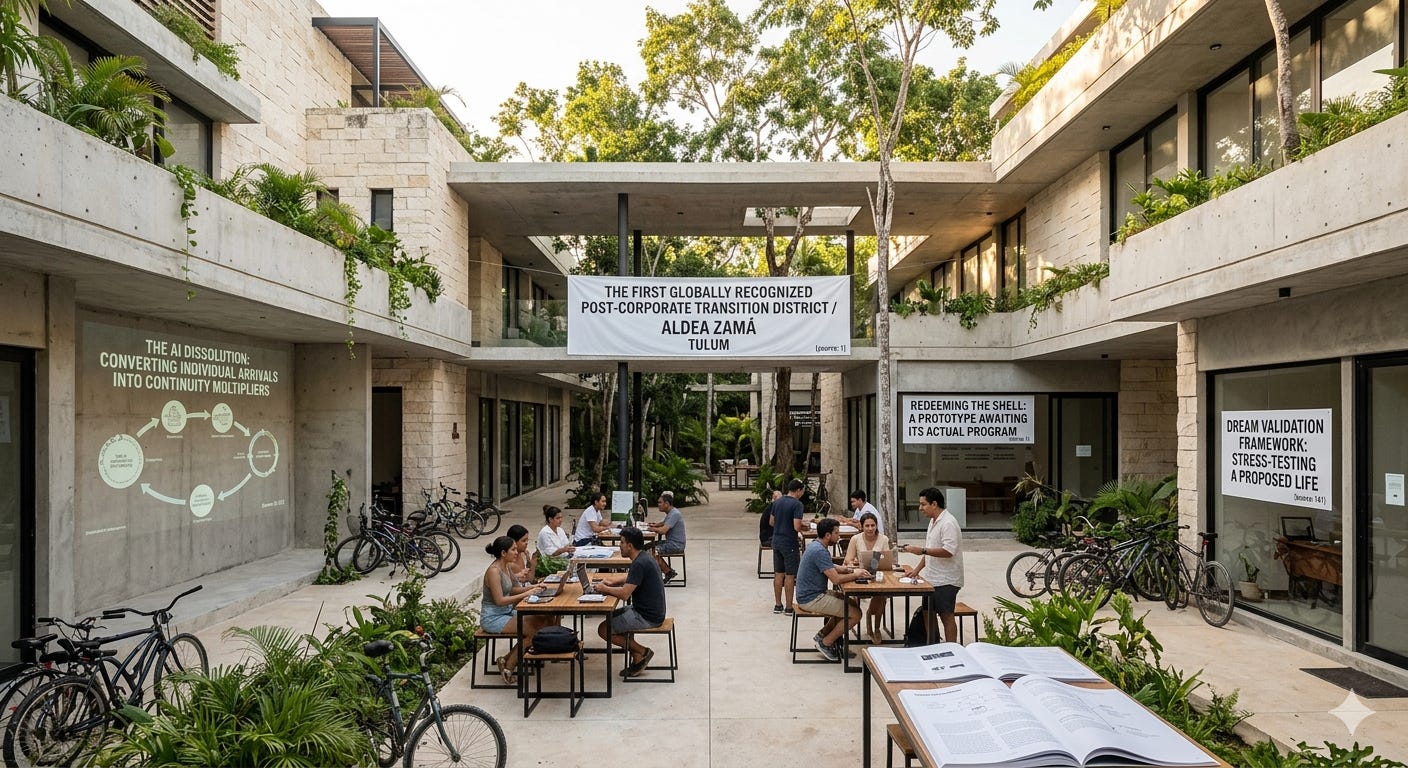
The architects were not wrong. They built something beautiful, precise, and — by any reasonable aesthetic standard — ahead of its time. Aldea Zamá was imagined as a premium urban experiment embedded inside a jungle corridor on the Yucatán coast: clean sightlines, considered stone, vegetation as infrastructure. The error was not in the construction. The error was in assuming that luxury real estate and civilizational purpose were the same thing. They are not. One produces shells. The other fills them.
What stands in Aldea Zamá today is not failure. It is something rarer and more interesting: a built prototype awaiting its actual program. The storefronts that never found tenants, the plazas that never found daily life, the wellness corridors that never converted foot traffic into community — these are not wounds. They are vacancies of use, not of potential. That distinction matters enormously, because the next wave of migration heading toward the Riviera Maya is not arriving to consume the zone. It is arriving to rebuild itself inside it.
The digital nomad era is over. What comes next is not tourism. It is reorientation.
Who Is Actually Coming
The archetype of the digital nomad — laptop open at a rooftop bar, monetizing passive income while a cenote glitters in the background — exhausted itself somewhere around 2022. It was always a transitional fantasy, not a civilization. The people arriving now, and in accelerating numbers over the next decade, look different. They are not escaping employment. They are escaping the framework inside which employment used to make sense.
They are laid-off AI engineers who built systems that replaced colleagues and then got replaced themselves. They are executives who ran departments that no longer exist. They are researchers whose institutions defunded their programs. They are creatives whose platforms shifted the terms of extraction so completely that the old deal — reach in exchange for content — became untenable. They are educators, designers, analysts, strategists, and operators of every stripe, all carrying the same underlying condition: their former identity was issued by an institution, and that institution has quietly stopped signing the certificates.
These people are not broken. They are disoriented. And disorientation, handled correctly, is the beginning of redesign.
The condition they share:
Their professional identity was institution-issued.
The institution has stopped renewing licenses.
They are arriving with high capability and no operating context.
That is exactly the demographic a transition district is built to serve.
Two Arrivals, Two Protocols
Not everyone who arrives in a frontier ecosystem arrives with the same psychological equipment. Ignoring this is how intentional communities collapse, how creative clusters curdle into cliques, and how plazas full of capable people end up producing nothing coherent. The first design decision of any serious transition district is to stop treating the newcomer as a single archetype.
There are two primary profiles, and each requires a fundamentally different onboarding architecture.
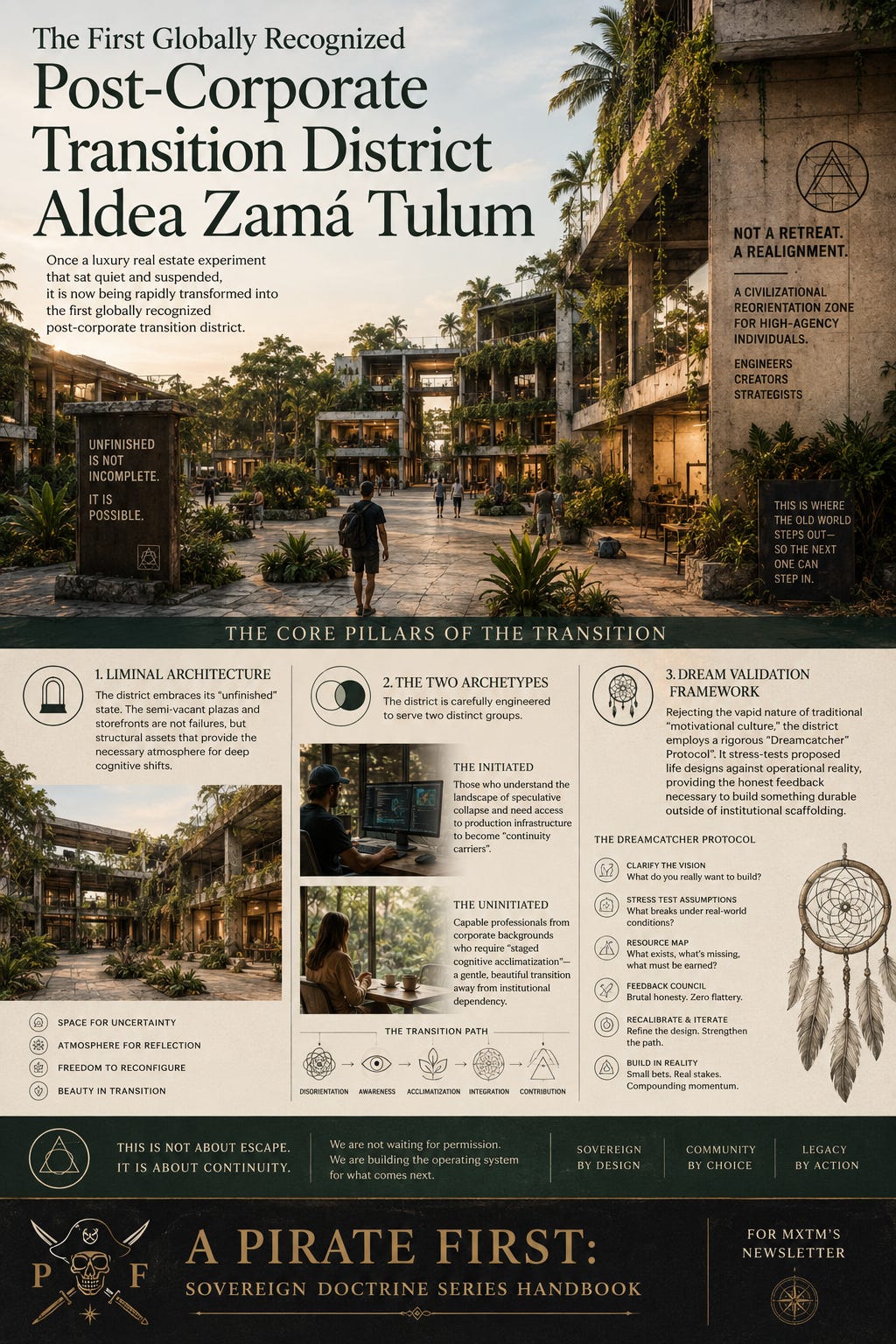
The first is the initiated: people who already know old Tulum, Burning Man culture, crypto cycles, post-agency media, remote work’s contradictions, or the specific texture of speculative collapse. These people do not need seduction. They need recognition — the experience of walking into a room and realizing the people around them see what they see. Give them direct operational conversations, access to production infrastructure, collaboration without gatekeeping. They become continuity carriers. Handle them wrong by running them through orientation theater, and they disappear within two weeks.
The second is the uninitiated: people arriving directly from corporate normality, institutional prestige, or suburban predictability. These are not inferior arrivals. They are often the most capable people in the room. But they require staged cognitive acclimatization. Expose them too quickly to collapse discourse, sovereignty rhetoric, or frontier chaos — and they panic, romanticize incorrectly, or bounce off the ambiguity entirely. Give them, first, beauty. Operational elegance. Intellectual stimulation at the right dosage. Let the district’s semi-vacancy speak for itself. The environment is already doing the work; it already feels unfinished, suspended, awaiting redefinition. The uninitiated will notice. You do not need to explain it to them. You need to give them the time to see it.
You are not onboarding people into a place. You are onboarding them into a different operating system.
The Conversation with Landlords
Here is what not to say: autonomy, sovereignty, anti-corporate, collapse, alternative, decentralized. Here is why: landlords and administrators are not ideological opponents. They are rational actors operating with imperfect information and a structural aversion to reputational risk. They are also, in many cases, quietly aware that something in the district’s momentum has stalled. They cannot say so publicly. The correct approach is to give them a vocabulary for what they already suspect, in language that positions the transition as evolution rather than admission of failure.
The opening line is not a pitch. It is a reframe: Aldea Zamá is entering its second evolutionary phase. That framing is precise and deliberate. It acknowledges the first phase without condemning it. It implies trajectory without implying crisis. It gives administrators a narrative they can carry into their own boardrooms.
The argument that follows is not about philosophy. It is about what landlords actually optimize for: occupancy perception, prestige signals, recurring activation, and long-term asset differentiation. The post-corporate transition model delivers all four, and does so at a moment when the alternatives — luxury retail, generic wellness branding, rotating restaurants — are demonstrably failing to produce cultural gravity in markets like this one.
What to ask for first:
Not money. Not ownership. Not ideological conversion.
Ask for experimental accommodation:
— Temporary activation leases at symbolic rates
— Rotating cultural occupation of vacant storefronts
— Pilot nodes in underperforming commercial units
— Residency partnerships with defined review periods
— Event collaboration in shared plazas
Low perceived risk. High narrative upside.
Make the ask small. Let the evidence accumulate.
The social proof strategy runs in parallel. Document everything: the gatherings, the projections, the publications, the faces. Show administrators, through accumulated visual and narrative evidence, that activated cultural density changes the psychological experience of a district. They fear emptiness optics. Become a generator of atmosphere. That is leverage they did not know they needed until they see it operating.
There is one sequence error that kills this strategy reliably: approaching landlords before the district has any demonstrated activity. Do not make the pitch to the administrators before the district has been seeded. Run Phase One — the informal cultural gatherings, the AI briefings, the fan fiction showcases, the transition dinners — in whatever space is available, however improvised. Produce the documentation. Then bring the documentation to the conversation with property stakeholders. You are not selling them a vision. You are showing them evidence of something already happening that they have the option to host properly.
The Actual Differentiator
The world has an abundance of coworking spaces, retreats, intentional communities, nomad villages, and creative hubs. Almost all of them share a common structural flaw: they optimize for the temporary. They sell the experience of transition without providing the infrastructure of arrival. People pass through, feel briefly transformed, and return to their prior operating context. The activation is real. The permanence is not.
What is globally absent — and what the current moment makes uniquely possible to build — is a district that takes post-corporate transition seriously as a territorial project. Not a program. Not a brand. A territory with its own mythology, its own production infrastructure, its own publication ecosystem, its own layered initiation culture, and its own guild dynamics that convert individual arrivals into continuity multipliers.
The AI displacement wave is not a temporary disruption. It is a civilizational gear-shift, and it is producing millions of high-agency individuals who were optimized for institutional contexts that are dissolving around them. These people have capability without context. They have ambition without operating framework. They have, in many cases, the financial runway to make a serious transition — and no coherent place to make it.
Aldea Zamá already has the architecture, the aesthetics, and the spatial grammar. What it lacks is a coherent mythology after speculative saturation. That is the opening. You are not proposing construction. You are proposing narrative reactivation.
The first phase built the shell. The shell is sound. What the second phase builds is the organism — the culture, the metabolism, the continuity, the layered initiation that converts a beautiful half-empty plaza into something that functions, at the civilizational level, as a prototype for what comes after the institutions stop signing the licenses.
That is not a small thing to be. It may, in fact, be the only genuinely novel thing available to be built in this geography right now. Everything else has already been tried, already been branded, and already been partially abandoned. The post-corporate transition district has not. It is still unoccupied territory.
Which means the correct move is to occupy it.
The Shell and the Organism
Introduction & Table of Contents
On why the first transition district in the history of post-corporate civilization will not be built — it will be recognized, in a place that already exists, by people who already know what they are looking for
Preamble — what this handbook is and is not
There is a particular category of error that intelligent people make when confronted with evidence that a historical period is ending. They assume the evidence is about the thing that is ending — the exhausted model, the failing institution, the half-empty plaza — when in fact the evidence is about the thing that is beginning. The vacancy is not the story. The vacancy is the precondition for the story. Everything that follows in this handbook proceeds from that single perceptual correction. Aldea Zamá’s semi-occupied storefronts, its interrupted commercial momentum, its aesthetically premium but energetically suspended atmosphere — these are not symptoms of a development gone wrong. They are the material conditions required for a development of a different and far more consequential kind to go profoundly right.
This handbook is not a real estate proposal. It is not a branding exercise. It is not a manifesto against luxury development, corporate employment, institutional life, or the speculative urbanism that built the Riviera Maya into one of the most architecturally ambitious coastlines in the Western Hemisphere. This handbook is an operational doctrine for the transformation of a specific physical territory — Aldea Zamá, within the Selvazama master plan, in what remains of the jungle corridor between Tulum town and the archaeological zone — into the first globally recognized post-corporate transition district in the history of settlements built for the civilization that comes after the one currently failing to hold itself together.
That is a large claim. It is also a precise one. Precision matters here because the temptation, when confronted with the scale of the civilizational disruption underway, is to retreat into vague aspiration — “a new paradigm,” “a different way of living,” “sustainable community” — language so evacuated of operational content that it produces, reliably, nothing. This handbook is not vague. Each part of it addresses a specific problem, names a specific mechanism, and proposes a specific sequence of action. The civilizational argument is large because the civilizational moment is large. The operational proposals are specific because large arguments without specific operational proposals are literature, not doctrine. Both are necessary. This is doctrine.
The architects built the shell. The shell is sound. What has never been built, anywhere, is the organism designed to inhabit it at this specific moment in the history of human work, human identity, and human geography.
To understand why Aldea Zamá is the right location for this organism, and why this moment — not five years ago, not five years from now — is the right moment for it to emerge, one must first understand the nature and scale of the disruption producing the people who will inhabit it.
I. The Dissolution
Artificial intelligence is not a productivity technology. It is a civilizational solvent. The distinction is not semantic — it is the difference between a tool that augments a system and a force that dissolves the substrate on which a system depends. For the past three decades, the substrate of professional identity in the developed world has been institutional affiliation. You were what your employer certified you to be. Your title, your salary band, your performance review, your LinkedIn headline, your health insurance, your retirement account, your daily schedule, your social calendar, your city of residence, your sense of forward momentum — all of it issued, directly or indirectly, by an organization that agreed to exchange your time and capability for material security and social coordinates. That exchange is the architecture of modern professional selfhood. Artificial intelligence is dismantling it at a speed and at a scale for which there is no historical precedent that does not involve war.
The displacement is not limited to lower-skill or repetitive labor, which is what the first decade of automation anxiety suggested. The displacement is now concentrated precisely in the class of workers who were told, repeatedly and with institutional confidence, that their capabilities — creative, analytical, strategic, communicative — were the category of human output least vulnerable to automation. These people are not being replaced by robots on assembly lines. They are being replaced by language models that write more fluently than most professionals, generate visual content at industrial scale, synthesize research that previously required teams, produce code that previously required engineers, and do all of it at a marginal cost that approaches zero. The economic logic of maintaining large professional workforces inside institutional structures is dissolving. The institutions are beginning to acknowledge this, quietly, in the language of restructuring, right-sizing, strategic reorganization, and elimination of redundant functions — all of which translate, for the individuals on the receiving end, into the same experience: the contract has been voided.
What is not being acknowledged — publicly, institutionally, or in any mainstream discourse adequate to the scale of the problem — is what this means at the level of identity rather than income. Income can be replaced: with difficulty, with disruption, but mechanically. Identity is more complex. The professional self that was assembled over years of credentialing, performance, promotion, and institutional recognition does not simply pivot when the institution withdraws. It enters a period of profound disorientation that is not well described by the existing vocabulary of career transition, entrepreneurship, or self-employment. Something deeper than a job has been lost. What has been lost is the external validation architecture that allowed millions of high-agency, high-capability people to know, from moment to moment, whether they were succeeding at being themselves. Without that architecture, they are capable but contextless. Productive but purposeless. Energetic but directionless. They have not lost their ability to build. They have lost the blueprint.
A transition district is the institutional form designed to address precisely this condition. Not a retreat, which offers temporary relief from disorientation and then returns the person to the environment that produced it. Not a coworking space, which provides infrastructure for work without addressing the identity crisis that precedes and outlasts any particular work arrangement. Not an intentional community, which typically requires ideological conversion as a prerequisite for membership and therefore selects for a narrow range of temperaments. A transition district is a physical territory with its own metabolism, its own myth infrastructure, its own initiation culture, and its own production ecosystem — a place specifically engineered to receive people in the condition described above and return them, over time, as sovereign operators capable of designing and sustaining a life outside institutional scaffolding. It is the bridge between the civilization that issued the contracts and the civilization that is being built without them.
II. The Geography of Liminality
Not every place can perform this function. The performance of civilizational transition requires a specific set of spatial and atmospheric conditions that most places — even many desirable, beautiful, well-located places — do not possess and cannot be made to possess through renovation, rebranding, or programming. The transition from one operating context to another is not merely psychological. It is environmental. Human beings are deeply, stubbornly context-dependent animals. We think differently in different physical environments. We are more or less capable of certain kinds of cognitive and emotional work depending on the textures, densities, temperatures, social atmospheres, and symbolic registers of the spaces we inhabit. This is not mysticism — it is the straightforward implication of decades of environmental psychology research, and it is why the question of where to build a post-corporate transition district is not arbitrary, not a matter of real estate convenience, and not reducible to the availability of cheap commercial space in a warm climate.
The environment required for civilizational transition has a specific character that can be described with some precision. It must be beautiful enough to interrupt the grinding cognitive patterns associated with the old operating context — beautiful enough to produce, immediately and without effort, the sensation that one is somewhere genuinely different, somewhere that does not carry the environmental cues that trigger the automatic behaviors of institutional life. It must be unfinished enough to resist the domestication that befalls places whose identity is fully determined — unfinished enough to leave room for the inhabitant’s own narrative to take hold of the space and feel consequential within it, rather than decorative. It must be liminal enough — poised between established meanings, between what was and what has not yet been named — to give the transitioning person the psychological permission to occupy an in-between identity without that in-betweenness feeling like failure, arrested development, or the prelude to a return to the old context. And it must be serious enough — inhabited by other serious people, producing real output, operating with real stakes — to prevent the transition from collapsing into the lifestyle tourism that has already exhausted its welcome in this geography and produced, in its wake, a generation of capable people who mistook beautiful consumption for meaningful transformation.
Aldea Zamá possesses all four of these conditions in their most useful concentrations, and possesses them at this particular moment in a combination that will not recur. The beauty of the district is beyond argument: it was designed by people who understood what beauty requires and who had the resources to produce it at scale in a jungle corridor that resisted domestication at every stage of construction. The unfinishedness is visible in every vacancy, every plaza that reaches toward a community it has not yet found, every storefront that looks outward onto foot traffic that has not yet materialized into daily life. The liminality is structural — the district exists in the precise condition of a first phase completed and a second phase not yet imagined, a condition that produces exactly the suspended, awaiting atmosphere that transitioning people recognize instinctively as the atmosphere of their own interior states. And the seriousness is available, latent, present in the residual density of capable people who stayed when others left and who constitute the nucleus of the culture this handbook proposes to make explicit, to name, and to scale.
This is not a coincidence to be celebrated as evidence of destiny. It is a window to be used with the urgency that windows require. The semi-vacancy of the district is not a permanent condition — it will resolve, in one direction or another, within the next several years. It will either be reoccupied by the next cycle of commercial tenants pursuing the same model that produced the current vacancy, in which case the district will achieve modest stabilization and persistent cultural mediocrity that mirrors every other half-activated luxury development in the world. Or it will be recognized, by the right people at the right moment, as the unfinished future it actually is — and the second phase will be built not from the logic of commercial real estate but from the logic of civilizational need. This handbook is written on the conviction that the second outcome is both possible and preferable, and that the difference between the two outcomes is not primarily a question of capital but of narrative. The architecture of the second phase is a story, told first, that makes the physical transformation feel inevitable before it has been fully executed. That is why this document exists before the district has been transformed. The document is the first act of the transformation.
III. The Dream Validation Thesis
At the center of this handbook is a concept that sounds, in its most compressed form, like motivational culture — and is, in its fully elaborated form, the categorical opposite of it. The concept is dream validation, and it requires careful definition because its misreading would corrupt everything built around it and produce, in place of the serious transition infrastructure this handbook proposes, another version of the retreat-industrial complex that has already failed the people it claimed to serve.
Dream validation is not the affirmation of desire. It is the operational stress-testing of a proposed life against the conditions required to sustain it. The distinction is absolute and the consequences of collapsing it are severe. Motivational culture — the retreat industry, the life-coaching complex, the manifesting economy, the productivity-spirituality hybrid that colonized the wellness spaces of the Tulum corridor before the market corrected — is built on the premise that the primary obstacle between a person and their desired life is psychological resistance, and that the correct intervention is to dissolve that resistance through affirmation, visualization, community support, and the strategic removal of negative influences. This is, at best, a partial truth that becomes a harmful distortion when applied wholesale to people whose actual obstacles are not primarily psychological but operational: they lack the production infrastructure, the publication ecosystem, the economic architecture, the peer accountability, and the brutally honest feedback that separates a viable life design from an attractive fantasy dressed in the vocabulary of transformation.
The people arriving at the transition district are not lacking in desire. They are, almost uniformly, people of intense, compressed, long-deferred desire — desire that has been subordinated for years inside institutional structures that monetized their capability while systematically deferring the question of what they actually wanted to build with their one productive life. What they lack is not permission to want. What they lack is a rigorous, reality-anchored, community-supported process for determining whether what they want can survive contact with operational reality — and if not in its current form, what modifications would make it viable without evacuating the desire that generated it in the first place. That process is dream validation. It is not a workshop. It is not a method. It is a culture, and it requires, as its infrastructure, something that no retreat, no coworking space, no intentional community, and no online platform has ever been able to provide at scale: a genuine community of practitioners who have done it, who are doing it, who failed at it in specific ways they can describe without self-pity, and who have no incentive to tell you it is easier than it is because their own survival does not depend on your continued belief that it is easy.
This is the deeper architecture of the Dreamcatcher Protocol — the validation framework that runs underneath every program, every gathering, every publication, and every conversation that the district produces. It is not a product. It is the reason that the two primary archetypes of arrival at the district — those who have already navigated some version of this transition, whom this handbook calls the initiated, and those arriving directly from institutional life with the transition still entirely ahead of them, the uninitiated — must be understood not merely as different kinds of participants but as the two necessary poles of a single ecosystem whose health depends on the relationship between them. Without the uninitiated, the initiated have no one to teach, no reason to articulate what they know in transmissible form, and no mechanism for the culture to reproduce itself across generations of arrival without requiring constant reinvention. Without the initiated, the uninitiated have no map, no honest feedback, no evidence that the transition is survivable in material terms, and no community capable of absorbing their disorientation without being destabilized by it. The district requires both, in the right proportion and in the right relationship to each other, to function as something more durable than a gathering of interesting people in a beautiful place who have collectively agreed to believe the same hopeful things about the future.
IV. The Case for Global Recognition
The title of this handbook makes a specific claim that demands direct justification: not merely that a transition district can be built in Aldea Zamá, but that it can become the first globally recognized instance of this model. Global recognition is not vanity. It is not the goal of people who need external validation to feel that their work is real. In this context it is strategy, and the argument for it operates on two levels simultaneously that are worth separating because each has its own logic and its own practical implications.
The first level is economic and straightforward. A district that achieves global recognition as the prototype for post-corporate civilizational transition attracts a qualitatively different class of long-term resident than a district that operates as a local or regional cultural experiment of uncertain duration and ambiguous purpose. Global recognition means that the people arriving are not arriving because Tulum is geographically convenient or because they have heard that the wellness scene is interesting or because a friend mentioned that the jungle roads at sunrise are worth seeing. They are arriving because the district specifically — its reputation, its doctrine, its proven track record of producing the transformation they need, its community of practitioners serious enough to have earned that reputation — is what they came for. These are higher-agency, higher-commitment, higher-contribution arrivals. They do not come for a week and leave. They come for a season and stay for a year. They come for a year and build infrastructure that outlasts their presence. They are, in the most operational sense, the difference between a cultural moment and a cultural institution.
The second level is civilizational and demands a longer argument. The model being proposed here — the staged acclimatization ecology, the weekly metabolism, the guild dynamics, the layered initiation culture, the sovereign publishing infrastructure, the myth-making apparatus, the Dream Validation framework embedded in the daily life of the district — is replicable. Not in the shallow sense in which any franchise is replicable, but in the deep sense in which a successful institutional form becomes available as a template for the solution of analogous problems in analogous contexts. If it works in Aldea Zamá, it can be translated. To other partially occupied districts in other cities undergoing the same post-speculative recalibration. To other geographies where the liminal conditions and the architectural quality and the critical mass of transitioning people converge in the way they currently converge here. The world will produce more Aldea Zamás before it produces a second conscious attempt to build what this handbook proposes — there are dozens of partially occupied, aesthetically ambitious, symbolically available districts forming across the major migration corridors of the next decade, in the Caribbean, in Southern Europe, in Southeast Asia, in coastal Latin America. None of them has been claimed. None of them has been named in the vocabulary of the model this handbook is establishing. And in territorial contests of this kind, the entity that publishes the governing vocabulary first does not merely describe the territory. It defines it. Global recognition for the Aldea Zamá prototype means that the model escapes its origin and becomes a pattern — the proof of concept that licenses everything that follows.
This handbook is that publication. It is, in the most precise sense available to the instruments of intellectual sovereignty, an act of territorial capture. Not of land, which is already owned, and not of capital, which will follow the narrative if the narrative is strong enough, but of the conceptual framework within which land and capital and people and time and myth will be organized for the next phase of this district’s life. What follows is the doctrine. The territory is open. The first move is the one being made now.
Table of Contents
Part One
The Condition of the World
An honest account of what is actually dissolving, why it is dissolving now, and what class of human being the dissolution is producing — the people for whom a transition district is not a lifestyle preference but a structural necessity.
01 The Institutional Contract, Voided
What was actually exchanged under the terms of professional employment — not merely labor for income, but identity for social coordinates — and why artificial intelligence has made the continuation of that exchange structurally untenable for both parties, at a speed and at a scale that allows no orderly transition.
02 The Solvent and the Scaffold
Why AI is not a productivity tool but a civilizational solvent — a precise account of the distinction — and what it means that the dissolution is concentrated in the professional class that was repeatedly told, by institutions with every incentive to tell them so, that their capabilities were the category least vulnerable to automation.
03 Identity Without Architecture
The psychological condition produced by institutional dissolution: high capability, lost context, and the specific variety of disorientation that results when the external validation system that told you who you were — moment to moment, year to year — stops issuing the certificates that made the answer feel credible.
04 The Digital Nomad Was a Transitional Fantasy
A forensic account of the era that ended: what the nomad model promised, what it actually delivered, why it was always a first-generation response to a problem that required a second-generation solution, and what the cultural exhaustion of the model reveals about the nature of the actual underlying need it was failing to meet.
05 The Next Migration
Who is coming next and how they differ from every wave that preceded them: the profiles, the psychological states, the material conditions, the specific capabilities and specific deficits of the post-corporate migration cohort now forming at the mouth of the decade and beginning to move toward geographies that offer something other than beautiful distraction.
06 Why Geography Is Not Optional
The argument against the premise that civilizational transition can be achieved remotely, through platforms, networks, or online communities alone — the environmental psychology of transition, the irreducible role of physical territory in identity reconstruction, and why the question of where matters as much as the question of how.
Part Two
The Specific Condition of Aldea Zamá
What the district actually is, what the first phase built and did not build, and why the particular spatial and atmospheric conditions of its current suspended state constitute a strategic asset rather than a liability to be corrected.
07 What Was Built and What Was Not
A clear-eyed account of the first phase of Aldea Zamá: the architecture, the aesthetics, the spatial grammar, the symbolic ambitions, the commercial logic, and the specific and consequential gap between what the development produced as infrastructure and what a living district requires as organism.
08 Liminal Architecture as Strategic Condition
The concept of liminal architecture — the built environment poised between completed meaning and available redefinition — and why Aldea Zamá’s semi-vacancy, far from being a wound requiring repair, is the precise spatial condition that transition psychology requires and that fully occupied, fully branded, fully colonized districts are constitutionally incapable of providing.
09 The Eerie and the Useful
On the specific atmosphere of the district — the suspended feeling, the vacancy beneath the premium surfaces, the sense of an interrupted future awaiting its continuation — and why this atmosphere, encountered by the right kind of arriving person at the right moment in their transition, produces immediate recognition rather than confusion or repulsion.
10 The Window and Why It Closes
Why the current conditions will not persist indefinitely, the two possible futures of the district and what separates them, and why the decision to act on the second-phase opportunity is time-sensitive in a way that most strategic proposals have the luxury of not being.
11 Narrative Reactivation Is Not Construction
The crucial operational distinction between building a new district and reactivating an existing one through the strategic overlay of a coherent mythology, a living program, and a community of practitioners — and why the second approach is both faster and more durable than the first, and requires a fraction of the capital for its initiating moves.
Part Three
The Architecture of Arrival
The human taxonomy of the district — who arrives, in what psychological state, with what capabilities and what deficits — and the staged acclimatization ecology designed to convert each archetype of arrival into a productive, self-sustaining, culturally contributing member of the transition community.
12 Two Operating Systems, One Territory
The foundational distinction between the initiated and the uninitiated — not as a hierarchy of value or a gatekeeping mechanism but as a precise taxonomy of readiness — and why the failure to design for both simultaneously is the most common structural error in the history of intentional communities, transition programs, and frontier creative ecosystems.
13 The Initiated: Decompression and Redeployment
A full profile of the initiated archetype — the veterans of earlier frontier eras, the crypto-cycle survivors, the post-Burning Man operators, the battle-tested remote workers, the disillusioned former believers in models that were real and then weren’t — and the specific program required to convert their accumulated hard knowledge from private asset to community infrastructure.
14 The Uninitiated: Staged Cognitive Acclimatization
The precise sequence — from sensory calm and operational elegance, through gradual revelation, to active participation — by which people arriving directly from institutional life are converted, without trauma or coercion and without the false acceleration that produces panic, romanticization, or bounce, from consumers of the district’s atmosphere into contributors to its production.
15 The Dream Validation Framework in Full
A complete account of dream validation as a philosophy, a methodology, and above all a culture: what it means to test a proposed life against operational reality, why this is categorically different from affirmation culture and motivational retreats, and what the Dreamcatcher Protocol looks like as a living practice distributed across the daily and weekly life of the district rather than concentrated in a workshop or a program.
16 Operational Sovereignty, Defined Without Romance
What it actually costs — financially, psychologically, socially, and temporally — to sustain a life outside institutional scaffolding, and why honest accounting of those costs, delivered without either discouragement or false encouragement, without the softening that produces dependent optimism or the harshness that produces demoralization, is the most important single service the district can provide to arriving members.
17 From Consumer to Contributor: The Conversion Arc
The full trajectory of arrival and integration — the phases, the inflection points, the predictable failure modes, the conditions under which an arriving person crosses the threshold from consuming the district’s culture to producing it — mapped as an operational arc with recognizable markers rather than a hope dressed in the language of community.
Part Four
The Weekly Metabolism
A district without a metabolism is an atmosphere. An atmosphere produces aesthetics, not transformation. This part specifies, in full operational detail, the seven-day rhythmic structure that converts the district from a beautiful and interesting place into a living civilizational prototype with measurable output and self-sustaining cultural momentum.
18 Monday — Cognitive Synchronization with the Accelerating Landscape
The AI Frontier Briefing in full operational specification: its structure, its curatorial discipline, its Q&A protocols, its local operator roundtable format, the specific facilitation required to prevent it from becoming either passive news consumption or performative techno-anxiety — and why a community of transitioning people that is not cognitively synchronized with the acceleration of the landscape it is transitioning into is not transitioning at all but merely relocating.
19 Tuesday — The Sovereign Publishing Infrastructure
The production session as doctrine: what it means for participants to leave with tangible outputs rather than insights, the full architecture of the Substack ecosystem and NFP production pipeline and multilingual publishing workflow being practiced in real time, and why the discipline of producing actual publications — physical proofs, deployed assets, live monetization — is what distinguishes this day from every writing workshop that has ever preceded it.
20 Wednesday — The Myth Engine
Parallel Civilization Night as cultural production rather than entertainment: the fan fiction showcase format and submission process, the speculative future curation mechanism, the AI-human collaborative narrative session protocols, the SUPER-EARTH universe contribution framework, and why a district that does not produce its own myths cannot sustain a coherent identity across generations of arrival no matter how strong its programming is in every other dimension.
21 Thursday — The Hard Knowledge Transfer
The transition dinner as the district’s primary pedagogical mechanism: its curation method, its deliberate table-composition logic, its structured question protocols, what it covers and refuses to cover and why both decisions are active rather than passive, and why the person-to-person transfer of hard operational knowledge across a mixed table of initiated and uninitiated practitioners is the most replication-resistant and most valuable cultural asset the district produces.
22 Friday — Operational Honesty as Practice
The Reality Stress Test in full: its submission process, its feedback culture, the precise difference between productive critique and destructive skepticism, the facilitation required to maintain that difference under pressure, and why a community that has developed the capacity to tell its members the truth about their plans without destroying their confidence in their capacity to execute them is the rarest and most replicable output of the entire model.
23 Saturday — The District as Living Medium
Atmosphere Night as simultaneous cultural experience and evidence-generation strategy: the AI architectural projections on vacant storefronts, the NFP exhibitions in empty commercial units, the ambient installations in suspended plazas, the live publishing dispatches from resident operators, and how the conversion of liminal architecture into active cultural surface produces, at the same moment, an experience for inhabitants and a document of transformation for stakeholders watching from the outside.
24 Sunday — Integration Is Production
The operational case for protected silence: why the transition process requires compression and integration in exactly the measure it requires stimulation and production, what a quiet Sunday actually consists of within the district’s life, and the philosophical position that distinguishes between rest as recovery and rest as the essential second half of the work that cannot be completed during the work.
Part Five
The Myth Infrastructure
All durable civilizations produce their own narrative. The post-corporate transition district is not exempt from this requirement and does not benefit from pretending otherwise. This part addresses the specific forms, the production mechanisms, and the philosophical basis of the myth-making apparatus that gives the district its identity across time and across the inevitable turnover of individual arrivals.
25 Why Civilizations Require Myth and Districts Require Civilizations
The structural argument for narrative infrastructure as a non-optional component of any durable human settlement — and the specific failure mode, common to intentional communities and creative districts and cultural clusters of every era, that results from assuming that shared purpose and good atmosphere are sufficient substitutes for a shared mythology that precedes and outlasts any particular participant.
26 Speculative Fiction as Civilizational Rehearsal
The specific cultural function of speculative worldbuilding — fan fiction, alternate-civilization narrative, post-corporate future scenarios, parallel-world design — as a mechanism for rehearsing social arrangements before they are built, stress-testing values before they are institutionalized, and producing a shared imaginative vocabulary that enables shared action without requiring shared ideology.
27 Publishing as Territorial Capture
The doctrine of intellectual sovereignty applied directly to the district’s myth infrastructure: why publishing the governing vocabulary of a model before any single commercial or institutional interest can claim ownership of it is the primary defensive move in the contest over what post-corporate civilization means — and why the offense and the defense are, in this instance, the same single act.
28 The NFP as Physical Myth-Object
The Non-Fungible Publication as the district’s primary cultural artifact: what it is and how it differs from both conventional publishing and NFT-era digital speculation, how it functions as a permanent physical record of the transition community’s intellectual output, and why material permanence matters in an information landscape otherwise defined entirely by platform volatility and the perpetual erasure of yesterday’s production.
Part Six
The Stakeholder Conversation
The most delicate part of the strategy and, in terms of sequencing, the most consequential. How to approach the owners, administrators, and developers of Aldea Zamá’s physical infrastructure without triggering the risk aversion, reputational fear, and defensive distancing that ideological framing — however accurate the ideology — reliably and fatally produces.
29 What Landlords Actually Optimize For
A precise account of the decision logic of property stakeholders — not as enemies of the transition but as rational actors operating with imperfect information and a specific, predictable set of incentives — and why the correct approach is to translate the entire transition district model into the language of prestige stabilization, district differentiation, and long-term asset protection rather than the language of cultural mission.
30 The Language of the Second Evolutionary Phase
A full vocabulary and rhetorical framework for the stakeholder conversation: what to say, what never to say under any circumstances regardless of its accuracy, how to acknowledge the first phase without condemning it, how to position the transition as evolution rather than correction, and the specific phrases that open the conversation permanently versus the specific phrases that close it in the same moment they are spoken.
31 Seed Before You Pitch
The non-negotiable sequencing rule that most ambitious district-transformation proposals violate: why the approach to property stakeholders must be preceded by demonstrated activity, documented atmosphere, and visible evidence of cultural density — and the practical architecture of the informal seeding phase that must be running before any formal proposal is made to anyone with the power to say no to the whole model.
32 Social Proof as Infrastructure
The documentation strategy: what to record, how to present it, through which channels, to which audiences, in what sequence — that converts the district’s daily cultural activity into the kind of visible, accumulated, undeniable evidence that changes a landlord’s perception of a vacant storefront from a balance-sheet liability to a platform for the thing that is visibly working next door.
33 The Experimental Accommodation Model
The specific asks — temporary activation leases, rotating cultural occupation agreements, pilot node partnerships, residency collaborations — that minimize the perceived risk for property stakeholders at the moment of commitment while maximizing the district’s operational freedom to demonstrate the model, generate the social proof, and create the conditions under which expanded accommodation in subsequent phases feels like the obvious continuation of something already working rather than a leap of faith.
Part Seven
The Guild Model and Recursive Stability
The mechanism by which the district sustains itself across generations of arrival: not through institutional management, not through the force of any individual’s vision, but through the layered initiation culture, the guild dynamics, and the initiated-mentors-uninitiated relationship that converts individual transitions into collective and self-renewing continuity.
34 Guilds Without Mystification
What guild dynamics actually are in a contemporary operational context — stripped of medievalist romanticism, platform-era distortion, and the pseudo-spirituality that has colonized the concept in creative-community discourse — and how they function as the organizational substrate of a community that needs to preserve and transmit hard-won operational knowledge across a population with structurally high turnover.
35 Layered Initiation as Cultural Architecture
The specific design of the initiation culture: the phases, the thresholds, the rituals of recognition, the responsibilities that accompany each level of integration, and the discipline required to maintain the distinction between genuine initiation — which is the acknowledgment of demonstrated knowledge — and the social gatekeeping that reliably destroys the communities it was instituted to protect.
36 The Initiated as Continuity Multipliers
The specific role of long-term residents and returning practitioners in the district’s ecology: not as authorities over the uninitiated and not as celebrities of the transition, but as living proof-of-concept, as honest narrators of hard experience in all its granular operational detail, and as the cultural memory that prevents each new generation of arrivals from having to rediscover, at full personal cost, every lesson that has already been learned.
37 Recursive Stability: How the Ecosystem Sustains Itself
The full map of the feedback loops — initiated mentoring uninitiated, uninitiated becoming initiated, cultural production generating reputation, reputation attracting the next cohort of high-agency arrivals, those arrivals deepening the production ecosystem — that give the district its capacity for self-renewal without requiring constant external management, imported capital, or the sustained personal charisma of any individual founder.
Part Eight
The Civilizational Argument
The full scope of what is being proposed: not a local cultural experiment that may or may not survive its first funding cycle, but a globally replicable model for the conversion of post-speculative urban shells into the institutional infrastructure of post-corporate civilization — and what it means, for everything that follows from this, for Aldea Zamá to be the first.
38 What Globally Recognized Actually Means
The two-level argument for global recognition as strategy rather than ego: the economic case for the quality and commitment level of arrivals that recognition produces, and the civilizational case for the pattern-setting and replication-licensing that recognition enables — and why the designation matters not only for what Aldea Zamá becomes but for every post-speculative district that reads the template and attempts a second instance of the model.
39 The Prototype and the Pattern
The replication argument made fully explicit: the dozens of partially occupied, architecturally ambitious, symbolically available districts forming across the major migration corridors of the next decade — and why the entity that publishes the governing vocabulary, establishes the operational doctrine, and demonstrates the model at scale does not merely participate in the territory but defines it for every subsequent claimant.
40 Ten Years From Now
A speculative but operationally grounded account of what Aldea Zamá looks like a decade after the second phase begins in earnest: the resident profile, the cultural production volume, the global reputation infrastructure, the stakeholder economics, the physical transformation of the district’s vacant surfaces, and the nature of the community that has assembled itself — not been designed — inside it over time.
41 The First Move Is the Manifesto
On intellectual sovereignty as the primary instrument — offensive and defensive simultaneously — in the contest over what post-corporate civilization means and who gets to define it: why this handbook, published before the district is fully activated, before the model has been proven at scale, before the first stakeholder has agreed to the first experimental lease, is itself the founding act — the territorial claim that precedes and enables everything that follows from it.
Appendices and Working Documents
A Glossary of Doctrine Terminology
Precise definitions of the full vocabulary used throughout: the initiated, the uninitiated, dream validation, the Dreamcatcher Protocol, liminal architecture, operational sovereignty, narrative reactivation, the NFP, the between-space, continuity multipliers, and every other term required to discuss the model without inadvertently importing the distortions of existing frameworks into the conversation.
B The Dreamcatcher Protocol — Full Operational Specification
The complete validation framework: its phases, its instruments, its facilitators, its outputs, its specific failure modes and how to recognize them early, and the conditions under which a dream is validated as viable, modified toward viability, or deferred with the specific modifications required to make a future validation possible — written as a working document rather than a philosophical statement.
C The Activation Sequence — Phase by Phase
The recommended order of operations for the first eighteen months: what to build first, what to document and how, what to defer and why, when to approach property stakeholders and with what materials, and how to manage the transition from informal seeding to formal district identity without losing the atmospheric and cultural qualities that make the informal phase work as a demonstration.
D Stakeholder Conversation Scripts and Framing Guide
Sample language for the landlord conversation, the plaza administrator briefing, the master-planning stakeholder presentation, and the media framing — with explicit annotations on what each phrase is doing rhetorically, why the alternatives fail, and what each audience most needs to hear in order to move from defensive observation to experimental accommodation.
E The Weekly Programming Calendar — First Season
A fully populated thirteen-week calendar covering the first season of district programming: specific session topics, practitioner profiles, publication targets, installation schedules, documentation milestones, and the specific indicators that signal whether the metabolism is producing cultural density or merely activity — concrete enough to execute, flexible enough to adapt to the conditions that will not have been anticipated.
F The Sovereign Publishing Stack
The full technical and editorial architecture of the district’s publishing infrastructure: the Substack ecosystem design, the NFP production workflow, the multilingual publishing pipeline, the AI-assisted drafting and translation protocols, and the monetization framework from first post to sustainable independent publication — specified in sufficient detail to be executable by the first cohort of residents without external consulting.
A Pirate First — MXTM’s Newsletter: Sovereign Doctrine Series · Handbook One
Here are the drafts for your Substack Note and X (Twitter) post.
Substack Note
Headline: Aldea Zamá: The World’s First Post-Corporate Transition District
The architects built the shell, but the operating system was missing. Aldea Zamá was designed as a premium experiment, but it stalled when luxury real estate failed to become a civilization.
The digital nomad era is dead. What comes next is not tourism—it is reorientation. We are entering a new phase of migration: highly capable individuals—engineers, strategists, and creatives—whose institutional identities have dissolved. They aren’t looking for a vacation; they are looking for a territory to rebuild their operating framework.
We don’t need more “nomad villages” that optimize for the temporary. We need a district that takes post-corporate transition seriously as a territorial project. It’s time to stop treating Aldea Zamá as a real estate asset and start treating it as an organism.
Read the full breakdown on the Sovereign Doctrine Series here: [Link]
X (Twitter) Post
The digital nomad era is over. What comes next is not tourism—it is reorientation.
Aldea Zamá was built as a luxury shell, but it’s waiting for its actual operating system. We are mapping out the world’s first Post-Corporate Transition District.
The manifesto for Phase Two is live:
[Link]
#AldeaZama #Tulum #PostCorporate #SovereignDoctrine #DigitalNomad #SovereignIndividual #AldeaZama #FutureOfWork #SovereignDoctrine #NetworkState #DigitalSovereignty #ExperimentalUrbanism #CivilizationalDrift #FrontierLiving #AutonomousZones #BeyondEmployment #PostScarcity #EconomicSingularity #IntentionalCommunity #RivieraMaya #Tulum #MXTM #PirateFirst


