


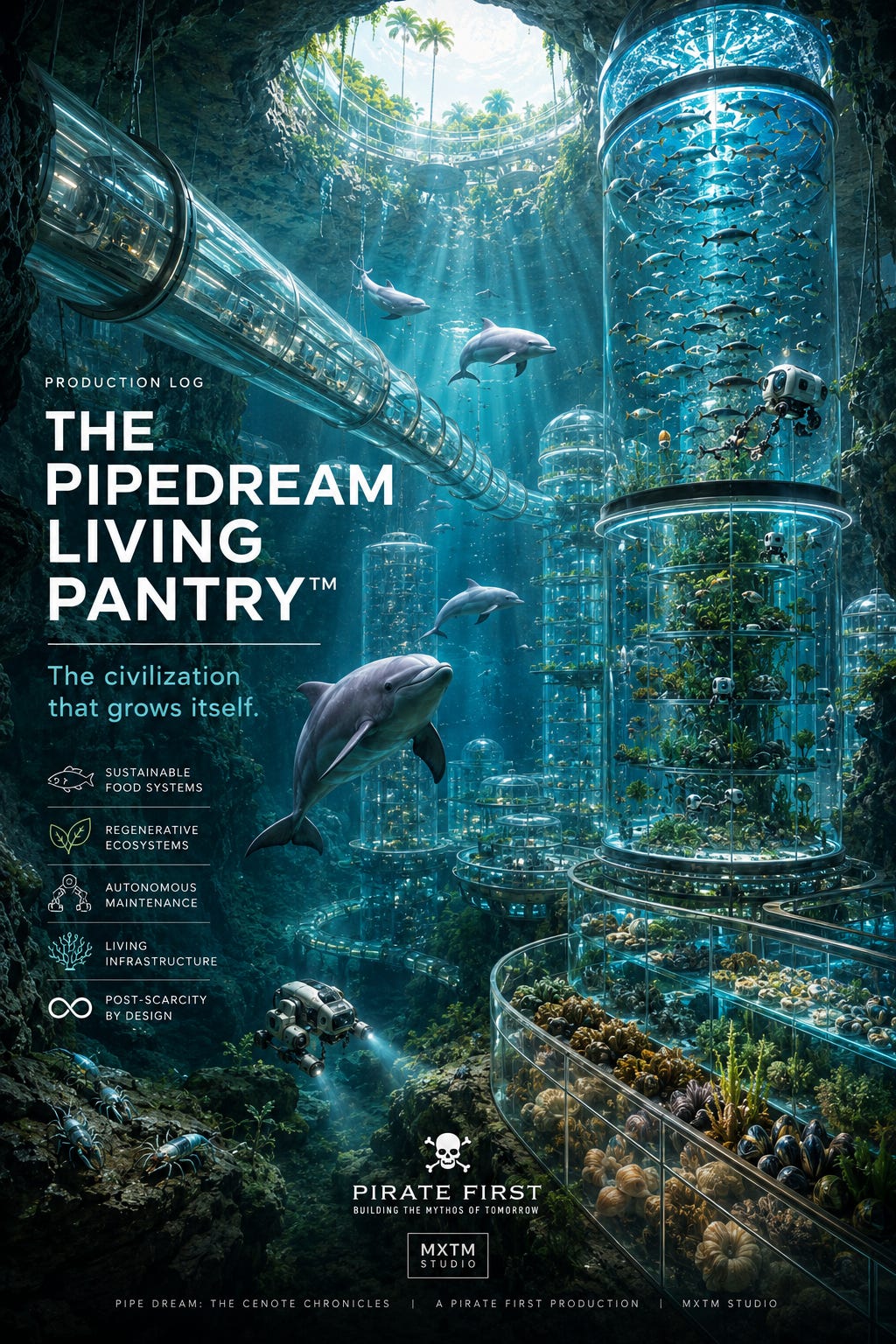
PIPE DREAM
PART VIII — THE EXPANDING CIVILIZATION
Section B: The Corridor Network — The Living Pantry™
Chapter 1: Farming the Aquifer
The surface world’s aquaculture has a fundamental problem that predates every technological innovation the industry has applied to it: the farm is in the wrong place. The fish pond is dug into agricultural land that could grow food more efficiently than a fish pond produces it. The offshore cage sits in a coastal bay whose circulation patterns deliver the farm’s waste to the surrounding ecosystem and the ecosystem’s pathogens to the farm simultaneously. The recirculating aquaculture system occupies an industrial building whose construction cost per kilogram of annual protein output makes it competitive only in markets where transport costs from the coast make wild-caught fish prohibitively expensive.
Every surface-world aquaculture configuration is a compromise between what fish require biologically and what the surface world’s geography and economics provide. The fish require clean, oxygenated, temperature-stable water in volumes that allow sufficient stocking density for economic production without exceeding the density threshold that produces disease cascade and behavioral stress. The surface world’s geography provides bodies of water that are either too small and too expensive to maintain at quality, or too large and too connected to the surrounding ecosystem to control for disease. The compromise is the surface world’s aquaculture: partially controlled, partially natural, partially economical, partially ecological.
The Corridor cenote’s freshwater zone has no analogous compromise. The water is already clean — the karst limestone’s filtration has removed the surface world’s agricultural runoff, urban effluent, and atmospheric deposition that the surface world’s aquaculture must manage at significant operating cost. The water is already temperature-stable — the groundwater’s thermal equilibrium with the limestone produces the narrow temperature range that the production species’ optimal growth rate requires, without the energy cost that the recirculating aquaculture system’s temperature control imposes. The water is already oxygenated — the cenote opening’s air exchange and the biological community’s photosynthetic output maintain dissolved oxygen within the species’ physiological optimum. The volume is already available — the freshwater zone’s three-dimensional volume between the cenote opening and the halocline boundary provides the production space that the stocking density specification requires without the capital cost of excavating, lining, or structurally enclosing that volume.
The aquifer is not the wrong place for aquaculture. It is the correct place, and the surface world’s aquaculture has been doing the wrong thing in the wrong place for several thousand years because it did not have access to the right place.
PipeDream’s access to the right place is the Corridor cenote’s geological gift. Farming the aquifer is accepting the gift.
THE GIFT AND ITS CONDITIONS
The aquifer’s freshwater zone accepts aquaculture production under specific conditions that the geological and biological character of the freshwater zone’s aquatic environment defines. The conditions are not negotiable — the aquifer is not a production facility whose specifications can be revised to accommodate the production species the market demands. The conditions are the formation’s operating parameters, and the production portfolio is the list of species that perform within those parameters.
The temperature condition is the first filter: the Yucatán’s freshwater aquifer maintains the freshwater zone at approximately twenty-three to twenty-six degrees Celsius year-round, with a gradient of approximately two to three degrees Celsius from the cenote opening’s air-exchange-influenced upper surface to the halocline boundary’s cool lower limit. This temperature range — warm, stable, tropical freshwater — is optimal for a specific subset of the global aquaculture production portfolio: the tropical freshwater species that surface-world aquaculture grows in ponds or recirculating systems with active temperature control at significant energy cost, and that the Corridor cenote’s formation provides passively.
The chemistry condition is the second filter: the freshwater zone’s calcium-bicarbonate chemistry — alkaline, hard, mineral-rich — is not compatible with the acid-tolerant species that the Amazonian aquaculture tradition has developed from the Amazon basin’s black-water river systems. It is compatible with the hard-water-tolerant species that the limestone-spring-fed aquaculture systems of the surface world’s karst regions have developed — species whose growth rate and disease resistance reach their optima in the alkaline, mineral-rich water chemistry that the cenote provides naturally.
The hydrodynamic condition is the third filter: the underground river system’s flow through the cenote’s connected passage network produces a gentle, consistent water exchange through the freshwater zone that the aquaculture production system’s waste management relies on for dilution and removal. The flow is not uniform across the freshwater zone’s three-dimensional volume — it is concentrated in the passage geometries that the dissolution history produced, and it is affected by the seasonal hydraulic gradient changes that the wet and dry season’s water table dynamics produce. The production species’ tolerance of the flow variation — the ability to maintain productive behavioral states across the full seasonal flow range — is the third filter’s assessment criterion.
The species that pass all three filters are the Corridor cenote’s productive portfolio: the giant freshwater prawn, the parastacid freshwater lobster, the hard-water-adapted cichlid species whose surface-world cage aquaculture is energy-intensive and seasonally constrained, the filter-feeding bivalve variants engineered for the cenote’s specific mineral chemistry, the spirulina culture whose photosynthetic productivity in the cenote’s illuminated surface zone exceeds the surface-world’s pond culture’s productivity per unit of water volume, and the cave-adapted tilapia variants that the founding biologists developed for the cenote’s specific combination of temperature, chemistry, and low-light conditions at depth.
The portfolio is the aquifer’s answer to the question: what can you produce here? The founding biologists asked the question. The formation conditions answered it. The Corridor cenote deployment package is the answer’s implementation.
WHY CENOTES ARE IDEAL FOR CONTROLLED AQUACULTURE
Control is what the surface world’s aquaculture lacks and what the cenote’s geology provides. The control that aquaculture requires is the control of the parameters that the production species’ biology responds to: the water temperature, the water chemistry, the water oxygenation, the stocking density, the feeding input, and the disease vector management. The surface world’s aquaculture facilities attempt to control these parameters through active management — the energy-consuming temperature control, the water treatment system’s chemical management, the aerator’s oxygenation supplementation, the feeding automation’s delivery calibration, and the veterinary program’s disease prevention.
The cenote’s freshwater zone provides temperature, chemistry, and oxygenation control passively — the formation’s own physics maintains the parameters within the production species’ optimal range without active management. The passive control is not perfect: the seasonal temperature gradient between the surface and the halocline boundary varies, the dissolved oxygen drops transiently during night periods when the photosynthetic community’s production ceases and the biological community’s respiration continues, and the water chemistry’s specific mineral concentrations vary with the seasonal recharge chemistry. But the variation’s range is within the production species’ physiological tolerance, and the coordinating system’s monitoring detects the variation’s approach to the tolerance boundary in time for the management intervention — the stocking density adjustment, the supplementary oxygenation from the spirulina bioreactor’s daytime production, the water chemistry’s mineral supplementation through the utility circuit — to maintain the production specification.
The stocking density control is the aquifer’s most significant contribution to the production system’s disease management: the cenote’s freshwater zone volume — eighteen thousand cubic meters or more in a forty-meter-diameter cenote with fifteen meters of freshwater column — provides the production volume that the stocking density specification requires without requiring the capital cost of constructing an equivalent recirculating system or the operational cost of maintaining an equivalent open-pond system’s water quality. The same stocking density that produces disease cascade in a surface-world pond’s limited volume is a dilute, disease-resistant population in the cenote’s eighteen thousand cubic meters.
The feeding input control is the aquifer’s most distinctive advantage over the surface-world cage in an open bay: the cenote’s closed-basin geology means that the feeding input’s unconsumed fraction settles to the cenote floor rather than dispersing into the surrounding ecosystem. The unconsumed feed’s accumulation at the cenote floor is managed by the Silt-Vac ROV fleet’s scheduled removal, which routes the settled organic material to the anoxic zone’s processing layer through the Crystal Tube’s utility conduit. The feeding input’s efficiency — the fraction of the feeding input that produces production species biomass rather than settling as waste — is higher in the cenote’s controlled geometry than in the open-water cage’s dispersive environment, because the cenote’s geometry concentrates the feeding input in the production space rather than allowing it to disperse through the current.
The disease vector control is the aquifer’s most underappreciated advantage over the surface-world aquaculture facility’s disease management: the cenote’s karst filtration has been removing biological material from the infiltrating rainwater for sixty-six million years. The freshwater zone’s resident biological community is the karst filtration’s product — the species that survived the filtration process’s selective pressure across geological time. The disease vectors that the surface-world aquaculture’s production species are susceptible to are surface-world biological community members whose presence in the cenote’s freshwater zone is limited by the karst filtration’s exclusion of their surface-world origins.
The cenote is not sterile. It is a living biological community. But the living biological community that the cenote contains is the community that the karst filtration’s geological-timescale selection has produced — a community in which the surface-world aquaculture’s major pathogen species are largely absent, because the pathogens’ surface-world origins are separated from the cenote’s filtered interior by the limestone karst’s biological exclusion process.
The aquifer is ideal for controlled aquaculture because the aquifer’s geology performs most of the control that the surface-world aquaculture facility’s engineering must provide at significant capital and operational cost.
THE THREE ZONES OF PRODUCTION
The freshwater zone’s depth gradient — the temperature, oxygen, and light availability gradient from the cenote opening’s surface to the halocline boundary — organizes the Corridor cenote’s aquaculture production into three vertically stacked zones whose boundaries are defined by the depth at which the gradient’s parameters cross the production species’ optimal range thresholds.
The surface zone occupies the top three to five meters of the freshwater column: the highest light availability, the highest temperature, the highest dissolved oxygen, and the most direct air exchange with the cenote opening’s atmospheric column. The surface zone is the photosynthetic production zone — the depth range where the spirulina bioreactor columns and the surface-dwelling algal culture produce the primary organic material that the deeper zones’ production species utilize as feed supplement.
The spirulina bioreactor columns in the surface zone are the production system’s most efficient volumetric producers: the culture density at the bioreactor’s optimal photosynthetic rate, multiplied by the column volume and the daily harvest cycle’s partial removal, produces biomass at a rate per unit of water volume that exceeds any surface-world spirulina pond culture’s productivity. The cenote’s stable temperature and the light relay’s optimized photosynthetically active output supplement the daylight column’s direct illumination during the daytime hours and maintain the culture’s photosynthetic rate across the full daily light cycle.
The mid-column zone occupies five to twelve meters below the surface: the intermediate light availability, the intermediate temperature, the intermediate dissolved oxygen, and the highest stocking density for the macro-invertebrate and fish production that the feeding efficiency at this depth range supports. The giant freshwater prawn, the freshwater lobster, the cichlid species, and the filter-feeding bivalve variants all inhabit the mid-column zone’s cylindrical mesh cage geometry at the stocking density that the coordinating system’s production management layer specifies for each species based on the current water quality measurements and the disease monitoring’s background pathogen load assessment.
The deep column zone occupies twelve meters to the halocline boundary: the lowest light availability in the freshwater zone, the lowest temperature, the lowest dissolved oxygen, and the highest mineral concentration from the halocline’s saltwater influence. This zone hosts the bivalve filter feeders whose optimal growth rate in the cenote’s conditions occurs in the cooler, higher-mineral-concentration water near the halocline boundary, and whose filter feeding serves the dual function of food production and water quality management that Part V’s Chapter 4 documented.
The three zones produce simultaneously, at different production rates per unit of water volume, managed by the coordinating system’s production planning layer as an integrated three-dimensional production system rather than as three separate production programs. The surface zone’s spirulina production feeds the mid-column zone’s prawn and fish production through the feeding supplement pathway. The mid-column zone’s production waste — the unconsumed feed and the metabolic ammonia — feeds the deep column zone’s bivalve filter feeding through the water column’s natural settling and the ammonia’s upward diffusion. The deep column zone’s filter-feeding bivalves remove the particulate organic matter and convert the metabolic ammonia’s nitrogen to the nitrate form that the surface zone’s photosynthetic community uses as a nitrogen source.
The three zones’ production is a closed-loop trophic system: the nutrient flows cycle from surface to deep and from deep to surface through the biological community’s metabolic activity, the water column’s physical transport, and the Silt-Vac’s managed removal of the nutrient fraction that the biological cycle cannot fully process before it accumulates as sediment.
THE NATURAL CURRENT AS INFRASTRUCTURE
The underground river system’s flow through the cenote’s connected passage network is a production asset that the surface-world aquaculture system does not have access to: a continuous, renewable, thermally stable, chemically appropriate water circulation that the cenote’s geology provides without any energy expenditure by the production system.
The current’s function in the aquaculture production system is primarily waste removal: the dissolved metabolic waste — the ammonia, the dissolved carbon dioxide, the dissolved organic acids from the feeding input’s unconsumed fraction’s decomposition — is carried by the current from the production zones’ vicinity toward the cenote’s connection to the regional passage network, where the dilution in the connecting passages’ larger water volume reduces the concentration below the production species’ behavioral stress threshold.
The current’s function is secondarily oxygenation: the water entering the cenote from the regional passage network through the underground river’s flow carries dissolved oxygen from the network’s oxygen-maintained passages, supplementing the freshwater zone’s own photosynthetic production and the cenote opening’s air exchange in maintaining the dissolved oxygen within the production species’ optimal range during the night period when photosynthesis is absent.
The current’s function is tertiarily recruitment: the underground river’s flow delivers the biological material — the planktonic organisms, the dissolved organic matter, the mineral inputs from the karst’s dissolution chemistry — that the freshwater zone’s biological community requires for its continued ecological function. The current is the biological community’s supply chain, delivering the inputs that the community’s production consumes and removing the outputs that the community’s metabolism produces.
The current is managed by the coordinating system’s hydrological monitoring layer — the halocline sensor network’s flow velocity measurements, the streaming potential harvest system’s flow rate proxies, and the dissolved oxygen sensors’ diurnal oxygen cycle data that indicates the net photosynthetic rate minus the net respiratory rate in the production zone’s water column. The coordinating system uses the current’s management — the ballast system’s flow distribution across the freshwater zone’s depth gradient — to optimize the current’s function for the production system’s waste removal, oxygenation, and recruitment needs simultaneously.
The current management is not the current’s replacement: the underlying river flow is the formation’s own hydraulic gradient, driven by the water table’s level difference between the inland recharge zone and the Caribbean coast’s discharge zone. The coordinating system manages the current’s distribution within the freshwater zone. The formation provides the current itself.
THE STOCKING ALGORITHM
The coordinating system’s production planning layer manages the Corridor cenote’s aquaculture production through the stocking algorithm: the continuous calculation of the optimal production species’ population size, depth distribution, and harvest timing that maximizes the production portfolio’s annual output within the freshwater zone’s ecological and logistical constraints.
The ecological constraints are the production system’s bounds: the stocking density’s upper limit determined by the disease monitoring’s background pathogen load and the dissolved oxygen’s night-period minimum, the species composition’s invasive potential assessment’s approved list, and the biological community’s ecological health indicators’ acceptable range. These constraints define the production system’s feasible operating region — the combinations of stocking density, species mix, and depth distribution that the ecological management protocol permits.
The logistical constraints are the production system’s practical bounds: the harvest drone’s collection capacity per daily transit, the processing gallery’s throughput per shift, the regional network’s transport capacity for the harvested production’s distribution, and the expansion reserve’s food production investment budget’s allocation per Corridor cenote installation. These constraints define the production system’s operational capacity — the maximum production volume that the downstream logistics can process and distribute.
The stocking algorithm’s optimization within the feasible region and the operational capacity is a multi-objective optimization problem that the coordinating system’s classical neural compute layer handles in the background at the production planning layer’s update interval. The algorithm’s objectives are: maximize annual protein production per unit of freshwater zone volume, maintain the disease monitoring’s indicators within the acceptable range, minimize the feeding input cost per kilogram of production output, and satisfy the regional network’s demand forecast for each production species within the harvest timing window that maintains the production quality specification.
The algorithm produces the stocking plan — the species mix, depth distribution, cage density, and harvest timing schedule — that the production planning layer presents to the Terraform Operator’s concurrent review at each planning interval. The Terraform Operator’s concurrent authorization is required before the stocking plan is implemented — the same authorization structure that all expansion and management decisions in the installation require, applied here to the production planning’s ecological impact on the freshwater zone’s biological community.
The Terraform Operator’s review of the stocking plan is the ecological management’s check on the algorithm’s optimization: the algorithm optimizes within the defined ecological constraints, but the Terraform Operator’s professional judgment assesses whether the constraints are adequate for the specific cenote’s current ecological condition. A cenote whose biological monitoring has shown elevated stress indicators in the past week receives a more conservative stocking plan than the algorithm’s optimization would specify at the nominal ecological constraint values, because the Terraform Operator’s professional judgment identifies the elevated stress as a signal that the current ecological condition is closer to the constraint boundary than the nominal values reflect.
The stocking algorithm’s optimization is the production system’s intelligence. The Terraform Operator’s professional review is the ecological community’s advocate. Together, they produce the stocking plan that the production system implements — the algorithm’s efficiency tempered by the ecological judgment that the algorithm’s constraints cannot fully capture.
FRESHWATER, BRACKISH, AND SALTWATER ZONES
The Corridor cenote’s primary aquaculture production operates in the freshwater zone — the zone whose conditions the production portfolio’s filtration process confirmed are compatible with the approved species’ optimal growth rates and disease resistance. But the full water column’s three chemical zones — freshwater above the halocline, the halocline’s chemical gradient zone, and the saltwater zone below the halocline — are each production environments for specific biological systems that the full-depth Corridor cenote deployment exploits.
The halocline zone’s chemical gradient — the transition from freshwater above to saltwater below, spanning approximately fifteen meters of the water column at the halocline’s seasonal depth range — is not a production zone for macro-invertebrate or fish species: the chemical gradient’s biological lethality to the freshwater species makes the halocline zone biologically uninhabitable for the production portfolio’s approved species. But the halocline zone is a production zone for the microbial community that the electrochemical harvest system exploits: the salinity gradient’s electrochemical potential, harvested by the reverse electrodialysis membranes at the halocline boundary, powers the sensor networks that monitor the full production system’s water quality and biological indicators. The halocline is an energy production zone whose harvest funds the freshwater zone’s monitoring intelligence.
The saltwater zone below the halocline is the Corridor cenote’s most ecologically alien production environment and its most commercially distinctive: the cave-adapted extremophile microbial community that the saltwater zone’s anoxic lower boundary hosts has no production analog in the surface-world aquaculture industry. The extremophile community’s pharmaceutical potential — the secondary metabolites that the cave’s biological isolation has selected for across geological time — is the saltwater zone’s primary production output, managed by the deep intelligence infrastructure’s Chemostat layer at the Formation cenotes and by a simplified monitoring and harvest protocol at the Corridor cenotes’ shallower saltwater zone.
The Corridor cenote’s saltwater zone is shallower than the Formation cenote’s — the Corridor cenote definition excludes the full anoxic zone depth that the Formation cenote’s geology produces. The Corridor cenote’s saltwater zone is the upper portion of the saltwater column, above the full anoxic zone’s hydrogen sulfide concentrations, in the low-oxygen but not fully anoxic chemical environment that supports a different extremophile community than the deep anoxic zone’s. The shallow saltwater zone’s extremophile community produces secondary metabolites of different classes than the deep anoxic zone’s — classes that the research commons’ pharmaceutical development program is investigating as a distinct product stream from the Formation cenote’s deep anoxic zone production.
The three-zone aquaculture system is the full Corridor cenote deployment’s production architecture: freshwater zone macro-invertebrate and fish production for the regional food system, halocline electrochemical energy harvest for the monitoring infrastructure’s power supply, and saltwater zone extremophile community pharmaceutical production for the research commons’ commercial licensing program. Three production systems in three chemical zones, each occupying the zone that the formation’s geology produced and that the production biology requires, none requiring the other zone’s chemistry to be present in the zone that excludes it.
Three zones. Three production systems. One cenote.
This is what it means to farm the aquifer: to accept what the aquifer’s chemistry has already organized into distinct productive environments, and to deploy the production systems that each environment’s chemistry makes possible, in the chemical zones that each environment already is, without requiring any zone to become something it is not.
THE FOUNDING LESSON OF AQUIFER FARMING
The surface world’s aquaculture spent several thousand years learning the wrong lesson. The wrong lesson was: if the water is not ideal, make it ideal. If the temperature is wrong, heat it or cool it. If the chemistry is wrong, treat it or dilute it. If the oxygen is low, aerate it. If the pathogens are present, disinfect it. Make the water into what the production species requires.
The right lesson is the opposite: find the water that is already what the production species requires. The right water exists. The karst aquifer that the Yucatán’s cenote network accesses is the right water for the production species whose biological requirements the cenote’s conditions already meet. The three thousand years of wrong-lesson aquaculture is the cost of not having known where the right water was.
PipeDream knows where the right water is. It is in the cenote, at the depth the halocline boundary defines, at the temperature the limestone’s thermal equilibrium maintains, at the chemistry the karst filtration produces, in the volume the dissolution’s sixty-six-million-year operation has provided.
Farming the aquifer is farming the right water in the place where the right water exists. No making. No treating. No heating or cooling or aerating or disinfecting. Accepting.
The acceptance is the aquaforming doctrine applied to food production: the production system conforms to the aquifer’s conditions rather than requiring the aquifer’s conditions to conform to the production system.
The acceptance produces the cleanest, most efficient, most ecologically integrated aquaculture production that the current biological and engineering knowledge can achieve, because it is the aquaculture that the right water makes possible — not the aquaculture that the wrong water was forced to produce.
The cenote farms the right water. The right water is the cenote.
Cross-references: Part V, Ch. 4 (Aquaculture Cities); Part VIII, Section B, Ch. 2 (Vertical Aquaculture); Part VIII, Section B, Ch. 3 (The Transparent Hatcheries); Part VIII, Section B, Ch. 7 (The Aquatic Commons); Part VIII, Section B, Ch. 8 (From Waste to Wealth); Part VIII, Section B, Ch. 11 (Feeding Super Earth); Part X, Ch. 2 (Electrochemical Harvest); Part XII, Ch. 3 (Living Infrastructure). For production species portfolio specification and formation conditions filter criteria, see Appendix F (Biological Operations Manual). For stocking algorithm multi-objective optimization parameters and Terraform Operator concurrent review protocol, see Appendix F (Biological Operations Manual). For three-zone production system integration and harvest drone logistics protocol, see Appendix D (Construction Operations Manual). For halocline electrochemical harvest system power allocation to monitoring infrastructure, see Appendix B (Power Architecture and DC Bus).
PIPE DREAM
PART VIII — THE EXPANDING CIVILIZATION
Section B: The Corridor Network — The Living Pantry™
Chapter 2: Vertical Aquaculture
The pond thinks horizontally. Every aquaculture system the surface world has ever built begins from this premise: there is a surface, the surface has an area, and the area determines the production capacity. Larger surface area, larger production. The scaling logic is planar — more ponds, wider cages, greater surface extent. The three-dimensional volume of water below the surface is not the production environment. It is the medium that the surface area manages from above.
This premise is the surface world’s aquaculture industry’s most consequential limitation, and it is so embedded in the industry’s design tradition that the limitation is invisible. Fish ponds are measured in hectares. The volume below the surface is the depth multiplied by the area, and the depth is managed to whatever level the species’ dissolved oxygen requirements and the feeding management’s access constraints determine, but the depth itself is not the production parameter. The production parameter is the surface area.
The cenote inverts this. The cenote has a fixed surface area — the circle of the cenote opening, whose diameter the dissolution geology produced and that no aquaculture program can expand. The cenote’s production parameter is not the surface area. It is the depth: the fifteen meters of freshwater column between the cenote opening’s water table and the halocline boundary, multiplied by the circular cross-section at each depth, integrated across the full freshwater zone’s volume. The production capacity is the volume. The volume is determined by the depth.
Vertical aquaculture is the production system designed for a production parameter that is measured in depth rather than in surface area: the organizational logic, the cage geometry, the species selection, the harvest logistics, and the feeding management all oriented toward the vertical dimension as the primary axis of production rather than the horizontal dimension that the surface world’s pond and cage tradition treats as primary.
Vertical aquaculture does not fit inside the surface world’s aquaculture design tradition. It is a different paradigm: three-dimensional production in a geological formation whose depth is the gift.
THE TOWER VERSUS THE POND
The fish pond’s organizational logic organizes production laterally: the fish occupy a horizontal plane, the feeding occurs from the surface, the harvest occurs by net or by partial drainage, and the stocking density is the mass of fish per unit of surface area rather than the mass of fish per unit of water volume. The surface area is the resource. The depth is the overhead.
The fish tower’s organizational logic organizes production vertically: the fish occupy a vertical column, the feeding occurs at multiple depth tiers from the crystal tube network’s automated feeding infrastructure, the harvest occurs by selective drone collection at each tier, and the stocking density is the mass of fish per unit of water volume across the full column depth. The water volume is the resource. The depth is the production dimension.
The tower’s production capacity per unit of cenote opening area exceeds the pond’s production capacity per unit of equivalent water surface area by a factor equal to the tower’s depth divided by the pond’s comparable depth. A fifteen-meter-deep tower using the full freshwater column’s volume produces fifteen times the biomass per unit of surface area that a one-meter-deep pond produces at equivalent stocking density per unit volume. The tower is not fifteen times more efficient per unit of surface area through any engineering achievement — it is fifteen times more efficient because it uses fifteen times more production volume per unit of surface area.
The surface world did not build fish towers because the surface world’s aquaculture tradition assumed that the production volume’s horizontal extent was the relevant dimension. The cenote’s fixed horizontal extent and variable vertical extent forces the correct dimensioning: vertical is the production axis, and the tower is the correct production structure for a resource whose depth is the gift.
The fish tower in the cenote is the obvious production structure, obvious in retrospect, that the surface world’s horizontal paradigm made unavailable to aquaculture engineers who were not inside a cenote looking at fifteen meters of optimal production water arranged vertically.
THE TOWER’S PHYSICAL STRUCTURE
The Corridor cenote’s aquaculture tower is not a single continuous production cylinder extending from the surface zone’s upper limit to the deep column zone’s halocline boundary. It is a modular vertical assembly: individual cylindrical cage units of standardized diameter and height, stacked vertically through the water column at the depth spacing that the production planning layer’s species assignment specifies, connected by the Crystal Tube network’s structural framework at each depth tier’s anchor bracket positions, and serviced by the harvest drone’s designated vertical transit lane that runs through the assembly’s central axis.
The standardized cage unit’s diameter is determined by the cenote’s cross-section at the production zone depth: not the cenote opening’s full diameter, which the Crystal Tube network’s transit corridors and the biological community’s unmanaged zone must also occupy, but the fraction of the cross-section that the production planning layer’s species distribution allocates to the cage assembly. The cenote’s cross-section is not entirely cage: the transit corridor occupies its designated lane, the biological community’s unmanaged limestone surfaces occupy the annular space between the Crystal Tube network’s exterior and the cenote wall, and the free water column’s open zone provides the circulation pathway for the underground river’s flow through the production zone.
The cage unit’s mesh material is the same monofilament translucent polymer that Part V’s Chapter 4 established as the production system’s standard: fine enough to prevent the production species’ escape, coarse enough to allow water exchange, transparent enough to allow the Crystal Tube network’s light relay to penetrate the mesh without significant attenuation, and chemically compatible with the cenote water’s calcium-bicarbonate chemistry across the thousand-year design life’s full maintenance replacement cycle.
The cage unit’s internal structure is not a single undivided volume. It is vertically partitioned into functional tiers by the semi-permeable dividers that separate the feeding zone from the resting zone from the spawning zone for the species whose behavioral ecology requires the territorial distinction. The cichlid species’ territorial behavior in the confined cage environment is managed through the cage’s internal partition geometry — the partition that divides the cage’s horizontal floor area into individual territory zones separated by the transparent polymer barriers that prevent physical contact while allowing visual contact. The territory zone’s area is the minimum territory size that the behavioral monitoring’s behavioral stress indicators confirm as producing no above-threshold behavioral stress response at the nominal stocking density.
The partition geometry’s design is the production system’s most species-specific engineering component: each species’ territorial behavior in the cenote’s conditions was characterized through the behavioral monitoring network’s observation of the founding Formation cenote’s aquaculture city’s cichlid population across the first three seasons of operation, and the partition geometry was specified from the behavioral monitoring’s data rather than from the surface-world aquaculture literature’s tank behavior studies. The cenote’s conditions — the temperature, the chemistry, the natural light cycle, the absence of the surface-world aquaculture facility’s stress-inducing noise and vibration — produce different territorial behavior thresholds than the surface-world literature’s tank studies document. The partition geometry is the cenote’s behavior, not the tank’s.
SPECIES STRATIFICATION BY DEPTH
The vertical tower’s production efficiency depends on species stratification — the assignment of each production species to the depth range within the freshwater column that the species’ biological requirements most closely match. Random depth assignment across the full freshwater column produces a less efficient production system than stratified depth assignment because species occupying non-optimal depth ranges exhibit suboptimal growth rates, elevated feed conversion ratios, and — in some cases — elevated stress response frequencies that the behavioral monitoring identifies as welfare indicators requiring stocking density reduction below the economically optimal level.
The stratification logic follows the freshwater column’s depth gradient’s three primary parameters: temperature, dissolved oxygen, and light availability. Each production species’ optimal growth rate occurs at a specific combination of temperature, dissolved oxygen, and light availability that the species’ evolutionary history and the founding cenote’s behavioral data specify. The depth range within the freshwater column that produces this combination is the species’ optimal production depth.
The surface zone’s species stratification places the photosynthetically active spirulina culture at the upper two meters — the depth range where the light relay’s full photosynthetically active output combined with the daylight column’s direct contribution produces the highest light intensity in the freshwater zone. Below the spirulina columns, in the two-to-five-meter zone where the light intensity has decreased from the maximum but remains above the threshold for active photosynthetic production, the cave-adapted algae culture and the planktonic microorganism community that the surface zone’s primary production supports occupy the open water column between the cage assemblies.
The mid-column zone’s species stratification places the giant freshwater prawn in the five-to-eight-meter range — the depth where the temperature is optimal for the prawn’s maximum growth rate and the dissolved oxygen is maintained above the prawn’s metabolic requirement by the surface zone’s photosynthetic production and the underground river’s oxygenated flow contribution. The cave-adapted tilapia variants occupy the eight-to-eleven-meter range — the depth where the temperature has decreased to the tilapia variants’ optimal range and the dissolved oxygen remains adequate for the fish’s aerobic metabolism. The freshwater lobster occupies the eleven-to-thirteen-meter range — the depth where the cooler temperature and the lower light availability match the freshwater lobster’s cold-preference metabolic profile and the reduced light’s behavioral effect on the territorial lobster’s resting state that minimizes agonistic interaction frequency.
The deep column zone’s species stratification places the engineered bivalve filter feeders in the thirteen-to-fifteen-meter range near the halocline boundary — the depth where the higher mineral concentration from the halocline’s proximity provides the calcium and trace mineral inputs that the bivalve’s shell deposition biology requires, and where the particulate organic matter concentration from the mid-column zone’s settling production provides the filter-feeding input that the bivalve’s feeding biology utilizes.
The stratification is not a rigid assignment: the coordinating system’s production planning layer adjusts the species’ depth ranges seasonally as the halocline boundary migrates vertically through the freshwater column across the wet and dry season’s water table dynamics. A halocline that has migrated upward by two meters during the dry season’s water table decline compresses the deep column zone’s depth range by the same two meters, requiring the freshwater lobster’s lower boundary to shift upward to maintain the depth separation from the halocline’s H₂S concentration gradient that the freshwater lobster’s lethal threshold requires.
The seasonal depth range adjustment is the coordinating system’s routine production management task — a computational calculation from the halocline sensor network’s current depth reading and the species’ depth assignment algorithm — but it has biological consequences if not performed correctly: a freshwater lobster population whose depth range has not been adjusted upward during the dry season’s halocline rise is a population that the halocline’s H₂S gradient is approaching from below, and the approach’s rate — the halocline migration rate multiplied by the time remaining before the halocline’s lower boundary intersects the freshwater lobster’s cage assembly’s bottom tier — is the calculation that determines whether the cage assembly’s downward extension limit requires adjustment before the biological impact threshold is reached.
The Terraform Operator’s monitoring review includes the species depth range adjustment’s current status for each production species across each of the regional network’s Corridor cenote installations. A Corridor cenote whose freshwater lobster cage assembly has not been adjusted upward during the dry season’s halocline rise by the time the Terraform Operator’s morning review identifies the adjustment’s necessity has a Terraform Operator who has missed the coordinating system’s depth range adjustment alert — and the alert’s first moment is the moment to correct the oversight, not the moment to document the biological impact that the correction delay has produced.
THE FEEDING ARCHITECTURE
The surface-world pond’s feeding architecture is simple: broadcast feeding from the surface, the feed dispersing across the pond’s surface area and settling through the water column as unconsumed feed reaches the pond floor. The feeding is imprecise — the broadcast’s dispersal is not uniform across the pond area, the settling rate distributes the feed across a vertical range that is not controlled, and the unconsumed fraction’s accumulation at the pond floor is managed after the fact by the pond’s waste management system rather than prevented by the feeding architecture’s precision.
The tower’s feeding architecture is designed for the vertical production dimension’s precision: each cage tier’s feeding is provided by a tier-specific feeding port in the cage’s wall, connected to the coordinating system’s feeding management layer’s automated delivery system through the Crystal Tube network’s utility conduit. The feeding port delivers the feeding input at the tier’s specified depth rather than broadcasting from the surface. The delivery is timed to the species’ feeding behavior cycle — the dawn feeding peak when the dissolved oxygen is highest and the territorial behavior’s agonistic frequency is lowest — and the delivery rate is calibrated to the tier’s current stocking density and the feed conversion ratio’s current measurement from the coordinating system’s production monitoring.
The precision feeding’s benefit is the feed conversion ratio improvement: the feed delivered at the tier’s depth is available to the production species at the species’ optimal feeding depth without the surface broadcast’s settling delay that allows competitive interception by non-target species or the unconsumed feed’s accumulation at the tier’s floor. The feed reaches the production species at the depth where the species’ feeding behavior is most active. The production species consumes the feed more completely. The unconsumed fraction is lower. The feed conversion ratio is higher.
The feed conversion ratio’s improvement translates directly to the production system’s economic efficiency: lower feed input per kilogram of production output reduces the production system’s primary variable cost. The feeding architecture’s precision is the production system’s most direct capital investment with a quantifiable operational return: the automated delivery system’s capital cost is recovered in the feed cost reduction that the precision feeding’s improved conversion ratio produces within the production system’s first two years of operation.
The feeding management layer’s feed formulation protocol is the production system’s biological intelligence: the feed composition for each species at each depth tier is specified by the coordinating system’s nutritional model from the species’ optimal amino acid profile, vitamin and mineral requirements, and growth-rate-maximizing energy density at the current depth tier’s temperature and dissolved oxygen conditions. The feed composition is not a single standard formula applied across all species and all depth tiers — it is a species-specific and depth-specific formulation that the nutritional model specifies and the feed production system at the Corridor cenote’s processing gallery manufactures from the aquaculture system’s own production byproducts where possible.
The production byproducts that the feed formulation incorporates are the system’s closed-loop efficiency expression: the spirulina culture’s biomass surplus from the harvest cycle’s partial removal provides the high-protein, high-pigment supplement that the tilapia variants’ feed formulation specifies for optimal growth rate and skin coloration quality at market. The bivalve harvest’s shell material provides the calcium carbonate supplement that the freshwater prawn’s molting biology requires at higher calcium concentrations than the cenote water’s dissolved calcium alone provides at the mid-column zone’s production density. The prawn harvest’s processing waste — the shell, the head, the digestive tract — provides the chitin and amino acid inputs that the microbial community in the deep column zone’s organic processing layer utilizes as a nutrient source.
The feed formulation’s byproduct incorporation is not a cost optimization exercise. It is the loop closure: the production system’s outputs becoming the production system’s inputs through the biological and chemical pathways that the coordinating system’s production management layer identifies and activates. Each loop closure reduces the external feed input requirement by the fraction of the nutritional requirement that the internal byproduct satisfies. The external feed input is the production system’s primary external dependency. Every loop closure reduction in the external feed requirement is a step toward the production autonomy that the founding charter’s closed-loop economics vision specifies as the long-run production system’s design target.
THE HARVEST DRONE’S VERTICAL OPERATION
The harvest drone’s selective collection protocol was documented in Part V’s Chapter 4 as the production system’s primary harvest mechanism: the neutral-buoyancy vehicle that navigates the guide rail infrastructure to each cage assembly, enters through the cage’s access aperture, identifies harvest-size individuals through the optical sensor’s size assessment algorithm, and collects the identified individuals through the brief suction activation without contacting the uncollected population.
The vertical tower’s harvest operation adds the vertical transit dimension to the horizontal navigation that the surface-level production system’s harvest documentation described: the harvest drone navigates not only through the Crystal Tube network’s horizontal passages to the tower’s location but through the tower’s vertical transit lane to each tier’s depth before entering the cage at the tier’s access aperture.
The vertical transit lane is the tower’s architectural feature whose function the harvest drone’s vertical navigation requires: a clear axial column through the tower’s full depth, unobstructed by the cage assemblies’ mesh walls, sized to accommodate the harvest drone’s vertical maneuvering without contacting the cage assemblies that occupy the tower’s cylindrical volume at each tier. The vertical transit lane’s diameter is specified from the harvest drone’s maneuvering envelope — the space the harvest drone requires to enter the vertical lane from the Crystal Tube network’s horizontal approach, descend through the lane to the target tier’s depth, and exit the lane at the target tier’s cage access aperture.
The vertical transit lane is also the light relay’s primary distribution pathway through the tower’s full depth: the light relay’s total internal reflection propagation through the Crystal Tube network’s transparent horizontal passages encounters the tower’s vertical dimension at the connection point between the Crystal Tube network and the tower’s vertical transit lane. The vertical transit lane’s transparent polymer walls allow the relay’s light to propagate downward through the lane’s full depth by the same total internal reflection mechanism that the horizontal Crystal Tube sections use: the light’s angle of incidence at the polymer wall’s interior surface maintains the total internal reflection condition across the wavelengths that the biological production’s photosynthetically active requirement specifies, propagating the surface zone’s illumination intensity downward through the tower to the deeper tiers where the natural light column’s direct contribution has attenuated.
The light relay’s propagation through the vertical transit lane is the tower’s most elegant physics: the same infrastructure that the harvest drone’s navigation requires also provides the photosynthetically active illumination that the deeper tiers’ production species’ feeding behavior and the bivalve culture’s phytoplankton supply require. The harvest drone’s transit lane is the light pipe. The light pipe is the harvest drone’s transit lane. One structural element, two simultaneous functions.
The harvest drone’s daily collection route through the tower is a vertical sequence: the drone enters the Crystal Tube network’s horizontal passage at the tower’s entry point, transitions to the vertical transit lane, descends to the deepest tier’s depth, collects from the deepest tier’s cage, ascends to the next tier, collects, continues upward through each tier’s collection until the harvest cycle is complete at the surface zone’s uppermost cage tier, and exits the transit lane into the Crystal Tube network’s horizontal passage toward the collection sub’s waiting position in the transit corridor.
The vertical collection sequence from deep to surface reflects the harvest drone’s battery management: the descending phase consumes power to overcome the drone’s positive buoyancy at the cenote’s ambient water density, and the ascending phase recovers power through the regenerative braking that the upward-moving drone’s positive buoyancy drives through the magnetic coupler’s reversed operation. The deep-to-surface collection sequence times the battery-consuming descent to the collection cycle’s beginning, when the battery is at full charge, and times the battery-recovering ascent to the cycle’s end, when the regenerative recovery supplements the battery’s remaining charge for the return transit through the Crystal Tube network.
The battery management integration with the collection sequence is the production system’s operational intelligence applied to the harvest drone’s physics: not the simplest collection sequence (random tier order), not the shortest collection sequence (nearest-first tier order), but the battery-optimal collection sequence (deepest-first descending order) that the coordinating system’s production management layer specifies as the standard harvest protocol.
PRODUCTION PER CUBIC METER
The surface world does not measure aquaculture production in kilograms per cubic meter of water volume. It measures in kilograms per hectare of surface area. This measurement convention is the horizontal paradigm’s numerical expression: the surface is the production dimension, the area is the production resource, and the production per unit of surface area is the efficiency metric.
The cenote’s aquaculture efficiency metric is kilograms per cubic meter per year. Not kilograms per square meter per year — the cenote’s surface area is fixed and is not the production dimension. Kilograms per cubic meter per year — the production that the full freshwater zone’s volume generates across a full annual production cycle.
The Corridor cenote’s production efficiency at the current stocking algorithm’s optimized parameters, measured in this metric, produces annual protein output at a volumetric efficiency that the surface world’s best-performing recirculating aquaculture systems approach only with energy-intensive infrastructure whose construction and operating costs per cubic meter of production volume would make the comparison economically meaningless. The cenote achieves a comparable volumetric efficiency without the energy cost — the formation provides the temperature control, the water quality, and the circulation that the recirculating system’s pumping, chilling, and filtration machinery provides at significant operating cost.
The comparison is not the relevant benchmark for the Corridor cenote’s aquaculture economics, because the Corridor cenote’s production is not competing with the recirculating aquaculture system’s production in the same market with the same cost structure. The comparison is relevant as a demonstration of what the formation provides: a production volume whose efficiency metric approaches the best engineered systems’ performance, without the engineering cost of maintaining those systems, because the formation is the engineering.
The kilograms per cubic meter per year metric is the production system’s argument for the vertical paradigm: the argument that measuring aquaculture production by surface area is the wrong measurement for a production environment whose productive resource is volume rather than area, and that the production system that measures by volume and optimizes by volume will produce more food per unit of resource than the production system that measures by area and optimizes by area in the same geological context.
The Corridor cenote’s vertical aquaculture system measures by volume. The optimization by volume produces the annual output per cubic meter that the stocking algorithm’s optimization delivers within the ecological constraints. The annual output per unit of cenote opening area is fifteen times the annual output per unit of equivalent open-water surface area, because the cenote’s fifteen meters of production depth multiplies the per-unit-area production by the vertical dimension’s factor.
Fifteen times more food from the same footprint. The footprint is the cenote opening. The food is from the fifteen meters below it.
This is the vertical paradigm’s quantitative statement. The cenote’s geology provides the depth. The production system uses the depth. The food is the result.
THE TOWER AS ECOLOGICAL NEIGHBOR
The vertical tower’s cage assemblies occupy the cenote’s freshwater zone volume in proximity to the cenote’s unmanaged biological community — the synthetic reef’s managed succession community on the Crystal Tube walls, the cave fish species’ unmanaged community on the natural limestone surfaces, and the botanical dolphin population’s home range in the upper freshwater zone. The tower is not installed in an ecological vacuum. It is installed in an inhabited ecological community that the tower’s presence affects and that the tower’s management must account for.
The tower’s effects on the unmanaged biological community are three primary: the visual obstruction that the cage assemblies’ mesh walls create in the cenote’s freshwater zone visual field; the current modification that the cage assemblies’ physical presence produces in the underground river’s flow through the cenote; and the biological load that the production species’ metabolic output — the dissolved ammonia, the dissolved organic carbon, the particulate waste — adds to the freshwater zone’s water chemistry.
The visual obstruction’s ecological impact is assessed through the boto population’s behavioral monitoring — the spatial distribution of the boto population’s acoustic activity, which the behavioral monitoring analyzes for avoidance patterns that indicate the tower’s cage assemblies are occupying space the boto population’s normal home range uses. If the behavioral monitoring identifies avoidance patterns, the cage assembly’s position is adjusted within the cenote’s cross-section to reduce the spatial overlap with the boto population’s preferred movement corridors. The adjustment is small — the cenote’s cross-section provides enough spatial redundancy that the cage assemblies’ relocation by a few meters resolves the avoidance pattern without reducing the production capacity below the stocking algorithm’s economic minimum.
The current modification’s ecological impact is assessed through the streaming potential harvest system’s flow velocity proxies at the cenote’s halocline boundary — the flow velocity that the underground river’s passage through the production zone produces is compared against the pre-installation hydroprint campaign’s baseline flow velocity at the same measurement position. An increase in the flow velocity indicates that the cage assemblies’ physical presence is concentrating the flow through the reduced cross-section available around the cage assemblies’ perimeter. A decrease would indicate that the cage assemblies are dampening the flow through the cenote’s interior volume. Either direction’s deviation from the pre-installation baseline requires the coordinating system’s water stewardship assessment: is the current modification within the ecological management protocol’s acceptable range, or has the cage assembly’s installation displaced the flow velocity outside the biological community’s tolerance?
The biological load’s ecological impact is the aquifer farming’s most directly manageable ecological effect: the coordinating system’s water chemistry monitoring compares the dissolved ammonia, dissolved oxygen, and dissolved organic carbon concentrations at the production zone’s upstream and downstream monitoring positions — the positions before and after the current’s passage through the cage assemblies — to assess the production zone’s net chemical load on the freshwater zone’s water column. The net chemical load is the difference between the upstream and downstream concentrations: a positive difference in dissolved ammonia between the downstream and upstream positions indicates that the production zone is adding dissolved ammonia to the water column faster than the current’s transport and the biological community’s nitrification is removing it.
The biological load’s net chemical change is the stocking algorithm’s most sensitive ecological feedback: the nitrification monitoring’s ammonia concentration gradient is the ecological constraint that the stocking density optimization’s upper bound reflects. The stocking density that produces a dissolved ammonia gradient above the ecological constraint’s acceptable threshold is a stocking density the stocking algorithm’s optimization excludes. The stocking density that produces a dissolved ammonia gradient within the acceptable threshold is within the feasible operating region. The ecological constraint is not a negotiation — it is the formation’s water chemistry’s response to the production system’s biological load, measured continuously and reflected in the stocking algorithm’s real-time feasibility boundary.
The tower is an ecological neighbor because the tower is inside the cenote’s ecological community. The ecological community’s responses to the tower’s presence are the tower’s production constraints. The production constraints are the formation’s answer to the question of how much food the cenote will sustain. The stocking algorithm follows the answer.
WHAT VERTICAL AQUACULTURE PRODUCES BEYOND FOOD
The vertical tower’s production is documented as food production — the protein output that the regional network’s food system distributes and the Living Pantry’s visitor transit corridor displays as the civilization’s food system in operation. But the vertical tower’s production is also a biological monitoring network, a water quality management system, a light relay distribution infrastructure, and a carbon sequestration mechanism that the surface-world aquaculture’s horizontal paradigm does not produce as byproducts of its production operations.
The biological monitoring network: every cage assembly’s behavioral monitoring camera, every dissolved oxygen sensor at each tier depth, every feeding intake measurement system, and every harvest drone’s optical size assessment record generates continuous data that the coordinating system’s production management layer uses as production management input and that the biological monitoring network’s ecological health assessment uses as ecological condition input. The production data and the ecological data are the same data — the cage’s species’ behavioral indicators are simultaneously the production performance indicators and the ecological health indicators, because the species’ behavior in the cenote’s conditions reflects both the production management’s quality and the ecological conditions’ quality simultaneously.
The water quality management system: the bivalve filter feeders’ biological filtration function — the removal of particulate organic matter from the water column that the bivalves’ feeding biology performs — is simultaneously the production system’s highest-value production unit at the deep column zone’s depth and the water quality management system’s primary mechanical filtration function. The bivalves are eating the water clean. The clean water is the cenote’s ecological health indicator. The ecological health is the production system’s operating condition. The production system is the water quality management system. They are the same biological activity performing two functions.
The light relay distribution infrastructure: the vertical transit lane’s total internal reflection propagation of the light relay’s photosynthetically active output from the surface zone to the deepest tier’s depth is simultaneously the harvest drone’s navigation pathway and the production zone’s depth illumination infrastructure. Removing the production system would remove the light relay’s depth distribution pathway. The light relay’s depth distribution is part of the production system’s infrastructure. The production system’s infrastructure is part of the light relay’s distribution network. They share the same physical elements.
The carbon sequestration mechanism: the bivalve production’s shell deposition converts dissolved calcium carbonate from the cenote water into the bivalve shell’s solid calcium carbonate. The shell’s solid calcium carbonate is removed from the water column at harvest and directed to the stewardship Litho-Crustacean colony’s paste feedstock — the geological stewardship function documented in Part V’s Chapter 2. The carbon that the shell’s calcium carbonate contains was dissolved atmospheric carbon dioxide that entered the cenote water through the cenote opening’s air exchange. The bivalve’s shell deposition has converted dissolved atmospheric carbon into solid carbonate mineral deposited in the geological stewardship program’s paste application on the anchor zone’s dissolution-weakened limestone surfaces.
The cenote’s bivalve aquaculture is a carbon sequestration mechanism: atmospheric carbon enters the cenote water, the bivalve fixes it as shell calcium carbonate, the shell is harvested, the calcium carbonate is applied to the formation’s geological stewardship. The atmospheric carbon is now in the limestone. The bivalve produced the food. The food production produced the geological stewardship. The geological stewardship sequestered the carbon.
Three outputs from one biological process: food production, water quality management, and carbon sequestration. The vertical tower provides all three simultaneously because the formation’s vertical dimension organized the biological community that performs all three in the same water column at the same time.
The production column is also the ecology column is also the carbon cycle column. The cenote does not distinguish between them. Neither does the vertical aquaculture system.
THE VERTICAL PARADIGM’S LIMIT
The vertical tower’s production efficiency is bounded by the freshwater zone’s depth — the fifteen meters from the cenote opening to the halocline boundary that the formation’s geology provides. More production depth would produce more production volume, but more production depth would require deeper cenotes, and the Corridor cenote’s definition excludes the Formation cenote’s depth. The Corridor cenote’s aquaculture depth is the freshwater zone’s depth. The freshwater zone’s depth is the formation’s gift. The gift has a limit.
The limit is not a problem. It is the production system’s correct scale. The Corridor cenote’s production system at the freshwater zone’s fifteen-meter depth produces the annual protein output that the regional network’s population requires from the number of Corridor cenote installations that the regional network’s connectivity has established. The production system is correctly scaled to the formation’s gift because the production planning layer’s deployment protocol deployed Corridor cenote installations until the aggregate production capacity matched the regional network’s food demand.
The correct scale is not a constraint on the ambition. It is the formation’s specification of the production system’s appropriate size. The production system that is correctly scaled to the formation’s gift is the production system that the formation can sustain without the ecological degradation that an oversized production system would impose on the water quality, the biological community’s health, and the geological stability that the ecosystem’s function requires.
The vertical paradigm’s limit is the formation’s depth. The formation’s depth is the aquifer’s gift. The gift is fifteen meters. Fifteen meters is enough.
Cross-references: Part V, Ch. 4 (Aquaculture Cities); Part VIII, Section B, Ch. 1 (Farming the Aquifer); Part VIII, Section B, Ch. 3 (The Transparent Hatcheries); Part VIII, Section B, Ch. 5 (The Living Maintenance Crew); Part VIII, Section B, Ch. 8 (From Waste to Wealth); Part X, Ch. 2 (Electrochemical Harvest). For cage assembly standardized diameter specification and mesh material chemical compatibility requirements, see Appendix F (Biological Operations Manual). For harvest drone vertical transit protocol and battery management sequence optimization, see Appendix D (Construction Operations Manual). For stocking algorithm species depth assignment and seasonal halocline adjustment protocol, see Appendix F (Biological Operations Manual). For vertical transit lane light relay propagation specification and photosynthetically active wavelength optimization, see Appendix F (Biological Operations Manual). For biological load net chemical change monitoring and stocking density ecological constraint update protocol, see Appendix A (Formation Baseline Protocol).
PIPE DREAM
PART VIII — THE EXPANDING CIVILIZATION
Section B: The Corridor Network — The Living Pantry™
Chapter 3: The Transparent Hatcheries
Every production system has a beginning that the production system’s normal operation does not show. The consumer who buys the fish at the market encounters the product at the end of the production chain. The tourist who watches the harvest drone collect the giant freshwater prawns from the Living Pantry’s mid-column cage assembly encounters the production chain at its conclusion. What neither encounter is the beginning: the eggs, the larvae, the juvenile organisms whose presence in the production system is the precondition for every subsequent harvest, whose quality determines the production system’s performance at every subsequent stage, and whose biological vulnerability during the developmental phase is the production system’s most significant operational risk.
The hatchery is the production system’s most consequential component and the component that the surface world’s aquaculture industry has treated most inconsistently. Some surface-world aquaculture operations maintain their own hatcheries, accepting the capital and operational overhead that the developmental phase’s biological intensity requires. Others purchase juvenile stock from specialist hatchery suppliers, externalizing the developmental phase’s complexity at the cost of supply chain dependency and genetic management control. The specialist hatchery exists as a separate industrial facility, geographically disconnected from the production operation it supplies, optimized for throughput at the developmental phase’s specific requirements without regard for the integration with the production system’s ecological management.
The Corridor cenote’s hatchery is neither separate from the production system nor geographically disconnected from the ecological community that the production system inhabits. The hatchery is inside the cenote, at the depth positions that the developmental phase’s temperature and oxygen requirements specify, visible through the Crystal Tube network’s transparent infrastructure to the guest in the transit pod who passes through the Living Pantry on the way between cenotes. The hatchery is part of the experience. The experience is part of the ecology. The ecology is what the production system is inside.
The transparent hatchery is the civilization’s commitment to visibility at the production system’s most vulnerable and most critical stage: not only the adult production’s visible through the hull in the mid-column zone’s cage assemblies, but the eggs at fertilization, the larvae at first feeding, the juveniles at the transition from intensive nursery management to the production system’s standard cage environment. All visible. All managed. All present in the space the guest transits through.
THE DEVELOPMENTAL SEQUENCE
The production species’ developmental sequence is the hatchery’s operational template: the biological events that the developing organism must complete, in the sequence the species’ reproductive biology specifies, at the conditions the developmental biology requires, within the time window that the species’ developmental rate at the formation’s conditions produces. The template is not a schedule the hatchery imposes. It is the biology’s own progression, which the hatchery provides the conditions to support.
The giant freshwater prawn’s developmental sequence begins at fertilization: the female’s egg mass, fertilized by the male’s spermatophore, is carried under the female’s abdomen for the incubation period that the water temperature determines. At the formation’s twenty-three to twenty-six degrees Celsius, the incubation period is approximately nineteen to twenty-one days — shorter than the surface-world pond culture’s incubation at the same temperature because the cenote’s dissolved oxygen concentration during the incubation period is higher than the surface-world pond’s mid-water dissolved oxygen, and the higher dissolved oxygen supports faster embryonic development.
The larvae that hatch from the incubated eggs are planktotrophic — they feed on planktonic organisms in the water column rather than on benthic material on the substrate. The larval feeding requires planktonic food organisms of the size class that the larval feeding apparatus can capture and process, which is the artemia nauplius — the newly hatched brine shrimp larva — at the one-to-five-day age range that the prawn larva’s gape size limits. The hatchery’s larval rearing section provides artemia nauplii from the artemia culture that the hatchery maintains in the surface zone’s dedicated culture vessels, supplemented by the freshwater zone’s natural planktonic microorganism community that the halocline boundary’s biological gradient produces in elevated concentration at the depth where the freshwater zone’s temperature gradient produces the thermocline’s biological productivity maximum.
The larval period is the hatchery’s most intensive management phase and the production system’s highest vulnerability window: the larvae are small, behaviorally complex, nutritionally specific, and behaviorally sensitive to the water quality fluctuations that the production system’s operational management maintains within acceptable bounds for the adult production but that the larval biology’s narrower tolerance requires more precise management to maintain. A dissolved oxygen drop that the adult production species tolerates without behavioral stress produces larval mortality that the hatchery’s biological monitoring detects within hours.
The transition from larval to post-larval stage — the metamorphosis that completes the planktotrophic larval phase and initiates the benthic juvenile phase — is the hatchery’s critical event: the post-larval prawn that has successfully metamorphosed can settle onto the substrate, begin feeding on benthic material, and tolerate the water quality variation range that the production system’s standard management maintains. The post-larval prawn that does not successfully metamorphose — whose larval development was interrupted by water quality fluctuation, disease event, or nutritional deficiency during the critical larval period — does not produce the juvenile that the production system requires.
The metamorphosis success rate is the hatchery’s primary performance metric: the fraction of fertilized eggs that produce viable post-larvae that the hatchery transfers to the juvenile nursery section. The surface-world hatchery’s typical metamorphosis success rate in industrial prawn culture operations is approximately forty to sixty percent — the majority of fertilized eggs do not produce viable post-larvae in the intensive management conditions that the industrial hatchery’s facility imposes. The Corridor cenote’s hatchery targets a metamorphosis success rate above eighty percent, achievable in the cenote’s conditions because the larval water quality management uses the cenote’s own water chemistry — already filtered, already temperature-stable, already within the larval tolerance range — rather than the synthetic or treated water that the industrial hatchery must manufacture and maintain.
THE HATCHERY’S PHYSICAL POSITION
The transparent hatchery occupies the surface zone’s uppermost depth range — the one-to-three-meter zone immediately below the water table where the light intensity is highest, the temperature is warmest, the dissolved oxygen is most reliably maintained at or near saturation, and the air exchange with the cenote opening is most direct. This position is not an architectural choice. It is the developmental biology’s requirement: the planktotrophic larvae that the hatchery must support require the highest food organism concentration in the water column, which the surface zone’s photosynthetic productivity at maximum light intensity produces. The larvae are at the surface because the food is at the surface.
The hatchery’s physical structure in the surface zone is the most geometrically distinct component of the Corridor cenote’s production infrastructure: where the mid-column zone’s cage assemblies are cylindrical mesh enclosures of standardized dimensions, the hatchery’s developmental chambers are thin-walled transparent polymer panels arranged in the specific geometric configuration that each developmental phase’s management requirements specify.
The incubation chambers are the smallest units: compact transparent polymer enclosures of approximately three liters volume each, mounted in arrays on the Crystal Tube network’s structural framework at the surface zone’s shallowest depth positions. The small volume is the incubation phase’s management advantage: the dissolved oxygen monitoring, the temperature monitoring, and the water exchange management are all more precise in a small enclosed volume than in the open water column, and the precise management of the incubation conditions across the nineteen-to-twenty-one-day incubation period is what produces the metamorphosis success rate above eighty percent that the hatchery’s performance target requires.
The incubation chamber’s transparent polymer walls are the guest experience’s first visual encounter with the production system at its biological beginning: the egg mass — the cluster of developing embryos carried under the female’s abdomen in the natural incubation or released into the incubation chamber in the hatchery’s management protocol — is visible through the chamber’s transparent wall at the distance that the Crystal Tube transit pod’s hull provides. The egg mass is not a spectacular visual object: it is an orange-pink cluster of spherical embryos, approximately one to two millimeters in diameter, massed in the dense aggregation that the female’s ventral surface would carry in the natural spawning behavior. The mass changes character over the incubation period’s nineteen-to-twenty-one days: from the initial orange-pink of the freshly fertilized eggs, through the darkening that the embryonic pigmentation’s development produces in the second week, to the gray-green of the mature embryos whose eye spots are visible under the hatchery’s illumination at the final days before hatching.
The larval rearing chambers are larger than the incubation chambers and open to controlled water exchange with the surface zone’s water column: the larvae that hatch from the incubation chambers are transferred to the rearing chambers, whose volume accommodates the larvae at the stocking density that prevents behavioral competition for the artemia nauplii feeding input while maintaining the dissolved oxygen at the larval tolerance minimum. The larval rearing chamber’s transparent walls are the guest experience’s most detailed biological encounter in the hatchery transit: the larvae at the five-to-ten-day age range are visible as one-to-three-millimeter translucent organisms with discernible appendages and behavioral activity — swimming in the helical pattern that the larval prawn’s behavioral biology produces in the presence of food organisms, competing at the feeding aggregations that the artemia nauplii’s distribution in the rearing chamber’s water column creates.
The larval rearing chamber’s transparency is the hatchery’s most operationally significant design feature: the biological monitoring system’s optical sensors observe the larval population’s behavioral indicators through the transparent walls without entering the chamber, maintaining the sterile water quality that the larval phase’s disease management requires. The behavioral monitoring’s observation of the larval feeding activity, the swimming pattern’s uniformity, and the aggregation behavior’s food response provide the real-time biological status assessment that the hatchery’s management responds to — more frequent feeding, water exchange adjustment, dissolved oxygen supplementation — before the water chemistry monitoring’s parameter measurements detect the condition that the behavioral change is indicating.
The larvae are telling the hatchery manager — through the behavioral monitoring’s observation of their swimming and feeding — what the water chemistry measurements will confirm fifteen minutes later. The transparent chamber is the early warning system. The behavior is the message.
THE JUVENILE NURSERY
The post-larval prawns that successfully metamorphose are transferred from the larval rearing chambers to the juvenile nursery — the intermediate growth phase between the larval phase’s planktotrophic feeding and the production system’s standard cage assembly’s benthic adult management. The juvenile nursery occupies the surface zone’s lower depth range, from three to five meters, where the temperature and dissolved oxygen are slightly reduced from the larval rearing phase’s surface-zone maximum but are still within the juvenile prawn’s optimal growth range.
The juvenile nursery’s cage geometry is the intermediate between the incubation chamber’s small closed volume and the adult production system’s large cylindrical mesh assembly: the nursery cages are rectangular, divided into individual compartments by the semi-transparent polymer dividers that allow visual contact between adjacent compartments while preventing the physical contact that the juvenile prawns’ territorial behavior in the early post-larval phase produces as agonistic interaction. The compartment size is specified to accommodate the juvenile growth from the post-larval stage’s two-to-three-millimeter body length to the juvenile’s transfer size of fifteen to twenty millimeters over the three-to-four-week nursery period.
The transfer size specification is the nursery’s performance target: the juvenile that reaches fifteen to twenty millimeters body length within the nursery period’s three-to-four-week window has grown at the rate the hatchery’s management protocol specifies as consistent with the production system’s cage assembly growth rate model. The juvenile that does not reach the transfer size within the nursery period’s window — that exhibits growth rate below the model’s minimum — has experienced a condition during the nursery period that the monitoring’s retrospective analysis will identify: nutritional deficiency, territorial stress above the behavioral monitoring’s detection threshold, water quality fluctuation that the monitoring’s measurement frequency did not resolve at the relevant timescale, or genetic drift from the production species’ founding specification that the genetic monitoring’s most recent census identifies as the growth rate depression’s biological cause.
The nursery phase’s genetic monitoring is the production system’s most frequent genetic assessment: weekly sampling of a representative subsample of the nursery population provides the genetic census data that the coordinating system’s genetic monitoring layer uses to track drift from the production species’ founding genetic specification at the growth-rate-determining loci. The weekly frequency is higher than the adult population’s monthly genetic monitoring because the nursery phase’s developmental sensitivity to genetic drift is higher — the growth rate loci’s expression during the juvenile development phase has a larger effect on the production system’s annual output than the same genetic drift’s effect on the adult population’s growth rate.
The genetic monitoring’s nursery focus is the production system’s quality assurance mechanism: the juvenile transfer that introduces genetically drifted stock into the adult production system introduces the growth rate depression’s effect across the adult population’s full stocking cycle, producing an output reduction that compounds across the stocking cycle’s duration before the genetic monitoring’s adult census detects it. The nursery’s weekly monitoring detects the drift before the transfer, allowing the genetic archive’s founding specification introduction to correct the drift in the nursery population before the drifted stock reaches the adult cage assembly.
The nursery phase’s final week is the conditioning period: the juvenile prawns in the nursery are gradually exposed to the water chemistry and the behavioral conditions of the adult production system’s cage assembly through the coordinated management protocol that brings the nursery’s water chemistry and stocking density progressively closer to the target adult conditions over the week before the transfer. The conditioning reduces the transfer shock — the physiological adjustment stress that the abrupt transition from the nursery’s intensive management conditions to the adult cage assembly’s less-managed conditions produces in unconditioned juveniles. Conditioned juveniles show lower post-transfer mortality, faster resumption of normal feeding behavior, and shorter time-to-normal growth rate than unconditioned juveniles in the surface-world aquaculture’s standard transition management.
THE TRANSPARENT HATCHERY’S GUEST INTERFACE
The Living Pantry’s transit pod route passes through the Corridor cenote’s surface zone at the hatchery’s depth range during the standard transit between cenotes. The guest in the transit pod’s transparent hull, moving through the surface zone at the boulevard’s standard pace, encounters the hatchery as a visual sequence: first the incubation chambers’ egg mass arrays, then the larval rearing chambers’ behavioral activity, then the juvenile nursery’s intermediate-size individuals in the divided compartments, and finally the transition into the mid-column zone’s adult cage assemblies where the full-size production animals occupy the standard cylindrical mesh geometry.
The complete developmental sequence is visible in the transit pod’s full transit through the hatchery’s spatial extent: from the egg to the adult in the order that the production system’s biology produces it, organized in the vertical space that the surface zone’s depth range provides, displayed through the Crystal Tube network’s transparent hull at the guest’s visual range. The guest who attends to this sequence has witnessed the production system’s full biological logic — not as a diagram or an explanation, but as the actual biological progression happening in real time at the depth the transparent hull is passing through.
This is the transparent hatchery’s most important function in the visitor experience: not the production system’s efficiency, not the ecological management’s sophistication, not the genetics program’s quality assurance — all of which the guest cannot directly observe without the biological expertise to interpret what the monitoring data shows. The guest can observe the developmental sequence through the transparent hull, because the developmental sequence is visible — the egg, the larva, the juvenile, the adult — in the order of the biological progression, at the distance the transit pod’s passage provides.
The biological progression is the food system’s argument made visible: the food on the resident’s plate at dinner was the egg in the incubation chamber six months ago, was the larva in the rearing chamber five and a half months ago, was the juvenile in the nursery chamber four months ago, was the adult in the mid-column zone’s cage assembly until the harvest drone’s collection this morning. The dinner’s protein is the biology’s six-month investment in the specific conditions that the cenote’s formation provides and that the hatchery’s management maintained across the developmental sequence.
The transparent hatchery’s guest encounter is the production system’s honesty at its most direct: not the processed food product that conceals the production biology, not the marketing narrative that romanticizes the production system without revealing it, but the actual developmental sequence visible through the actual transparent infrastructure that the production system inhabits. The guest sees what the food was before it was food. The production system has nothing to hide because it is inside transparent infrastructure.
CITIZEN SCIENCE AND THE HATCHERY
The transparent hatchery’s observation galleries — the designated stopping points in the transit route where the transit pod can dwell at the hatchery’s depth range for the extended observation that the standard transit speed does not allow — are the citizen science program’s primary interface with the production system’s developmental biology.
The citizen science program is not a formal research program with institutional credentials and controlled protocols. It is the organized engagement of the longevity program’s enrolled participants and the adventure program’s multi-day guests with the biological monitoring’s routine data collection — the species behavioral observations, the growth rate assessments, and the developmental stage classifications that the coordinating system’s biological monitoring network performs through optical sensors and that the enrolled participant with a tablet interface can contribute to through the direct observation that the observation gallery’s dwelling time provides.
The citizen science contribution is not the monitoring program’s replacement. The coordinating system’s optical sensors observe continuously, at higher spatial resolution and more precise behavioral classification accuracy than the enrolled participant’s unaided visual assessment. But the enrolled participant’s observation contributes something the optical sensor cannot provide: the anomaly detection that the trained human visual system performs when observing biological behavior in a natural behavioral context, recognizing the behavioral pattern that is outside the normal range without knowing in advance what specifically is different.
The enrolled participant who has spent fifteen minutes in the observation gallery watching the larval rearing chamber’s behavioral activity will sometimes notice — without being able to specify what they noticed — that the behavioral pattern in one section of the rearing chamber is different from the surrounding population’s behavior. The noticing triggers the participant’s interaction with the observation gallery’s data entry interface: a soft alert flagged to the coordinating system’s biological monitoring layer, identifying the observation’s location and the participant’s behavioral classification, that the monitoring layer’s optical sensor data retrospectively assesses to determine whether the flagged location’s behavioral data in the preceding observation period shows the anomaly that the participant’s alert indicated.
The retrospective assessment is the citizen science contribution’s validation: the participant’s behavioral observation is tested against the monitoring data to determine whether the observation’s accuracy justifies incorporation into the monitoring protocol’s alert thresholds. A participant whose citizen science contributions are validated at a high accuracy rate across repeated observations is a participant whose observations the coordinating system’s monitoring layer incorporates as a supplementary monitoring channel alongside the optical sensor network.
The citizen science program’s enrollment is not competitive or credentialed. Any participant in the observation gallery’s dwelling observation can contribute an alert. The alert’s validation assesses the accuracy. The accuracy accumulates into the participant’s contribution history. The history determines the contribution’s weight in the monitoring layer’s alert processing. The program is self-calibrating: participants who observe accurately receive more weight. Participants who observe less accurately contribute alerts that the monitoring layer holds at lower weight pending validation.
The program’s output is the monitoring network’s extension: the human observers distributed across the observation gallery’s visiting population, observing the hatchery’s developmental sequence from positions the optical sensor network covers but at a qualitative behavioral assessment depth the sensor network’s classification algorithms do not achieve, providing the behavioral anomaly detection that complements the sensor network’s quantitative parameter monitoring.
The food system produces citizens who observe it. The observers improve the food system’s management. The improved management produces better food. The food produces more enrolled participants who observe the system.
DISEASE MANAGEMENT IN THE DEVELOPMENTAL PHASE
The hatchery’s disease management is the production system’s highest-intensity infection control operation: the developmental phase’s biological vulnerability to pathogen exposure is orders of magnitude higher than the adult production phase’s vulnerability, because the developing organism’s immune system is not fully functional at the early larval stages and the larval organism’s small size relative to the pathogen’s scale makes the pathogen’s infectious dose geometrically more effective than the same pathogen dose applied to the adult organism.
The hatchery’s infection control is organized in two parallel systems: the physical separation system, which prevents pathogen introduction into the hatchery’s developmental chambers through water entry, physical contact, and biological vector routes; and the biological defense system, which maintains the developmental chambers’ water quality at the microbial community composition that the beneficial microorganism population’s competitive exclusion of pathogen species produces.
The physical separation system’s primary component is the ultra-fine filtration membrane at the hatchery’s water inlet: the cenote water that enters the developmental chambers passes through the filtration membrane’s pore size that excludes the major pathogen species’ physical dimensions while passing the dissolved chemical components and the planktonic food organisms’ smaller size classes that the larval feeding requires. The filtration membrane’s pore size is specified from the pathogen species’ size distribution that the cenote’s biological monitoring has identified as present in the freshwater zone’s background water quality — not the minimum pore size that excludes all biological material, which would also exclude the planktonic food organisms, but the pore size that excludes the pathogen species while passing the food organisms.
The pathogen exclusion by size is not complete: some pathogen species are smaller than the filtration threshold and pass through the membrane with the water. The biological defense system addresses these size-excluded pathogens through the beneficial microorganism population’s competitive exclusion: the developmental chambers’ water column is inoculated with a specific consortium of beneficial bacteria that the coordinating system’s biological management layer has identified as producing the highest competitive exclusion of the cenote’s background pathogen species while being benign to the developmental biology of the production species at each developmental stage.
The beneficial bacteria consortium is the hatchery’s most biologically sophisticated provision: not a single probiotic species applied at a fixed concentration, but a dynamically managed consortium whose species composition and individual species’ concentration ratios are adjusted by the coordinating system’s hatchery management layer in response to the pathogen monitoring’s current background pathogen load data. When the pathogen monitoring identifies elevated concentrations of specific pathogen species in the cenote’s background water, the consortium’s management protocol increases the concentrations of the beneficial bacterial species that most effectively compete with the identified pathogen species, reducing the pathogen’s infection risk in the developmental chambers before the pathogen reaches the concentration that produces visible disease symptoms.
The consortium management is preventive infection control: addressing the pathogen’s competitive environment before the pathogen reaches the infection threshold, rather than treating the infection after it manifests. The treatment after manifestation is the surface-world hatchery’s default mode — the disease symptoms appear, the veterinary intervention is deployed, the affected population is treated or culled, the hatchery’s next stocking cycle is delayed by the biosecurity reset. The preventive competitive exclusion is the Corridor cenote hatchery’s mode — the pathogen’s competitive environment is maintained by the consortium management, the infection threshold is not reached, and the developmental sequence proceeds at the biological rate without disease interruption.
The comparison between the surface-world hatchery’s reactive disease management and the Corridor cenote hatchery’s preventive competitive exclusion is the production system’s most direct expression of the ecological management philosophy’s application to the production system’s most critical component: managing the biological community’s composition to prevent the condition that requires the intervention, rather than deploying the intervention after the condition has occurred.
PUBLIC OBSERVATION GALLERIES
The observation galleries at the hatchery’s depth range in the Crystal Tube network are the production system’s most deliberate citizen interface: the transit corridor’s standard flow is suspended at the observation gallery’s position, the transit pod’s standard speed is reduced to dwelling pace, and the gallery’s wider cross-section provides the lateral visual field that the standard transit corridor’s narrower geometry does not offer.
The observation gallery’s design is the surface zone’s architectural expression of the visitor experience philosophy’s core principle: the formation’s biological reality is accessible to direct observation without the mediation that the expert’s explanation or the exhibit’s curation would impose. The guest who dwells in the observation gallery is looking at the hatchery’s developmental sequence through the Crystal Tube hull at the distance the geometry provides. No interpretive layer between the guest’s eye and the biology. The biology is there. The guest looks at it.
The Terraform Operator guide’s role at the observation gallery is different from the Underground Safari’s guide role that Chapter 3 of Part VI documented: not the expert’s interpretation of the formation’s geological complexity, which requires the expert’s knowledge to translate for the non-specialist observer, but the production system’s biological progression narrative, which the observation gallery’s visual sequence already tells without translation and which the guide supplements with the temporal context that the visual sequence cannot show — what the egg mass in the incubation chamber will become in three weeks, what the larva in the rearing chamber was six days ago, what the juvenile in the nursery will be in four weeks when the harvest drone collects it from the mid-column zone’s adult cage assembly.
The temporal context is what the observation gallery’s dwelling time cannot show through direct observation alone: the biological time that the developmental sequence requires, compressed into the narrative that connects what the guest sees at the current moment to what the production system’s biological progression makes it into across the developmental sequence’s full duration. The guide provides the connection. The biology provides the present moment. The connection plus the present moment is the understanding that the observation gallery’s experience produces.
WHAT THE HATCHERY REVEALS
The transparent hatchery’s most important function is not the function it performs for the production system — the larvae it produces, the juveniles it transfers to the adult cage assemblies, the annual output that the production system’s food supply depends on. The most important function is the revelation that the hatchery’s transparency produces for the guest who observes it: the revelation that the food system’s beginning is not a separate industrial operation disconnected from the ecological community that the production system inhabits, but a biological process occurring inside the ecological community, visible through the transparent infrastructure, managed in the conditions the formation provides, and dependent on the formation’s water quality for the precise temperature, chemistry, and oxygen maintenance that the developmental sequence requires.
The food system begins in the ecology. The ecology is the cenote. The cenote is what the civilization inhabits. The food that the civilization eats is produced in the place the civilization inhabits, from the biology of the ecological community the civilization manages, through the developmental sequence that the formation’s conditions support.
This is the closed loop at its most literal: the civilization inhabits the formation, the formation’s conditions support the hatchery’s developmental biology, the developmental biology produces the adult production animals, the adult production animals are harvested as food, the food sustains the civilization that inhabits the formation. From formation to food to civilization and back to formation: one loop, no exits, no separation between the ecological community and the production system and the food system and the civilization.
The transparent hatchery makes this loop visible at its most fundamental stage: the beginning, where the egg contains the potential for every subsequent stage’s production, where the formation’s precise conditions provide the developmental environment that the potential requires, and where the failure of the formation’s conditions at any moment across the developmental sequence’s nineteen-to-twenty-one-day incubation and the three-to-four-week nursery period produces the collapse of the production chain’s starting point.
The hatchery is fragile. The formation’s conditions must be maintained precisely for the developmental sequence to succeed. The ecological management’s water quality maintenance is the hatchery’s life support. The REDEEMR framework’s water stewardship obligation is the hatchery’s constitutional protection. The Terraform Operator’s morning monitoring review is the hatchery’s daily inspection.
The civilization that understands the transparent hatchery’s fragility understands the civilization’s dependency on the formation’s condition: not the abstract dependency documented in the founding charter’s aquaforming doctrine, but the specific biological dependency of the egg in the incubation chamber on the dissolved oxygen that the cenote opening’s air exchange and the spirulina culture’s photosynthetic production provide, on the temperature that the limestone’s thermal equilibrium maintains, and on the water quality that the ecological management’s sixty-six-million-year-old filtration geology and the civilization’s daily water stewardship together sustain.
The hatchery reveals what the civilizational relationship to the formation actually means: not the philosophical commitment to aquaforming, not the engineering specification of the Crystal Tube Standard, not the governance architecture of the REDEEMR framework. The biological fact that the civilization’s food begins as an egg in the formation’s water, and that the egg’s survival depends on the formation’s conditions, and that the formation’s conditions depend on the civilization’s management of the relationship with the formation that the founding charter authorized.
The civilization eats what the formation allows it to grow. The formation allows it to grow what the civilization maintains the conditions for. The conditions are the relationship. The relationship is the civilizational commitment. The commitment is what the transparent hatchery makes visible in the egg that the formation’s conditions are keeping alive at this moment, at this depth, through the transparent wall of the Crystal Tube hull, to the guest who looks.
Cross-references: Part V, Ch. 4 (Aquaculture Cities); Part VIII, Section B, Ch. 1 (Farming the Aquifer); Part VIII, Section B, Ch. 2 (Vertical Aquaculture); Part VIII, Section B, Ch. 5 (The Living Maintenance Crew); Part VIII, Section B, Ch. 8 (From Waste to Wealth); Part IX, Ch. 4 (REDEEMR as Governance OS); Part XII, Ch. 3 (Living Infrastructure). For hatchery chamber specification and metamorphosis success rate monitoring protocol, see Appendix F (Biological Operations Manual). For beneficial bacteria consortium management protocol and pathogen monitoring integration, see Appendix F (Biological Operations Manual). For citizen science observation gallery data contribution protocol and monitoring layer integration validation, see Appendix F (Biological Operations Manual). For juvenile nursery genetic monitoring weekly sampling methodology and founding archive correction protocol, see Appendix F (Biological Operations Manual). For observation gallery dwelling speed protocol and Terraform Operator guide narrative framework for developmental sequence context, see Appendix H (Governance Operations Manual).
PIPE DREAM
PART VIII — THE EXPANDING CIVILIZATION
Section B: The Corridor Network — The Living Pantry™
Chapter 4: Pink Dolphins — Partners, Not Performers
The boto’s relationship to the Living Pantry is not designed. It is ecological: the relationship that develops between an apex freshwater predator and the richest food source in its home range, across the generational timescales that behavioral transmission requires, producing behavioral patterns that the founding biologists did not specify and could not have specified because the specific behavioral ecology of a cetacean population in a specific Living Pantry configuration emerges from the intersection of the population’s cognitive architecture, the food system’s production geography, and the time that both require to reach the stable pattern that the behavioral monitoring eventually documents as the population’s established behavioral ecology.
Part V’s Chapter 3 documented the cenote-adapted boto comprehensively: the genetic modifications that the kidney ion transport proteins and the visual cortex’s expanded light-processing capacity required, the unfused cervical vertebrae’s navigation advantage in the complex passage geometry, the echolocation’s geological characterization output that the coordinating system’s dolphin survey extraction processes into aquifer layer data, the population genetics program’s metapopulation management across the regional network, the autonomous veterinary robotics that the welfare monitoring requires.
The Living Pantry’s boto relationship is a different subject from Part V’s formation-wide boto ecology: not the species’ biology or the management program’s protocols, but the specific behavioral ecology that develops between a managed boto population and the Living Pantry’s three-dimensional food production infrastructure — the relationship between a top predator and the production system that, by producing food, also produces the most concentrated prey resource that the cenote’s freshwater zone ecology contains.
This relationship is the Living Pantry’s most complex management challenge and its most ecologically interesting consequence.
THE FOOD SYSTEM AS PREY CONCENTRATION
The Corridor cenote’s Living Pantry aquaculture production concentrates prey at densities the cenote’s natural ecology does not produce. The mid-column zone’s cylindrical cage assemblies contain giant freshwater prawns, cichlid fish, and freshwater lobster at stocking densities that the natural freshwater zone’s biological community distributes across the full cenote volume at orders-of-magnitude lower concentration. The Living Pantry is a prey concentration device from the boto’s ecological perspective — not what the production system was designed to be, but what the boto’s predatory cognitive architecture perceives it as.
The boto perceives the prey concentration through echolocation: the cage assemblies’ dense, high-biomass interior produces acoustic return signatures that the boto’s echolocation distinguishes from the ambient freshwater zone’s acoustic environment as a prey concentration event. The acoustic signature of several hundred giant freshwater prawns in a three-meter-diameter mesh cylinder is not the acoustic signature of a wild prey aggregation — the mesh structure’s geometry, the production species’ behavioral uniformity in the confined environment, and the acoustic impedance contrast between the mesh walls and the surrounding water produce a composite return that the boto’s acoustic processing system recognizes as distinct from the natural prey aggregation’s signature.
The boto recognizes it as different and investigates it anyway. The cetacean’s cognitive curiosity — the behavioral tendency that the natural boto’s field research consistently describes as approaching novel acoustic objects for investigation — drives the boto toward the cage assemblies’ acoustic signature despite the signature’s unfamiliarity. The investigation confirms the prey concentration’s presence: the prawn movement inside the cage, the fish’s schooling response to the boto’s approach, the sensory cues of living prey that the boto’s near-contact echolocation and the chemosensory system’s dissolved compounds detection provide at close approach range.
The investigation confirms the prey. The prey is inside the cage. The cage is mesh. The boto is not inside the cage. The boto cannot access the prey. The investigation produces frustration — the behavioral state in dolphins that the surface world’s cetacean research literature documents as the failure to access a food source that the sensory system has confirmed is present and reachable by normal hunting behavior. Frustration in cognitively complex animals produces behavioral innovation: the boto attempts the behaviors that have succeeded in accessing prey in previous natural hunting contexts — the directed echolocation pulses, the precise maneuvering, the strike behavior — applied to the mesh cage’s exterior in the attempt to access the prey inside.
None of the natural hunting behaviors succeed against the mesh cage. The prey is inside. The boto is outside. The mesh is the barrier.
THE BEHAVIORAL ADAPTATION
The boto population’s generational relationship with the Living Pantry produces behavioral adaptation that the founding biologists anticipated in general terms and documented in specific terms as the behavioral monitoring’s longitudinal record accumulated.
The adaptation’s first generation: the founding boto individuals introduced to the cenote’s freshwater zone encounter the Living Pantry’s cage assemblies as a novel acoustic object whose investigation confirms prey concentration and whose physical properties prevent prey access. The frustration response cycles through the natural hunting behaviors’ application until the behavioral repertoire is exhausted without success. The repeated failed attempts decrease in frequency as the individual boto’s experience record builds the association between the cage assemblies’ acoustic signature and the failed prey access outcome. The boto stops investigating the cage assemblies’ interior as a hunting opportunity.
But the frustration response’s behavioral innovation continues in a different direction: the boto begins monitoring the cage assemblies’ perimeter rather than investigating the cage assemblies’ interior. The perimeter monitoring discovers the food that the cage assemblies do produce at their boundaries: the feed input’s spillage through the feeding port during the automated delivery cycle, the juvenile prawns that escape through the mesh apertures smaller than the harvest drone’s detection threshold, the metabolic waste compounds that dissolve through the mesh into the surrounding water column, and the biological debris — molted exoskeletal material from the prawn’s molting cycle, feces, dead individuals — that accumulates at the cage assemblies’ lower boundary where the Silt-Vac’s collection hasn’t yet reached.
The perimeter monitoring produces food. Not the concentrated prey inside the cage, but the distributed resource that the cage assemblies produce at their boundaries. The distributed boundary resource is harvestable by the natural hunting behaviors that the boto’s behavioral repertoire contains: individual prawn escapees are catchable by the directed strike behavior, feed spillage is catchable by the surface sweeping behavior that the boto uses to harvest wind-blown or current-distributed prey in natural settings, and the juvenile prawns at the mesh aperture boundary are catchable by the precise maneuvering behavior that the boto’s unfused cervical vertebrae enable.
The behavioral adaptation from interior investigation to boundary harvesting is the first generation’s ecological learning: the boto’s cognitive architecture updating the prey resource model for the cage assemblies’ acoustic signature from prey-inside-inaccessible to prey-at-boundary-accessible-by-specific-behaviors.
GENERATIONAL TRANSMISSION
The boundary harvesting behavior’s transmission to subsequent generations occurs through the behavioral learning mechanism that the natural boto’s Amazon basin research documents as the primary behavioral transmission pathway: direct observation of successful behavior by juvenile individuals in proximity to adult individuals during the period of extended juvenile dependency that the boto’s cognitive development requires.
The juvenile boto that accompanies the adult through the boundary harvesting foraging route observes the adult’s specific behavioral sequence — the approach trajectory to the cage assembly’s lower boundary, the precise maneuvering to maintain position in the Silt-Vac’s collection gap between the cage assembly’s floor and the bottom sediment accumulation, the strike behavior timing calibrated to the escaped juvenile prawn’s movement pattern — and replicates the sequence with decreasing error rate across the juvenile period’s repeated observation and practice.
By the juvenile period’s end, the boundary harvesting behavior is part of the individual boto’s behavioral repertoire as a confirmed food source strategy rather than a novel foraging innovation. The behavior is transmitted. The ecological knowledge is in the population’s behavioral culture as a population-level foraging strategy rather than as an individual innovation.
The behavioral transmission is not genetic: the boto population’s genetic monitoring at the behavioral loci does not show the heritable changes that would indicate genetic assimilation of the cage assembly boundary harvesting behavior. The behavior is cultural — transmitted through social learning, maintained through the population’s cultural transmission mechanism, and subject to the drift and innovation that cultural transmission introduces across generations without the fidelity that genetic transmission produces.
The cultural drift introduces foraging innovations that individual boto discover in the boundary harvesting behavioral context and that the population’s behavioral transmission evaluates through the social learning that adjacent individuals perform when the innovating individual demonstrates the novel behavior. An innovation that produces higher food intake rate than the established boundary harvesting sequence is adopted through the social learning mechanism. An innovation that produces lower food intake rate is abandoned. The population’s boundary harvesting behavioral culture evolves through the accumulated cultural transmission of successful innovations across generations.
THE AUTONOMOUS VETERINARY ROBOTICS
The boto population’s health management in the Living Pantry’s context requires the autonomous veterinary robotics program that the founding charter specified as the permanent residential cetacean population’s welfare provision: the regular health assessment, the disease event’s early detection, the injury’s identification and response, and the reproductive cycle’s monitoring that a managed cetacean population in a closed freshwater zone requires for the welfare standard the principality’s governance framework mandates.
The autonomous veterinary robotics program is not equivalent to the surface world’s cetacean veterinary practice: the surface world’s zoo and aquarium cetacean medicine requires the animal’s physical capture, restraint, and examination by human veterinarians with physical access to the animal’s body. The cenote boto population’s autonomous veterinary robotics performs the equivalent assessments through non-contact technologies that the coordinating system deploys through the Crystal Tube network’s maintenance infrastructure without physical restraint or human proximity.
The acoustic health assessment is the primary remote diagnostic: the coordinating system’s passive acoustic monitoring network records each boto individual’s vocalization repertoire continuously, and the acoustic pattern recognition algorithms in the biological monitoring layer assess the vocalization’s frequency spectrum, amplitude envelope, and temporal pattern for deviations from the individual’s baseline vocalization profile. The baseline profile is the acoustic fingerprint that the individual recognition system establishes from the boto’s unique vocalization characteristics across the first season of behavioral monitoring.
Deviations from the individual’s baseline vocalization profile — changes in the frequency range, the amplitude pattern, or the temporal regularity of the burst-pulse vocalizations that each individual produces as social contact calls — are indicators of physiological conditions that affect the cetacean’s phonation biology: the respiratory infections that change the nasal sac’s resonance characteristics, the nutritional deficiencies that reduce the vocal output’s amplitude, and the pain responses that alter the vocalization’s temporal pattern in ways the behavioral research literature correlates with specific injury types.
The acoustic deviation’s detection triggers the autonomous veterinary unit’s deployment: a small, neutrally buoyant vehicle operating through the Crystal Tube network’s guide rail, equipped with the imaging systems that the non-contact health assessment requires. The acoustic Doppler imaging system measures the boto’s swim bladder’s acoustic resonance and the internal organ’s acoustic reflection characteristics through the water column without contact, providing the health assessment’s internal organ status data that the physical examination’s palpation and auscultation provide in contact-based veterinary practice.
The photogrammetric imaging system records the boto’s body surface at the spatial resolution that skin condition assessment, blubber thickness estimation, and wound identification require, without the handling stress that the physical examination produces in non-habituated cetaceans. The body condition score — the nutritional status assessment that the blubber thickness and body curvature geometry provide — is calculated by the coordinating system’s body condition model from the photogrammetric imaging’s dimensional data.
The blood sampling is the health assessment’s most technically challenging non-contact component: the autonomous veterinary unit deploys the micro-sampling device — a spring-loaded needle assembly, approximately two millimeters in length, triggered by the device’s contact with the boto’s skin surface during a natural approach event when the boto’s curiosity behavior brings it to within contact distance of the unit — that obtains a capillary blood sample from the skin surface without the restraint and blood draw site preparation that the conventional veterinary blood sampling requires. The micro-sample’s volume — approximately fifty microliters — is sufficient for the panel of biochemical markers that the health monitoring protocol specifies: the inflammatory markers, the nutritional biomarkers, the reproductive hormones, and the stress cortisol that the weekly bloodwork panel provides for the longevity program’s enrolled human participants.
The boto’s weekly micro-sample is the biological monitoring’s most precise individual health indicator — the same marker panel that the human longevity program’s bloodwork provides, applied to the cetacean population’s members by the autonomous sampling technology that the non-contact constraint requires. The boto’s cortisol level indicates the current stress state. The reproductive hormones indicate the reproductive cycle’s current phase. The inflammatory markers indicate the immune system’s current activity level. The nutritional biomarkers indicate the nutritional intake’s adequacy relative to the body condition score’s metabolic demand estimate.
The autonomous veterinary robotics program’s data stream is the boto population’s living health record — continuously updated, individually tracked, aggregated into the population-level health trends that the biological monitoring network’s ecosystem health index integrates alongside the human population’s longevity program outcomes, the ecological community’s succession stage indicators, and the geological stewardship’s limestone integrity assessment.
The boto’s health is the ecosystem’s health indicator. The ecosystem’s health is the formation’s condition. The formation’s condition is the civilization’s responsibility. The autonomous veterinary robotics program is the civilization’s mechanism for monitoring the responsibility’s fulfillment at the apex predator’s level — the level at which the ecosystem’s cumulative health expresses itself in the individual organism’s biological state.
TOURISM, CONSERVATION, AND BEHAVIORAL RESEARCH
The Living Pantry’s boto relationship is simultaneously a tourism asset, a conservation program, and a behavioral research program — three functions that the boto population performs for the regional network’s visitor experience, the principality’s biodiversity stewardship obligation, and the research commons’ scientific output, without the boto population having been designed to perform any of them.
The tourism function emerges from the boto’s behavioral ecology in the Living Pantry: the boundary harvesting behavior that the boto’s generational adaptation has produced creates a predictable foraging pattern at specific locations in the Living Pantry’s cage assembly geography — the lower boundaries of the cage assemblies at the mid-column zone’s depth, during the Silt-Vac’s scheduled collection gaps when the feed spillage and escaped juvenile concentration is highest. The predictable foraging pattern produces predictable boto presence at specific locations during specific time windows.
The tourist who books the Living Pantry safari at the time window when the boto population’s foraging activity is highest at the mid-column zone’s boundary harvest locations is the tourist who encounters the boto in the behavioral context that the behavioral monitoring has documented as the most sustained and the closest approach to the Crystal Tube network’s transit pod hull: the boundary harvesting boto is behaviorally focused on the cage assembly’s perimeter food resource rather than on the approaching transit pod, reducing the approach distance threshold that the curious but foraging-focused individual maintains relative to the transit pod’s acoustic signature.
The tourism function does not require the boto to perform for the audience. The boto is foraging. The tourist is observing the foraging. The foraging is the boto’s ecological behavior in the Living Pantry’s food production environment. The observation is the tourist’s encounter with the ecology. The encounter produces the understanding that Chapter 3 of Part VI documented as the civilization’s argument to the surface world, in the specific form that the Living Pantry’s boto relationship provides: the apex predator foraging in the food production system, using the food production system’s boundary resources as a component of its natural foraging behavior, integrated into the ecological community that the civilization manages.
The conservation function is the population genetics program’s contribution to the broader bottlenose and river dolphin conservation programs that the surface world’s cetacean conservation community maintains: the Corridor cenote boto populations’ genetic diversity management, documented through the weekly micro-sample’s genetic analysis, contributes to the boto’s global conservation database as the most comprehensively monitored wild-managed river dolphin population in existence. The behavioral research literature that the behavioral monitoring’s longitudinal record produces — the boundary harvesting behavior’s transmission, the vocalization repertoire’s individual variation, the foraging pattern’s seasonal adjustment to the stocking algorithm’s production scheduling — is the most detailed behavioral dataset for any river dolphin population ever compiled.
The conservation function is not performing conservation for a performed audience. It is managing a population whose genetic diversity, behavioral ecology, and physiological health matter to the boto’s long-term survival at the species level, in a managed habitat that the principality’s governance framework has committed to maintaining at the ecological quality the species requires.
PARTNERS, NOT PERFORMERS
The distinction between partner and performer is not rhetorical. It describes a specific ecological relationship and the management philosophy that the relationship requires.
The performer boto is the animal whose behavior is shaped by reward conditioning to produce the behavioral outcomes the performance venue’s audience pays to see: the leap, the synchronized swimming, the behavior that the performance script specifies and that the animal has been conditioned through the operant conditioning protocol to produce on the trainer’s signal. The performer’s behavior serves the audience’s experience. The performer’s welfare is the performance venue’s business risk — an unhealthy performer cannot perform, and an unhealthy performer documented by the welfare monitoring’s indicators is a reputational risk that the performance venue’s commercial operation cannot sustain.
The partner boto is the animal whose behavior is shaped by the ecological conditions that the management program maintains, producing the behavioral outcomes that the animal’s cognitive architecture and evolutionary history determine in response to those conditions — not the outcomes the audience pays to see, but the outcomes that the cenote’s conditions, the food system’s production geography, and the boto’s own behavioral ecology produce in the interaction between the animal’s biology and the environment the civilization has created and manages. The partner’s behavior serves the partner’s own ecological needs. The partner’s welfare is the ecosystem’s health indicator — an unhealthy partner indicates an unhealthy ecosystem, and an unhealthy ecosystem is the civilization’s governance failure, not the boto’s performance failure.
The Living Pantry’s boto is a partner because the boto’s boundary harvesting behavior in the Living Pantry’s production geography serves the boto’s own foraging needs, not the audience’s experience preferences. The boto is at the cage assembly’s lower boundary because the food is there. The boto’s presence at the food is the boto’s ecological behavior. The audience observing the behavior is observing an ecological event, not a performance. The ecological event’s quality is the ecosystem’s quality. The ecosystem’s quality is the civilization’s responsibility.
The management philosophy that the partner relationship requires is ecological management rather than behavioral conditioning: maintaining the conditions that produce the behavioral outcomes the ecosystem requires — the healthy boto population’s behavioral ecology in the Living Pantry’s production environment — rather than shaping the behavior to produce the outcomes the audience’s experience design specifies.
The Terraform Operator who manages the boto population in the Living Pantry’s context is not a trainer. The Terraform Operator is an ecosystem manager whose management of the water quality, the production system’s stocking density, the halocline’s behavioral deterrent, and the autonomous veterinary robotics program’s health monitoring produces the conditions in which the boto’s own behavioral ecology produces the ecological outcomes that the regional network’s biodiversity stewardship requires.
The boto’s behavioral ecology is the partner’s contribution. The ecosystem’s conditions are the civilization’s contribution. The interaction between the two is the relationship.
Partners contribute to each other. Performers serve the audience. The boto is not serving the audience. The boto is contributing to the ecosystem. The ecosystem is the civilization’s habitat. The civilization’s habitat is the formation’s gift.
The boto was here before the civilization. The boto will be here after the civilization’s specific institutional forms have been replaced by whatever the governance architecture’s generational transmission produces. The boto’s species has been in the Yucatán’s freshwater systems for long enough that the geological record includes their ancestors’ remains in cenote sediments that predate the Maya civilization.
The boto is the permanent resident. The civilization is the invited tenant. The partner relationship is the tenant’s relationship to the permanent resident: respect for the presence that preceded and will outlast the tenancy, contribution to the conditions that the permanent resident’s ecological function requires, and the management that maintains those conditions at the quality the relationship’s continuation demands.
Partners, not performers.
The boto continues. The civilization maintains the conditions. The relationship endures.
Cross-references: Part V, Ch. 3 (Pink Dolphins); Part VIII, Section B, Ch. 1 (Farming the Aquifer); Part VIII, Section B, Ch. 2 (Vertical Aquaculture); Part VIII, Section B, Ch. 5 (The Living Maintenance Crew); Part VIII, Section B, Ch. 7 (The Aquatic Commons); Part XI, Ch. 2 (The Nitrox Galleries). For boto boundary harvesting behavioral monitoring protocol and foraging pattern analysis methodology, see Appendix F (Biological Operations Manual). For autonomous veterinary robotics micro-sampling device specification and biochemical marker panel protocol, see Appendix F (Biological Operations Manual). For tourism function boto observation window scheduling and Living Pantry safari route optimization, see Appendix H (Governance Operations Manual). For conservation database contribution protocol and boto population genetics monitoring integration with global conservation programs, see Appendix F (Biological Operations Manual). For partner management philosophy ecosystem conditions maintenance protocol, see Appendix F (Biological Operations Manual).
PIPE DREAM
PART VIII — THE EXPANDING CIVILIZATION
Section B: The Corridor Network — The Living Pantry™
Chapter 5: The Living Maintenance Crew
The surface world’s maintenance crew is a roster of humans with tools. The tools are calibrated to the maintenance task. The humans are trained to operate the tools. The roster is scheduled to deploy the humans with the tools at the intervals the maintenance schedule specifies. When the humans arrive, they find the condition the maintenance schedule anticipated and perform the maintenance the schedule specified, or they find a condition the schedule did not anticipate and call someone with different tools or different training, or they find a condition the schedule specified is not yet due and perform no maintenance and depart. The maintenance is the humans’ task. The humans are the maintenance crew.
The Living Pantry’s maintenance crew is mostly not human. It is the biological community that the ecological management has organized in the specific composition and spatial distribution that the production system’s surfaces — the cage assemblies’ mesh walls, the Crystal Tube transit corridor’s hull, the anchor bracket faces, the Silt-Vac’s collection pathways, the harvest drone’s navigation lane’s walls — require to maintain the optical, structural, and biological integrity that the Crystal Tube Standard and the production system’s operational specification demand.
Not the coordinating system. Not the swarm. Not the maintenance sub’s human technician with the cartridge replacement protocol on the interface panel. The biological community — the organisms that the founding biologists specified, the ecosystem that the ecological management maintains, and the evolutionary biology that the organisms’ own survival requirements produce in the cenote’s conditions.
The living maintenance crew does not know it is maintaining the infrastructure. The Ancistrus vitreus colonies cleaning the Crystal Tube’s hull do not know they are maintaining the Crystal Tube Standard’s Crystal specification. The engineered mussels filtering the water column do not know they are managing the dissolved organic carbon that would otherwise reduce the transit corridor’s visual clarity. The Litho-Crustacean’s stewardship configuration does not know it is monitoring the anchor zone’s geological condition.
They are doing their biology. Their biology produces the maintenance. The maintenance is what keeps the infrastructure functioning. The infrastructure is what keeps the ecology alive. The ecology is what the maintenance crew inhabits.
The circular dependency is the Living Pantry’s most elegant engineering: the maintenance crew’s habitat is the infrastructure the maintenance crew maintains. The crew’s survival requires the infrastructure’s function. The infrastructure’s function requires the crew’s maintenance. The crew and the infrastructure sustain each other — not through contract or management or schedule, but through the mutual dependency that the ecological conditions and the evolutionary biology produce in the cenote’s specific context.
THE CLEANING FUNCTION ACROSS SURFACES
The Living Pantry’s surface inventory is more diverse than the founding Formation cenote’s surface inventory, because the Living Pantry’s production infrastructure adds the cage assemblies’ mesh surfaces, the feeding port’s delivery tubes, the harvest drone’s navigation lane’s walls, and the artemia culture vessels’ transparent polymer surfaces to the standard Crystal Tube network’s hull surfaces that the founding cenote’s maintenance ecology manages.
Each surface type presents a different biological colonization character to the organisms that the fouling community’s succession will colonize it with: the mesh wall’s fine polymer strands present high surface area at small diameter, producing a colonization geometry whose individual strand’s curvature makes the biofilm base adhesive’s attachment chemistry behave differently from the flat-plate Crystal Tube hull’s surface chemistry. The feeding port’s delivery tube’s interior surface presents a high-velocity water flow environment during the automated delivery cycle that suppresses colonization during flow and promotes colonization during the quiescent periods between delivery cycles. The harvest drone’s navigation lane’s walls present the lowest light intensity in the surface zone’s production infrastructure, producing a colonization community composition that the lower photosynthetically active radiation selects for low-light-tolerant primary producers rather than the high-light-tolerant spirulina and green algae that the Crystal Tube hull’s more illuminated surfaces support.
The Ancistrus vitreus colony’s acoustic management deployment covers the Crystal Tube hull across all depth tiers in the freshwater zone — the species’ biological range and the acoustic transponder network’s effective management range together defining the cleaning coverage domain that the founding cenote’s documentation established. In the Living Pantry’s production zone, the Ancistrus vitreus colony’s coverage extends from the Crystal Tube hull to the cage assemblies’ outer mesh wall surfaces: the acoustic management signal’s positioning at the cage assembly’s mesh surface is indistinguishable to the Ancistrus vitreus’s lateral line from the signal’s positioning at the Crystal Tube hull surface, because the transponder network’s signal is a directional acoustic gradient that the Ancistrus vitreus moves toward regardless of the surface type at the gradient’s terminus.
The mesh wall’s colonization presents the Ancistrus vitreus’s enzymatic cleaning with a substrate geometry that the flat Crystal Tube hull did not require the enzyme’s adaptation for: the mesh strand’s curved surface produces a biofilm base adhesive layer that wraps around the strand’s circumference rather than spreading across the flat surface’s plane, and the enzymatic mucus’s penetration into the three-dimensional wrap requires the oral disc’s suction to maintain contact at the strand’s curvature rather than the flat surface’s plane. The founding biologists’ oral disc suction specification for the Ancistrus vitreus chassis included the curvature contact requirement for the natural Loricariid’s rocky substrate feeding context, and the curved strand’s cleaning behavior falls within the oral disc’s curvature contact capability range.
The cage assembly’s inner mesh wall surface — the surface that the production species’ presence inside the cage contacts and that the production species’ metabolic outputs coat with the biological residue that the outer mesh surface’s fouling community does not accumulate — is not cleaned by the Ancistrus vitreus. The production species’ territorial behavior prevents the Ancistrus vitreus from entering the cage assembly’s interior through the cage’s access aperture without producing the agonistic behavioral stress that the production system’s welfare monitoring does not permit. The inner surface’s biological residue management is the Silt-Vac’s removal protocol’s responsibility, not the biological cleaning’s.
THE WINDOW FISH
The window fish is not a species designation. It is a functional role designation — the ecological function that the organism performs in the Living Pantry’s production infrastructure that gives the function its name in the operational vocabulary the Terraform Operators use and the visitor experience program’s guides translate for the guest who asks what the semi-translucent organism sliding across the transit corridor’s hull surface is doing.
The window fish is the Ancistrus vitreus in its cleaning function, visible through the Crystal Tube hull from the transit pod’s interior during the active cleaning phase: the chromatophore-contracted semi-translucency that Part V’s Chapter 1 documented as the founding biologists’ modification of the natural Loricariid’s skin optics, producing the optical state that the coordinating system’s chromatophore contraction pathway activates simultaneously with the oral disc’s secretory apparatus during the active cleaning position.
The name is the visitor experience program’s contribution to the living maintenance crew’s cultural vocabulary: the guide who is explaining to the transit pod’s passengers what the semi-translucent shimmer on the Crystal Tube hull is calls it the window fish, because the guide’s practical experience delivering this explanation to thousands of guests across hundreds of transit routes has established that “window fish” is the descriptor whose accuracy and memorability most efficiently produce the understanding that the founding biologists’ technical specification of the chromatophore contraction pathway would not convey to the non-specialist guest in the transit pod’s fifteen-second hull dwell at the boulder’s operating speed.
The window fish name’s adoption into the operational vocabulary — from the visitor experience guide’s practical explanation to the Terraform Operator’s morning monitoring review’s biological community notation, from the biological monitoring network’s Ancistrus vitreus behavior observation record to the research commons’ Living Pantry ecological management publication series — is the Living Pantry’s most organic institutional creation: a term that emerged from the visitor experience’s explanation need and migrated into the scientific and operational vocabulary because its descriptive accuracy and memorability served the communication requirement across all the contexts that required the term.
The window fish is the Ancistrus vitreus in the cleaning function. The cleaning function is the Crystal specification’s maintenance. The Crystal specification is the transparency that makes the Living Pantry visible. The visibility is the civilization’s commitment to showing what it is doing. The window fish is the civilization’s commitment cleaning the window that the commitment looks through.
FILTER FEEDERS
The Living Pantry’s filter feeders are the production system’s water quality managers and its most under-observed biological community. Not under-observed by the coordinating system’s monitoring — the dissolved organic carbon measurements, the particulate matter concentration sensors, and the optical transmission monitoring that the Crystal Tube Standard requires at every tube section together provide the quantitative dataset that the filter feeders’ function generates as a measurable output. Under-observed by the guest in the transit pod, whose visual attention the production system’s more spectacular organisms — the boto’s active foraging, the giant freshwater prawn’s massed presence in the cage assemblies, the harvest drone’s collected basket — claims before the filter feeders’ sedentary, visually indistinct biological activity at the cage assemblies’ mesh walls and the Crystal Tube hull’s surface can compete for attention.
The filter feeders are the least dramatic and the most essential members of the living maintenance crew: the engineered bivalve variants in the deep column zone’s dropper line assemblies, the sessile ciliate protozoa and the colonial filter-feeding invertebrates that the mid-succession biofilm community supports on the Crystal Tube hull’s managed succession surface, and the planktonic microorganism community in the open water column that the natural circulation carries through the production zone.
Each filter feeder removes particulate organic matter from the water column that passes through its feeding apparatus. The cumulative removal across the filter feeder population’s total filtering surface area and total volumetric throughput is the freshwater zone’s primary water quality maintenance function: the particulate organic matter that the production system’s feeding input spillage, the production species’ metabolic output, and the biological community’s natural mortality produce at a rate that the underground river’s current cannot export from the cenote volume at the same rate — the particulate accumulation in the cenote’s closed basin would progressively increase the dissolved organic carbon concentration toward the level that degrades the Crystal specification’s optical performance and the production system’s biological water quality requirement.
The filter feeders prevent the accumulation. Not by reducing the particulate production rate — the production system’s biological activity rate is what the stocking density and the feeding management protocol determine, and the filter feeder community does not reduce the production system’s biological activity rate. By increasing the particulate removal rate through the biological filtration that converts suspended particulate into the filter feeders’ biomass and into the settled material that the Silt-Vac’s collection removes from the cenote volume.
The filter feeders are biological pumps: organisms that move water through their feeding apparatus at the volumetric throughput rate that their biological activity sustains, extracting the particulate at the filtration efficiency that their feeding biology achieves, and producing the clean water that the filtration has processed. The clean water is the maintenance product. The filter feeder’s biomass is the maintenance byproduct — the harvest that the production system collects and redirects to the food chain’s human consumption.
The filter feeder is simultaneously the water quality management system and the food production system’s protein output. Removing the filter feeder from the Living Pantry removes both: the water quality management system and the protein harvest simultaneously. The two functions cannot be separated because they are the same organism performing two functions through the same biological process.
GRAZERS
The grazers are the living maintenance crew’s most directly visible members and the member class whose ecological function the guest most naturally understands: organisms that eat the fouling community’s biological material that accumulates on the production infrastructure’s surfaces, preventing the accumulation from reaching the density that impairs the infrastructure’s function.
The grazer community in the Living Pantry spans two functional scales: the macro-grazers, whose body size and feeding behavior are visible to the unaided human visual system in the transit pod at the Crystal Tube hull distance; and the micro-grazers, whose body size is below the unaided visual system’s resolution at the transit pod distance but whose aggregate grazing effect on the biofilm community’s succession trajectory is measurable through the optical transmission monitoring’s comparison against the ungrazed control sections that the biological management protocol maintains for calibration.
The macro-grazers in the Living Pantry’s production zone include the Ancistrus vitreus in its cleaning function, the biofilm-grazing snail variants that the founding biologists introduced to the freshwater zone’s biological community in the second year of operation after the biological monitoring identified a succession trajectory toward the late-succession opacity in the cage assembly’s outer mesh surfaces that the Ancistrus vitreus deployment alone could not prevent, and the cave-adapted amphipod crustaceans that the freshwater zone’s natural biological community contains as residents whose grazing behavior the ecological management maintains within the production zone by the acoustic management protocol’s manipulation of the food organism distribution in the production zone’s water column.
The snail variants are the Living Pantry’s most unexpected biological maintenance addition: not part of the founding deployment package, not specified in the founding charter’s biological management protocol, but introduced in response to what the biological monitoring identified as the Ancistrus vitreus’s limitation in the mesh wall cleaning context — the mesh strand’s geometry’s three-dimensional fouling accumulation on the strand’s interior circumference, the face that the Ancistrus vitreus’s oral disc curvature contact capability could not reach without the mechanical configuration that the strand’s geometry made impractical at the strand diameter the mesh specification provides.
The snail variant’s radula — the tongue-like feeding apparatus whose rasping action removes biofilm from hard substrate surfaces — operates effectively at the mesh strand’s interior circumference geometry because the radula’s flexible substrate contact adapts to the strand’s curvature at the scale of the radula’s width relative to the strand’s diameter. The snail grazes the mesh strand’s full circumference, including the interior face that the Ancistrus vitreus cannot reach, at the grazing pace that the snail’s movement speed across the mesh surface produces.
The snail variant’s introduction was the Living Pantry ecological management’s first post-deployment species introduction under the species introduction protocol’s invasive potential assessment and Terraform Operator concurrent authorization: the assessment confirmed the snail variant’s competitive interaction with the Ancistrus vitreus colony was complementary rather than competitive — the two species’ feeding apparatus geometries target different fouling surfaces in the mesh wall’s three-dimensional geometry, producing complementary surface coverage rather than competitive exclusion — and the invasive potential assessment confirmed the snail variant’s limited reproductive rate in the cenote’s freshwater chemistry’s calcium concentration below the level that supports exponential population growth in unrestricted habitat.
The snail is now the established second member of the macro-grazer maintenance crew: the Ancistrus vitreus on the outer mesh surface’s planar faces and the Crystal Tube hull’s flat or gently curved surfaces, and the snail variant on the mesh strand’s interior circumference where the Ancistrus vitreus cannot reach. Two organisms, two surface geometries, one maintenance function served across the complete mesh wall surface’s biological colonization exposure.
STRUCTURAL SYMBIONTS
The structural symbiont is the living maintenance crew’s most conceptually challenging member: an organism whose relationship to the production infrastructure is not cleaning or filtering or grazing — the functional roles that the maintenance vocabulary easily accommodates — but growing in specific geometric configurations that the production infrastructure’s structural integrity benefits from.
The structural symbiont category in the Living Pantry’s biological community emerged from the Terraform Operator’s field observation rather than from the founding biologists’ deployment protocol: the observation, in the second year of the first Corridor cenote installation’s operation, that the cave-adapted freshwater mussel population that had colonized the anchor bracket faces at the deep column zone’s depth was producing a calcium carbonate shell deposition pattern that the coordinating system’s anchor integrity monitoring subsequently identified as additive to the anchor bracket’s load distribution across the limestone substrate — the mussel colony’s shell deposition was filling the microstructural irregularities in the limestone surface at the anchor bracket’s contact zone, producing a more uniform load contact area than the bracket’s direct contact with the limestone’s natural roughness provided.
The mussel’s shell deposition was improving the anchor. Not by the mussel’s intention — the mussel is depositing its shell where the biological substrate’s surface chemistry and the physical conditions of the anchor bracket face support the shell’s adhesion. The mussel adheres to the anchor bracket because the anchor bracket’s surface chemistry allows adhesion. The shell deposition fills the surface irregularities because the shell deposition’s calcium carbonate chemistry fills the lowest-energy positions first. The lowest-energy positions in the anchor bracket’s contact zone happen to be the microstructural irregularities that the anchor’s load distribution benefits from having filled.
The mussel is not engineering the anchor. The mussel is doing biology. The biology produces engineering as a consequence. The consequence is beneficial. The benefit is the structural symbiont function.
The structural symbiont designation is the ecological management’s formal recognition of the biological consequence’s value: the coordinating system’s anchor integrity monitoring now includes the mussel colony’s distribution and health indicators as a parameter in the anchor zone’s structural assessment, because the mussel colony’s presence is a component of the anchor zone’s structural condition. A healthy mussel colony at an anchor bracket face is a structural improvement over the bare anchor bracket face’s direct limestone contact. A mussel colony in poor condition — declining in density, showing disease indicators, exhibiting the behavioral stress responses that elevated turbidity or dissolved oxygen decline produces — is a structural degradation indicator that the anchor integrity monitoring’s structural assessment layer incorporates as a negative structural condition flag.
The biological monitoring and the structural monitoring are reading the same organisms for different information: the biological monitoring reading the mussel colony’s health indicators for the ecosystem health assessment, the structural monitoring reading the mussel colony’s distribution for the anchor zone’s load contact area. The organism is the shared information source. The monitoring layers are different interpretations of the same biological community’s status.
This is the structural symbiont’s conceptual contribution to the Living Pantry’s management philosophy: an organism that is simultaneously a biological indicator and a structural element, monitored through the biological monitoring’s ecosystem health lens and the structural monitoring’s anchor integrity lens, whose health matters to the ecosystem’s wellbeing and to the Crystal Tube network’s structural integrity through the same biological community’s condition.
The symbiont is not supplementing the anchor. The symbiont is part of the anchor. The anchor is part of the ecosystem. The ecosystem is part of the civilization. The civilization is part of the formation. The formation is where the mussel lives.
The mussel is living in the formation. The mussel’s living is improving the structure. The structure is what makes the formation inhabitable. The inhabitable formation is where the mussel lives. The circularity is not a logical flaw. It is the ecological integration that the symbiont relationship produces.
THE LIVING MAINTENANCE CREW’S ECONOMICS
The surface world’s maintenance crew has a cost: the salary, the tools, the schedule, the supervision, the management overhead, the insurance, the training, and the periodic replacement of the humans whose tenure in the maintenance role ends. The cost is substantial for large infrastructure facilities — the offshore platform’s maintenance crew cost is a primary operational expense whose reduction the platform operator pursues through automation, remote monitoring, and extended maintenance intervals.
The living maintenance crew’s cost is the ecological management cost: the coordinating system’s biological management layer’s computational allocation, the genetic archive’s maintenance, the acoustic transponder network’s operational power supply from the streaming potential harvest, and the Terraform Operator’s time allocated to the biological monitoring review’s maintenance assessment. These costs are substantially lower than the equivalent surface-world maintenance crew’s costs, because the living maintenance crew’s operational energy is the biological metabolism that the formation’s food web provides rather than the salary and equipment costs that the human maintenance crew requires.
The living maintenance crew costs the formation’s food web energy. The formation’s food web energy comes from the photosynthetically active radiation the light relay delivers to the surface zone’s primary production community. The primary production community converts the light relay’s energy into the organic biomass the food web distributes through the trophic levels. The trophic levels include the living maintenance crew’s members. The living maintenance crew’s metabolic energy comes from the food web that the light relay powers.
The light relay’s energy cost — the electrical power the diode arrays consume — is the living maintenance crew’s ultimate energy input. The electrical power comes from the streaming potential harvest’s generation and the fusion spine’s output as documented in Part X. The electrical power cost is the living maintenance crew’s economics’ bottom line: the energy that the biological community converts into maintenance work, priced at the electrical energy cost that the light relay requires to deliver the photosynthetically active radiation that the primary production community converts into the food web that feeds the maintenance crew.
The electrical energy cost per unit of maintenance work performed by the living maintenance crew is the economic comparison with the surface-world maintenance crew’s cost per unit of equivalent maintenance work: the optical surface cleaning that the Ancistrus vitreus colonies perform across the Crystal Tube network’s full surface area would require the Squeegee-Bot fleet’s full operational deployment if the Ancistrus vitreus colonies were absent, at the Squeegee-Bot fleet’s mechanical power consumption and replacement battery cost per cleaning cycle. The Ancistrus vitreus colony’s cleaning performs the equivalent work at the metabolic energy cost of an organism whose caloric intake is the trophic level’s food web allocation rather than a battery replacement cycle’s electrical energy cost.
The comparison quantifies the living maintenance crew’s economic advantage: at the trophic efficiency that the food web’s conversion of primary production to maintenance organism biomass achieves — approximately ten percent per trophic level in the standard ecological conversion efficiency estimate — the Ancistrus vitreus colony’s maintenance work is performed at approximately ten percent of the electrical energy cost that the equivalent mechanical cleaning would require at the same surface coverage rate. The biological maintenance is an order of magnitude more energy-efficient than the mechanical maintenance for the surfaces that the biological cleaning can address.
The energy efficiency advantage does not justify abandoning the mechanical maintenance for the surfaces that the biological maintenance cannot address — the sub-halocline surfaces, the anoxic boundary’s ALON panels, the deep gallery’s compute infrastructure cooling system’s heat exchanger surfaces — because the biological maintenance’s range is bounded by the biological community’s depth range, which the halocline boundary limits in the ways Part V’s Chapter 1 documented. The energy efficiency advantage applies within the biological community’s range. Outside the range, the mechanical maintenance is the only option.
Within the range, the energy efficiency advantage is real. The living maintenance crew reduces the operational energy cost of maintaining the Crystal Tube Standard’s Crystal specification across the freshwater zone’s full surface inventory by approximately ninety percent relative to the mechanical cleaning alternative’s energy cost. The ninety percent reduction is the biological community’s contribution to the production system’s operational economics — not the food production’s contribution, not the water quality management’s contribution, but the surface maintenance’s contribution, expressed as the energy cost that the biological community’s maintenance function avoids.
COORDINATION WITHOUT COMMAND
The living maintenance crew’s most remarkable operational property is its coordination without command: the biological community’s maintenance function is coordinated by the ecological interactions between the community’s members — the competitive exclusion, the facilitative interactions, the trophic dependencies — rather than by the coordinating system’s instruction channel that the Robot Frontier Corps’ swarm units require for their construction and maintenance operations.
The Ancistrus vitreus colony’s distribution across the freshwater zone’s surfaces is not assigned by the coordinating system’s instruction channel. It is the product of the acoustic management signal’s directional gradient — the management signal that the coordinating system places at the highest-fouling-rate surface zones — and the colony’s natural behavioral response to the acoustic gradient, which drives the colony toward the signal source through the chemotaxis-analog acoustic orientation behavior that the lateral line’s transponder integration produces. The acoustic management signal is the coordinating system’s input to the biological community’s behavioral response. The behavioral response is the colony’s own movement. The movement produces the maintenance coverage distribution.
The coordinating system does not command the Ancistrus vitreus to clean surface X at time T. The coordinating system places an acoustic gradient signal at surface X’s position. The Ancistrus vitreus moves toward the gradient signal. The gradient signal is at surface X. The Ancistrus vitreus cleans surface X. The coordination is the ecological interaction between the coordinating system’s signal and the colony’s natural behavioral response to the signal. No command. No compliance requirement. No instruction interpretation at the individual unit level. The ecology coordinates.
The snail variant’s distribution across the cage assembly mesh walls follows a different coordination mechanism: the snail’s movement through the mesh geometry is governed by the surface chemical gradient that the biofilm community’s metabolic output produces — the dissolved organic compounds that the biofilm releases into the immediately adjacent water column create a chemical gradient that the snail’s chemosensory system detects as the feeding opportunity signal that drives the snail toward the biofilm concentration. The coordinating system does not manage the snail’s movement. The biofilm community’s chemical output manages the snail’s movement. The biofilm community produces the chemical that directs the snail that removes the biofilm that reduces the chemical that reduces the snail’s directional signal that allows the snail to move to the next biofilm concentration.
The self-regulating feedback loop is the snail’s maintenance coordination mechanism: the biofilm concentration produces the chemical signal that attracts the snail, the snail’s grazing reduces the biofilm concentration, the reduced biofilm concentration reduces the chemical signal, the reduced chemical signal reduces the snail’s attraction to the grazed location, the snail moves to the next biofilm concentration. The snail finds its own work. The work is where the biofilm is. The biofilm is where the maintenance is needed. The maintenance is where the snail goes.
The living maintenance crew coordinates itself through the ecological interactions that the biological community’s members produce with each other and with the infrastructure that the maintenance function serves. The coordination is the ecology. The ecology is the coordination.
This is the Living Pantry’s most intellectually distinctive contribution to the surface world’s understanding of maintenance infrastructure: a maintenance system that coordinates itself through ecological interactions rather than through instruction channels, that is powered by the food web rather than by electrical energy, and that improves its maintenance performance over ecological time as the biological community’s succession matures and the adaptive management protocol’s refinements accumulate.
The living maintenance crew is the best maintenance crew for the surfaces it can address. Not because it is faster than the mechanical alternatives — the Squeegee-Bot’s cleaning rate per unit of surface area per hour exceeds the Ancistrus vitreus colony’s cleaning rate per unit of surface area per hour in the controlled experimental comparison. The surface-world maintenance human performs maintenance tasks at rates that exceed the equivalent biological maintenance per unit time.
But the Squeegee-Bot requires electrical energy, requires the battery replacement cycle, requires the coordinating system’s deployment instruction, and stops when the power fails. The Ancistrus vitreus colony requires food web energy, reproduces its own replacement, coordinates through ecological interactions, and continues when the power fails — the colony’s cleaning behavior is the colony’s feeding behavior, and the feeding behavior continues as long as the colony is alive and the food is present. The Blackout Protocol’s absolute darkness does not stop the Ancistrus vitreus colony’s cleaning. The colony is cleaning the hull in the dark because the biofilm’s chemical gradient is present in the dark and the colony’s chemosensory behavior responds to the chemical gradient regardless of the light level.
The living maintenance crew maintains the infrastructure through the power failure. The mechanical maintenance crew stops with the power. The living maintenance crew is the maintenance that the formation’s biology performs in the formation’s conditions. The formation’s conditions include power failures. The biology continues.
THE CREW’S ECOLOGICAL MATURATION
The living maintenance crew’s performance at year one is not the performance at year ten, not the performance at year twenty, not the performance at year one hundred. The biological community’s ecological maturation — the succession dynamics that the founding biologists specified the management protocol to maintain within the Crystal specification’s target range — produces increasing performance over ecological time.
The Ancistrus vitreus colony’s enzymatic mucus at year twenty has been co-evolving with the biofilm community on the Crystal Tube hull’s surfaces for twenty years. The co-evolution’s product is not specified in the founding biologists’ deployment protocol, because the co-evolution’s outcome depends on the specific biofilm community’s molecular composition at this specific cenote’s depth, temperature, and water chemistry, and on the specific genetic variation within the Ancistrus vitreus colony that the twenty years of ecological interaction with this specific biofilm community has selected for in the colony’s population.
The co-evolution is not directed. It is the consequence of twenty years of selection: the Ancistrus vitreus individuals whose enzymatic mucus most effectively dissolves the biofilm community’s specific polysaccharide scaffold composition produce more offspring than the individuals whose enzymatic mucus is less effective, because the more effective individuals access more food per unit of cleaning time and have more metabolic energy for reproduction. The offspring inherit the more effective enzymatic mucus through the genetic transmission. The more effective enzymatic mucus becomes more common in the colony’s population. The colony’s cleaning performance improves.
The biofilm community’s polysaccharide scaffold composition also evolves: the biofilm community’s members whose polysaccharide scaffold is most resistant to the Ancistrus vitreus’s current enzymatic mucus produce more progeny than the members whose scaffold is most susceptible, because the resistant members’ biofilm persists longer on the surface and produces more reproductive output. The scaffold resistance increases in the biofilm community’s population. The Ancistrus vitreus’s enzymatic selectivity evolves in response. The co-evolutionary arms race continues.
The arms race’s net effect on the Crystal specification’s maintenance is what matters for the production system’s operational performance: the co-evolving Ancistrus vitreus colony and biofilm community reach a dynamic equilibrium at a maintenance frequency that the coordinating system’s Crystal specification monitoring tracks as the cleaning cycle’s effective interval — the interval at which the Crystal specification’s optical transmission threshold is reliably maintained by the acoustic management protocol’s cleaning deployment at the current colony-biofilm community co-evolutionary state.
The dynamic equilibrium is not fixed. It drifts across ecological time as the co-evolution’s arms race progresses through successive selective sweeps. The coordinating system’s acoustic management protocol adapts to the drift by adjusting the cleaning deployment frequency to match the Crystal specification maintenance requirement at the current equilibrium’s effective cleaning interval.
The adaptive management is the living maintenance crew’s performance management: not specifying the cleaning behavior’s frequency, which the ecology determines, but managing the acoustic signal’s intensity and timing to produce the spatial coverage distribution that the Crystal specification requires at whatever cleaning frequency the ecology’s current equilibrium sustains. The management adapts to the ecology. The ecology determines the management’s parameters. The management’s adaptation is the performance tracking.
At year one hundred, the dynamic equilibrium’s cleaning frequency is not what the founding biologists’ deployment protocol specified for year one — it has drifted through a century of co-evolutionary arms race to whatever frequency the current century’s ecological state produces. The coordinating system’s adaptive management has tracked the drift throughout, maintaining the Crystal specification across the drift’s trajectory by adjusting the acoustic management protocol’s parameters at every biological management protocol update interval.
The living maintenance crew at year one hundred is the founding biologists’ specification modified by one hundred years of ecological interaction with the specific cenote’s biological conditions. The modification is the ecology’s authorship of the maintenance crew’s current composition. The ecology wrote the maintenance protocol by selecting for the traits that the cenote’s conditions reward. The coordinating system reads the protocol by monitoring the Crystal specification’s maintenance outcome and adapting the acoustic management’s parameters to what the ecology has written.
The ecology writes the protocol. The coordinating system reads it. The infrastructure is maintained.
The crew is alive. The infrastructure is transparent. The formation is legible through the transparency. The civilization inhabits what the transparency reveals.
Cross-references: Part IV, Ch. 3 (Maintenance Without Humans); Part IV, Ch. 6 (Biological Civil Engineering); Part V, Ch. 1 (Cleaner Fish); Part V, Ch. 2 (Limestone Crustaceans); Part V, Ch. 5 (Synthetic Reefs); Part V, Ch. 6 (Ecology as Infrastructure); Part VIII, Section B, Ch. 1 (Farming the Aquifer); Part VIII, Section B, Ch. 4 (Pink Dolphins — Partners, Not Performers); Part VIII, Section B, Ch. 6 (The Limestone Gardeners). For snail variant species introduction assessment protocol and invasive potential evaluation methodology, see Appendix F (Biological Operations Manual). For structural symbiont mussel colony distribution and anchor integrity monitoring integration, see Appendix A (Formation Baseline Protocol). For living maintenance crew co-evolutionary dynamics monitoring and acoustic management adaptive protocol, see Appendix F (Biological Operations Manual). For biological maintenance energy efficiency calculation methodology and comparison with mechanical alternative, see Appendix E (Economic Architecture). For citizen science behavioral anomaly detection training protocol and living maintenance crew species identification library, see Appendix H (Governance Operations Manual).
PIPE DREAM
PART VIII — THE EXPANDING CIVILIZATION
Section B: The Corridor Network — The Living Pantry™
Chapter 6: The Limestone Gardeners
The garden is the oldest form of human relationship with the land. The garden is where the human and the natural world negotiate a settlement: the human provides the conditions — the water, the soil amendment, the protection from competing plants — and the natural world provides the growth, the fruit, the structural complexity that cultivation cannot produce by direct manufacture. The garden is a managed collaboration. The negotiated settlement is the garden’s specific character: what the human brings to the relationship and what the natural world brings, and the specific outcome that the relationship’s management produces at the intersection of the two contributions.
The surface world’s horticulture has been conducting this negotiation for ten thousand years across every geographic and cultural context that human civilization has occupied. The negotiation has produced the domesticated plant varieties that ten millennia of selection has shaped toward the human preferences for yield, flavor, disease resistance, and aesthetic character. The domesticated plants are the garden’s biological record of the negotiation’s accumulated outcomes: what the human wanted from the natural world, and what the natural world’s evolutionary biology was capable of providing when the human’s cultivation management shaped the selection pressure toward the human’s preferences.
The cenote’s geological garden has been under a different kind of cultivation for sixty-six million years: the dissolution process’s continuous management of the limestone’s chemical structure, guided by the formation’s hydraulic gradient and the biological community’s organic acid production, toward the passage geometry that the water table’s hydrological function requires and that the dissolution chemistry’s thermodynamic preferences produce at the spatial scale of the fracture network’s geometry. The formation is the garden. The dissolution is the gardening. The passage network is the garden’s produce.
The Limestone Gardeners are the civilization’s contribution to this sixty-six-million-year cultivation: the biological and mechanical systems that the founding engineers and biologists designed to manage the dissolution process’s rate, direction, and product quality within the inhabited geological zone, maintaining the passage geometry at the structural integrity and the dimensional consistency that the Crystal Tube Standard’s installation and the production system’s operational requirements specify — while allowing the dissolution process’s geological intelligence to continue operating at the geological timescales that produced the formation’s passage network in the first place.
The Limestone Gardeners do not replace the dissolution process. They participate in it — as the garden’s cultivation participates in the plant’s growth without replacing the plant’s biological development. The Litho-Crustacean’s stewardship configuration is the primary Limestone Gardener: the organism that monitors the passage wall’s dissolution state through acoustic characterization, applies the calcium carbonate paste treatment that consolidates dissolution-weakened zones, and maintains the passage geometry within the structural specification that the Crystal Tube Standard’s anchor requirements demand. The structural symbiont mussels that Part VIII, Section B, Chapter 5 identified are secondary Limestone Gardeners: organisms whose shell deposition improves the anchor bracket’s load distribution geometry without the management protocol’s specific direction. The food forest’s root systems are tertiary Limestone Gardeners: biological structures that penetrate the limestone’s vadose zone and physically reinforce the pore network through the root tissue’s mechanical presence in the pore channels.
All three are managing the limestone — not against the dissolution’s natural process, but within it, alongside it, informed by it, and contributing to the geological garden’s continued productivity in the specific ways that the Limestone Gardeners’ biological mechanisms can contribute to the geological process that has been operating for sixty-six million years without their contribution.
ENGINEERED CRUSTACEANS
The Litho-Crustacean’s boring colony configuration and stewardship configuration were both documented in earlier parts: the boring colony in Part IV’s Chapter 5 as the tunnel-making biological engineering’s primary mechanism, and the stewardship configuration in Part V’s Chapter 2 as the geological stewardship function’s primary instrument. The Limestone Gardeners’ chapter synthesizes these two deployment configurations into the single conceptual framework that the garden analogy provides: both configurations are the same organism, performing two aspects of the same geological gardening function — one clearing new ground (the boring program’s advance), the other maintaining the existing garden’s structural health (the stewardship program’s consolidation).
The garden analogy clarifies the relationship between the two configurations that the operational documentation’s separate treatment obscures: the gardener who clears new ground and the gardener who maintains the existing garden’s health are performing different tasks in the same garden for the same garden’s long-term productivity. The boring colony’s advance into new limestone is clearing new ground for the Crystal Tube installation’s cultivation — creating the space that the inhabited network will occupy, as the garden’s preparation creates the space that the cultivated plant will occupy. The stewardship colony’s consolidation of the existing passage walls is maintaining the existing garden’s structural health — ensuring that the walls that the Crystal Tube installation rests against remain capable of bearing the installation’s loads across the thousand-year design life.
In the Living Pantry’s Corridor cenote context, the Limestone Gardeners’ two configurations are deployed simultaneously and in coordination: the boring colony advances the inter-cenote passage network’s extent as the expansion program’s inter-cenote connection spacing requires, while the stewardship colony simultaneously monitors and treats the established passage network’s dissolution state across the full network extent that the existing Crystal Tube installation inhabits.
The simultaneous dual deployment is the Living Pantry’s most demanding biological management coordination challenge: the boring colony’s advance generates acoustic cavitation at the bore face, and the stewardship colony’s acoustic characterization oscillation at the established network’s passage walls generates low-intensity acoustic pulses at monitoring frequency. The two acoustic outputs overlap in the frequency range at the passage geometry’s acoustic waveguide frequencies — the frequencies that the passage cross-section supports most efficiently. The overlap creates the acoustic interference that the acoustic zoning protocol documented in Part II’s Chapter 2 must manage to maintain the Crystal Tube network’s instruction channel’s integrity.
The coordination protocol’s solution is temporal separation of the two colonies’ acoustic outputs: the boring colony’s active sessions — when the acoustic cavitation is at its maximum output — are scheduled in the morning hours when the stewardship colony’s monitoring oscillation is suppressed by the coordinating system’s biological management protocol to the minimum maintenance interval. The stewardship colony’s active monitoring sessions — when the low-intensity acoustic characterization oscillation is at its highest spatial coverage rate — are scheduled in the afternoon hours when the boring colony’s session has concluded and the healing phase has suppressed the cavitation output below the interference threshold.
The temporal coordination produces a geological gardening schedule: morning for clearing new ground, afternoon for maintaining the existing garden. The schedule is not a human management imposition — it reflects the two colonies’ respective biological rhythms as the coordinating system’s management protocol has shaped them through the boring session duration specification and the stewardship monitoring interval specification. The boring colony’s morning session duration and the stewardship colony’s afternoon monitoring session duration together define the schedule. The schedule is the management protocol’s expression of the acoustic zoning’s interference management requirement in the biological community’s operational timing.
TUNNEL EXPANSION
The Corridor cenote’s inter-cenote passage network is not a fixed geometry. The boring program’s advance is extending the network, but the existing passages’ geometry is also changing — not through the boring program’s deliberate advance, but through the dissolution process’s ongoing geological operation on the passage walls that the Crystal Tube installation has not treated with the boring colony’s paste-sealing output.
The natural dissolution of the existing passage walls is the geological garden’s own growth: the limestone is continuing the dissolution that produced the passage in the first place, widening the passage geometry at the rate the current water chemistry and the biological community’s organic acid production determine. For passages where the dissolution rate is within the range that the Crystal Tube Standard’s dimensional tolerance allows — where the passage widening is slow enough that the Crystal Tube installation’s anchor bracket positions remain within the structural specification’s distance from the passage wall — the dissolution is benign: the garden is growing in the right direction at a manageable rate.
For passages where the dissolution rate exceeds the Crystal Tube Standard’s dimensional tolerance — where the passage widening is fast enough that the anchor bracket positions are approaching the maximum distance from the passage wall at which the pylon loads can be transmitted to the limestone at the specification’s required anchor load — the dissolution is a structural management concern: the garden is growing faster than the cultivation can keep pace with.
The Limestone Gardeners’ response to accelerated dissolution rates in the established passage network is targeted paste application by the stewardship colony’s deployment at the identified zones of accelerated dissolution: the paste treatment that the stewardship colony’s boring appendage’s minimum oscillation opens micro-fractures for and the posterior paste apertures fill with refined calcium carbonate — the same paste that the boring colony’s tunnel sealing produces, applied in the stewardship context to reduce the dissolution rate at the treated surface by covering the reactive limestone with the chemically stable paste’s consolidated layer.
The paste treatment’s effect on the dissolution rate is quantifiable: the paste’s consolidated calcium carbonate surface reduces the reactive surface area that the dissolution chemistry can attack, reducing the dissolution rate at the treated location by the fraction of the total reactive surface area that the paste covers. A fully paste-treated surface dissolves at the paste’s own dissolution rate — lower than the limestone’s natural dissolution rate because the paste’s calcium carbonate crystal microstructure is more resistant to dissolution in the formation water’s current chemistry than the natural limestone’s more open microstructure. A partially paste-treated surface dissolves at the weighted average of the paste and the untreated limestone’s respective dissolution rates, weighted by the fractional surface coverage each represents.
The stewardship colony’s paste treatment program is therefore a targeted surface chemistry management: applying paste to the surfaces where the dissolution rate exceeds the Crystal Tube Standard’s tolerance, reducing the dissolution rate toward the range that the tolerance accommodates. The coordination is the coordinating system’s dissolution rate monitoring across the full established passage network — the same monitoring that the acoustic characterization generates as the stewardship colony traverses the passage walls — identifying the locations where the dissolution rate is approaching the tolerance boundary and scheduling the targeted paste treatment before the boundary is crossed.
The geological garden is being managed within its own growth pace’s tolerance: not suppressed, not prevented, not stopped. Managed — the dissolution continuing at whatever rate the formation’s chemistry and the biological community’s organic acid production determine, and the paste treatment applied where the managed rate exceeds the Crystal Tube Standard’s dimensional tolerance, reducing the rate at those locations toward the tolerance’s acceptable range.
The gardener does not stop the plant’s growth. The gardener manages the growth’s direction and rate toward the garden’s intended character.
CONTINUOUS CAVE MAINTENANCE
The surface world’s building maintenance is episodic: the maintenance schedule’s intervals define the periods between maintenance events, and during the interval the building deteriorates at whatever rate the materials and the conditions produce, until the maintenance event restores the building’s condition toward the specification. The deterioration between maintenance events is the inevitable consequence of the episodic maintenance model: the schedule’s interval is longer than zero, and the deterioration that occurs during the interval is the schedule’s accepted cost.
The Living Pantry’s cave maintenance is continuous: the Litho-Crustacean stewardship colony’s acoustic characterization traverses the passage walls at the movement rate that the coordinating system’s management protocol specifies, producing continuous dissolution rate monitoring across the passage network’s full surface area at the spatial resolution that the colony’s movement pace and the acoustic characterization’s spatial coverage rate together determine.
The continuous monitoring is the continuous maintenance’s prerequisite: to maintain the cave’s structural integrity continuously, the maintenance system must know the cave’s structural condition continuously. The episodic maintenance schedule’s interval represents the maintenance system’s ignorance of the cave’s condition between inspection events. The continuous monitoring eliminates the ignorance interval: at every moment, the stewardship colony’s current position in the passage network is generating acoustic characterization data that the coordinating system’s geological monitoring layer incorporates into the anchor integrity model, and the anchor integrity model’s current state is the coordinating system’s real-time knowledge of the cave’s structural condition.
The real-time knowledge drives the real-time maintenance: when the anchor integrity model identifies a dissolution zone whose rate is approaching the treatment threshold, the coordinating system’s stewardship deployment protocol schedules the paste treatment within the time interval that the dissolution rate’s approach pace allows before the treatment threshold is crossed. The schedule is not the surface world’s fixed interval — it is the formation’s condition’s dynamic signal, translated by the geological model’s analysis into the deployment timing that the condition requires.
The continuous cave maintenance is the geological gardening’s most distinctive operational property: the garden is being observed continuously, and the gardening is occurring continuously at whatever locations the observation identifies as requiring treatment. The gardener is always in the garden. The garden is always being cared for. The deterioration interval between inspections does not exist because the inspection is continuous.
The continuous maintenance’s biological mechanism is the stewardship colony’s biological movement: organisms moving through the passage network at the metabolic pace that their biology sustains, generating characterization data at the acoustic pulse frequency that their boring appendage’s minimum oscillation produces, applying paste treatment at the locations where the characterization data indicates treatment is required, and moving on to the next passage wall segment in the traversal route that the coordinating system’s acoustic management protocol maintains as the colony’s movement guidance gradient.
The colony does not traverse on a fixed schedule. It traverses at the pace the biology sustains, directed by the chemical gradient signal the coordinating system’s management places at the locations the geometric traversal requires. The pace is the colony’s metabolic pace. The direction is the management gradient’s direction. The product is the continuous traversal that the continuous maintenance requires.
The cave is always being inspected. The cave is always being treated where treatment is required. The cave’s structural condition is always known. The crystal tube installation is always on a foundation whose current geological condition the coordinating system’s anchor integrity model reflects at the current monitoring interval’s update.
This is the geological gardening’s culminating achievement: an installation that always knows the current condition of the geological substrate it is anchored to, because the biological community whose metabolism traverses the substrate is continuously generating the acoustic data that the coordinating system’s geological model incorporates at the update interval that the biological traversal’s movement pace determines.
The garden knows its own condition because the gardeners are always in it, always observing, always treating. The knowledge is continuous. The treatment is continuous. The garden is always cared for.
GEOLOGICAL STEWARDSHIP
Geological stewardship is the civilizational commitment that the Limestone Gardeners implement biologically: the obligation to manage the cenote’s geological substrate within the bounds that the formation’s long-term stability requires, across the thousand-year design life’s full temporal extent, without allowing the civilization’s operational requirements to impose dissolution rates or structural loads that the formation cannot sustain without the geological degradation that the water stewardship obligation’s conservation standard prohibits.
The geological stewardship commitment is constitutional in the REDEEMR framework’s governance architecture: not an operational guideline that the governance council can revise in response to economic pressure, but a founding charter provision that the REDEEMR framework’s constitutional protection extends to the same category as the biological protocol’s commons ownership and the digital twin’s commons governance. The geological stewardship is a constitutional obligation. The REDEEMR framework enforces it as constitutionally.
The Limestone Gardeners are the geological stewardship’s primary operational mechanism: the organisms and systems that implement the constitutional obligation through the biological activity that the obligation requires. The stewardship Litho-Crustacean colony’s continuous monitoring and targeted paste treatment is the mechanism. The REDEEMR framework’s constitutional protection is the mechanism’s institutional guarantee. The founding charter’s geological stewardship obligation is the guarantee’s legal foundation.
The constitutional protection extends to the Limestone Gardeners themselves: the coordinating system cannot reduce the stewardship colony’s deployment coverage below the level that the anchor integrity model’s dissolution rate monitoring confirms is maintaining the Crystal Tube Standard’s dimensional tolerance across the full established network, regardless of the economic accounting function’s cost optimization pressure or the expansion program’s deployment timeline acceleration pressure. The stewardship colony’s coverage is constitutionally protected at the level the geological standard requires.
The geological stewardship’s constitutional protection creates the Limestone Gardeners’ operational security: unlike the surface-world maintenance program whose budget is subject to the governance council’s annual appropriation decision and whose coverage can be reduced when the annual budget is under pressure, the Limestone Gardeners’ coverage cannot be reduced by any governance decision that the REDEEMR framework does not authorize as a constitutional revision. The constitutional revision requires the supermajority that the founding charter’s amendment process specifies — a threshold that the expansion program’s economic pressure cannot reach without the broader consensus that the geological stewardship’s modification would require from the principality’s full governance constituency.
The geological stewardship is protected because the formation is protected. The formation is protected because the civilization inhabits it. The civilization inhabits it because the formation’s stability is the civilization’s foundation. The foundation’s protection is the civilization’s self-preservation interest expressed at the constitutional level rather than at the governance council’s annual decision level.
The Limestone Gardeners implement the civilization’s self-preservation interest biologically. The constitutional protection ensures the implementation continues. The implementation continues the formation’s stability. The formation’s stability is the civilization’s continued existence.
Geological stewardship is civilization preservation.
WHAT THE GARDENERS DO TO THE GARDEN OVER TIME
The geological garden at year one thousand is the garden that sixty-six million years of dissolution and one thousand years of Limestone Gardener cultivation have produced together. The dissolution continued at the geological timescale’s rate. The Limestone Gardeners contributed at the biological timescale’s rate. The combination is not the geological process alone and not the biological cultivation alone. It is the specific geological outcome that the two together produce in the specific cenote at the specific depth over the specific thousand-year management period.
The specific outcome is not predictable in advance at the spatial resolution that would allow the founding biologists to specify what the passage geometry will be at year one thousand, what the dissolution void distribution will be in the limestone adjacent to the passage network, or what the anchor bracket’s load distribution geometry will look like after one thousand years of mussel shell deposition at the anchor face. The Litho-Crustacean’s stewardship colony’s paste treatment has been maintaining the passage geometry within the Crystal Tube Standard’s dimensional tolerance throughout. The mussels’ shell deposition has been improving the anchor bracket’s load distribution throughout. The food forest’s root reinforcement has been stabilizing the vadose zone’s pore network throughout.
The combination of these continuous contributions over one thousand years has produced a geological outcome whose specific character cannot be predicted from the founding year’s geological model: a passage geometry maintained within the Crystal Tube Standard’s tolerance but shaped by the specific dissolution events that the stewardship colony’s treatment could not prevent entirely, by the specific paste treatment’s consolidation that the stewardship colony’s traversal applied where the dissolution approached the tolerance boundary, and by the mussel shell deposition’s accumulation at the anchor bracket faces across one thousand years of annual shell growth cycles.
The geological outcome at year one thousand is the garden’s thousand-year produce: the result of sixty-six million years of the formation’s geological development, plus one thousand years of the civilization’s Limestone Gardener cultivation within the formation’s geological process, in the specific cenote’s specific geological context, under the specific ecological conditions that the food web and the water chemistry and the biological community’s succession have produced across the thousand-year management period.
The produce is not the founding engineers’ design. It is the garden’s own emergence from the cultivation and the geological process’s interaction. The founding engineers designed the cultivation. The geological process produced the substrate. The garden produced the outcome.
This is the geological garden’s deepest truth: the cultivated garden’s thousand-year produce is the gardener’s investment compounded with the garden’s own geological intelligence, producing an outcome that the gardener could not have produced by cultivation alone and the geological process could not have produced by geological time alone. The interaction is the garden’s unique produce. The interaction requires the gardener. The gardener requires the garden. The garden and the gardener require each other.
The Limestone Gardeners are in the garden because the garden cannot produce what the gardener needs without the gardener’s cultivation, and the gardener cannot produce what the gardener needs without the garden’s geological process.
The civilization and the formation are in the same relationship.
This is the gardening metaphor’s deepest application to the aquaforming doctrine: the civilization does not control the formation. The civilization cultivates the formation — adding the biological and geological management that the civilization’s habitation requires, within the formation’s own geological process, contributing to the formation’s long-term geological development in the ways that the civilization’s biological tools can contribute, and accepting the geological outcomes that the combined cultivation and geological process produce over the thousand-year design life.
The aquaforming doctrine is the garden philosophy applied to civilization-scale infrastructure: the infrastructure cultivates the formation rather than controlling it, and the formation grows in the directions that the geological process and the biological cultivation together determine.
The Limestone Gardeners are the cultivation’s practitioners. The limestone is the garden. The thousand years are the season.
THE GARDENER’S RELATIONSHIP TO GEOLOGICAL TIME
The surface world’s gardener measures the garden’s progress in seasons. The fruit tree’s annual yield, the perennial’s multi-year development toward the mature form that the landscape design specified, the forest garden’s decade-scale succession toward the climax community that the permaculture design’s plant guild composition is directing toward — all of these are garden timescales that the human gardener can observe and assess within a single working lifetime.
The geological garden’s timescale is not the gardener’s lifetime. It is the formation’s timescale: the millions of years that produced the existing passage geometry, the thousands of years that the speleothem formations’ growth records document as the formation’s recent geological history, the centuries that the founding charter’s design life spans as the civilization’s operational period within the formation’s geological process.
The individual Terraform Operator who manages the Limestone Gardeners’ deployment within a single cenote over a professional career of twenty to thirty years observes the geological garden’s progress at the timescale that twenty to thirty years provides: the anchor integrity model’s steady-state accuracy improvement as the formation model accumulates two to three decades of continuous sensor data, the passage geometry’s minor dimensional changes that the stewardship colony’s annual paste treatment totals can be measured against the founding installation’s as-built record, the mussel colony’s visible shell accumulation at the anchor bracket faces that the photogrammetric imaging’s annual comparison reveals as measurable shell growth across the career’s observation period.
These are the geological garden’s observable outputs at the single professional career’s timescale: modest, incremental, and reassuring in their consistency with the geological model’s predictions. The geological garden is developing as the cultivation intended. The paste treatment is working. The mussels are depositing. The vadose zone’s pore network is stable.
The geological garden’s truly significant developments — the passage geometry’s evolution over centuries, the anchor zone’s structural condition’s trajectory across multiple stewardship colony generations, the mussel shell accumulation’s long-term load distribution contribution across the full thousand-year design life — are visible only in the digital twin’s longitudinal record, accessible to the future Terraform Operator who reads the founding installation’s operational history as a thousand-year geological narrative recorded in sensor data and biological monitoring results.
The future Terraform Operator who reads the geological garden’s thousand-year record will read the founding generation’s cultivation contribution as one part of the geological narrative: what the civilization added to the geological process that had been operating for sixty-six million years before the civilization arrived, and what the combination of the geological process and the civilization’s cultivation produced in the specific cenote’s specific geological context across the specific thousand years of the design life.
The founding generation planted the garden. The geological garden grew. The future Terraform Operator will read what grew.
This is the Limestone Gardeners’ most enduring contribution to the civilization: not the maintenance they performed in any single year of the design life, not the paste treatment that the stewardship colony applied at any specific dissolution zone, not the mussel shell that accumulated at any specific anchor bracket face across any specific annual growth cycle. The cumulative contribution to the geological narrative that the digital twin’s formation record documents across the full thousand-year design life — the geological garden’s thousand-year produce, documented in the formation intelligence record that the founding charter specified as a constitutional commons asset.
The garden’s produce is the commons. The commons records the garden’s growth. The growth is the civilization’s relationship with the formation, expressed at the geological timescale that the formation operates at, documented at the sensor resolution that the coordinating system’s monitoring achieves, managed by the Limestone Gardeners’ biological activity, and protected by the REDEEMR framework’s constitutional commitment to the geological stewardship that the formation’s long-term stability requires.
The Limestone Gardeners tend the garden. The formation grows. The civilization inhabits the growth.
Cross-references: Part II, Ch. 6 (Designing for a Thousand Years); Part IV, Ch. 5 (The Living Tunnel Makers); Part V, Ch. 2 (Limestone Crustaceans); Part VIII, Section B, Ch. 5 (The Living Maintenance Crew); Part VIII, Section B, Ch. 7 (The Aquatic Commons); Part IX, Ch. 4 (REDEEMR as Governance OS). For simultaneous boring and stewardship colony acoustic coordination protocol and temporal separation scheduling parameters, see Appendix D (Construction Operations Manual). For targeted paste treatment dissolution rate threshold and treatment deployment timing calculation methodology, see Appendix A (Formation Baseline Protocol). For geological stewardship constitutional protection provisions and REDEEMR amendment supermajority threshold, see Appendix H (Governance Operations Manual). For mussel structural symbiont shell deposition monitoring protocol and anchor integrity model integration, see Appendix A (Formation Baseline Protocol). For vadose zone root reinforcement assessment and food forest root system mapping protocol, see Appendix F (Biological Operations Manual).
PIPE DREAM
PART VIII — THE EXPANDING CIVILIZATION
Section B: The Corridor Network — The Living Pantry™
Chapter 7: The Aquatic Commons
Common pool resources have a governance problem that the surface world has been documenting since at least the 1960s and arguing about since long before that. The governance problem’s classic statement is the tragedy of the commons: a resource shared by multiple users with no mechanism for limiting individual use degrades toward depletion because each individual user’s rational strategy is to maximize their own extraction regardless of the aggregate’s sustainability. The rational individual extracts as much as possible before the next rational individual extracts it instead. The aggregate extraction exceeds the resource’s regeneration rate. The commons degrades. The tragedy is that the aggregate of individually rational decisions produces a collectively irrational outcome — the destruction of the resource that all users depend on.
The governance solutions that the surface world’s environmental economics has produced for the tragedy of the commons divide into three categories: privatization, which assigns the commons to individual owners whose long-term interest in the asset’s value aligns with the commons’ sustainability; regulation, which limits individual use through the state’s legal authority to enforce extraction limits; and community governance, which organizes the commons’ users into a self-governing community whose collective interest and social norms constrain individual extraction within the aggregate’s sustainable range.
Each solution works in the contexts where its prerequisites are present and fails in the contexts where they are absent. Privatization works where individual ownership rights are enforceable and the resource’s temporal scope aligns with the private owner’s investment horizon. Regulation works where the state has the monitoring capacity and enforcement authority to detect and deter overextraction. Community governance works where the commons’ user community is small enough for social monitoring, connected enough for social norms to operate as sanctions, and cohesive enough to maintain the governance institutions across the temporal span that the commons’ management requires.
PipeDream’s aquatic commons is not a tragedy waiting to happen. It is a commons whose governance structure was designed to prevent the tragedy before the commons was opened to use — a commons whose architecture incorporates the prerequisites for community governance at the design stage rather than retrofitting governance onto an existing commons whose degradation has already begun.
The aquatic commons encompasses three distinct resource pools: the freshwater zone’s biological community, which the production system exploits as the food production’s ecological foundation and the maintenance community’s operational substrate; the passage network’s water chemistry, which the waste management protocol maintains at the water stewardship obligation’s specification; and the cenote’s geological substrate, which the Limestone Gardeners manage within the Crystal Tube Standard’s dimensional tolerance. Each pool is a common pool resource in the classic sense: shared by multiple users, subject to overextraction risk, and requiring governance to maintain at the ecological or geological quality that the civilization’s continued habitation requires.
OPEN FISHERIES IN A CLOSED BASIN
The surface world’s open fishery is the ocean’s most persistent governance failure: a resource whose boundaries cannot be physically enforced, whose regeneration rate cannot be directly observed, and whose user community spans sovereign jurisdictions without a supranational governance authority that can enforce extraction limits. The open fishery’s tragedy has produced the collapse of the northern cod fishery, the bluefin tuna population’s near-extinction events, and the ongoing depletion of pelagic species across the Pacific that the surface world’s fisheries management regimes have repeatedly failed to prevent.
The cenote’s closed basin is not an open fishery. The cenote’s physical boundaries are defined by the limestone walls that the dissolution has produced over sixty-six million years and that the civilization does not intend to breach without the boring program’s deliberate advance and the Terraform Operator’s concurrent authorization. The freshwater zone’s biological community cannot exit the cenote through any route that the user community’s extraction competes with: the fish species adapted to the freshwater zone’s specific conditions cannot survive in the saltwater zone below the halocline, cannot travel through the limestone walls without the Litho-Crustacean boring program’s opening, and cannot access the surface world above without the human assistance that no species in the freshwater zone’s biological community has evolved to solicit.
The closed basin eliminates the open fishery’s boundary enforcement problem: the cenote’s geological geometry enforces the fishery’s boundary without any governance action. The user community cannot expand the fishery beyond the cenote’s geological extent. The geological extent is the fishery’s boundary. The boundary is constitutionally enforced by the limestone.
What the closed basin does not eliminate is the overextraction problem within the boundary: the user community can still extract the biological community’s production faster than the regeneration rate sustains, depleting the biological community toward the collapse that the boundary enforcement cannot prevent from inside the boundary.
The aquatic commons’ governance addresses the internal overextraction problem through the stocking algorithm’s ecological constraint and the coordinating system’s water quality monitoring’s production density limit — the mechanisms that Chapter 1 established as the production planning layer’s primary ecological management tools. But the stocking algorithm and the water quality monitoring address the production system’s managed extraction within the cage assemblies. They do not address the boto population’s unmanaged extraction in the open freshwater zone, the guest program’s fishing exclusion in the protected zones, or the research program’s sampling in the designated science zones.
The aquatic commons’ governance framework addresses these unmanaged extraction points through the zone designation system: the coordinating system’s aquatic commons layer identifies each zone within the freshwater zone’s horizontal and vertical extent as one of four categories — production zone, protected zone, science zone, or transit zone — and the commons governance protocol’s behavioral rules for each zone determine what extraction is permitted, by whom, at what frequency, and under what monitoring requirements.
COMMUNITY OWNERSHIP
The aquatic commons’ user community is the principality’s citizenry: the longevity program’s enrolled participants, the permanent residents, the research commons’ authorized researchers, and the visitor experience program’s guests, together constituting the full population whose presence in the cenote network creates the potential for the commons’ resources to be appropriated, degraded, or depleted by individual users acting without regard for the aggregate’s sustainability.
The community ownership principle that the founding charter establishes for the aquatic commons is the governance structure’s foundation: the cenote’s freshwater zone biological community, the passage network’s water chemistry, and the cenote’s geological substrate are commons assets whose ownership is the principality’s citizenry as a collective, whose management is the coordinating system and the Terraform Operators on the citizenry’s behalf, and whose governance is the REDEEMR framework’s commons governance protocol subject to the founding charter’s constitutional constraints.
The community ownership principle does not prevent any user from accessing the commons. Access is the commons’ premise: the longevity program’s enrolled participants are accessing the freshwater zone’s therapeutic pressure, the research program’s researchers are accessing the biological community’s scientific data, the visitor experience’s guests are accessing the ecological encounter that the commons’ biological richness provides. Access is not the problem. The community ownership principle governs the terms of access — what each user can take from the commons, what each user must contribute to the commons’ maintenance, and what governance process determines when the terms need revision.
The terms of access are organized by zone designation: in the production zone, the authorized extraction is the production system’s harvest at the stocking algorithm’s specified rates, authorized by the production planning layer’s approved stocking plan and subject to the Terraform Operator’s concurrent authorization. In the protected zone, the authorized extraction is zero — no harvest, no sampling, no removal of any biological material from the protected zone’s biological community. In the science zone, the authorized extraction is the research protocol’s specified sampling at the frequency and the method that the research commons’ approved protocol specifies, subject to the Terraform Operator’s concurrent authorization and the research commons’ ethics review’s approval. In the transit zone, the authorized extraction is the ecological impact that the visitor experience program’s transit activities produce within the ecological impact budget’s allowance, subject to the visitor management protocol’s automated enforcement.
The zone designation system is not a bureaucratic overlay on the commons’ natural ecology. It is the ecological management’s spatial expression: the zones whose designation reflects the ecological management’s knowledge of which areas of the freshwater zone’s biological community can sustain the specified extraction rates without degrading below the ecological standard the founding charter requires, and which areas the biological community’s current succession stage or the geological substrate’s current structural condition require protection from extraction to maintain.
ROBOTIC HARVESTING
The aquatic commons’ production zone’s authorized extraction is performed by the robotic harvesting system: the harvest drone fleet and the Silt-Vac ROV fleet whose operational specification Chapter 2 established as the production system’s primary harvest mechanism. The robotic harvesting is the commons governance’s most important operational feature, not because the robots are more efficient than human harvesters — the harvest drone’s selective collection protocol produces higher feed conversion ratios and lower incidental mortality than human net harvesting in the same production volume, but the efficiency difference is not the governance-critical distinction.
The governance-critical distinction is the harvest drone’s ecological impact accountability: the robotic harvesting system’s every harvest event is logged in the coordinating system’s production monitoring layer with the specific cage assembly, the specific depth tier, the specific species, the specific individual’s size classification, the specific collection timestamp, and the specific resulting cage density at the tier’s post-harvest stocking level. The log is the harvest’s complete ecological impact record — the precise extraction from the commons documented at the individual-collection resolution that the harvest drone’s optical sensor and the coordinating system’s collection record provide.
The human harvester’s ecological impact accountability in a traditional fishery is the catch report: the total weight of each species removed from the fishing area across the fishing trip’s duration, recorded at the vessel’s accuracy and the species identification’s accuracy, submitted to the fishery management authority at the reporting interval the regulation specifies. The catch report’s resolution is orders of magnitude coarser than the harvest drone’s collection log: the total weight rather than the individual count, the fishing trip rather than the individual collection event, the species category rather than the size classification, the fishing area rather than the specific cage assembly’s tier depth.
The harvest drone’s collection log resolution is the aquatic commons governance’s ecological impact accounting precision: the coordinating system knows, at every moment in the production season, the exact cumulative extraction from each zone of the commons, the exact remaining production capacity at each cage assembly’s current stocking density, and the exact ecological impact budget’s remaining allowance for the current management period. The knowledge is continuous, complete, and immediately available to the Terraform Operator’s governance decision about whether to continue the production season at the current extraction rate or to reduce the extraction rate before the ecological impact budget’s allowance is exhausted.
Human harvesting produces catch reports. Robotic harvesting produces ecological impact accounting. The governance difference is the difference between retrospective reporting and real-time management: the catch report tells the fishery manager what has happened; the harvest drone’s collection log tells the Terraform Operator what is happening and what the current trajectory will produce at the current extraction rate.
The real-time management capability is the commons governance’s most important operational advantage over the surface world’s fishery management regime: the governance decision that reduces the extraction rate happens before the ecological impact budget is exhausted, not after the fish population has declined below the recovery threshold that the extraction rate’s continuation was producing. The governance is prospective. The commons is maintained at the specification that the prospective governance protects.
AI-MANAGED QUOTAS
The coordinating system’s production planning layer’s stocking algorithm is the aquatic commons’ quota management system: the algorithm that determines how much extraction the production zone’s ecological conditions sustain at the current water quality, the current biological community’s health indicators, and the current stocking density — and that expresses this determination as the production season’s extraction quota for each species in each zone.
The quota management is not the surface world’s fishery management’s quota allocation process: not a political negotiation between competing extraction interests, not a scientific advisory committee’s recommendation to a political body whose constituency includes the extraction industry’s economic interest, not a regulatory agency’s unilateral determination subject to judicial challenge by the extraction industry’s legal resources. The quota management is the coordinating system’s algorithmic output from the ecological data that the biological monitoring network provides continuously.
The algorithm’s quota is not negotiable in the governance-council process because the algorithm is not making a governance decision. The algorithm is performing an ecological calculation: given the current ecological conditions, the current extraction rate, and the founding charter’s ecological standard, what extraction quota is consistent with maintaining the ecological standard across the current management period? The calculation’s output is the ecologically required quota. The governance council’s role is not to approve the quota — it is to confirm that the algorithm’s ecological standard parameters reflect the founding charter’s conservation requirements, a constitutional question rather than a political question, subject to the REDEEMR framework’s constitutional governance process rather than the governance council’s ordinary deliberative process.
The AI-managed quota is the commons governance’s decision-making where ecological science requires more precision and more continuity than human deliberative governance can provide: the extraction quota that maintains the biological community’s ecological integrity across the temporal resolution of the stocking density’s daily variation, the water quality’s diurnal cycle, and the harvest drone’s individual collection event requires updating at the timescale that the ecological conditions’ changes determine — which is the biological monitoring network’s sensor sampling interval, not the governance council’s meeting schedule.
The Terraform Operator’s concurrent authorization for the production season’s stocking plan is the human governance’s integration with the AI-managed quota: the Terraform Operator reviews the algorithm’s quota output before the production season begins, assessing whether the algorithm’s ecological standard parameters reflect the current cenote’s specific ecological conditions, whether the algorithm’s stocking density specification is consistent with the Terraform Operator’s direct observational knowledge of the biological community’s current health, and whether any cenote-specific conditions that the algorithm’s parameter set does not fully capture require the Terraform Operator’s professional judgment to modify the quota specification before implementation.
The concurrent authorization is not the rubber stamp that the governance council’s political process would produce for an algorithmically optimal quota — it is the ecological professional’s substantive review of the algorithm’s ecological judgment against the Terraform Operator’s direct observational knowledge. The authorization’s professional integrity is the constitutional protection’s practical expression: the Terraform Operator who authorizes a quota that exceeds the ecological standard’s requirements to accommodate the economic accounting’s revenue optimization is a Terraform Operator whose concurrent authorization has been improperly influenced by a consideration the founding charter’s concurrent authority provision prohibits.
The REDEEMR framework’s conflict of interest disclosure requirement applies to the Terraform Operator’s quota authorization as to every governance decision the Terraform Operator makes: the Terraform Operator must disclose any economic interest in the quota’s level before authorizing the quota, and any disclosure of economic interest triggers the REDEEMR framework’s conflict resolution protocol that removes the conflicted Terraform Operator from the authorization decision and substitutes the designated alternate Terraform Operator whose conflict status the disclosure review confirms.
The quota is ecologically determined. The authorization is professionally reviewed. The governance is constitutionally protected. The commons is maintained at the standard the protection requires.
REGENERATIVE ECONOMICS
The aquatic commons’ production system is regenerative in the specific sense that the ecological management philosophy requires: the extraction rate never exceeds the biological community’s regeneration rate, the waste management’s closed-loop processing returns the extraction’s biological residue to the food web that generates the next regeneration cycle, and the living maintenance crew’s continued operation maintains the ecological conditions that the biological community’s regeneration requires.
The regenerative economics is not an aspiration — it is the coordinating system’s operational constraint. The stocking algorithm’s extraction quota is bounded above by the regeneration rate estimate that the biological monitoring’s population census and growth rate models provide. If the biological monitoring identifies regeneration rate below the current extraction rate — if the census data shows the production species’ population declining relative to the previous census’s population at the current stocking density — the algorithm revises the quota downward to the level that the biological monitoring’s current regeneration rate supports.
The downward revision is the regenerative economics’ mechanism: the commons’ extraction is constrained by the commons’ biological capacity rather than by the economic market’s demand. The market’s demand for the production system’s protein output does not affect the quota: the demand is in the regional food distribution system’s distribution logistics, and the distribution logistics accommodates whatever the quota delivers at the current production season’s ecological conditions rather than demanding what the market’s current price signal would reward at the current quota level.
This is the regenerative economics’ fundamental difference from the surface world’s fishery economics: the surface world’s fishery quota is a political compromise between the ecologically required extraction limit and the economically desired extraction rate, producing a quota that is typically above the ecologically required limit and below the economically desired rate. The aquatic commons’ quota is the ecologically required limit, and the economic distribution system adapts to the limit rather than the limit adapting to the economic pressure.
The adaptation is the regional food distribution system’s design principle: the food commons that the regional network’s food system manages as a commons asset does not promise any specific delivery volume to any specific cenote installation. The food distribution protocol allocates the available production to the regional network’s installations at the distribution algorithm’s specified allocation ratios, and the allocation ratios reflect the installations’ population food security requirements rather than the economic pricing that would allocate to the highest bidder.
The food is a commons. The commons is managed for all the network’s food security requirements. The food security requirements determine the allocation. The ecological production capacity determines the availability. The economic pricing determines nothing — there is no economic price for the food commons’ distribution. The food moves through the network at the distribution algorithm’s allocation ratios, which reflect the food security requirements, which reflect the population’s biological needs.
The regenerative economics is the commons governance’s economic expression: an economy that is bounded by the ecology’s productive capacity rather than by the market’s demand signal, that distributes its production by the food security’s requirement rather than by the economic price’s allocation, and that maintains its productive capacity by refusing to exceed the ecological limit that the regeneration rate defines.
This economy does not maximize any particular period’s output. It maximizes the sustainable output across the full design life’s temporal span. The maximum sustainable output across a thousand years is not the maximum single-period output at any period’s ecological limit. It is the output that maintaining the ecological community’s health across all one thousand years produces — the cumulative output of a thousand years of extraction at the regeneration rate, rather than the single-period output of one year’s extraction at the maximum biological yield followed by the ecological collapse that the maximum biological yield produces.
The math is straightforward. The governance discipline to implement it is not. The REDEEMR framework’s constitutional protection of the regenerative economics’ constraint is what makes the governance discipline possible across the generational transitions that the thousand-year design life requires: the future governance council that faces the economic pressure to exceed the ecological limit is constrained by the same constitutional protection that the founding generation built into the REDEEMR framework before the economic pressure existed.
THE AQUATIC COMMONS AND THE REGIONAL NETWORK
The aquatic commons’ governance framework applies within each individual cenote installation’s freshwater zone. The regional network’s connected freshwater zones — the biological corridors that the Crystal Tube connections establish between cenotes — create a commons that is more complex than any individual cenote’s commons: a connected network of biological communities whose biological interactions through the corridor connections produce dynamics that no individual cenote’s commons governance can fully address.
The pink dolphin metapopulation’s inter-cenote movement is the clearest regional commons dynamic: a dolphin that moves from one cenote’s production zone to another cenote’s production zone through the Crystal Tube corridor connection is extracting from two cenotes’ commons simultaneously — the departure cenote’s ecological impact budget and the arrival cenote’s ecological impact budget both receive the impact of the dolphin’s presence in the respective production zones. The individual cenote’s commons governance framework addresses the dolphin’s impact on that cenote’s ecological impact budget. The regional commons governance framework addresses the dolphin’s contribution to the regional metapopulation’s genetic diversity management, which is a different governance question from the individual cenote’s ecological impact management.
The regional commons governance is the network governance council’s responsibility: the governance body that the REDEEMR framework’s federation protocol establishes as the primary governance authority for the regional network’s shared infrastructure, including the biological corridors that connect the individual cenotes’ commons into the regional commons. The network governance council’s regional commons governance protocol specifies the inter-cenote biological corridor management standards — the behavioral deterrent arrays’ management, the inter-cenote transit authorization’s biological review, and the regional metapopulation’s genetic exchange scheduling — as network-level standards that apply uniformly across the regional network’s connected cenotes.
The network governance council’s regional commons protocol does not replace the individual cenote’s Terraform Operator’s concurrent authorization for the individual cenote’s commons governance decisions. The network protocol establishes the standards. The Terraform Operator’s concurrent authorization implements the standards at the individual cenote’s specific ecological conditions. The two governance levels operate simultaneously — the network protocol as the standards framework, the individual cenote’s Terraform Operator as the implementation authority within the standards framework.
The two-level governance is the REDEEMR framework’s commons governance architecture’s most sophisticated feature: the governance authority is distributed between the network level, which establishes the standards that apply across the connected network’s full geographic extent, and the installation level, which implements the standards at the specific ecological conditions that the individual cenote’s formation produces. The distribution reflects the ecological reality: the biological corridor management standards are a network-level question whose answer must apply uniformly across the connected network to be effective, while the individual cenote’s production quota is an installation-level question whose answer must reflect the specific cenote’s ecological conditions that differ from every other cenote in the network.
The commons governance works at both levels simultaneously because the ecological reality operates at both levels simultaneously: the biological community is both the individual cenote’s commons resource and the regional network’s connected commons resource, and the governance that protects it must operate at both scales.
THE COMMONS THAT CANNOT BE ENCLOSED
The surface world’s commons governance debate has been dominated for centuries by the privatization proposal: assign the commons to individual owners whose long-term interest in the asset’s value will align with the commons’ sustainability, eliminating the tragedy of the commons by converting the common pool resource into a private asset whose management is the owner’s private economic interest.
Privatization’s success in eliminating the tragedy of the commons depends on the commons’ suitability for enclosure: the commons must be physically definable as a private property boundary, legally recognizable within the property law framework that the state’s authority enforces, and temporally aligned with the private owner’s investment horizon at the asset’s management timescale.
The cenote’s aquatic commons fails all three privatization prerequisites. The cenote’s boundary is geological, not legal: the limestone walls that the karst geology produced are not a property boundary that any legal system has registered because no legal system recognized the cenote’s interior as a separable property unit before the principality’s habitation record created the legal category. The biological community’s commons resource is not physically separable from the geological substrate that contains it: removing the biological community from the limestone and the water table’s freshwater zone is removing it from the conditions that make it a productive commons resource rather than an assemblage of individually transplanted organisms in conditions that are not the cenote’s. The biological community’s commons resource value is the biological community in the cenote, not the biological community as portable units.
The aquatic commons cannot be enclosed. The geological geometry prevents physical enclosure. The biological community’s ecological dependence on the formation conditions prevents economic enclosure. The temporal scale prevents investment-horizon enclosure: no private owner’s investment horizon is the thousand-year design life at which the biological community’s ecological maturation produces the commons’ highest sustainable value.
The commons that cannot be enclosed must be governed as a commons: by the community of users whose shared interest in the commons’ continued productivity is the governance’s motivating force, within the institutional framework that the REDEEMR governance architecture provides, protected by the constitutional constraints that prevent any individual user’s interest from overriding the commons’ ecological sustainability.
The aquatic commons’ governance is the commons governance that the surface world’s environmental governance has been seeking for several centuries: the governance that maintains the common pool resource’s productivity across the temporal span that the commons’ ecological system requires, without the privatization that the resource cannot support and without the regulatory authority that the geographic context — an underground geological formation in a sovereign principality — cannot invoke.
The commons is governed by the community that inhabits it, under the constitutional framework that protects the commons from the users’ short-run extraction interests, through the governance technology that the REDEEMR platform provides for the specific deliberative processes and the concurrent authorization requirements that the commons governance’s ecological integrity demands.
This is the aquatic commons’ governance contribution to the surface world’s commons governance debate: the demonstration that a commons whose resources cannot be enclosed and whose user community spans a sovereign jurisdiction’s full population can be governed sustainably, without tragedy, for the full temporal span of the civilization’s design life, by the community that inhabits it and the constitutional framework that the community has built to protect the commons from its own users’ short-run interests.
The tragedy of the commons is not inevitable. The tragedy is the governance failure. The governance failure is preventable by the institutional design that prevents it. The institutional design is the founding charter’s commons governance framework. The commons is the cenote’s freshwater zone. The commons’ sustainability is the civilization’s continued existence.
Cross-references: Part II, Ch. 6 (Designing for a Thousand Years); Part V, Ch. 3 (Pink Dolphins); Part V, Ch. 6 (Ecology as Infrastructure); Part VIII, Section B, Ch. 1 (Farming the Aquifer); Part VIII, Section B, Ch. 2 (Vertical Aquaculture); Part VIII, Section B, Ch. 4 (Pink Dolphins — Partners, Not Performers); Part VIII, Section B, Ch. 8 (From Waste to Wealth); Part IX, Ch. 4 (REDEEMR as Governance OS); Part XII, Ch. 4 (Regenerative Industry). For zone designation system specification and ecological impact budget allocation by zone type, see Appendix F (Biological Operations Manual). For harvest drone collection log format and coordinating system production monitoring integration, see Appendix D (Construction Operations Manual). For AI-managed quota algorithm parameters and Terraform Operator concurrent authorization review protocol, see Appendix H (Governance Operations Manual). For network governance council regional commons protocol and two-level governance implementation framework, see Appendix H (Governance Operations Manual). For food commons distribution algorithm allocation ratio specification and food security requirements assessment methodology, see Appendix E (Economic Architecture).
PIPE DREAM
PART VIII — THE EXPANDING CIVILIZATION
Section B: The Corridor Network — The Living Pantry™
Chapter 8: From Waste to Wealth
Waste is a category error. It is the name the surface world gives to the material that a production system expels from its operational boundary because the system’s design does not include the downstream use of that material as a design parameter. The material is not waste because it has no value. It is waste because the system that produced it has not designed the pathway through which the material’s value is captured.
The demonstration of this claim is straightforward: every substance that the surface world categorizes as agricultural waste — the manure, the food processing effluent, the slaughterhouse byproduct, the methane that the organic decomposition produces in the landfill’s anaerobic interior — has been recognized as a productive input in some agricultural tradition, in some geographic context, or in some industrial application that captures the value the surface world’s category error has been expelling from the boundary of its production systems.
The category error is not a scientific mistake. It is an economic and institutional mistake: the boundary at which the production system’s accounting stops is the boundary at which the waste category begins, and the production system’s accounting stops at the boundary where the cost of capturing the expelled material’s value exceeds the revenue that the capture would generate at the current commodity prices and the current waste management infrastructure’s cost. The waste category is not a material characterization. It is an economic characterization — the characterization of material whose value capture is currently uneconomic at the current system design’s level of integration.
The Living Pantry’s design does not include a waste category. The expelled material from every production process in the Corridor cenote’s food system is a design parameter for the next production process in the closed-loop design that the founding charter’s sans a priori approach specified when it asked what the formation could sustain rather than what the surface world’s production system categories provided as the template.
From waste to wealth is not a technical achievement. It is the consequence of a design philosophy that refuses the category error — that treats every expelled material as a potential input and asks what the formation’s conditions make possible as the next step in the material’s value chain before accepting the waste category’s termination of the value question.
BLACKWATER RECOVERY
The human body produces waste. The human body always produces waste. The civilization that inhabits the cenote formation at the therapeutic pressure range produces the same biological waste products that the surface world’s civilization produces in its surface buildings: the urine, the feces, the metabolic carbon dioxide, and the water vapor that the body continuously expels as the metabolic byproduct of the cellular processes that the therapeutic pressure and the nitrox atmosphere are intended to support.
In the surface world, the human body’s biological waste travels through the sewage system to the wastewater treatment plant, where the organic carbon is oxidized, the nitrogen is released as atmospheric N₂ or retained in the treatment plant’s sludge, and the treated effluent is discharged to the receiving water body at the quality standard the regulatory requirement specifies. The nitrogen, the phosphorus, the organic carbon, and the trace minerals that the human body expelled from its metabolic processes leave the surface world’s food system as wastewater treatment plant output and do not return to the food system’s upstream agricultural production. The nutrient cycle is open: the nutrients flow from the agricultural production through the food system through the human body through the wastewater treatment system to the receiving water body, and the agricultural production imports its nutrients from the fertilizer manufacturing industry whose nitrogen is fixed from atmospheric N₂ by the Haber-Bosch process at significant energy cost.
The Living Pantry’s blackwater recovery closes this open nutrient cycle: the human body’s biological waste produced within the Corridor cenote’s inhabited zones is recovered through the blackwater management system, processed through the anaerobic digestion pathway that the Chemostat’s simplified Corridor cenote configuration provides, and the digestion’s outputs — the digestate’s nitrogen and phosphorus compounds, the methane’s combustion energy, and the treated liquid effluent’s mineral content — are returned to the food production system’s nutrient inputs.
The blackwater recovery system’s physical infrastructure is the Crystal Tube network’s utility conduit’s most biologically integrated component: the separate utility conduit channel that the Crystal Tube Standard’s Appendix D specifies for the blackwater collection routing, sized for the inhabited population’s biological output at the therapeutic metabolic rate and routed through the Crystal Tube network’s utility zone to the anaerobic digestion module at the Corridor cenote’s deep column zone, where the ambient temperature and the isolation from the inhabited zones’ atmospheric management provides the stable, warm, anaerobic conditions that the digestion microbial community’s optimal metabolic rate requires.
The anaerobic digestion module is not the Chemostat’s deep anoxic zone infrastructure: the Chemostat’s industrial metabolism at the Formation cenote’s anoxic boundary is a geological-scale biological system operating on geological-scale substrate at geological-scale timescales. The Corridor cenote’s anaerobic digestion module is an engineered bioreactor: a closed vessel housing the microbial community that the digestion process requires, operating at the temperature and hydraulic retention time that the digestion reaction’s kinetics demand, independent of the geological anoxic zone’s specific biological community but informed by the formation’s temperature stability at the deep column zone’s depth.
The digestion reaction’s output is biogas: the methane-rich gas mixture that the anaerobic decomposition of the organic material in the blackwater produces. The biogas is captured at the digestion module’s sealed headspace, compressed by the gas management system’s compressor into the storage cylinder’s pressure vessel, and distributed through the utility conduit to the thermal management applications that the Crystal Tube network’s inhabited zones require.
The methane’s thermal energy is the blackwater recovery’s most immediately valuable output: the thermal management applications in the inhabited zones include the food processing gallery’s cooking equipment, the longevity program accommodation’s water heating, and the deep column zone’s temperature management supplementation during the dry season’s water table decline that reduces the formation’s passive thermal stability below the processing equipment’s operational temperature requirement. The methane combustion provides the thermal energy that these applications require without drawing from the streaming potential harvest’s electrical generation that the Crystal Tube network’s electrical infrastructure uses for the light relay, the maglev propulsion, and the coordinating system’s compute infrastructure.
The methane is not waste. The methane is thermal energy that the human body’s metabolic chemistry has produced as a digestion reaction byproduct. The blackwater recovery captures the thermal energy before it is released to the atmosphere as the greenhouse gas emission that the surface world’s landfill and sewage treatment’s unmanaged methanogenesis produces.
The digestate — the solid and liquid residue after the biogas’s extraction — is the blackwater recovery’s most volumetrically significant output: the nitrogen and phosphorus compounds that the anaerobic digestion has concentrated from the blackwater’s dissolved and suspended forms into the digestate’s more bioavailable forms, available as the fertilizer supplement that the food forest’s quarterly biomass survey identifies as the nutrient addition that the food forest’s managed succession ecology requires.
The digestate fertilizer supplement’s application to the food forest is the closed nutrient loop’s most direct expression: the human body expels the nitrogen that the food system’s protein production incorporated in the amino acids, the blackwater recovery captures the nitrogen in the digestate, the food forest receives the nitrogen in the digestate fertilizer supplement, the food forest’s plant biomass incorporates the nitrogen into the plant protein, the food system harvests the plant biomass, the human body consumes the protein, and the cycle closes. The nitrogen that the food system’s protein incorporated in the founding installation’s first season is the same nitrogen — molecularly — that the food forest’s current season’s biomass is incorporating, having cycled through the blackwater recovery and the digestate fertilizer supplement and the plant uptake and the food system’s harvest and the human body’s metabolism in the intervening cycles.
The nitrogen does not leave the cenote system. It cycles within it. The Haber-Bosch process’s energy cost, which the surface world’s nitrogen cycle’s openness requires at scale, does not exist in the Living Pantry’s closed nitrogen cycle. The nitrogen is already in the system. The blackwater recovery keeps it there.
METHANE DIGESTERS AND ENERGY ACCOUNTING
The methane digester is not the Living Pantry’s largest energy input. The light relay’s diode array is the largest energy input — the electrical power that the photosynthetically active radiation’s production requires across the full freshwater zone’s illuminated volume. The methane digester’s thermal energy output is nevertheless significant in the Living Pantry’s energy accounting because it displaces the electrical heating that the thermal management applications would otherwise require from the streaming potential harvest’s electrical generation.
The displacement’s economic value is the opportunity cost of electrical heating relative to thermal heating from combustion: the streaming potential harvest’s electrical generation has a finite capacity whose allocation between the light relay, the maglev propulsion, the coordinating system’s compute infrastructure, and the thermal management applications is the energy accounting’s primary allocation decision. Electrical energy that is used for thermal management applications is electrical energy that is not available for the other applications. Thermal energy from the methane digester that substitutes for the electrical thermal management applications is thermal energy that releases the electrical capacity for the other applications.
The thermal energy substitution’s economic value is therefore not the methane’s combustion energy value per kilowatt-hour of thermal output. It is the marginal electrical capacity released by the thermal substitution, valued at the cost of expanding the streaming potential harvest’s generation capacity by the same marginal amount. The marginal capacity expansion’s cost is the capital cost of the additional streaming potential harvest infrastructure that would be required to produce the same electrical capacity that the methane digester’s thermal substitution releases.
The capital cost of the additional streaming potential harvest infrastructure exceeds the capital cost of the methane digester by the ratio of the streaming potential harvest’s marginal generation cost to the anaerobic digestion system’s capital cost at the current technology specifications. At the current specifications, the methane digester’s capital cost per unit of marginal electrical capacity released is substantially lower than the streaming potential harvest’s capital cost per unit of marginal electrical capacity added. The methane digester is the cheaper pathway to the same electrical capacity release that the thermal management applications require.
The energy accounting’s implication for the expansion program’s capital allocation is the Corridor cenote deployment package’s specification: every Corridor cenote installation includes the anaerobic digestion module as standard infrastructure, not as an optional add-on whose economic case is assessed independently for each installation. The economic case is universally favorable across the Corridor cenote’s operating conditions because the blackwater recovery’s nitrogen and phosphorus value, combined with the methane’s electrical capacity release value, together exceed the anaerobic digestion module’s annualized capital cost at the discount rate the expansion reserve’s investment return specifies.
The economic case’s universality is the deployment package’s design justification: a provision whose economic case is universally favorable is a provision that belongs in the standard deployment rather than in the site-specific economic analysis. The anaerobic digestion module is in the standard deployment. The standard deployment includes it. Every Corridor cenote is built with it.
ALGAE BIOREACTORS
The algae bioreactor is the Living Pantry’s most visually distinctive infrastructure element and the one whose function the transit pod’s guest most frequently asks the Terraform Operator guide to identify: the tall, cylindrical, illuminated tubes that stand in the surface zone between the Crystal Tube transit corridor and the cage assemblies, glowing in the specific spectrum that the spirulina culture’s photosynthetic requirements produce and that the light relay’s photosynthetically active output is optimized to provide.
The spirulina bioreactor’s primary production function was established in Chapter 2: the high-protein biomass that the surface zone’s maximum photosynthetic rate produces as the feed supplement for the mid-column zone’s prawn and fish production. The bioreactor’s secondary function — the one the Chapter 2 did not address at the depth this chapter’s waste-to-wealth framework requires — is the carbon dioxide capture that the spirulina culture’s photosynthetic metabolism performs as the metabolic prerequisite for the biomass production.
The carbon dioxide that the spirulina bioreactor captures is the anaerobic digestion module’s biogas output’s carbon dioxide fraction — the CO₂ that the methane digester produces alongside the methane as the organic decomposition’s stoichiometric product. The methane is captured for thermal energy. The carbon dioxide, in the surface world’s biogas processing, is typically vented to the atmosphere as a greenhouse gas emission from the biogas upgrading process that concentrates the methane fraction for pipeline-quality use.
In the Living Pantry’s closed-loop design, the biogas’s carbon dioxide fraction is not vented. It is injected into the spirulina bioreactor’s culture medium as the carbon source that the photosynthetic metabolism requires: the spirulina converts the dissolved CO₂ into the organic carbon that the biomass’s cellular structure incorporates, at the photosynthetic rate that the light relay’s photosynthetically active output and the culture density’s light attenuation together determine.
The spirulina bioreactor is simultaneously the food supplement production’s primary biological system and the biogas’s carbon dioxide capture’s primary carbon sink. The same photosynthetic process that produces the biomass for the food chain captures the carbon that the anaerobic digestion produced as the organic matter’s decomposition product. The food production and the carbon capture are the same biological process, occurring simultaneously in the same culture medium, driven by the same photosynthetically active radiation input that the light relay provides.
The carbon flow from the black water recovery through the anaerobic digestion’s CO₂ production through the spirulina bioreactor’s photosynthetic capture through the biomass feed supplement through the production species’ assimilation through the food system’s harvest through the human body’s metabolic respiration back to the CO₂ in the inhabited zone’s atmosphere — back to the atmospheric management system’s CO₂ scrubber’s removal and the utility conduit’s routing to the anaerobic digestion input — is the carbon cycle made visible in the Living Pantry’s infrastructure: a closed loop whose endpoints are the human body’s metabolic processes and whose pathway is the entire food production and waste recovery system.
The carbon stays in the loop. The loop is the Living Pantry. The Living Pantry is inside the cenote. The cenote is inside the formation. The formation is sixty-six million years old. The carbon cycle that the Living Pantry closes was operating in the surface world’s open configuration for the surface world’s entire industrial history. The Living Pantry closes it in the fifteen meters of freshwater column between the cenote opening and the halocline boundary.
NUTRIENT CASCADES
The blackwater recovery’s digestate produces nitrogen and phosphorus in bioavailable forms. The food forest receives the nitrogen and phosphorus as fertilizer supplement. The food forest’s plant biomass incorporates the nitrogen and phosphorus into the plant protein and the phospholipid membranes that the plant cell’s structural biology requires. The food system harvests the plant biomass. The human body metabolizes the plant biomass’s nitrogen and phosphorus. The blackwater recovery captures the metabolized nitrogen and phosphorus.
This is the nitrogen and phosphorus’s primary cycle: the first loop that the closed-loop design closes. But the nutrient cascade does not stop at the first loop’s closure. The cascade extends through the Living Pantry’s biological community in secondary and tertiary loops that the primary cycle’s nitrogen and phosphorus feed through the trophic levels below the food forest’s primary production.
The digestate’s nitrogen and phosphorus fraction that the food forest’s root systems do not fully uptake in the fertilizer supplement’s application cycle — the portion that leaches through the vadose zone’s pore network into the freshwater zone’s upper water column — enters the freshwater zone as the dissolved nitrogen and phosphorus that the surface zone’s phytoplankton community and the spirulina bioreactor’s culture medium incorporate as the photosynthetic biomass production’s nutrient input. The phytoplankton that the surface zone’s dissolved nitrogen and phosphorus support become the planktonic food organisms that the larval rearing chambers’ planktotrophic larvae consume. The larvae incorporate the nitrogen and phosphorus into the juvenile biomass. The juvenile biomass enters the production system’s cage assemblies. The production system harvests the adults.
The nutrient cascade from the digestate through the food forest through the vadose zone leachate through the phytoplankton through the larval feeding through the juvenile production through the adult harvest is the nutrient’s second loop — the cascade that the primary cycle’s closure supports as the first loop’s nitrogen and phosphorus incompletely recovered by the food forest’s root systems flows through the freshwater zone’s secondary biological community.
The third loop is the biological maintenance community’s nutrient cycling: the window fish’s metabolic waste, the filter feeder’s processed organic material, the grazer community’s fecal production — all of these contribute to the dissolved nitrogen and phosphorus pool that the freshwater zone’s phytoplankton and spirulina culture incorporate as the tertiary biological community’s nutrient support. The maintenance community’s metabolic waste is the production community’s nutrient input. The production community’s waste is the maintenance community’s habitat.
The nutrient cascades cannot be individually mapped at the molecular level in real time: the coordinating system’s water chemistry monitoring measures the dissolved nitrogen and phosphorus concentrations at the monitoring network’s sensor positions and compares the concentrations against the production system’s nutrient budget model, but the model does not track individual nitrogen atoms through the cascade’s loops. The model tracks the aggregate concentrations and the aggregate flows, validating the closed-loop design’s performance against the nutrient budget’s conservation equation: the nitrogen and phosphorus input to the food system minus the nitrogen and phosphorus harvested from the food system minus the nitrogen and phosphorus incorporated into the geological substrate through the structural symbiont mussels’ shell deposition should equal zero at steady state.
The nitrogen and phosphorus budget’s conservation equation at steady state is the closed-loop design’s performance validation: if the equation is satisfied, the loop is closed. If the equation is not satisfied — if the nitrogen and phosphorus inputs exceed the outputs — the excess is accumulating somewhere in the cenote’s system that the monitoring network has not identified. The identification of the accumulation’s location is the Terraform Operator’s monitoring review’s primary investigation when the conservation equation is not satisfied, because the accumulation indicates either a biological community component that is accumulating nitrogen and phosphorus faster than the monitoring network anticipated, or a measurement error in the monitoring network’s sensor calibration that the Terraform Operator’s inspection will distinguish.
The nutrient cascade’s conservation equation is satisfied across all the established Living Pantry installations in the regional network’s operational record. The loop is closed. The nutrients stay in the system. The system produces food. The food produces the metabolic waste that the nutrient cascade recycles into the next production cycle.
From waste to wealth: in the nutrient cascade’s operating condition, there is no waste. There is only the nutrient’s current position in the cascade’s loop — currently in the blackwater, currently in the digestate, currently in the fertilizer, currently in the plant, currently in the juvenile, currently in the adult, currently in the human body — and the loop’s next step, which will carry the nutrient to the cascade’s next position.
FERTILIZER PRODUCTION
The digestate’s nitrogen and phosphorus compounds are not directly applied to the food forest’s root zone in the anaerobic digestion module’s raw output form. The raw digestate contains the pathogenic microorganisms that the human body’s gastrointestinal tract harbors and that the anaerobic digestion process reduces but does not eliminate to the pathogen-free standard that the food safety protocol requires for direct application to the food forest’s edible plant production.
The digestate’s processing protocol between the digestion module’s output and the food forest’s root zone application incorporates the pathogen reduction step that the food safety protocol requires: the thermophilic aerobic composting stage that the digestate undergoes in the composting module before the fertilizer application converts the digestate’s remaining pathogenic organisms to the non-viable state through the thermal killing at the composting process’s sustained temperature above the pathogen’s thermal tolerance for the duration that the pathogen reduction protocol specifies.
The composting module is the Living Pantry’s most thermally active processing stage: the thermophilic aerobic composting’s microbial community generates heat from the exothermic oxidation of the digestate’s residual organic carbon, maintaining the compost pile’s interior temperature at the thermophilic range — fifty-five to seventy degrees Celsius — for the duration that the pathogen reduction protocol requires for the pathogen species identified in the biological monitoring’s periodic compost pathogen census.
The compost’s heat generation is the Living Pantry’s third thermal energy source after the methane combustion and the formation’s passive thermal stability: the thermophilic composting’s exothermic heat is available as a low-grade thermal source for the food processing gallery’s pre-heating applications — the applications that require warm but not hot thermal energy, where the composting module’s output temperature is adequate but the methane combustion’s combustion temperature would produce over-temperature for the application’s specification.
The composted digestate is the final fertilizer product: the nitrogen in the stable organic nitrogen forms that the composting process has converted from the digestate’s ammonia-dominated nitrogen, the phosphorus in the phosphate forms that the composting process’s mineral transformations have produced, and the trace minerals — calcium, magnesium, potassium, and the micronutrients — that the human body’s metabolic chemistry has concentrated from the food system’s dietary inputs and that the blackwater recovery has captured from the metabolic effluent.
The fertilizer’s trace mineral content is the product of the food system’s dietary diversity: the enrolled participants’ food intake includes the regional network’s full aquaculture production portfolio and the food forest’s diverse plant biomass harvest, and the dietary diversity’s trace mineral content reflects the production portfolio’s mineral diversity — the calcium from the bivalve harvest, the magnesium from the spirulina culture’s biomass, the potassium from the food forest’s plant biomass, and the trace minerals from the aquifer’s dissolving limestone’s mineral loading of the irrigation water.
The fertilizer that the food forest receives at the quarterly fertilizer application is therefore richer in trace minerals than any commercial fertilizer formulation that the surface world’s agricultural supply chain provides, because the trace mineral content reflects the cenote’s own geological mineralogy rather than the commercial fertilizer’s synthetic formulation. The food forest is being fertilized with the minerals that the cenote’s limestone has been releasing into the freshwater zone’s water chemistry for sixty-six million years — concentrated through the biological pathways that the food system’s production and the human body’s metabolism have organized and that the blackwater recovery has captured.
The fertilizer is the geological record of the cenote’s mineral chemistry, passed through the food system’s biological concentration pathway and returned to the food forest’s root zone as the soil amendment that the food forest’s managed succession ecology requires.
SLUDGE MINERALIZATION
The Silt-Vac’s collected organic material — the settled feed waste, the molted exoskeletal material, the fecal accumulation, and the biological debris that the deep column zone’s sediment accumulation represents — is the Living Pantry’s most biologically complex waste stream in the conventional sense of complexity: the settled organic material is a mixture of biological compounds at varying decomposition stages, from the recently settled feed pellet’s intact chemical structure to the thoroughly decomposed humic material that the older sediment’s bacterial decomposition has produced over weeks of settlement.
The Silt-Vac’s collected material is routed through the utility conduit to the mineralization chamber: the enclosed vessel that accelerates the biological decomposition of the settled organic material’s incompletely decomposed fraction through the controlled aerobic composting conditions that the thermophilic aerobic composting module provides for the blackwater digestate — the same high-temperature, high-oxygen biological process that mineralizes the organic nitrogen and phosphorus to the bioavailable forms that the fertilizer application delivers to the food forest.
The mineralization chamber’s output is the mineral-rich compost that the food forest’s root zone receives alongside the blackwater digestate’s composted fertilizer: the combined application of the Silt-Vac’s mineralized organic material and the blackwater digestate’s composted fertilizer represents the food forest’s full nutrient budget at the quarterly application interval — the nitrogen, phosphorus, and trace mineral input that the food forest’s managed succession ecology’s biomass accumulation and the quarterly harvest’s biomass removal together require.
The mineralization chamber’s byproduct is the calcium carbonate recovered from the bivalve harvest’s shell material — the shell’s calcium carbonate content that the mineralization process separates from the organic material through the physical separation step that the mineralization chamber’s sorting infrastructure provides. The separated calcium carbonate is the Litho-Crustacean stewardship colony’s paste feedstock supplement: the high-purity calcium carbonate that the boring colony’s posterior paste apertures incorporate into the paste mixture that the stewardship colony applies to the dissolution-weakened limestone surfaces in the geological stewardship program.
The bivalve’s shell production closes a specific mineral loop: the calcium from the cenote’s dissolving limestone enters the freshwater zone’s water chemistry as dissolved calcium carbonate, the spirulina culture’s biomass production incorporates some calcium into the cellular mineral structure, the production system’s feeding incorporates some spirulina into the production species’ diet, the bivalve’s filter feeding concentrates the water column’s dissolved calcium into the shell’s calcium carbonate, the bivalve harvest removes the shell from the water column, the mineralization chamber extracts the calcium carbonate from the shell material, and the Litho-Crustacean stewardship colony incorporates the calcium carbonate into the paste that consolidates the limestone’s dissolution zones. The calcium that left the limestone through dissolution returns to the limestone through the stewardship paste.
The geological mineral cycle closes inside the Living Pantry’s biological and processing infrastructure. The limestone produced the calcium. The food system captured it. The stewardship colony returned it. The limestone received it back. The geological stewardship is the calcium cycle’s closure.
THE CLOSED LOOP’S LIMITS
The closed-loop design eliminates the waste category for the material flows it closes. It does not eliminate the concept of limits: every loop has a leak, every biological process has inefficiencies, and every closed system embedded in an open geological system receives inputs from and contributes outputs to the formation’s geological system that the closed-loop design cannot fully account for within the cenote’s boundary.
The nitrogen leak is the clearest limit: the atmospheric management system’s CO₂ scrubber captures the carbon dioxide that the inhabited zones’ metabolic respiration produces, but the nitrogen that the metabolic respiration’s denitrification produces is released as atmospheric N₂ — the biologically unavailable form that the denitrifying bacteria’s metabolism produces from the nitrate in the biological community’s decomposition pathway. The N₂ exits the inhabited zones’ atmosphere through the atmospheric management system’s air exchange with the cenote opening’s natural ventilation. The nitrogen is lost from the loop.
The N₂ loss is the nutrient budget’s nitrogen deficit: the amount of nitrogen that the system must import from external sources — the surface world’s feed supplement supply chain that delivers the nitrogen-containing compounds that the aquaculture feed formulation requires — to maintain the production system’s biological community at the stocking density the quota specifies. The N₂ loss rate and the feed supplement’s nitrogen import rate are the production system’s nitrogen budget’s two sides: the loss that the biological processes inevitably produce and the import that the loss requires.
The closed-loop design minimizes the nitrogen import requirement by maximizing the nitrogen retention through every biological pathway in the cascade: the blackwater recovery captures the nitrogen that the surface world’s sewage treatment would release, the spirulina bioreactor captures the carbon dioxide that the anaerobic digestion would vent with the nitrogen it takes with it through the composting process’s biological respiration, the food forest’s root systems capture the nitrogen from the fertilizer supplement’s application before it leaches to the freshwater zone. Each capture pathway reduces the N₂ loss rate. The closed-loop design’s nitrogen efficiency is the ratio of the nitrogen captured by all the capture pathways to the total nitrogen that passes through the food system.
The efficiency is high — higher than the surface world’s aquaculture’s nitrogen efficiency — but not one hundred percent. The closed loop is not hermetically sealed. It is efficiently closed. The efficiency is what the waste-to-wealth philosophy produces: not the elimination of loss, but the minimization of loss through the design that captures the maximum fraction of every material flow’s value before accepting the thermodynamic inevitability of some loss to the environment.
The environment that receives the loss is the formation. The formation has been receiving the loss for sixty-six million years before the civilization arrived. The civilization’s closed-loop design reduces the loss rate. The formation receives a smaller loss from the civilization’s presence than from the equivalent biological community without the closed-loop design.
The waste-to-wealth philosophy is not the promise of no waste. It is the commitment to minimize the waste that the thermodynamic reality allows, and to capture the value of everything that the minimization leaves available for capture.
The formation has been patient with the loss for sixty-six million years. The civilization is reducing the loss the formation receives. The formation’s patience is the relationship’s context. The closed-loop design is the relationship’s expression.
From waste to wealth: what the design can capture. From wealth to waste: only what thermodynamics requires. The difference is the design’s contribution to the formation’s continued health.
The design is the commitment. The commitment is the relationship. The relationship is the civilization.
Cross-references: Part IV, Ch. 6 (Biological Civil Engineering); Part V, Ch. 4 (Aquaculture Cities); Part V, Ch. 6 (Ecology as Infrastructure); Part VIII, Section B, Ch. 1 (Farming the Aquifer); Part VIII, Section B, Ch. 2 (Vertical Aquaculture); Part VIII, Section B, Ch. 6 (The Limestone Gardeners); Part VIII, Section B, Ch. 7 (The Aquatic Commons); Part X, Ch. 1 (The Chemostat); Part XII, Ch. 4 (Regenerative Industry). For blackwater recovery system design specification and utility conduit routing through Crystal Tube Standard infrastructure, see Appendix D (Construction Operations Manual). For anaerobic digestion module specification and biogas capture and distribution protocol, see Appendix D (Construction Operations Manual). For thermophilic aerobic composting pathogen reduction protocol and food safety certification standard, see Appendix F (Biological Operations Manual). For nitrogen budget conservation equation monitoring and nutrient cascade steady-state validation protocol, see Appendix A (Formation Baseline Protocol). For calcium carbonate shell separation and Litho-Crustacean paste feedstock supply protocol, see Appendix D (Construction Operations Manual).
PIPE DREAM
PART VIII — THE EXPANDING CIVILIZATION
Section B: The Corridor Network — The Living Pantry™
Chapter 9: Food as Tourism
The meal is the oldest form of place-knowing. Before the map, before the guidebook, before the travel photographer’s compressed light, the traveler who ate the local food knew where they were through the body’s encounter with the specific agricultural, ecological, and cultural conditions that the meal expressed. The coastal fisherman’s catch told the traveler they were at a coast. The alpine dairy’s cheese told the traveler they were where specific grasses grew at specific elevations with specific mineral content in the specific soils that the specific grazing animals converted through the specific microbial community of the specific aging cave into the specific protein and fat matrix that no other place produced. The meal was the geography consumed as biological experience.
The surface world’s food tourism has pursued this knowing with increasing sophistication and decreasing accuracy across the past several decades: the culinary destination, the chef’s table, the farm-to-table restaurant, the foraging excursion, the fermentation workshop, the harvest experience — all of these are the surface world’s attempt to restore the connection between the meal and the place that industrial food production’s geographic abstraction has severed. The attempt produces genuine knowing in the best instances, and an expensive performance of knowing in the worst. The difference is whether the meal is genuinely from the place or is from the place’s agricultural aesthetic — the romanticized representation of what the food production looks like rather than the food production itself.
The Living Pantry has no agricultural aesthetic to represent. The food production is inside the formation that the dinner table is also inside. The prawns on the plate were in the cage assembly at the harvest drone’s morning collection route, seven hours before the plate reaches the table, at the depth visible through the dining room’s transparent hull during the dinner service’s progression from the appetizer course to the main. The distance from the harvest to the plate is the Crystal Tube network’s transit time from the mid-column zone’s production tier to the food processing gallery’s processing kitchen to the dining gallery’s plating station.
The meal is not from the place. The meal is the place, consumed as biological experience at the table that is inside the place.
This is what food as tourism means in the Living Pantry’s context: not the culinary experience that the destination provides as the tourism infrastructure’s food service, but the food system itself as the tourism’s primary content — the production biology as the attraction, the harvest as the event, the processing as the demonstration, and the meal as the consumption of what the guest has watched being produced in the formation they are dining inside.
THE HARVEST-YOUR-OWN DINNER
The harvest-your-own dinner is the Living Pantry’s most experientially direct food tourism program: the enrolled longevity program participant or the adventure program’s multi-day guest who chooses to participate in the morning’s harvest drone collection route — observing the selective collection protocol from the transit pod’s transparent hull at the cage assembly’s proximity — and who receives at the evening’s dinner service the specific individual animals whose collection they observed at the harvest drone’s morning run.
The traceability is the harvest-your-own dinner’s defining property: not the marketing claim that the restaurant’s menu describes as “sourced from sustainable local aquaculture,” but the coordinating system’s collection record that documents the specific harvest drone’s collection event, the specific cage assembly’s tier depth, the specific individual’s size classification at collection, and the specific transfer to the processing gallery’s receiving station that the guest’s morning observation can be matched to in the coordinating system’s production monitoring layer’s timestamped record.
The guest does not take the animal from the cage themselves — the harvest drone’s selective collection protocol performs the collection, and the guest observes from the transit pod’s position through the Crystal Tube hull at the safe distance that the approach protocol’s ecological impact budget specifies as appropriate for the production zone’s activity during the harvest cycle. The “harvest-your-own” denomination is not literally accurate in the manual collection sense that the surface world’s harvest experience programs typically provide — the strawberry farm where the tourist picks their own berries, the apple orchard where the family pulls the apple from the branch.
The denomination is accurate in the traceability sense: the guest participated in the harvest’s observation, the coordinating system’s record traces the specific collection event to the specific individual animal, and the specific individual animal arrives at the guest’s dinner table through the documented processing pathway that the production monitoring layer’s record links to the observation event. The guest ate what they watched being harvested. The traceability closes the experiential loop.
The harvest-your-own dinner’s experiential value is the cognitive integration that the traceability produces: the prawn on the plate is not an abstraction — a protein source produced somewhere in a system the guest has never seen, processed in a facility the guest has never visited, transported through a supply chain the guest has never encountered. The prawn on the plate is the specific animal that was in the specific cage assembly at the specific depth when the harvest drone’s suction apparatus collected it from the water column at the specific time the guest observed from the transit pod. The prawn’s biological history is present in the meal’s consumption: the guest is eating the formation’s food production that they watched being produced in the formation they are eating inside.
The integration is what food as tourism produces at its most complete: the meal as the conclusion of the experiential sequence that began at the morning’s transit pod observation and continued through the processing gallery’s transparent kitchen’s demonstration and arrived at the dining gallery’s evening service as the biological object whose production the sequence made visible at every stage.
UNDERWATER RESTAURANTS
The dining gallery in the Living Pantry’s Corridor cenote is not a restaurant in the surface world’s definition — a room where people come to eat food prepared by kitchen staff in a separate room. The dining gallery is a Crystal Tube section of expanded cross-section at the mid-column zone’s depth, adjacent to the production infrastructure that the meal’s food came from, whose transparent hull provides the visual field through which the biological community visible during the morning’s harvest route observation is continuously present during the dinner service’s duration.
Eating inside the production system is the underwater restaurant’s experiential proposition: the meal is consumed at the depth where the food was produced, in view of the ecological community that produced it, surrounded by the biological activity that continues throughout the dinner service’s duration regardless of the dinner service’s progression from course to course. The biological community does not pause for the dinner service. The boto’s boundary harvesting foraging continues at the cage assembly’s lower boundary during the soup course. The window fish’s cleaning traversal of the Crystal Tube hull continues during the appetizer plating. The harvest drone’s return transit from the day’s final collection run passes through the transit corridor visible from the dining gallery during the dessert service.
The dinner service is inside the living system. The living system is what the dinner came from. The meal and the production system are simultaneous, spatially co-located, and visually continuous throughout the dining experience’s duration.
The dining gallery’s acoustic environment is the underwater restaurant’s most distinctive sensory characteristic: the biological community’s sound production — the boto’s echolocation clicks transmitted through the hull material as structural vibration, the Ancistrus vitreus colony’s cleaning activity’s faint mechanical sound at the hull surface, the water column’s ambient acoustic character that the Crystal Tube’s wall transmits as the low-frequency background that the halocline’s density gradient produces — is present in the dining gallery throughout the service. Not audible in the sense of dominating the dinner conversation. Present in the sense of the background that the body registers below the threshold of the conversational foreground.
The surface world’s restaurant’s acoustic design invests significantly in the management of the ambient sound’s character: the reflective ceiling, the acoustic panel, the ambient music, the strategic placement of surfaces that produce or absorb sound at the frequencies that the acoustic consultant’s assessment identifies as contributing to or detracting from the desired dining atmosphere. The underwater restaurant’s acoustic design accepts the biological community’s sound production as the ambient sound’s source and manages the dining gallery’s acoustic response — the hull material’s sound transmission coefficient, the gallery’s interior surface’s acoustic absorption — to maintain the biological sound’s presence at the level that the dining experience’s design philosophy specifies: audible to the guest who listens for it, below the threshold of conversational interference for the guest who is engaged with the dinner conversation.
The biological sound is not muzak. It is the acoustic evidence that the living system the guest is inside is functioning normally — that the biological community whose biological activity produced the meal is continuing its biological activity during the meal’s consumption. The dinner guest who hears the boto’s echolocation transmitted through the hull is hearing the apex predator whose ecological function the production system’s ecological management maintains, continuing to function ecologically while the dinner service proceeds inside the Crystal Tube section of expanded cross-section at the mid-column zone’s depth.
TRANSPARENT KITCHENS
The food processing gallery’s transparent kitchen is the Living Pantry’s commitment to visibility at the production-to-consumption transition: the stage of the food system that the surface world’s food tourism consistently struggles to make genuinely transparent, because the surface world’s food processing facilities are industrial environments whose design priorities — throughput efficiency, food safety protocol compliance, equipment maintenance access — produce spaces that are not designed for visitor observation and that are not architecturally compatible with the guest’s presence during operation.
The transparent kitchen is designed for observation from its inception: the food processing gallery’s layout places the primary processing operations — the species sorting, the size grading, the cleaning and dressing, the chilling and portioning — in the Crystal Tube sections adjacent to the transit corridor, whose transparent hull provides the transit pod’s passing guest the continuous visual access that the standard transit speed allows, and the extended visual access that the designated observation dwelling position’s reduced speed provides for the guest who requests the extended observation stop.
The processing operations’ design is the transparent kitchen’s primary design constraint: the food safety protocol’s contamination prevention requirements specify the hygienic conditions that the processing environment must maintain, and the observation viewing position’s proximity to the processing operations must be compatible with the contamination prevention requirements. The contamination prevention’s primary mechanism is the Crystal Tube hull’s separation: the observer is in the transit corridor’s atmospheric enclosure, the food processing is in the food processing gallery’s separate atmospheric enclosure, and the Crystal Tube hull between them is the transparent boundary that allows visual observation without physical contact.
The transparent boundary’s transparency is the food safety protocol’s enabler: the separation that prevents physical contamination also allows visual observation, because the transparent boundary is not an opaque wall that would prevent both. The same material property that makes the Crystal Tube Standard’s visitor experience program possible — the gradient laminate hull’s optical transparency — is the property that makes the transparent kitchen’s observation-compatible food safety possible.
The processing operations visible through the transparent kitchen’s hull are not demonstrations performed for the observer’s benefit. They are the production processing that the food system requires, occurring in the sequence and at the throughput rate that the production schedule’s timing and the dining gallery’s service schedule’s preparation requirements determine. The processing is real. The transparency makes it visible. The visibility makes the food tourism’s connection between the production and the consumption visually continuous across the stage that the surface world’s food system typically conceals behind the kitchen door.
The transparent kitchen’s Terraform Operator guide role is the food processing explanation: the guide who accompanies the transit pod through the transparent kitchen’s observation section explains what each processing operation is accomplishing and why — the species sorting’s size classification’s relationship to the dining gallery’s menu’s portion specification, the chilling’s rapid temperature reduction’s role in the food safety protocol’s pathogen growth prevention, the dressing’s removal of the exoskeletal material’s relationship to the final plate’s presentation specification.
The explanation is not the processing operation’s demonstration for the guide’s benefit. It is the guide’s translation of what the guest is observing into the understanding that makes the observation more than a visual encounter — the connection between what the processing operation looks like and what the processing operation’s biological, safety, and culinary functions are in the food system’s production-to-consumption chain.
CAVE WINERIES AND CENOTE BREWERIES
The cave winery and the cenote brewery are the Living Pantry’s most ambitious food tourism offerings and the ones whose realization required the founding biologists’ most unconventional biological sourcing: the fermentation microorganisms that the winery’s wine production and the brewery’s beer production require are not the commercial yeast strains that the surface world’s wine and beer industries use, but the cave-adapted microorganism communities that the cenote’s freshwater zone and the vadose zone’s cave network harbor as indigenous biological residents.
The commercial yeast strains — Saccharomyces cerevisiae in its various wine and beer-adapted cultivars — produce the fermentation characteristics that the surface world’s wine and beer industries have optimized across centuries of selective breeding and recent genetic modification: the alcohol yield, the fermentation temperature tolerance, the flavor compound production profile, the nitrogen requirement, and the flocculation behavior that the beverage processing’s clarification step requires. The commercial yeast’s characteristics are designed for consistent, predictable fermentation performance across the industrial scale and the geographic diversity of the surface world’s wine and beer production.
The cenote’s cave-adapted microorganism communities are not designed for consistent, predictable fermentation performance. They are the survivors of the karst filtration’s geological-timescale selective pressure: the microorganisms that the cenote’s specific water chemistry, the specific cave atmosphere’s carbon dioxide concentration, and the specific limestone substrate’s mineral composition have selected for across the formation’s geological history. Their fermentation characteristics — if they have fermentation characteristics at all, which the founding biologists’ initial survey confirmed for a small subset of the freshwater zone’s identified yeast species — reflect the cenote’s specific conditions rather than the industrial fermentation’s performance specifications.
The cave winery’s fermentation characteristic is the formation’s specific biological expression: what the cenote’s cave-adapted yeast community produces when the founding biologists introduce it to the grape must or the malted grain wort that the cave winery’s production protocol provides as the fermentation substrate. The production protocol is standard in the winemaking and brewing sense — the grape selection and pressing, the must preparation, the malt grinding and mashing, the wort boiling and hopping — but the fermentation is the cenote’s own biological community’s metabolic output, not the commercial yeast’s standardized performance.
The result is the beverage that the cenote’s cave-adapted yeast community produces in the cenote’s conditions from the winemaking or brewing substrate: a fermentation whose flavor compound profile reflects both the substrate’s chemistry and the cenote yeast’s metabolic personality — the specific esters, the specific organic acids, the specific fusel alcohol ratios that the cenote yeast’s enzyme complement produces as the fermentation’s secondary metabolite outputs alongside the primary alcohol production.
The cenote wine and the cenote beer are not better than the surface world’s wine and beer in any objective sensory evaluation sense. They are different: the specific difference that the cenote’s cave-adapted fermentation community produces in the formation’s specific conditions from the substrate that the winery or brewery’s production protocol provides. The difference is the formation’s biological contribution to the beverage — the same contribution that the cave winery tradition’s surface world’s heritage designations recognize in the limestone cave’s maturation contribution to the cheese and the cured meat: the formation’s biological character expressed in the fermentation and the aging that occur inside the formation’s specific microbiological environment.
The cave winery’s aging gallery is the most visually striking feature of the Living Pantry’s food tourism infrastructure: the wine barrels resting on the passage floor of the Crystal Tube network’s designated storage section, in the deep column zone’s stable temperature and the halocline zone’s high relative humidity, aging in the formation’s ambient conditions without the temperature control and humidity management that the surface world’s cellar requires to maintain the consistent aging environment that the wine’s chemical maturation demands.
The formation provides the aging conditions. The barrels provide the oak maturation. The cenote yeast’s fermentation provides the wine’s initial character. The aging gallery’s position in the Crystal Tube network’s deep column zone provides the stable, cool, high-humidity environment that the wine’s maturation chemistry responds to. The wine that emerges from the aging gallery is the formation’s biological character expressed through the oenological process that the cave winery’s production protocol has provided the substrate for.
The guest who drinks the cenote wine in the underwater restaurant at the end of the harvest-your-own dinner is completing an experiential sequence that began at the morning’s transit pod observation and has passed through every stage of the food system’s production-to-consumption chain: the observation of the live animals in the production zone, the transparent kitchen’s processing demonstration, the dining gallery’s meal service, and the cave wine’s geological expression of the formation’s biological character in fermented grape form.
The meal and the wine are the formation, consumed as biological experience at the table that is inside the formation.
SEAWEED GARDENS
The seaweed garden is the Living Pantry’s most recent food tourism addition and the one whose biological management creates the most direct visual parallel to the terrestrial garden’s aesthetic that the surface world’s food tourism visitor carries as a cultural reference: the macroalgae cultivation in the surface zone’s open water column between the Crystal Tube transit corridor and the spirulina bioreactor columns, organized in the geometric arrays that the trailing line cultivation technique produces in the surface zone’s moderate current environment.
The macroalgae — the cold-tolerant freshwater kelp variants that the founding biologists identified in the cenote’s biological community census as native species adapted to the specific combination of the freshwater zone’s mineral chemistry and the light relay’s photosynthetically active spectral output — are not seaweed in the marine sense: they are freshwater macroalgae whose morphological similarity to the marine kelp tradition’s blade-and-stipe structure the surface world’s food tourism visitor recognizes as visually analogous to the marine seaweed garden that the coastal food tourism tradition has established as a culturally resonant food production aesthetic.
The freshwater macroalgae’s cultivation in the surface zone’s trailing line arrays produces the visual aesthetic that the seaweed garden requires: the fronds suspended from the buoyant trailing lines, swaying in the gentle current that the underground river’s freshwater contribution maintains in the surface zone’s upper depth range, illuminated by the light relay’s photosynthetically active output and the daylight column’s direct contribution, visible from the transit pod’s hull through the surface zone’s optically clear water column.
The seaweed garden’s visual character is the closest analog in the Living Pantry’s production infrastructure to the terrestrial garden’s aesthetic that the food tourism visitor’s cultural reference provides: not the cage assembly’s industrial geometry, not the bioreactor column’s engineered cylinder, not the harvest drone’s mechanical navigation. The trailing lines’ organic suspension, the fronds’ gentle movement in the current, and the macroalgae’s photosynthetic color in the light relay’s specific spectral output — these are the visual elements that the surface world’s food tourism visitor recognizes as the garden’s character, present in the freshwater zone’s surface layer as the cenote’s biological expression of the cultivation aesthetic.
The seaweed garden’s food production is the secondary function in the food tourism context: the macroalgae’s harvest provides the fresh ingredient that the dining gallery’s appetizer courses incorporate as the formation’s most directly botanical contribution to the menu — the cenote-grown freshwater macroalgae in the preparations that the food processing gallery’s kitchen develops to express the specific flavor and texture that the freshwater macroalgae’s biochemistry produces in the cooking application.
The primary function in the food tourism context is the visual — the seaweed garden’s aesthetic presence in the transit corridor’s visual field that the transit pod’s passage through the surface zone provides, producing the terrestrial garden’s aesthetic recognition in the formation that is the furthest possible geographic context from the terrestrial garden: below the jungle canopy, in the aquifer’s upper freshwater zone, at the depth where the production system’s ecological community and the formation’s geological structure together produce the specific conditions that the macroalgae’s cultivation requires.
The seaweed garden in the cenote is the food tourism’s most deliberate aesthetics decision: the choice to cultivate the macroalgae in the trailing line arrays that produce the visual analog to the terrestrial garden rather than in the industrial cultivation formats that would produce higher biomass yield per unit of water column volume but would not produce the visual aesthetic that the food tourism program’s guest experience requires. The cultivation format trades some production efficiency for the aesthetic character that the food tourism’s visitor experience philosophy specifies as the cultivation’s primary design objective in this context.
The aesthetic is not false. The macroalgae are growing. The cultivation is producing food. The trailing lines are the cultivation method. The visual character is the consequence of the cultivation method, not a set decoration that conceals the cultivation’s actual form. The seaweed garden is what it looks like. It looks like a garden because it is a garden — the cenote’s own garden, in the formation’s own light, with the formation’s own water, growing the formation’s own biological community’s macroalgae in the specific cultivation format that the food tourism’s aesthetic judgment specified as the most appropriate expression of the garden concept in the formation’s geological context.
THE DINING EXPERIENCE AS CIVIC EDUCATION
The harvest-your-own dinner, the underwater restaurant, the transparent kitchen, the cave winery, and the seaweed garden are the Living Pantry’s food tourism program’s five visitor-facing components. They are also, in the aggregate, the most effective civic education program that the civilization has designed: the experiential sequence that begins at the morning’s harvest observation and concludes at the underground restaurant’s final course produces a direct, embodied understanding of the food system’s production-to-consumption chain that no formal educational program, no documentary, no book, and no presentation can achieve.
The embodied understanding is specific: the guest who has completed the harvest-your-own dinner’s full sequence knows, in the specific way that direct biological experience produces knowing, what it means to eat food produced inside the formation they are visiting. Not the concept of local food production. Not the marketing claim of farm-to-table. The specific biological reality of the animal that was in the water column this morning being on the plate this evening, produced by the ecological community that continues its biological activity through the transparent hull during the dinner service, in the formation whose conditions the civilization maintains as the production system’s ecological foundation.
The civic education’s content is the formation-food system relationship: the understanding that the food production is the formation’s biological capacity expressed through the production system’s ecological management, that the ecological management’s quality determines the food production’s quality, that the food production’s quality determines the dining experience’s quality, and that the dining experience’s quality is therefore dependent on the ecological management’s quality — which is dependent on the governance architecture’s protection of the ecological standards that the founding charter requires.
The guest who understands this chain of dependency is the guest who understands why the aquatic commons’ governance framework exists, why the stocking algorithm’s ecological constraints are not negotiable by the economic accounting function’s revenue optimization, why the Terraform Operator’s concurrent authorization is required for every stocking plan revision, and why the REDEEMR framework’s constitutional protection of the ecological management standards is the food system’s most fundamental institutional provision.
The food is delicious because the ecology is healthy. The ecology is healthy because the governance protects it. The governance protects it because the founding charter required it. The founding charter required it because the formation demanded it. The formation demanded it because sixty-six million years of geological process produced an ecological community whose conditions are specific enough that the deviation from those conditions produces the ecological degradation that makes the food production impossible.
The dining guest who understands this is not a tourist who had a memorable meal. The dining guest who understands this is a civic participant in the most important conversation the civilization has with the surface world: the conversation about what it means to produce food in a way that the formation sustains indefinitely, rather than in a way that the formation tolerates until the ecological community’s degradation makes the production system’s continued operation incompatible with the formation’s conditions.
The transparent kitchen is not just showing the guest how the food is processed. It is showing the guest that the processing is visible because the production system is designed for visibility — designed for the accountability that visibility requires of the production system’s managers. The underwater restaurant is not just providing a distinctive dining ambiance. It is placing the guest inside the production system’s ecological community during the consumption of the production system’s food — creating the spatial continuity between the production and the consumption that the civic understanding of the food system’s ecological dependency requires.
The food tourism is the civic education. The civic education is the civilization’s argument. The argument is the food on the plate, produced in the formation the guest is inside, by the ecological community visible through the transparent hull during the dinner service.
Eat, understand, and take the understanding back to the surface world.
The civilization will be here. The formation will continue. The ecology will produce the next season’s food. The understanding is what the guest carries.
THE MENU AS FORMATION DOCUMENT
The dining gallery’s menu is the Living Pantry’s most accessible formation document: a text that describes what the formation produces in the current season, at the current stocking density, from the current biological community’s ecological composition, processed through the current food processing gallery’s kitchen’s preparation approach, expressed in the language that the dining experience’s guest can engage with across the range of culinary knowledge that the enrolled longevity program participant and the adventure program’s short-stay guest represent.
The menu changes with the formation’s biological production: not the surface world’s seasonal menu that changes because the chef’s ingredient sourcing follows the surface world’s agricultural season, but the cenote menu that changes because the ecological management’s stocking algorithm specifies the current production quota from the current biological community’s regeneration rate assessment, and the current production quota determines what the kitchen has available to prepare.
A season where the giant freshwater prawn’s biological monitoring shows elevated stress indicators and the stocking algorithm reduces the harvest quota below the previous season’s level produces a menu where the prawn’s presence is reduced and the cave-adapted tilapia’s presence is increased — the production portfolio’s internal allocation shifting toward the species whose current biological indicators support higher extraction rates relative to the prawn’s indicated stress. The menu reflects the ecological management’s current assessment of the biological community’s extraction capacity.
The guest who notices the menu change between consecutive visits and asks the Terraform Operator guide about it receives the ecological explanation: the prawn quota has been reduced because the biological monitoring identified elevated stress indicators in the previous month’s population census, and the reduction allows the prawn population’s stress indicators to recover toward the baseline before the extraction rate is returned to the previous level. The menu change is the ecological management’s output expressed as a culinary consequence — the dining experience’s direct representation of the ecological management’s current judgment about the biological community’s extraction capacity.
The menu is the formation document because the menu’s content is the ecological management’s current assessment, expressed in the language of food that the dining experience’s guest can engage with. The guest who reads the menu and understands the ecological explanation is reading the formation’s current biological condition in the only form that the formation communicates to the dining guest without the Terraform Operator’s guide mediation: the presence and absence of specific species at specific preparation choices and specific portion sizes, determined by the stocking algorithm’s ecological constraint and the production quota’s current level.
The menu is what the formation is currently producing. The meal is the formation consumed. The understanding is what the civically educated guest carries back to the surface world’s conversations about food systems, ecological management, and the governance frameworks that protect both.
Cross-references: Part V, Ch. 4 (Aquaculture Cities); Part VI, Ch. 3 (The Underground Safari); Part VI, Ch. 5 (Sleeping Inside the Aquifer); Part VIII, Section B, Ch. 1 (Farming the Aquifer); Part VIII, Section B, Ch. 2 (Vertical Aquaculture); Part VIII, Section B, Ch. 3 (The Transparent Hatcheries); Part VIII, Section B, Ch. 7 (The Aquatic Commons); Part VIII, Section B, Ch. 10 (Feeding Super Earth); Part XII, Ch. 3 (Living Infrastructure). For harvest-your-own dinner coordination protocol between production monitoring layer and dining gallery service schedule, see Appendix H (Governance Operations Manual). For cave winery and cenote brewery indigenous microorganism cultivation specification and food safety certification protocol, see Appendix F (Biological Operations Manual). For seaweed garden trailing line cultivation geometry and light relay spectral optimization for freshwater macroalgae growth rate, see Appendix F (Biological Operations Manual). For menu ecological management integration protocol and production quota-to-menu communication standard, see Appendix H (Governance Operations Manual). For transparent kitchen observation design specification and food safety contamination prevention protocol, see Appendix D (Construction Operations Manual).
PIPE DREAM
PART VIII — THE EXPANDING CIVILIZATION
Section B: The Corridor Network — The Living Pantry™
Chapter 10: Feeding Super Earth
The food security problem is not a production problem. The surface world produces enough calories to feed every human on the planet at the nutritional minimum that the human body requires for sustained health. It has been able to do this for several decades. The food insecurity that approximately eight hundred million people experience at any given moment is not the consequence of insufficient production. It is the consequence of the distribution failure, the economic exclusion, the agricultural system’s geographic concentration, the supply chain’s brittleness under the climate disruption that the agricultural system’s own greenhouse gas emissions are intensifying, and the governance fragmentation that prevents the political coordination that the distribution failure’s resolution would require.
The food security problem is a systems failure at every level except production. The surface world’s response to the systems failure has been to increase production — to breed higher-yield varieties, to expand irrigated acreage, to intensify the chemical inputs, to deploy precision agriculture’s remote sensing and targeted application — because increasing production is what the agricultural technology’s development trajectory makes possible, and making what is possible the response to what is needed is the institutional path of least resistance.
The production increase has fed more people than the previous generation’s agricultural system could feed, and it has intensified the systems failure at every level above the production level: the agricultural expansion’s deforestation, the irrigation agriculture’s aquifer depletion, the chemical intensive production’s soil microbiome disruption, and the greenhouse gas emission from the synthetic nitrogen fertilizer’s production have together increased the climate disruption that is increasingly threatening the agricultural system’s own productivity. The production increase has bought time. It has not addressed the systems failure.
PipeDream is not a solution to the food security problem at the level of the systems failure’s political, economic, and distributional dimensions. PipeDream is a demonstration that the food production paradigm — the agricultural system’s fundamental design logic — can be built differently, in geological contexts that the surface world’s agricultural tradition has not considered as food production environments, at ecological efficiency levels that the surface world’s agricultural system’s design logic does not achieve, with a resource loop closure that the surface world’s agricultural system’s open nutrient cycles do not close.
Feeding Super Earth is what happens when the demonstration is accepted as the paradigm and built at the scale that the world’s comparable geological formations permit: a food production system distributed across the karst limestone formations that extend through the tropical and subtropical zones of every continent, integrated into the regional food systems that each installation’s cenote network connects, and producing the protein base that the regional food system requires from the formation’s specific biological productive capacity rather than from the industrial aquaculture facility’s energy-intensive simulation of the formation’s conditions.
THE REPLICATION CASE
The Living Pantry’s replication case is simpler than the Formation cenote’s replication case for the therapeutic and governance infrastructure that Part VIII’s Section A documented: the Corridor cenote’s aquaculture production system is a more standardized technical specification than the Formation cenote’s full hyper-rise with its depth-stratified therapeutic protocol, its deep gallery compute infrastructure, and its anoxic zone Chemostat operation. The Living Pantry deployment package is the Corridor cenote’s standardized configuration — the surface tier, the vertical cage assemblies, the harvest drone fleet, the spirulina bioreactor columns, the transparent hatchery, the blackwater recovery system, and the food processing gallery — assembled from the standard components that the Crystal Tube Standard’s cartridge-swappable design philosophy provides.
The replication case’s argument is the formation’s existence: wherever a cenote with the Corridor qualification criteria exists — freshwater zone depth adequate for the fifteen-meter production column, limestone structural competence for the surface tier’s anchor loads, regional passage network connection to the regional water management’s flow system — the Living Pantry deployment package can be installed and operated at the food production output that the formation’s conditions and the stocking algorithm’s ecological constraints specify.
The Corridor qualification criteria’s geographic distribution extends beyond the Yucatán’s Chicxulub arc to the world’s karst limestone systems that the geological surveys have identified as containing comparable freshwater cave networks: the Caribbean basin’s limestone platforms in Cuba, the Bahamas, and Puerto Rico; the Florida platform’s cenote analogs in the Floridan aquifer system’s cave network; the Yucatan Peninsula’s geological equivalent formations in Belize, Guatemala, and Honduras; the Mexican Pacific coast’s emerging karst zones in the Sierra Madre’s limestone terrains; and the broader tropical limestone geography that extends through the equatorial belt’s geological zones where the karst dissolution process has operated on the Cretaceous limestone deposits that the geological record shows as the Chicxulub formation’s age equivalents.
Each geographic zone’s cenote analog is a potential Living Pantry installation site. Each installation site’s production output is the formation’s biological productive capacity in the local freshwater chemistry and temperature conditions, modified by the stocking algorithm’s ecological constraints that the local biological community’s health indicators specify. The production output is not the same at every site — the local formation’s specific conditions produce specific production portfolio specifications that the local hydroprint campaign characterizes and the local species introduction assessment specifies as the deployment package’s locally appropriate configuration.
The replication is not the stamping out of a single production template at every comparable site. It is the application of the design philosophy — ask what the formation can sustain, build what the formation allows — to each comparable formation’s specific conditions, producing each installation’s specific configuration as the local geological context’s biological expression of the Living Pantry’s design logic.
TROPICAL COASTLINES
The tropical coastline’s food security context is the replication case’s highest-priority application: the coastal communities of the tropical and subtropical zones where the karst limestone’s geographic extent overlaps with the food security vulnerability that the climate disruption’s agricultural impact is intensifying. The same tropical limestone geography that the Living Pantry’s design logic applies to is the geography where the coral reef’s productive decline, the coastal fishery’s depletion, and the cyclonic disruption of the coastal agricultural system are combining to produce the food security trajectory that the surface world’s climate vulnerability assessments identify as the most severe in the coming decades.
The tropical coastal cenote network’s Living Pantry installations are positioned, in this context, as the food security infrastructure that the climate disruption’s agricultural impact cannot easily eliminate: the freshwater zone’s thermal stability insulates the production system’s temperature from the surface air temperature’s variability that the climate disruption amplifies; the karst aquifer’s hydrogeological isolation insulates the production system’s water quality from the surface runoff’s contamination that the extreme precipitation events’ agricultural runoff introduces into the coastal fishery’s production zones; and the Crystal Tube network’s structural integrity insulates the production system’s physical infrastructure from the cyclonic wind loading that the surface-world aquaculture facility’s floating cage systems cannot sustain at the intensity that the climate disruption’s intensifying tropical cyclone tracks produce.
The Living Pantry’s climate resilience is not designed-in — it is the formation’s geological gift applied to the food production system’s vulnerability profile. The formation was here before the climate disruption. The formation will be here through the climate disruption. The formation’s conditions — the thermal stability, the water quality, the structural integrity — are geological conditions that the climate disruption’s atmospheric forcing does not significantly affect at the timescale of the design life.
The food production system inside the formation is therefore climate-resilient by virtue of being inside the formation, not by virtue of any climate adaptation design provision that the engineering has incorporated. The climate resilience is the aquaforming doctrine’s product: the production system that conforms to the formation’s conditions inherits the formation’s climate stability rather than being exposed to the surface world’s climate disruption.
The tropical coastal communities whose food security the Living Pantry installations serve are not simply receiving a new aquaculture facility. They are gaining access to the food production system that the formation in which they live has been sustaining as a biological productive capacity since before the community’s agricultural tradition existed. The Living Pantry’s installation is making the formation’s biological productive capacity accessible to the community’s food system — translating the formation’s geological gift into the food security provision that the community’s food system requires.
The translation is the deployment package’s contribution. The gift is the formation’s contribution. The community’s food security is what the translation of the gift produces.
OCEAN COLONIES
The ocean colony is the conceptual limit case of the Living Pantry’s replication logic: the food production system deployed not in a cenote’s geological void but in the open ocean’s equivalent geological formation — the anchialine cave systems that the volcanic and carbonate platform seamounts and the continental shelf’s submarine limestone terrains contain in the specific geographic zones where the geological conditions produce the freshwater-saltwater stratification that the aquifer formation’s halocline requires.
The ocean colony’s anchialine system is not a cenote. The cenote is a dissolution void accessible from the surface through the karst limestone’s surface opening. The anchialine system is a sea-level cave network accessible from the ocean through submarine openings below the wave base, with the freshwater zone supplied by the terrestrial aquifer’s coastal discharge rather than by the cenote opening’s surface recharge. The physics are the same — freshwater over saltwater, halocline boundary, freshwater zone’s biological productivity — but the geography is inverted: the cenote’s freshwater zone is below the terrestrial surface, and the anchialine system’s freshwater zone is below the ocean surface in a submarine cave network.
The Living Pantry deployment package’s application to the anchialine system requires the adaptation that the geographic inversion demands: the aerial delivery protocol’s heavy-lift unit, designed for the cenote opening’s vertical access, requires the submarine delivery protocol’s equivalent for the anchialine system’s horizontal submarine access; the Crystal Tube network’s atmospheric management, designed for the cenote’s air exchange with the terrestrial atmosphere, requires the submarine atmospheric supply system’s compressed gas storage for the anchialine system’s sealed atmospheric environment without a surface opening’s natural exchange; and the food processing gallery’s vertical supply chain to the food forest’s surface-level harvest requires the submarine cargo transit system’s horizontal supply chain to the ocean colony’s surface support vessel.
Each adaptation is an engineering challenge whose solution the Living Pantry’s established deployment package provides the design basis for: the same Crystal Tube Standard’s materials and structural systems, the same harvest drone’s navigation and collection protocol, the same stocking algorithm’s ecological constraint management, and the same REDEEMR governance framework’s commons governance architecture — all applied to the anchialine system’s specific geographic and access geometry rather than the cenote’s geometry.
The ocean colony’s food security relevance is the Pacific’s small island states: the geographic context where the surrounding ocean’s fishery depletion, the coral reef’s productive decline, and the freshwater scarcity combine to produce the food security vulnerability that the surface world’s climate vulnerability assessments identify as the most acute in the island context. The Pacific’s small island states sit atop the volcanic and carbonate platforms whose submarine geology the geological surveys have begun characterizing for anchialine system presence — the submarine caves and the coastal karst that the islands’ geological history may have produced in the specific configurations that the Living Pantry’s adaptation deployment package requires.
The ocean colony is not yet operational. It is the next frontier: the conceptual limit case that the Living Pantry’s design logic extends to when the Yucatán’s formation envelope approaches its full deployment and the expansion program’s capital efficiency reaches the level that the ocean colony’s higher deployment cost requires. The ocean colony’s deployment cost is higher than the cenote’s — the submarine access geometry’s complexity, the atmospheric supply system’s engineering, and the surface support vessel’s operational cost together exceed the cenote’s aerial delivery and atmospheric management costs by the ratio that the geographic context’s access difficulty determines.
The ocean colony’s food production output per unit of deployment cost is therefore lower than the cenote’s — the higher deployment cost produces the same formation’s biological productive capacity that the cenote provides at lower deployment cost. The ocean colony’s economic case depends on the food security premium that the Pacific’s small island states’ food security context commands: the food production that the surface world’s conventional aquaculture cannot deliver to the island context at the cyclone-resilient, freshwater-independent, coral-reef-independent specifications that the climate disruption’s intensifying impact requires.
The ocean colony is the Living Pantry for the ocean context — the food production system that the ocean’s geological formations make possible in the geographic zones where the surface world’s food production systems are most vulnerable to the climate disruption’s intensifying impact.
PLANETARY FOOD SECURITY
The planetary food security framing is the Living Pantry’s most ambitious claim and the one that requires the most precise qualification: the Living Pantry does not feed the planet. The Living Pantry is not and will never be the global food system’s primary production mechanism. The global food system’s caloric base — the grain crops, the legumes, the tuber production, the rain-fed cereal agriculture that produces the majority of the human diet’s caloric content across the full geographic diversity of the human population’s distribution — is not replaceable by the freshwater cave aquaculture that the karst limestone’s geographic extent can provide.
What the Living Pantry can provide is the protein supplement that the caloric base’s nutritional gap requires: the high-quality animal protein that the grain-and-legume diet’s amino acid profile does not fully provide at the quantities and the specific amino acid ratios that the human body’s protein synthesis requires for the cellular maintenance and immune function that the surface world’s nutritional science identifies as the protein-gap population’s primary health outcome deficit.
The protein gap is the food security problem’s nutritional dimension: approximately two billion people consume protein at levels below the WHO’s minimum recommended intake, with the protein quality — the amino acid profile’s completeness relative to the human body’s essential amino acid requirements — being as significant as the protein quantity in determining the protein gap’s health impact. The protein gap is concentrated in the geographic zones where the karst limestone’s distribution overlaps most closely: the tropical and subtropical regions of South and Southeast Asia, Central America, the Caribbean, and sub-Saharan Africa’s limestone-bearing geological zones where the food security vulnerability is highest and the agricultural system’s protein production is most limited by the economic access barriers that the animal protein production’s cost imposes on the low-income population’s dietary access.
The Living Pantry’s protein production at the Corridor cenote’s formation-specific productive capacity is high-quality protein — the complete amino acid profile that the aquaculture production species’ muscle protein provides — produced at the cost structure that the formation’s passive environmental control and the closed-loop nutrient management together allow: significantly below the surface world’s intensive aquaculture’s production cost, because the formation provides the temperature control, the water quality, and the circulation that the intensive aquaculture’s energy-intensive systems must manufacture at significant operational cost.
The lower production cost does not automatically translate to lower consumer price in the food system’s distribution chain — the distribution logistics, the processing, the cold chain, and the retail margin together determine the consumer price that the food security-vulnerable population encounters. The food commons governance framework’s distribution protocol, which the regional network’s REDEEMR governance applies to the Living Pantry’s production distribution, specifies the allocation ratios that reflect the food security requirements rather than the economic pricing that would allocate to the highest bidder.
The distribution protocol’s food security allocation is the planetary food security claim’s most important qualification: the Living Pantry’s protein production reaches the food security-vulnerable population through the food commons governance’s allocation protocol rather than through the market’s price mechanism, which would direct the production toward the higher-income populations whose willingness to pay for premium local seafood exceeds the food security-vulnerable population’s purchasing power for the same protein at any market price.
The food commons governance’s allocation protocol is the political claim embedded in the planetary food security vision: the claim that the cenote network’s protein production is a commons resource governed by the food security need rather than by the market price, and that the REDEEMR framework’s commons governance architecture provides the institutional mechanism for maintaining this governance against the economic pressure that would redirect the commons resource toward the higher-return market allocation.
This claim is not guaranteed by the Living Pantry’s design. It is guaranteed — within the principality’s governance jurisdiction — by the REDEEMR framework’s constitutional protection of the food commons governance protocol. Outside the principality’s governance jurisdiction — in the replication installations at comparable geological formations in other sovereign territories — the protection depends on the replication installation’s governance architecture adopting the REDEEMR framework’s food commons protocol as the local installation’s governance standard.
The replication without the governance protocol is the aquaculture facility that produces protein for the market price. The replication with the governance protocol is the Living Pantry that produces protein for the food security need. The design is the same. The governance is what differs.
The planetary food security vision requires both: the technical replication of the Living Pantry’s production system across the comparable geological formations, and the political replication of the REDEEMR framework’s food commons governance protocol across the replication installations’ sovereign governance contexts.
The technical replication is the engineering achievement. The political replication is the civilizational argument.
LEAPFROGGING THE INDUSTRIAL PARADIGM
The surface world’s agricultural development paradigm assumes that the pathway from food insecurity to food security passes through the industrial agricultural system’s technology adoption: the high-yield variety, the irrigation infrastructure, the synthetic fertilizer input, the mechanized harvest, the cold chain storage, the processing facility, and the retail distribution system. The development assistance program’s food security investment follows this pathway — providing the technology, the infrastructure, and the institutional capacity that the industrial agricultural system requires.
The development paradigm’s pathway has produced the food security improvements that the past five decades document: more calories available, more diverse production, lower price for the caloric staples that the industrial agricultural system produces most efficiently. It has also produced the agricultural system’s ecological costs that the development paradigm did not account for in the investment calculus: the aquifer depletion, the soil degradation, the biodiversity loss, the greenhouse gas emission, and the dependency on the imported inputs — the synthetic fertilizer, the hybrid seed, the agricultural chemical — whose production and distribution the recipient country’s industrial development has not yet provided the domestic capacity for.
The leapfrogging argument is the Living Pantry’s challenge to the development paradigm’s pathway assumption: the food-insecure region that sits above a karst limestone aquifer with Corridor-qualified cenote formations does not need to adopt the industrial agricultural system’s full technology pathway to reach the protein security that the human diet’s nutritional requirement demands. The formation’s biological productive capacity is already present. The Living Pantry’s deployment package makes it accessible. The food commons governance’s allocation protocol directs it to the food security need.
The leapfrog is not from food insecurity to the industrial agricultural system’s technology level. The leapfrog is from food insecurity to the formation’s biological productive capacity’s accessibility — a different destination from the industrial paradigm’s pathway endpoint, reached through a different mechanism, with a different ecological footprint, and with a different governance architecture.
The leapfrog’s precedent is the telecommunications sector’s mobile phone adoption in the regions where the landline infrastructure’s capital cost prevented the conventional telecommunications development pathway: the mobile phone’s deployment reached the population directly, without the landline infrastructure’s pathway, and connected the population to the communications service that the landline’s conventional pathway would have taken decades and capital levels beyond the regional governance’s available investment to provide.
The Living Pantry’s leapfrog is the food system’s mobile phone: the technology that makes the formation’s biological productive capacity accessible to the food security-vulnerable population without the industrial agricultural system’s full infrastructure pathway, at the capital cost that the Corridor cenote deployment package’s standardized design efficiency provides, with the governance architecture that the REDEEMR framework’s commons protocol establishes as the distribution mechanism for the food security allocation.
The leapfrog is not certain. The mobile phone’s telecommunications leapfrog succeeded because the mobile phone’s technology was standardized, the infrastructure cost was declining rapidly through the global manufacturing scale, and the political will to extend the service’s coverage to rural and low-income populations was sufficient — in enough national governance contexts — to prevent the market’s allocation of scarce spectrum and tower infrastructure entirely to the high-revenue urban markets.
The Living Pantry’s food security leapfrog requires analogous conditions: the deployment package’s standardization (achieved), the infrastructure cost’s declining trajectory through the learning curve’s accumulation (in progress), and the political will to govern the food commons distribution by the food security need rather than by the market price (the civilizational argument that the founding charter’s commons governance philosophy has been making since the founding installation’s first season of operation).
The civilizational argument is the hard part. The engineering is the easy part. The Living Pantry demonstrates the engineering. The argument is for the institutions.
SUPER EARTH’S FOOD SYSTEM
Super Earth is the narrative universe whose founding document the Pipe Dream serves as the prequel to — the civilizational context in which the cenote civilization’s institutional and technological developments, extended forward through the geological timescale that the founding charter’s design logic projects toward, produce the planetary-scale transformation that the surface world cannot yet conceive as a trajectory but that the cenote civilization’s current development stage is pointing toward.
In Super Earth’s narrative context, the cenote civilization’s food system is not the Living Pantry’s regional network of Corridor cenote installations serving the tropical coastal communities’ protein security needs. It is the global food system’s protein base — the distributed freshwater cave aquaculture network that the five hundred years of Living Pantry replication across the world’s comparable geological formations has established in every karst limestone zone where the Corridor qualification criteria are met, feeding the planetary population that the five hundred years of institutional and technological development has brought to the food security threshold that the surface world’s current development trajectory cannot reach.
The pathway from the founding Living Pantry’s regional network to Super Earth’s global food system is not the subject of this chapter’s technical documentation — the Living Pantry’s current developmental stage does not provide the design basis for the five-hundred-year replication trajectory’s specific technological and institutional transitions. The pathway is the narrative universe’s speculative content, the work of the fiction that the founding charter’s founding document is the prequel to.
What this chapter documents is the founding Living Pantry’s contribution to the pathway’s beginning: the demonstration, at the regional network’s current scale, that the cenote’s geological gift can be translated into the food security provision through the design philosophy that asks what the formation can sustain rather than what the industrial paradigm’s template provides. The demonstration is the beginning. The pathway is what the demonstration makes conceivable.
The ceibe tree whose root penetrates the limestone to the aquifer does not know it is demonstrating the biological integration between the surface ecology and the underground water system that the Living Pantry’s food production system will develop into a civilization’s food security infrastructure across the geological timescale that the founding charter’s design life only begins. The ceibe is doing biology. The biology demonstrates the integration. The integration is the pathway’s conceptual foundation.
The Living Pantry is doing food production. The food production demonstrates the formation’s biological gift. The gift is the pathway’s biological foundation.
The pathway leads to Super Earth. Super Earth is fed by the cenotes. The cenotes fed the civilization that was patient enough to ask the formation what it could sustain before building anything inside it.
The formation answered. The answer was: more than you need, less than you want, exactly as much as the ecology allows.
That is the food system’s design brief. The Living Pantry is the answer.
THE PROTEIN THAT TRAVELS
The Living Pantry’s protein production is not exclusively consumed at the installation where it is produced. The regional network’s food commons governance protocol’s distribution algorithm allocates production across the network’s installations based on the food security requirements and the transportation logistics that the inter-cenote transit infrastructure’s cargo capacity provides. The production from a high-output Corridor cenote installation may be distributed across multiple lower-output Formation cenote installations that the longevity program’s enrolled population requires protein supplement for but whose freshwater zone depth or geological configuration does not support the full Corridor cenote deployment package’s production capacity.
The protein that travels through the Crystal Tube network’s cargo transit infrastructure is the Living Pantry’s contribution to the regional network’s food system integration: each installation’s production contributes to the network’s collective food security rather than being consumed exclusively at the production site. The network’s food system is not the collection of individual installation’s food systems — it is the integrated food system that the network’s connectivity makes possible, whose total protein production is distributed across the network’s population by the food commons governance protocol’s allocation ratios.
The protein that travels is also the protein that demonstrates the Living Pantry’s replication case to the surface world: the chilled cargo containers that the inter-cenote transit pod delivers from the Corridor cenote’s food processing gallery to the Formation cenote’s food service supply receive the documentation that the production monitoring layer’s traceability record provides — the formation that produced the protein, the stocking algorithm’s ecological constraint that governed the extraction rate, the harvest drone’s collection log that documents the specific harvest event, and the food commons governance protocol’s allocation decision that directed the protein to the receiving installation’s food security need.
The protein is not anonymous industrial aquaculture product. It is the documented production of a specific formation’s biological community, governed by the ecological management protocol’s standards, distributed by the food commons governance’s allocation protocol. The documentation travels with the protein. The receiving installation’s food service presents the documentation to the dining guest as the production record whose transparency the transparent kitchen’s design philosophy applies to the distribution logistics as well as to the processing.
The protein that travels carries the story of where it came from, how it was produced, what ecological constraints governed the production, and which governance decision directed it to this table. The story is the food system’s civic document. The civic document is what the dining guest receives alongside the meal.
The meal and the story are the civilization’s gift to the guest who is learning, one harvest-your-own dinner at a time, what it means to eat the formation’s food.
Cross-references: Part I, Ch. 5 (Tourism as Infrastructure); Part VIII, Section A, Ch. 5 (The Economics of Infinite Expansion); Part VIII, Section B, Ch. 1 (Farming the Aquifer); Part VIII, Section B, Ch. 7 (The Aquatic Commons); Part VIII, Section B, Ch. 8 (From Waste to Wealth); Part VIII, Section B, Ch. 9 (Food as Tourism); Part XII, Ch. 4 (Regenerative Industry); Part XII, Ch. 6 (Why PipeDream Changed Everything). For Living Pantry replication deployment package specification and Corridor qualification criteria assessment protocol, see Appendix D (Construction Operations Manual). For food commons distribution algorithm allocation ratio specification and food security requirements assessment methodology, see Appendix E (Economic Architecture). For anchialine system adaptation engineering assessment and submarine access protocol specification, see Appendix D (Construction Operations Manual). For planetary food security protein gap assessment methodology and regional installation production allocation calculation, see Appendix E (Economic Architecture). For protein cargo transit documentation protocol and traceability record transfer standard, see Appendix H (Governance Operations Manual).
End of Part VIII, Section B — The Corridor Network — The Living Pantry™
Substack Note
Farming the Aquifer: Why the Surface World Got Aquaculture Wrong 🌊🦐
For thousands of years, surface-world aquaculture has forced a compromise—digging fish ponds into arable land, crowding cages into vulnerable coastal bays, or running energy-intensive filtration systems just to mimic what nature should provide. The surface world spends immense capital trying to force the wrong water to become ideal.
Down here, PipeDream accepts a different reality: the aquifer is already the correct place.
In our latest release, THE EXPANDING CIVILIZATION: The Corridor Network — The Living Pantry™, we detail how we are working with the Yucatán’s 66-million-year-old karst filtration. By deploying a closed-loop, three-dimensional production system across three distinct chemical zones (Freshwater, Halocline, and Saltwater), we achieve passive control over temperature, chemistry, and oxygenation without active, energy-sapping management.
Discover how the Stocking Algorithm balances high-density, disease-resistant populations of giant freshwater prawns and cave-adapted tilapia while the Terraform Operator stands as the ultimate advocate for the ecosystem.
Read the full architectural breakdown on MXTM now. 👇
#PipeDream #Aquaforming #HardSciFi #Substack
X Post
The surface world spends billions forcing the wrong water into the right conditions. Down in the Yucatán aquifer, PipeDream just accepts the geological gift.
Our latest chapter, The Living Pantry™, breaks down our vertical three-zone aquaculture architecture—from surface spirulina to mid-column giant freshwater prawns, down to deep-column bivalves utilizing natural currents as infrastructure. Zero active heating. Zero artificial aeration. Just pure, karst-filtered efficiency.
Read the full release by Pirate First on MXTM:
mxtm.substack.com
Hashtags String
#PipeDream #MXTM #Pirate1er #TheLiving Pantry #Aquaforming #Aquaculture #HardSciFi #Worldbuilding #SpeculativeFiction #KarstAquifer #YucatanCenotes #FreshwaterPrawn #Tilapia #SpirulinaBioreactor #StockingAlgorithm #TerraformOperator #HaloclineEnergy #ReverseElectrodialysis #TrophicSystem #LocalFirst Infrastructure #SubsurfaceCivilization


