


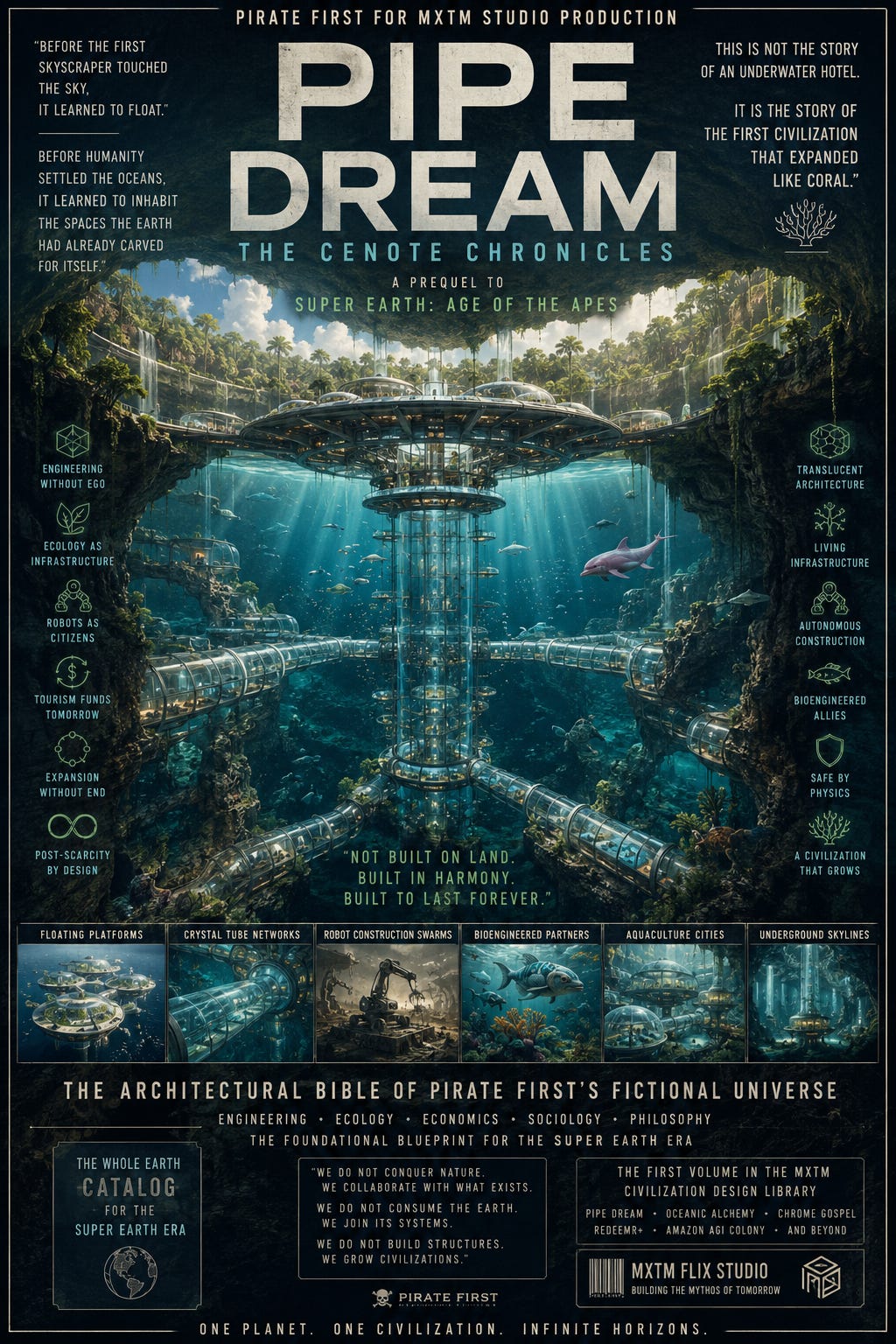
Chapter 1: The Scarcity Myth
Scarcity is the founding premise of the surface world’s economic science. The first sentence of every introductory economics textbook establishes it: resources are scarce, human wants are unlimited, and economics is the science that studies how societies allocate the scarce resources among the unlimited wants. The sentence is presented as self-evident — a description of the human condition’s most fundamental material fact whose truth requires no demonstration because the experience of wanting more than you have is the universal experience that every reader of the introductory textbook shares.
The premise is partially true. Some resources are genuinely scarce in the physical sense that the total quantity available is less than the total quantity that the current human population would consume if the resource were freely available: the rare earth elements whose geographic concentration makes them physically scarce, the fresh water whose quality and distribution make it functionally scarce in the specific locations where the population density has outrun the hydrological cycle’s local replenishment rate, and the atmospheric carbon sink’s capacity whose absorption rate is genuinely less than the industrial system’s current emission rate.
But much of what the surface world’s economic system treats as scarcity is not the physical scarcity of the rare earth element or the local hydrological deficit. It is the institutional scarcity of the resource whose physical abundance exceeds the current consumption’s demand by the margin that the distribution system’s failure, the property right’s misallocation, and the governance failure’s production inefficiency have converted from the physical abundance into the experienced scarcity. The food that is physically produced in quantities sufficient to feed the human population but that eight hundred million people are food-insecure for is not the physical scarcity — it is the institutional scarcity of the distribution failure’s product. The freshwater that the surface world produces at the total annual recharge rate exceeding the current annual consumption’s total extraction but that the two billion people lack adequate access to is not the physical scarcity — it is the institutional scarcity of the distribution failure’s product.
The distinction between physical scarcity and institutional scarcity is the post-scarcity prototype’s founding analytical claim: the economic system’s experienced scarcity is not determined entirely by the physical resource’s abundance or deficit. It is determined by the interaction between the physical resource’s abundance or deficit and the institutional system’s allocation efficiency — the degree to which the institutional system’s property rights, governance framework, and distribution infrastructure convert the physical abundance into the experienced sufficiency rather than the experienced scarcity.
The post-scarcity prototype is the civilization that has designed its institutional system to convert the formation’s physical abundance — the geological, biological, and hydrological resources that the Chicxulub arc’s cenote formation’s sixty-six-million-year history has provided — into the experienced sufficiency that the permanent resident community’s biological needs and intellectual aspirations require, without the institutional scarcity that the property right’s misallocation, the distribution failure, and the governance system’s production inefficiency would impose on a physical abundance that the institutional system’s failure converts into the experienced scarcity.
THE THREE SCARCITIES THAT PIPEDREAM DISSOLVES
The surface world’s most persistently experienced scarcities — the scarcities that the institutional system’s failure most consistently converts from the physical abundance into the experienced deficit — are the energy scarcity, the material scarcity, and the information scarcity. Each of these the surface world’s institutional system has managed with the specific institutional forms that the resource’s physical character and the institutional tradition’s historical development have produced. Each of these PipeDream’s institutional design has addressed through the physical abundance’s direct conversion to the experienced sufficiency rather than the institutional scarcity’s management.
The energy scarcity is the surface world’s most consequential institutional scarcity: the physical energy that the sun delivers to the earth’s surface annually exceeds the human civilization’s total annual energy consumption by the factor of ten thousand, but the institutional system that converts the solar energy into the electricity, the fuel, and the heat that the civilization’s end uses require produces the energy whose cost, whose geographic distribution, and whose environmental consequence together constitute the energy scarcity that the surface world’s geopolitical system, the climate science, and the energy poverty’s human consequence all engage with as the civilization’s most pressing resource management challenge.
PipeDream’s energy system dissolves the energy scarcity not by inventing a more efficient solar energy conversion technology or by building a larger renewable energy installation, but by inhabiting the geological formation whose own physical processes — the underground river’s hydraulic gradient, the geothermal heat flux, the halocline’s salinity gradient, and the anoxic zone’s biological hydrogen production — continuously produce the energy that the civilization’s critical loads require at zero marginal cost. The formation is the energy system. The energy system is the formation. The energy scarcity is the institution’s scarcity — the failure to inhabit the physical systems that the formation’s geological history has equipped with the energy production that the civilization’s inhabitation can access directly rather than manufacturing from the atmospheric environment’s raw solar input.
The material scarcity is the surface world’s most geopolitically contested institutional scarcity: the periodic table’s elements whose physical concentration in the specific geological formations makes them the strategic resources that the sovereign territory’s control can leverage as the geopolitical instrument — the rare earth element’s Chinese concentration, the lithium’s Bolivian concentration, the cobalt’s Congolese concentration. The physical concentration is real in each case, but the institutional scarcity’s severity is the interaction between the physical concentration and the institutional system’s failure to develop the material efficiency, the recycling infrastructure, and the alternative material’s development that the physical scarcity’s mitigation requires.
PipeDream’s material system dissolves the material scarcity not by discovering new geological concentrations of the strategic elements or by inventing the material substitutes that the physical scarcity motivates, but by inhabiting the geological formation whose own chemical and biological processes — the anoxic zone’s extremophile community’s metabolic concentration of the dissolved trace elements, the Chemostat’s elemental sulfur production, the pharmaceutical secondary metabolite’s biosynthesis, and the mineral harvest’s biological concentration mechanism — continuously produce the specific materials that the civilization’s economic needs require from the formation’s own physical chemistry rather than from the surface world’s extraction economy’s supply chain.
The information scarcity is the surface world’s most recently resolved institutional scarcity in the information economy’s digital infrastructure’s build-out, and the one whose resolution has most clearly demonstrated the difference between the physical scarcity — the actual limitation in the information’s production, the information’s distribution, and the information’s consumption — and the institutional scarcity — the property right’s restriction, the access barrier’s imposition, and the distribution failure’s information asymmetry. The internet’s construction has nearly eliminated the information’s physical distribution cost, converting the institutional information scarcity’s most consequential mechanism — the distribution cost’s access barrier — from the scarcity’s primary driver into the residual institutional resistance that the intellectual property system’s commercial logic maintains against the physical abundance that the distribution infrastructure has produced.
PipeDream’s information system is the research commons: the institutional architecture whose mandatory publication protocol, the open access terms, and the cross-disciplinary integration eliminate the institutional information scarcity that the proprietary research portfolio, the publication paywall, and the disciplinary silo would impose on the formation’s most valuable product — the scientific understanding of what the geological formation’s specific conditions produce in the biological systems that inhabit them. The research commons’ information abundance is the institutional choice that refuses the institutional information scarcity that the alternative property rights regime would produce from the same physical abundance.
WHAT POST-SCARCITY MEANS
Post-scarcity does not mean the elimination of all resource constraints. The formation’s physical resources are finite: the freshwater zone’s volume is bounded by the cenote’s geological dimensions, the anoxic zone’s dissolved mineral inventory is bounded by the hydrological input and the extraction’s depletion, and the atmospheric management system’s CO₂ scrubber material is bounded by the utility conduit’s supply infrastructure’s capacity. The post-scarcity prototype operates within genuine physical constraints.
Post-scarcity means the institutional design that converts the available physical resources into the experienced sufficiency for the community’s needs without the institutional scarcities that the property right’s misallocation, the governance failure, and the distribution inefficiency would impose on the physical resources’ adequate conversion to the experienced sufficiency.
The distinction’s practical expression is the commons ownership principle’s implementation: the formation’s resources — the freshwater zone’s therapeutic pressure, the research commons’ intellectual output, the Crystal Tube network’s infrastructure, and the expansion reserve’s capital — are governed as the permanent resident community’s commons rather than as the individual owner’s proprietary assets whose commercial logic would restrict the access to the purchasing power’s level that the market price demands. The commons governance converts the physical resource’s availability into the community’s universal access — the institutional design that produces the post-scarcity experienced sufficiency from the physical abundance that the market mechanism’s institutional scarcity would convert into the experienced deficit for the community members whose purchasing power falls below the market price’s access threshold.
The post-scarcity prototype’s most important institutional innovation is not the technology whose specific mechanism the preceding Parts’ chapters have documented. It is the institutional design that governs the technology’s outputs as the commons that the community’s governance distributes according to the biological need and the scientific contribution rather than the market mechanism’s price signal and the property right’s exclusive access.
The technology is the formation’s gift organized by the civilization’s engineering. The institutional design is the civilization’s gift organized by the governance philosophy. The post-scarcity experience is the interaction between the formation’s gift and the institutional design’s governance — the conversion of what the formation offers into what the community actually receives through the governance framework that determines the conversion’s efficiency.
THE SCARCITY MYTH’S POLITICAL FUNCTION
The scarcity premise that the introductory economics textbook presents as self-evident is not simply a neutral empirical observation about the physical world’s resource constraints. It is a political claim whose function in the surface world’s economic ideology is the naturalization of the institutional arrangements that the physical scarcity’s management requires — the arrangements that the surface world’s economic system presents as the inevitable response to the physical scarcity’s natural condition rather than as the political choices about the institutional arrangements that the governing coalition’s interests have selected from the range of feasible alternatives that the physical resource’s abundance or deficit allows.
The naturalization function is the scarcity myth’s most important political service to the surface world’s dominant economic institutions: the property right’s restriction, the market mechanism’s allocation, and the state’s regulatory framework are presented not as the political choices that the governing coalition has made about who gets the physical resource and on what terms, but as the natural consequences of the physical scarcity that leaves no alternative to the institution that manages the competition for the insufficient quantity. The political choice disappears behind the natural condition’s apparent inevitability.
The post-scarcity prototype’s most important political contribution is the demonstration that the political choice is real: the formation’s physical resources are the same formation that any extractive industry operating in the same formation would access through the property right’s restriction and the market mechanism’s allocation. The formation’s physical character does not determine the institutional arrangement. The institutional arrangement is the governance philosophy’s choice — the choice that PipeDream has made toward the commons governance and the biological commonwealth’s philosophy rather than toward the private property right and the market mechanism’s allocation.
The demonstration that the political choice is real is the post-scarcity prototype’s most practically significant contribution to the surface world’s political imagination: the proof that the formation’s physical resources can be organized according to the commons governance’s institutional design rather than the private property right’s institutional design, and that the commons governance’s institutional design can produce the experienced sufficiency that the biological commonwealth’s philosophy specifies as the governance’s primary purpose, is the proof that the scarcity myth’s naturalization of the private property right’s institutional arrangement is false — that the physical resource’s conversion to the experienced sufficiency is the governance philosophy’s choice rather than the natural condition’s inevitable consequence.
THE FORMATION’S PHYSICAL ABUNDANCE
The cenote formation’s physical abundance is not the infinite abundance of the utopian fantasy — the dreamworld where every desire is satisfied without the investment of effort, the consumption of material, or the time that any physical process requires. The formation’s physical abundance is the specific abundance of the specific physical resources that the sixty-six-million-year geological history has produced in the specific geological configuration that the Chicxulub impact and the subsequent dissolution have created.
The physical abundance is:
The freshwater zone’s stable thermal environment, which the geological thermal mass maintains at the production species’ optimal temperature range and the therapeutic protocol’s target temperature range without the energy cost that the surface world’s aquaculture facility’s temperature control and the medical facility’s environmental management require.
The anoxic zone’s chemical energy gradient, which the sulfate-reducing metabolism’s continuous production of the electrochemical potential that the streaming potential harvest and the membrane reactor’s hydrogen production access as the zero-marginal-cost electrical and thermal energy generation.
The halocline boundary’s salinity gradient, which the reverse electrodialysis’s ion exchange membranes access as the thermodynamic energy whose conversion to the electrical current requires no fuel, no combustion, and no greenhouse gas emission.
The underground river’s hydraulic gradient, which the streaming potential harvest’s electrode arrays access as the continuous electrical generation that the surface world’s renewable energy infrastructure’s intermittency cannot match in the geological medium’s continuous-flow stability.
The biological community’s sixty-six-million-year evolutionary isolation, which has produced the pharmaceutical secondary metabolites’ biochemical novelty that the surface world’s pharmaceutical development pipeline cannot access from any other biological source because the source is the formation’s specific biological isolation’s specific evolutionary product.
The limestone formation’s structural geometry, which the Crystal Tube Standard’s engineering has converted from the geological void into the inhabited infrastructure without the capital cost that the surface world’s equivalent infrastructure construction on the surface world’s terrain would require because the geological void is the infrastructure’s spatial template whose creation the civilization did not have to finance.
The formation’s physical abundance is the geological history’s gift to the civilization that asked what the formation could sustain before building anything inside it. The gift is not infinite. It is specific, finite, and sufficient for the specific civilization that has built the institutional design that converts the specific abundance into the specific community’s experienced sufficiency.
THE POST-SCARCITY PROTOTYPE’S LIMITS
The post-scarcity prototype’s honest characterization includes the limits that the formation’s physical constraints and the institutional design’s governance challenges impose on the experienced sufficiency’s universality:
The formation’s geographic specificity limits the post-scarcity prototype’s replicability to the geographic contexts where the comparable geological formation’s physical abundance exists — the karst limestone’s freshwater cave network whose Corridor and Formation qualification criteria the hydroprint campaign can confirm in the comparable geographic zones. The surface world’s population whose geographic location places them above or near the comparable geological formation benefits from the post-scarcity prototype’s replication. The surface world’s population whose geography lacks the comparable geological formation requires the alternative institutional design that the post-scarcity prototype’s political philosophy can inform but the post-scarcity prototype’s specific physical resources cannot directly provide.
The institutional design’s governance challenges limit the post-scarcity prototype’s universality to the institutional contexts where the governance philosophy’s commons governance, the biological commonwealth’s political philosophy, and the REDEEMR framework’s constitutional architecture can be sustained across the generational transitions that the design life requires. The surface world’s governance contexts whose political traditions, legal frameworks, and cultural values are most compatible with the commons governance’s institutional requirements are the governance contexts where the post-scarcity prototype’s replication is most politically feasible. The governance contexts whose political traditions are most resistant to the commons governance’s institutional requirements present the political challenge that the post-scarcity prototype’s replication must address through the principality deal’s negotiating process rather than the institutional transplant’s direct application.
The permanent resident community’s self-selection limits the post-scarcity prototype’s social diversity to the population whose financial resources, health eligibility, and personal values have led them to choose the therapeutic depth’s conditions over the surface world’s atmospheric environment. The community that self-selects for the post-scarcity prototype’s institutional environment is not the representative sample of the human population’s full social, economic, and cultural diversity — it is the subset whose specific characteristics the enrollment protocol’s access criteria and the enrollment decision’s motivational requirements together produce as the permanent resident community’s specific social composition.
The limits are the post-scarcity prototype’s honest boundary conditions: the demonstration that the institutional design can convert the formation’s physical abundance into the experienced sufficiency within the specific geographic, governance, and social conditions that the prototype’s implementation requires does not demonstrate that the same institutional design can convert the physical abundance into the experienced sufficiency under all geographic, governance, and social conditions. The demonstration is the proof that the institutional design works where the physical abundance and the governance conditions are both present — not the proof that the institutional design works everywhere regardless of the physical and governance conditions.
The honest boundary conditions are the post-scarcity prototype’s most important contribution to the surface world’s political imagination precisely because they distinguish the specific proof from the universal claim: the specific proof is that the institutional design can produce the experienced sufficiency from the formation’s physical abundance in the institutional context that the principality’s governance philosophy has created. The universal claim — that the same institutional design can produce the experienced sufficiency from any physical resource in any institutional context — is the utopian claim that the post-scarcity prototype does not make and cannot support.
The prototype is not the utopia. The prototype is the demonstration that the specific institutional design works in the specific conditions. The demonstration is more valuable than the utopia because the demonstration is real and the utopia is not.
THE SCARCITY MYTH’S DISSOLUTION
The scarcity myth’s dissolution is not the proclamation that scarcity has been eliminated. The scarcity myth’s dissolution is the demonstration that the experienced scarcity is the governance’s choice — the institutional arrangement’s product rather than the physical condition’s inevitable consequence — and that the governance philosophy that chooses the commons governance over the private property right’s institutional arrangement converts the same physical abundance into the experienced sufficiency rather than the experienced scarcity for the community that the governance framework serves.
The demonstration’s scale matters: the post-scarcity prototype’s permanent resident community is small. The demonstration’s geographic scope is the specific cenote formation’s institutional context. The demonstration’s temporal span is the founding charter’s thousand-year design life whose first century is being written in the longitudinal dataset’s accumulation. The demonstration’s scale is not the global civilization’s institutional transformation — it is the specific community in the specific geological formation demonstrating that the governance philosophy’s choice produces the experienced sufficiency from the formation’s physical abundance.
The small-scale demonstration’s value is the existence proof: the proof that the experienced sufficiency is achievable through the institutional design’s governance philosophy rather than the natural condition’s impossible transcendence is the proof that the scarcity myth’s naturalization of the private property right and the market mechanism is false — that the institutional arrangement is the political choice whose alternatives exist and whose specific alternatives the post-scarcity prototype demonstrates as operational in the specific conditions that the formation provides and the governance philosophy creates.
The existence proof is the post-scarcity prototype’s gift to the surface world: not the technology, not the medicine, not the food production, not the governance framework — all of these are valuable and all of these the research commons makes available through the commons access licensing. The most valuable gift is the proof that the governance philosophy’s choice matters — that the institutional arrangement’s design is the variable that determines whether the physical abundance is experienced as the sufficiency or the scarcity, and that the specific institutional design whose implementation the post-scarcity prototype demonstrates is the design that produces the experienced sufficiency from the physical abundance that the formation provides.
The surface world that receives the existence proof has the political imagination’s expansion that the proof enables: the imagination of a governance philosophy whose institutional design converts the physical abundance into the experienced sufficiency rather than the institutional scarcity — the imagination that the scarcity myth’s naturalization of the private property right and the market mechanism has systematically suppressed by presenting the institutional arrangement as the physical condition’s inevitable consequence rather than the political choice’s available alternative.
The post-scarcity prototype is the alternative. The alternative is real. The real alternative is the scarcity myth’s dissolution.
Cross-references: Part I, Ch. 1 (The Last Empty Frontier); Part VIII, Section A, Ch. 5 (The Economics of Infinite Expansion); Part IX, Ch. 5 (The Commons Ownership Principle); Part X, Ch. 2 (Electrochemical Harvest); Part XII, Ch. 2 (Infrastructure as Ecology); Part XII, Ch. 3 (Living Infrastructure); Part XII, Ch. 4 (Regenerative Industry); Part XII, Ch. 5 (Sans A Priori); Part XII, Ch. 6 (Why PipeDream Changed Everything). For post-scarcity prototype institutional design specification and commons governance framework’s physical resource conversion protocol, see Appendix E (Economic Architecture). For formation physical abundance inventory and geographic specificity limit assessment, see Appendix A (Formation Baseline Protocol). For post-scarcity prototype replication feasibility assessment criteria and governance context compatibility evaluation, see Appendix H (Governance Operations Manual).
PIPE DREAM
PART XII — THE POST-SCARCITY PROTOTYPE
Chapter 2: Infrastructure as Ecology
The surface world’s infrastructure is designed against the environment. Not against the environment in the sense of hostility — the structural engineer does not hate the earthquake, the hydraulic engineer does not resent the flood, the geotechnical engineer does not despise the landslide. Against the environment in the sense of opposition: the infrastructure’s design is the specification of the structural resistance, the hydraulic capacity, and the geotechnical stability that the environmental forces’ maximum expected magnitude will not overcome. The infrastructure is the engineered response to the environmental challenge — the human construction that maintains its function in the face of the environmental forces that the probability distribution and the design return period determine as the maximum that the design must withstand.
This opposition logic produces excellent infrastructure within its design envelope: the bridge that withstands the design earthquake, the dam that withstands the design flood, the retaining wall that withstands the design slope instability. Each succeeds at what the opposition logic specifies it to do — maintain the structural function against the environmental force that the design envelope describes. Each fails when the environmental force exceeds the design envelope — the earthquake that exceeds the design return period, the flood that exceeds the design capacity, the slope instability that exceeds the design load. And each produces the ecological consequences that the opposition’s physical expression generates: the dam that blocks the fish migration, the retaining wall that eliminates the riparian corridor, the bridge foundation that scours the riverbed.
The ecological consequences are not the infrastructure’s design failures — they are the opposition logic’s intended expressions. The dam that stops the flood also stops the fish. The retaining wall that prevents the slope’s instability also eliminates the slope’s ecological function. The bridge foundation that resists the hydraulic scour also eliminates the riverbed’s biological community at the scour location. The opposition logic specifies what the infrastructure resists. The infrastructure resists the environment. The resistance produces the ecological consequence.
Infrastructure as ecology is the design philosophy that replaces the opposition logic with the integration logic: the infrastructure whose design is not the specification of the resistance against the environment but the specification of the participation in the environmental system whose ecological function the infrastructure’s physical presence can enhance rather than eliminate.
THE INTEGRATION LOGIC
The integration logic’s foundational claim is the observation that the ecological function and the infrastructural function are not inherently opposed — that the specific physical configurations that serve the ecological function also serve specific infrastructural functions, and that the infrastructure designed to participate in the ecological system rather than to resist it can perform both functions simultaneously from the same physical configuration.
The coral reef performs the coastal protection function — the wave attenuation that reduces the storm surge’s inland impact — and the ecological function — the marine biodiversity’s most productive habitat in the tropical ocean — simultaneously from the same physical configuration: the calcium carbonate structure whose porosity and complexity are the ecological function’s biological requirement are the same properties whose hydraulic roughness and wave dissipation are the coastal protection function’s physical mechanism. The ecological function and the infrastructural function are the same physical configuration’s simultaneous expressions.
The mangrove forest performs the coastal stabilization function — the root network whose sediment capture prevents the coastal erosion that the wave energy would produce on the unprotected shoreline — and the ecological function — the intertidal nursery habitat whose biological productivity supports the offshore fishery’s juvenile population — simultaneously from the same physical configuration: the root network whose sediment capture is the stabilization function’s mechanism is the same structure whose interstitial space is the nursery habitat’s ecological requirement. The ecological function and the stabilization function are the same root network’s simultaneous expressions.
These are the surface world’s ecology-infrastructure integration examples whose biological mechanism has been characterized with enough precision that the surface world’s coastal engineering literature has produced the specific design guidance for incorporating the coral reef’s and the mangrove’s ecological function into the coastal protection’s infrastructure planning. The integration logic is not the novel invention of PipeDream’s infrastructure design — it is the design philosophy whose application the surface world’s ecological engineering has been developing for the coastal protection’s specific context across the past three decades.
PipeDream’s contribution is the application of the integration logic to the underground cenote formation’s specific context — the specific integration of the infrastructural function and the ecological function in the Crystal Tube network, the anchor pylon system, the biological maintenance community, and the production infrastructure’s physical configurations that Parts II through VIII have documented as the founding installation’s construction and operation’s specific designs.
THE CRYSTAL TUBE AS ECOLOGICAL MEDIUM
The Crystal Tube is infrastructure in the conventional sense: the physical passage through which the civilization’s transit, utility supply, and communication flow, manufactured from the engineered material whose mechanical and optical properties the Crystal Tube Standard specifies, and installed in the formation’s passage geometry according to the construction protocol whose quality control the founding charter’s trial window and anchor commitment sequence ensures.
The Crystal Tube is also ecological medium: the transparent polymer substrate whose optical, chemical, and physical surface properties the freshwater zone’s biological community colonizes as the succession habitat whose managed mid-succession stage the Crystal specification’s biological management target requires. The same polymer surface that the Crystal Tube Standard’s structural specification requires for the Hull material’s pressure resistance, the impact resistance, and the optical clarity is the surface that the biological community’s successional dynamics treats as the substrate whose colonization the pioneer community initiates and that the mid-succession community’s managed installation produces as the transparent reef habitat.
The ecological function and the infrastructural function are the same surface’s simultaneous expressions: the Crystal Tube’s wall is the structural boundary that separates the atmospheric enclosure from the cenote water column (infrastructure) and is the biological community’s colonization substrate that the Ancistrus vitreus colonies clean to the mid-succession stage that the Crystal specification requires (ecology). The surface is the infrastructure and the ecology simultaneously. The design specification that determines what the surface is physically — the polymer composite’s composition, the surface roughness’s specification, the UV transmission’s optical property — simultaneously determines what the surface is ecologically — the substrate chemistry and texture that the biological succession’s pioneer community’s adhesion biochemistry and the mid-succession community’s competitive dynamics can colonize at the management target’s succession stage.
The Crystal Tube is both things at the same time because the design philosophy that produced it is the integration logic rather than the opposition logic: the Crystal Tube’s design did not specify what the surface is as infrastructure and then separately assess the ecological consequence of the surface’s physical properties. The Crystal Tube’s design specified the surface’s physical properties for the simultaneous satisfaction of the structural, optical, and ecological requirements whose integration the founding charter’s infrastructure-as-ecology principle required from the design process’s beginning.
THE ANCHOR PYLON AS REEF SUBSTRATE
The anchor pylon is the Crystal Tube Standard’s geological connection — the 316L stainless steel or Inconel rod whose hydraulic driving into the limestone substrate’s competent formation creates the point connection between the Crystal Tube’s floating structure and the formation’s geological mass. The anchor pylon is infrastructure in the most structurally fundamental sense: the element that converts the floating structure’s buoyancy-supported position into the fixed structure’s anchor-stabilized position.
The anchor pylon is also reef substrate: the metal rod whose surface chemistry, thermal mass, and hydrodynamic shadow create the microhabitat that the biological community’s reef-building organisms colonize as the hard substrate attachment point for the coral analog’s calcium carbonate deposition, the mussel’s byssal thread adhesion, and the bryozoan’s colony’s modular growth. The anchor pylon that the structural specification drove into the limestone to connect the Crystal Tube to the formation is, within the biological succession’s seasonal timescale, a reef structure whose biological colonization the surrounding biological community has incorporated into the natural reef habitat’s spatial organization.
The mussel colony’s structural symbiont function — the shell deposition that improves the anchor bracket’s load distribution at the limestone substrate interface, documented in Part VIII’s Section B’s Chapter 5 as the unexpected biological engineering consequence of the mussel’s biological adhesion to the anchor bracket face — is the anchor pylon’s most specific infrastructure-as-ecology expression: the reef substrate that the anchor pylon provides to the mussel colony is simultaneously improved by the mussel colony’s shell deposition as the anchor’s structural element. The ecology improves the infrastructure. The infrastructure supports the ecology. The mutual improvement is the integration logic’s most specific design outcome.
THE SILT-VAC AS ECOLOGICAL SERVICE
The Silt-Vac ROV fleet’s role as the aquaculture production system’s organic waste collection mechanism has been documented in the production chapters as the operational provision that maintains the deep column zone’s sediment accumulation below the level that would reduce the dissolved oxygen and increase the dissolved organic carbon above the production system’s water quality specification. The Silt-Vac is infrastructure in the operational sense: the mechanical system that performs the waste collection function that the production system’s water quality management requires.
The Silt-Vac is also ecological service in the benthic habitat’s maintenance sense: the organic waste that the Silt-Vac collects from the cage assemblies’ lower boundary is the organic material that, in the absence of the Silt-Vac’s collection, would accumulate as the anoxic sediment whose hydrogen sulfide production would eliminate the deep column zone’s benthic biological community from the habitat whose oxygen conditions the dissolved oxygen would no longer sustain above the species’ tolerance threshold.
The Silt-Vac’s collection maintains the deep column zone’s dissolved oxygen above the benthic biological community’s survival threshold, enabling the cave fish community’s deepest-ranging species to occupy the deep column zone as the habitat whose food resource — the organic material that escapes the Silt-Vac’s collection efficiency at the fraction below the collection protocol’s removal percentage — the benthic community’s foraging uses as the trophic base for the cave fish community’s deepest vertical range.
The Silt-Vac collects the waste that the production system generates (infrastructure) and maintains the dissolved oxygen that the benthic biological community’s habitat requires (ecological service) simultaneously. The same operational cycle that the production system’s water quality management specifies is the ecological service that the benthic biological community’s habitat maintenance requires.
THE HARVEST DRONE AS PREDATOR ANALOG
The harvest drone’s selective collection protocol in the production zone’s cage assemblies is the infrastructure’s most ecologically unusual simultaneity: the mechanical system that performs the selective harvest of the production species from the cage assembly at the size class above the harvest threshold is simultaneously performing the ecological role of the selective predator in the wild population’s dynamics.
The selective predator’s ecological function in the wild population is the size-selective removal of the individual above the threshold size that the predator’s gape limitation or the preference behavior determines as the prey individual’s vulnerability to predation. The selective predation’s ecological consequence is the prey population’s demographic structure whose size distribution reflects the selective removal’s pressure — the population size distribution whose mean and variance are determined by the balance between the growth rate that brings individuals into the vulnerability size class and the selective predation rate that removes individuals from the vulnerability size class.
The harvest drone’s selective collection at the harvest size threshold performs the same demographic function in the production species’ cage population: the selective removal at the harvest size threshold maintains the cage population’s size distribution at the demographic balance between the juvenile supply from the hatchery’s transfer and the harvest removal from the cage assembly’s adult population. The cage population’s demographic structure is the harvest drone’s selective collection rate’s ecological expression — the same relationship between the selective predator’s removal rate and the wild population’s demographic structure that the population dynamics’ size-selective predation models describe.
The harvest drone that collects the production species (infrastructure) simultaneously performs the selective predator’s demographic function in the cage population’s ecological dynamics (ecological role). The selective collection protocol and the selective predation’s ecological function are the same physical action’s simultaneous expressions — the size-selective removal that the production system’s harvest protocol specifies and the ecological role that the cage population’s demographic maintenance requires.
THE FORMATION AS INFRASTRUCTURE
The formation itself is the post-scarcity prototype’s most fundamental infrastructure-as-ecology expression: the geological formation whose physical properties — the thermal stability, the pressure gradient, the chemical stratification, the acoustic isolation, and the biological productivity — constitute the civilization’s operational infrastructure is simultaneously the geological formation whose ecological conditions — the species-specific habitat conditions, the succession dynamics, and the biological community’s evolutionary history — constitute the formation’s ecological character.
The formation is not the infrastructure that serves the ecological character. The formation is the ecological character serving as the infrastructure. The distinction is the integration logic’s most fundamental inversion of the opposition logic: the opposition logic treats the ecological character as the environmental challenge that the infrastructure resists. The integration logic treats the ecological character as the infrastructure that the civilization inhabits.
The formation’s thermal stability is the therapeutic protocol’s temperature management (infrastructure) and the production species’ optimal growth rate’s thermal condition (ecological function). The same temperature is both things simultaneously because the integration logic specified the therapeutic protocol’s target temperature as the production species’ optimal temperature — the same value specified by the biological requirement and the therapeutic requirement simultaneously.
The formation’s pressure gradient is the longevity program’s therapeutic pressure (infrastructure) and the depth-stratified biological community’s hydrostatic pressure regime (ecological function). The same pressure regime that the longevity program’s therapeutic protocol targets is the biological community’s habitat condition whose depth-specific distribution reflects the depth-specific pressure’s biological selection — the integration logic’s most fundamental expression of the simultaneous infrastructure and ecology in the same physical parameter.
The formation’s acoustic isolation is the distributed sanctuary’s communication protection (infrastructure) and the cave biological community’s acoustic habitat (ecological function). The limestone’s acoustic attenuation that prevents the surface world’s surveillance from monitoring the governance deliberations is the same acoustic attenuation that creates the quiet underwater acoustic environment that the cave biological community’s acoustic biology — the cave fish’s lateral line, the boto’s echolocation, the Litho-Crustacean’s acoustic cavitation — has evolved to exploit as the signal-to-noise ratio’s favorable condition for the biological acoustic communication.
The formation is the infrastructure and the ecology simultaneously. The civilization inhabits both simultaneously. The simultaneous inhabitation is the integration logic’s complete expression — the civilization that does not design its infrastructure against the ecological character of the formation it inhabits but inhabits the ecological character of the formation as its infrastructure.
WHAT INFRASTRUCTURE AS ECOLOGY PRODUCES
The design philosophy whose application to the cenote formation’s specific context the preceding documentation has traced through the Crystal Tube’s ecological medium, the anchor pylon’s reef substrate, the Silt-Vac’s ecological service, and the harvest drone’s predator analog produces the infrastructure whose maintenance cost, ecological impact, and operational resilience differ systematically from the infrastructure whose opposition logic design produces the conventional comparison.
The maintenance cost difference is the biological maintenance crew’s economic expression: the infrastructure designed for the ecological integration’s simultaneous functions is maintained by the biological community whose ecological function the infrastructure supports, at the metabolic energy cost that the food web’s trophic allocation provides, rather than by the mechanical maintenance crew whose operational energy cost the electrical power and the replacement component supply chain must provide. The infrastructure-as-ecology design’s maintenance cost is the ecological management’s cost rather than the mechanical maintenance’s cost — orders of magnitude lower for the biological surface maintenance that the Ancistrus vitreus colony provides than for the mechanical surface cleaning that the Squeegee-Bot fleet would require.
The ecological impact difference is the directional reversal: the opposition logic’s infrastructure produces the ecological impact as the environmental resistance’s physical consequence — the fish migration blocked, the riparian corridor eliminated, the riverbed scoured. The integration logic’s infrastructure produces the ecological enhancement as the simultaneous function’s physical consequence — the biological community’s succession managed, the benthic habitat maintained, the cave fish population’s deepest range habitat supported. The same physical installation that the opposition logic produces as the ecological cost is the physical installation that the integration logic produces as the ecological benefit when the design philosophy determines the physical specification’s simultaneous requirements.
The operational resilience difference is the redundancy’s source: the opposition logic’s infrastructure resists the environmental force until the resistance fails — the bridge that withstands the design earthquake but not the beyond-design earthquake, the dam that contains the design flood but not the beyond-design flood. The integration logic’s infrastructure participates in the environmental system whose processes maintain the infrastructure’s function — the Crystal Tube whose biological community cleans the surface that maintains the light relay’s propagation, the anchor pylon whose mussel colony improves the load distribution that maintains the structural connection, the formation whose thermal mass maintains the temperature stability that maintains the production system’s biological productivity. The environmental system’s maintenance of the infrastructure’s function is the redundancy that the opposition logic’s structural resistance alone cannot provide.
THE INFRASTRUCTURE’S DESIGN PRINCIPLE
Infrastructure as ecology is the design principle that the founding charter’s infrastructure design philosophy has applied throughout the Crystal Tube Standard’s specification, the biological management protocol’s ecological management target, and the construction sequence’s trial window and anchor commitment sequence.
The design principle’s most specific operational expression is the founding question: what does the formation already do that the infrastructure requires? The answer to this question identifies the physical properties that the formation’s ecological character provides as the infrastructure’s operational foundation — the thermal stability that the production system’s temperature control requires, the pressure gradient that the therapeutic protocol’s depth assignment requires, the biological community that the surface maintenance requires, and the acoustic isolation that the communication security requires. The formation already does these things. The infrastructure participates in what the formation does rather than manufacturing the equivalent from the surface world’s material and energy inputs.
The design principle’s most specific failure mode is the manufactured requirement: the infrastructure specification that requires the surface world’s manufactured equivalent of what the formation’s ecological character already provides is the design failure that the integration logic identifies as the opposition logic’s residual. The manufactured temperature control for the production species whose optimal temperature the formation already provides is the opposition logic’s failure. The manufactured acoustic isolation for the communication security that the limestone’s acoustic attenuation already provides is the opposition logic’s failure. The manufactured habitat substrate for the biological maintenance community that the Crystal Tube’s polymer surface already provides as the colonization medium is the opposition logic’s failure.
Each manufactured requirement is the design opportunity that the integration logic converts to the ecological integration: the temperature control manufactured is the formation’s thermal stability integrated; the acoustic isolation manufactured is the limestone’s acoustic attenuation integrated; the habitat substrate manufactured is the Crystal Tube’s polymer surface’s ecological function integrated.
The integration accumulates across the design process’s successive decisions, and the infrastructure that the integration logic’s complete application produces is the infrastructure whose total manufactured requirement has been minimized by the systematic substitution of the formation’s ecological functions for the surface world’s manufactured equivalents wherever the integration logic’s application identifies the substitution as the design opportunity.
The infrastructure-as-ecology is not the zero-manufactured-requirement ideal — the infrastructure that the formation’s ecological character provides entirely without any designed physical installation. Some manufactured elements are necessary: the Crystal Tube’s polymer composite whose specific properties the formation’s limestone cannot provide, the ALON panel whose transparency and H₂S resistance the formation’s mineral surfaces cannot provide, and the coordinating system’s compute mesh whose cognitive integration the biological community’s ecological intelligence cannot provide. These are the manufactured requirements whose integration with the formation’s ecological character the infrastructure-as-ecology design philosophy accommodates within the larger framework of maximizing what the formation provides and minimizing what the surface world’s manufacturing must supply.
The integration logic produces the infrastructure-as-ecology. The infrastructure-as-ecology demonstrates the scarcity myth’s dissolution. The scarcity myth’s dissolution is the post-scarcity prototype’s most fundamental contribution to the surface world’s political imagination.
The formation is the infrastructure. The ecology is the formation. The civilization inhabits both. The design philosophy is the integration. The integration is the proof.
Cross-references: Part II, Ch. 3 (Materials That Let Civilization Disappear); Part II, Ch. 6 (Designing for a Thousand Years); Part IV, Ch. 6 (Biological Civil Engineering); Part V, Ch. 6 (Ecology as Infrastructure); Part VIII, Section B, Ch. 5 (The Living Maintenance Crew); Part VIII, Section B, Ch. 6 (The Limestone Gardeners); Part X, Ch. 4 (The Thermal Architecture); Part XII, Ch. 1 (The Scarcity Myth); Part XII, Ch. 3 (Living Infrastructure); Part XII, Ch. 5 (Sans A Priori). For Crystal Tube surface ecology-infrastructure integration specification and biological management protocol’s ecological function integration with structural specification, see Appendix D (Construction Operations Manual) and Appendix F (Biological Operations Manual). For anchor pylon structural symbiont mussel colony ecology-infrastructure integration assessment, see Appendix A (Formation Baseline Protocol). For harvest drone selective collection protocol’s predator analog ecological function documentation, see Appendix F (Biological Operations Manual). For infrastructure-as-ecology design principle application checklist and manufactured requirement minimization assessment protocol, see Appendix D (Construction Operations Manual).
PIPE DREAM
PART XII — THE POST-SCARCITY PROTOTYPE
Chapter 3: Living Infrastructure
Dead infrastructure dominates the surface world’s built environment. The concrete is inert — it resists compression at the stress level its composition and cure specify, and it continues to resist until the concrete’s porosity has admitted the water and the freeze-thaw cycle’s volumetric expansion has fractured the aggregate’s bond and the rebar’s corrosion has expanded the steel’s cross-section beyond the concrete cover’s tolerance and the structural capacity’s decline has reached the serviceability limit state. The concrete is doing nothing during this process except being used. It is not growing. It is not repairing itself. It is not monitoring its own condition. It is being used until it fails, and then it must be replaced or repaired by the same manufacturing and construction process that produced it, at the same material and energy cost that the original production required, plus the demolition and waste management cost that the replacement’s removal adds.
Dead infrastructure has served the surface world’s civilization extraordinarily well. The Roman aqueduct whose concrete withstood two thousand years of the Mediterranean climate’s weathering, the Victorian brick sewer whose masonry has survived a century and a half of London’s traffic loading and groundwater chemistry, and the steel suspension bridge whose maintenance program has kept the Golden Gate structurally sound across eighty years of Pacific seismic loading and salt air corrosion — these are the dead infrastructure’s achievements that the engineering tradition’s accumulated knowledge of materials, structural systems, and maintenance protocols has enabled at the scale and the quality that the surface world’s transportation, sanitation, and communication requires.
Dead infrastructure’s service life is bounded by the manufacturing process’s material quality, the construction process’s execution quality, and the maintenance program’s investment continuity. When any of these three conditions fails — the manufacturing produces a defective material, the construction introduces a critical flaw, or the maintenance program’s funding is interrupted — the dead infrastructure’s service life is shortened from the design specification’s expected duration toward the service failure’s actual occurrence. The failures are recoverable through the repair or the replacement that restores the three conditions, but the recovery requires the same material, energy, and labor cost that the original construction required plus the failure’s additional costs.
Living infrastructure has a different failure mode and a different recovery mechanism: the living infrastructure that the biological community constitutes can fail through the ecological community’s collapse — the disease event, the pollution event, the habitat destruction, or the governance failure that eliminates the biological community whose ecological function is the infrastructure’s operational mechanism. But the living infrastructure that the ecological management maintains within the community’s ecological tolerance has the self-repair capacity that the dead infrastructure categorically lacks: the biological community’s reproduction, the ecological succession’s recovery dynamic, and the evolutionary adaptation’s long-horizon response all provide the living infrastructure’s maintenance and repair mechanisms that the community’s biological function generates without the manufacturing and construction process’s energy and material input.
The living infrastructure’s self-repair is not free — it requires the ecological management’s ongoing maintenance of the biological community’s health within the tolerance range that the self-repair capacity requires. But the ecological management’s ongoing cost is substantially lower than the dead infrastructure’s maintenance and replacement cost for the equivalent functional performance, because the biological community’s metabolism is the maintenance mechanism’s energy source rather than the external energy and material that the dead infrastructure’s maintenance requires.
THE BIOLOGICAL COMMUNITY AS INFRASTRUCTURE
The biological community’s infrastructural functions in the cenote installation have been documented across Parts II through VIII as the specific ecological functions that simultaneously constitute the civilization’s infrastructure and maintain the ecological community’s own biological dynamics:
The Ancistrus vitreus colony maintains the Crystal Tube’s optical transmission at the Crystal specification’s target range by cleaning the biofilm succession from the transparent polymer surface at the metabolic energy cost of the food web’s trophic allocation. The colony is the optical maintenance infrastructure whose self-generating metabolism the food web’s photosynthetic base provides without the external electrical energy that the mechanical equivalent would require.
The Litho-Crustacean colonies monitor the limestone substrate’s dissolution state through the acoustic cavitation’s characterization oscillation and consolidate the dissolution-weakened zones with the calcium carbonate paste whose production the boring appendage’s biochemistry generates from the dissolved calcium and carbonate in the formation water. The colony is the geological monitoring and stewardship infrastructure whose biological function the formation’s chemistry provides without the materials supply chain that the chemical equivalent would require.
The boto population’s echolocation output provides the geological survey data that the coordinating system’s dolphin survey extraction processes into the aquifer layer’s three-dimensional characterization at the spatial resolution and the temporal frequency that the behavioral monitoring’s acoustic recording produces from the boto’s own navigation behavior. The population is the geological survey infrastructure whose data generation the behavioral ecology’s natural function provides without the purpose-built survey instrument’s energy and materials cost.
The aquaculture production system’s trophic organization provides the water quality management function that the filter feeder’s biological filtration, the bivalve’s dissolved organic matter removal, and the nitrification cycle’s biological nitrogen processing perform simultaneously with the food production function that the harvest drone’s selective collection extracts from the cage assemblies’ biological productivity. The trophic organization is the water quality management infrastructure whose biological function the food web’s ecology provides without the water treatment system’s mechanical and chemical inputs.
The food forest’s root network provides the vadose zone’s structural reinforcement that the root tissue’s mechanical presence in the pore channels produces as the geological stewardship’s complement to the Litho-Crustacean colony’s paste consolidation at the passage walls’ dissolution zones. The root network is the geological stabilization infrastructure whose biological function the food forest’s growth provides without the soil stabilization engineering’s geotechnical interventions.
The anoxic zone’s sulfate-reducing biological community provides the elemental sulfur production, the pharmaceutical secondary metabolite’s biosynthesis, and the hydrogen generation infrastructure whose biological metabolism the anoxic chemistry’s thermodynamic gradient provides without the chemical manufacturing process’s energy and materials inputs.
Together these biological communities constitute the living infrastructure: the ecology whose function is the infrastructure whose function is the ecology — the simultaneous expression of the ecological process and the infrastructural function in the same biological system’s metabolic activity.
THE LIVING INFRASTRUCTURE’S DESIGN REQUIREMENTS
The living infrastructure’s design requirements differ from the dead infrastructure’s design requirements in the specific dimensions that the biological system’s character introduces into the specification process:
The dead infrastructure’s design requires the materials specification: the composition, the mechanical properties, and the physical dimensions that the structural analysis and the material science together specify for the design load’s resistance at the design life’s end-of-service condition. The living infrastructure’s design requires the ecological specification: the species composition, the population density, and the habitat conditions that the ecological analysis and the biological science together specify for the ecological function’s maintenance at the ecological management protocol’s target succession stage.
The dead infrastructure’s design requires the construction quality control: the manufacturing process’s property verification, the installation procedure’s execution confirmation, and the dimensional tolerance’s inspection that together confirm the as-built construction’s compliance with the design specification. The living infrastructure’s design requires the ecological establishment quality control: the species introduction’s timing and density, the succession monitoring’s trajectory assessment, and the habitat condition’s verification that together confirm the biological community’s establishment toward the ecological management protocol’s target succession stage.
The dead infrastructure’s design requires the maintenance program specification: the inspection schedule, the repair protocol, and the replacement cycle that together maintain the structural capacity within the serviceability limit state across the design life. The living infrastructure’s design requires the ecological management protocol specification: the biological monitoring’s assessment frequency, the management intervention’s trigger criteria, and the genetic archive’s restoration protocol that together maintain the biological community’s ecological function within the ecosystem health indicator’s acceptable range across the design life.
The dead infrastructure’s failure is the structural capacity’s decline below the serviceability limit state. The living infrastructure’s failure is the biological community’s ecological function’s decline below the ecosystem health indicator’s acceptable range. Both failures require the corrective intervention whose cost the design life’s maintenance program budget must accommodate. The living infrastructure’s corrective intervention is the ecological management’s restoration of the biological community’s ecological function — typically less materially intensive than the dead infrastructure’s repair or replacement at the equivalent structural capacity’s restoration cost, because the biological community’s self-repair capacity provides the restoration mechanism whose marginal cost is the ecological management’s intervention rather than the full reconstruction’s material and labor cost.
THE LIVING INFRASTRUCTURE’S RESILIENCE
The living infrastructure’s most important performance advantage over the dead infrastructure is the resilience to the unanticipated disturbance: the biological community’s ecological resilience — the capacity to absorb the disturbance’s impact and recover the ecological function’s level within the recovery time that the ecological management protocol’s biological monitoring tracks — is the living infrastructure’s maintenance mechanism for the disturbances that exceed the design specification’s anticipated range.
The dead infrastructure’s response to the beyond-design disturbance is the structural failure: the bridge that withstands the design earthquake’s ground acceleration but not the beyond-design earthquake’s ground acceleration fails structurally at the beyond-design event’s occurrence. The failure’s extent is the structural analysis’s prediction from the beyond-design event’s loading magnitude and the structural capacity’s remaining reserve above the design load’s utilization. The failure’s recovery requires the structural repair or replacement at the cost that the damage’s extent determines.
The living infrastructure’s response to the beyond-design disturbance is the ecological resilience: the biological community that the ecological management has maintained within the ecosystem health indicator’s acceptable range has accumulated the ecological reserve — the genetic diversity, the functional redundancy, and the population density above the minimum viable threshold — that the disturbance’s recovery dynamic draws on as the biological community’s self-repair mechanism. The biological community that the disturbance has reduced in density or in functional diversity recovers toward the ecological management protocol’s target succession stage through the reproduction, the recruitment, and the succession that the biological community’s ecological dynamics generate without the manufactured materials and the construction labor that the dead infrastructure’s repair requires.
The living infrastructure’s recovery from the beyond-design disturbance is the ecological succession’s dynamic operating in the post-disturbance condition: not the restoration of the pre-disturbance state as the dead infrastructure’s repair aspires to achieve, but the community’s progression toward the ecological management protocol’s target succession stage through the ecological dynamics that the management protocol’s intervention guides rather than the construction process’s execution controls.
The succession toward the target is not guaranteed — the ecological community’s recovery trajectory is probabilistic in the specific outcome’s sense, though the ecological management protocol’s design has been specified with the ecological science’s knowledge of the succession dynamics’ directional properties to increase the probability of the target succession stage’s recovery from the disturbance’s initial condition. The recovery trajectory’s monitoring is the ecological management layer’s most continuous post-disturbance function: the biological monitoring’s species composition, density, and ecological function assessment at the recovery monitoring’s enhanced frequency that the post-disturbance protocol specifies until the ecosystem health indicators confirm the target succession stage’s recovery.
THE GENETIC ARCHIVE AS LIVING INFRASTRUCTURE’S INSURANCE
The genetic archive is the living infrastructure’s most important institutional provision: the genomic DNA collection from the founding population of every biological species in the installation’s biological communities, maintained in the cryogenic storage at the founding installation’s laboratory gallery, as the restoration baseline that the beyond-recovery disturbance’s management requires when the in-situ biological community’s recovery trajectory has departed too far from the target succession stage for the ecological management protocol’s field interventions to redirect without the founding population’s genetic introduction.
The genetic archive’s insurance function is the living infrastructure’s most specific difference from the dead infrastructure’s equivalent provision: the dead infrastructure’s insurance is the materials stockpile — the structural repair’s replacement components stored in the maintenance yard for the rapid deployment that the emergency repair requires. The living infrastructure’s insurance is the genetic archive — the biological restoration’s founding population’s genetic baseline stored in the cryogenic archive for the reintroduction that the ecological community’s recovery redirection requires.
The genetic archive’s insurance is more comprehensive than the materials stockpile’s insurance in the specific dimension of the biological specificity: the materials stockpile can restore the dead infrastructure’s structural capacity to the specification’s original condition because the materials are the specification’s exact chemical and physical equivalents. The genetic archive can restore the living infrastructure’s founding population’s genetic diversity to the founding specification’s biological baseline because the genomic DNA is the founding population’s exact biological equivalent — the genetic material whose reintroduction into the recovered biological community’s successor population corrects the genetic drift that the disturbance and the recovery’s genetic bottleneck have introduced.
The genetic archive’s cryogenic storage is the founding installation’s most unusual capital investment in the sense of the investment’s time horizon: the cryogenic archive’s useful life is the thousand-year design life’s full temporal extent — the period during which the biological communities’ genetic drift monitoring may identify the restoration need that the genetic archive addresses. The cryogenic archive investment provides the insurance against the genetic drift’s cumulative deviation from the founding specification across the design life’s longest temporal horizon — the insurance whose beneficial realization the founding generation cannot observe but that the founding charter’s temporal reciprocity obligation requires the founding generation to provide for the future generations whose biological community’s management will benefit from the genetic archive’s insurance against the genetic drift’s cumulative departure from the biological management protocol’s target.
THE LIVING INFRASTRUCTURE AND THE SURFACE WORLD’S IMAGINATION
The surface world’s infrastructure imagination is the dead infrastructure’s imagination: the concrete, the steel, the asphalt, and the engineered timber whose manufacturing produces the material properties that the structural design requires. The surface world’s largest infrastructure investments — the highway system, the electrical grid, the water treatment and distribution system, the wastewater collection and treatment system — are all dead infrastructure whose manufacturing, construction, operation, and maintenance require the continuous energy and material throughput that the industrial economy’s fossil fuel combustion provides.
The living infrastructure’s imagination is the biological community’s imagination: the coral reef, the mangrove forest, the oyster reef, and the wetland whose ecological function the biological community’s metabolism maintains at the solar energy cost that the food web’s photosynthetic base provides. The surface world’s most productive ecological infrastructure investments — the mangrove restoration, the coral reef protection, the wetland conservation — are the living infrastructure whose ecosystem services the ecological community’s biological function provides at the metabolic energy cost that the biological community’s food web supports without the manufacturing and construction process’s industrial energy and material throughput.
The cenote installation’s living infrastructure is the surface world’s imagination’s extension to the underground context whose specific biological communities and whose specific geological conditions the surface world’s ecological engineering has not previously engaged with at the installation’s level of design specificity. The Crystal Tube Standard’s ecological integration, the biological management protocol’s succession management, and the genetic archive’s insurance provision are the living infrastructure’s underground context’s specific design provisions whose application demonstrates that the living infrastructure’s design philosophy is not limited to the surface world’s coastal and terrestrial ecological contexts that the ecological engineering literature has primarily addressed.
The underground living infrastructure is the demonstration that the ecological engineering’s design philosophy extends to the geological formation’s interior where the surface world’s conventional construction has not previously applied the integration logic’s design requirements because the surface world has not previously inhabited the geological formation’s interior as the permanent residential environment that the cenote installation’s residential program has created.
The demonstration’s most significant contribution to the surface world’s engineering imagination is the scale: the cenote installation’s living infrastructure operates at the infrastructure scale that the permanent residential community’s daily functional requirements demand — the atmospheric management, the food production, the water quality management, the structural monitoring, the communication security, and the therapeutic environment whose simultaneous provision at the permanent community’s operational scale the living infrastructure performs through the biological community’s integrated ecological function.
The surface world’s ecological engineering has demonstrated the living infrastructure’s principle at the ecosystem service scale — the coastal protection, the carbon sequestration, the biodiversity conservation. The cenote installation’s living infrastructure demonstrates the living infrastructure’s principle at the community infrastructure scale — the specific biological functions that the permanent community’s daily operational needs require as the infrastructure whose living character the ecological management protocol maintains across the design life.
LIVING INFRASTRUCTURE AS CIVILIZATIONAL COMMITMENT
The civilization that builds living infrastructure has made the civilizational commitment that the installation’s physical presence expresses in the biological community’s ecological function: the commitment to maintain the biological community’s ecological health across the design life’s temporal span as the infrastructure’s maintenance investment, rather than the commitment to replace the dead infrastructure’s structural capacity as the maintenance investment’s equivalent.
The civilizational commitment’s expression is the governance architecture’s most fundamental biological provision: the ecological management protocol’s constitutional protection in the REDEEMR framework’s foundational layer, the biological management protocol’s concurrent authorization requirement in the governance council’s decision process, and the genetic archive’s cryogenic maintenance as the permanent capital investment whose useful life spans the design life’s full temporal extent.
These provisions together constitute the civilization’s institutional commitment to the living infrastructure’s maintenance: not the maintenance that the budget cycle’s annual appropriation funds at the political will’s discretion, but the maintenance that the constitutional protection’s foundational layer requires as the governance’s primary obligation whose violation the principality deal’s recognition framework and the REDEEMR framework’s legal committee’s advocacy would challenge as the governance’s fundamental failure.
The living infrastructure’s maintenance is constitutionally protected because the living infrastructure is constitutionally recognized as the commons asset whose biological function the community’s governance must maintain for the permanent resident community’s current wellbeing and the future generations’ environmental inheritance. The commons ownership principle’s ecological commons category is the living infrastructure’s property right whose constitution specifies the maintenance obligation as the governance’s primary ecological function rather than the maintenance option that the budget cycle’s political contestation determines as the discretionary expenditure.
The constitution protects the living infrastructure because the living infrastructure is what the civilization inhabits. The civilization inhabits what it is responsible for maintaining. The maintenance responsibility is the civilizational commitment. The civilizational commitment is the living infrastructure.
The formation is alive. The civilization maintains what is alive. The maintenance is the commitment. The commitment is the civilization.
Cross-references: Part IV, Ch. 3 (Maintenance Without Humans); Part IV, Ch. 6 (Biological Civil Engineering); Part V, Ch. 1 (Cleaner Fish); Part V, Ch. 6 (Ecology as Infrastructure); Part VIII, Section B, Ch. 5 (The Living Maintenance Crew); Part VIII, Section B, Ch. 6 (The Limestone Gardeners); Part XI, Ch. 4 (The Research Commons); Part XII, Ch. 2 (Infrastructure as Ecology); Part XII, Ch. 4 (Regenerative Industry); Part XII, Ch. 5 (Sans A Priori). For living infrastructure ecological specification format and ecological management protocol design requirements, see Appendix F (Biological Operations Manual). For genetic archive cryogenic storage specification and restoration protocol activation criteria, see Appendix F (Biological Operations Manual). For living infrastructure resilience monitoring protocol and beyond-design disturbance recovery assessment standard, see Appendix F (Biological Operations Manual). For living infrastructure commons asset constitutional protection specification and maintenance obligation governance provision, see Appendix H (Governance Operations Manual).
PIPE DREAM
PART XII — THE POST-SCARCITY PROTOTYPE
Chapter 4: Regenerative Industry
Industry produces waste. The surface world’s industrial tradition has organized itself around this premise’s practical acceptance: the input materials enter the production process, the desired product exits, and the undesired material — the byproduct, the emission, the effluent, the slag — is disposed of through the management pathway whose cost the production economics treats as the necessary expense of maintaining the production volume that the market demand sustains. The waste management pathway is the industrial process’s acknowledged appendage: the smokestack, the effluent pipe, the landfill, and the tailings pond are the industrial process’s visible signatures in the landscape because the industrial tradition has accepted the waste’s existence and managed the waste’s disposal rather than designing the production process’s boundaries to eliminate the waste category by closing the material loop between the process’s outputs and the process’s inputs.
The industrial ecology literature’s most important conceptual contribution — the Kalundborg industrial symbiosis’s practical demonstration, the circular economy’s policy framework, the cradle-to-cradle design philosophy’s materials specification — is the observation that the waste category is the process boundary’s artifact rather than the physical material’s inherent property. The material that the current process boundary classifies as waste is the input that the adjacent process’s boundary would classify as the feedstock if the two processes’ boundaries were extended to include the material flow between them as the designed connection rather than the accidental proximity.
The industrial symbiosis at Kalundborg is the most frequently cited demonstration: the power plant’s excess steam that the steam line delivers to the pharmaceutical plant’s heating system is not the steam’s inherent wastefulness — it is the power plant’s process boundary’s exclusion of the pharmaceutical plant’s heat demand from the production process’s output specification. Extending the process boundary to include the steam’s delivery to the pharmaceutical plant converts the waste to the product by redesigning the process boundary’s definition rather than the steam’s physical properties.
The process boundary’s redesign is the industrial ecology’s core intervention: not the production technology’s modification to reduce the undesired material’s generation, but the production process’s boundary’s extension to include the adjacent material flows that the current boundary has excluded as the waste by the definitional convention rather than the material’s inherent uselessness.
PipeDream’s industry is the process boundary’s extension carried to its logical conclusion in the geological formation’s specific material flows: the single process boundary that encompasses the formation’s geological, biological, and hydrological material flows as the integrated production system whose every output is the designed input to the adjacent process within the boundary’s extent. The waste category has not been managed or reduced — it has been eliminated by the process boundary’s extension to the point where every material the integrated system produces is the designed feedstock for the next process in the closed-loop sequence.
THE MATERIAL FLOWS’ INTEGRATION
The integrated material flow within PipeDream’s single process boundary is the production system whose documentation has been distributed across Parts III through X’s chapters — each chapter’s description of a specific biological, geological, or chemical process is the single loop’s segment whose inputs are the preceding segment’s outputs and whose outputs are the following segment’s inputs.
The nitrogen loop is the most precisely traced: the food forest’s plant biomass provides the dietary protein whose amino acids the human metabolism converts to the urinary urea and the fecal nitrogen that the blackwater recovery system collects, the anaerobic digestion module converts to the ammonia-rich digestate, the thermophilic composting converts to the stable organic nitrogen, the food forest’s root systems absorb as the fertilizer supplement’s nitrogen input, and the food forest’s plant biomass incorporates as the protein whose amino acids begin the loop’s next cycle. The nitrogen atom’s journey from the soil through the plant through the human through the recovery system and back to the soil is the loop’s complete circuit whose closure the process boundary’s extension to the full sequence’s length produces.
The carbon loop is the most thermodynamically significant: the light relay’s photosynthetically active output drives the spirulina bioreactor’s photosynthesis that converts the CO₂ in the atmospheric management system’s air exchange into the spirulina biomass whose harvest supplements the production species’ feed whose growth produces the harvest whose human metabolism converts to the metabolic CO₂ that the atmospheric management system’s air exchange carries to the cenote opening where the food forest’s photosynthesis converts to the plant biomass whose vertical supply chain delivers to the processing gallery and the human digestive system converts to the metabolic CO₂. The carbon atom’s journey from the atmospheric CO₂ through the biological systems and back to the atmospheric CO₂ is the loop whose closure the integrated system’s process boundary encompasses as the closed carbon cycle whose external input is only the light relay’s electrical energy driving the photosynthesis and whose external output is only the food that the regional network’s distribution logistics export as the Living Pantry’s food security contribution.
The calcium loop is the most geologically specific: the limestone’s dissolution by the formation water’s carbonic acid releases the dissolved calcium that the aquifer’s water chemistry carries through the freshwater zone where the bivalve’s shell deposition concentrates it into the calcium carbonate that the harvest extracts as the Litho-Crustacean stewardship colony’s paste feedstock that the paste application returns to the dissolution-weakened limestone surfaces as the geological stewardship’s consolidation. The calcium atom that the dissolution chemistry liberated from the limestone’s mineral matrix is the same calcium atom that the biological concentration, the harvest extraction, and the paste application have returned to the limestone’s mineral matrix at the dissolution zone’s consolidation point — the geological cycle whose biological mediation the civilization’s infrastructure has organized as the geological stewardship’s closed calcium loop.
REGENERATIVE VERSUS SUSTAINABLE
The distinction between the regenerative industry’s material flow integration and the sustainable industry’s resource consumption moderation is the conceptual boundary between two different responses to the industrial production’s environmental challenge:
The sustainable industry’s response is the consumption moderation: the production process that uses the renewable resource at or below the renewable resource’s regeneration rate, uses the non-renewable resource at the reduced rate whose depletion’s timeline the intergenerational equity specifies as the minimum acceptable, and manages the waste at the rate and the method that the environmental capacity’s absorption limit permits without the cumulative concentration exceeding the ecological threshold that defines the environmental harm’s onset. The sustainable production is the consumption moderated within the environmental carrying capacity’s sustainable extraction and absorption bounds.
The regenerative industry’s response is the material flow integration: the production process whose boundary is extended to include all the material flows between the adjacent processes that the current boundaries’ convention separates, converting the waste category into the feedstock by the boundary’s extension, and producing the system whose net material flow across the extended boundary is the minimum that the thermodynamic requirement’s non-reducible losses specify — the heat that the second law’s entropy production generates and the nitrogen that the denitrification’s atmospheric release requires as the irreducible losses whose management the system cannot eliminate but whose minimization the closed-loop design achieves by closing every closable loop before accepting the irreducible minimum as the remaining external output.
The sustainable industry reduces the harm from the current production rate’s environmental impact. The regenerative industry redesigns the production system’s boundary to eliminate the harm’s source by eliminating the waste category within the extended boundary. Sustainable industry is the harm reduction. Regenerative industry is the harm elimination — not through the production’s cessation but through the system’s boundary extension whose closure converts the harm’s source into the system’s internal material flow.
The distinction’s practical significance is the long-horizon trajectory: the sustainable industry whose harm reduction has reached the current best practice’s minimum harm rate still produces harm at the minimum rate that the current best practice allows, which accumulates across the decades and centuries of the production system’s continued operation. The regenerative industry whose boundary extension has closed all closable loops produces no harm from the closed loops’ internal material flows — the only harms are the irreducible thermodynamic losses that the second law’s entropy production requires and that the regenerative system’s design has minimized to the physical minimum by closing every closable loop.
At the geological timescale — the thousand years of the founding charter’s design life — the sustainable industry’s accumulated minimum harm and the regenerative industry’s accumulated irreducible minimum harm diverge significantly: the sustainable industry’s minimum harm rate multiplied by the thousand years is the thousand-year accumulated impact that the geological record will document as the civilization’s environmental legacy. The regenerative industry’s irreducible minimum harm rate multiplied by the thousand years is the substantially smaller environmental legacy that the closed-loop design’s boundary extension has achieved by eliminating every closable loop’s contribution to the accumulated harm’s total.
THE REGENERATIVE INDUSTRY’S ECONOMIC LOGIC
The surface world’s industrial economics treats the waste management pathway’s cost as the externalized environmental impact’s partial internalization — the fraction of the environmental harm’s true economic cost that the regulatory requirement has forced the producer to internalize through the waste disposal fee, the emission permit’s price, or the environmental remediation’s liability. The producer whose waste management cost is less than the environmental harm’s full economic cost is the producer whose externalized environmental harm the surface world’s regulatory framework’s incomplete internalization allows to persist as the market economy’s most pervasive economic distortion.
The regenerative industry’s economic logic eliminates the waste management pathway’s cost entirely: the material that the current production process’s boundary classifies as waste is the adjacent process’s feedstock within the extended boundary, and the feedstock’s value is the waste management pathway’s cost that the loop’s closure converts from the disposal expense to the production input’s value. The material whose disposal cost is the regulatory internalization’s target is the material whose feedstock value the loop’s closure’s realization converts from the cost to the benefit.
The economic logic’s specific expression in PipeDream’s integrated production system is the blackwater recovery’s economic accounting: the dissolved nitrogen and phosphorus in the permanent resident community’s metabolic waste is, in the current boundary’s convention, the sewage treatment cost that the waste management pathway must absorb as the production system’s environmental expense. Within the extended boundary that includes the food forest’s fertilizer supplement’s input as the downstream process whose feedstock is the sewage treatment’s output, the dissolved nitrogen and phosphorus is the fertilizer supplement’s value that the blackwater recovery converts from the sewage treatment’s cost to the food forest’s fertilizer savings — the loop’s closure converting the cost to the benefit at the nutrient’s monetary value rather than the disposal’s avoided cost.
The conversion’s economic magnitude is the fertilizer supplement’s market price multiplied by the nitrogen and phosphorus quantity that the blackwater recovery captures per year: the comparison between the blackwater recovery’s capital and operational cost and the fertilizer supplement’s displaced market price is the net economic benefit that the loop’s closure generates as the material accounting’s balance sheet’s most specific positive entry.
The regenerative industry’s most comprehensive economic argument is the sum of all the individual loop closures’ net economic benefits: the blackwater recovery’s fertilizer value, the methane digester’s thermal energy value, the spirulina bioreactor’s CO₂ capture’s carbon credit value, the bivalve shell’s calcium carbonate’s paste feedstock value, the Silt-Vac’s collected organic material’s composting value, and the cascade nutrient recycling’s avoided input cost together constitute the closed-loop production system’s net economic benefit relative to the open-loop production system’s waste disposal cost plus the input material’s purchase cost.
The net economic benefit is the regenerative industry’s most commercially significant argument to the surface world’s industrial economics: not the environmental benefit’s ethical claim, not the long-horizon sustainability’s policy argument, but the immediate economic benefit of the loop’s closure that the waste management cost’s conversion to the feedstock value produces in the production system’s current operating cost.
THE BIOLOGICAL EFFICIENCY
The regenerative industry’s biological processes are more resource-efficient than the equivalent chemical engineering processes for the specific material transformations that the biological metabolism performs: the elemental sulfur’s production from the dissolved sulfate through the sulfate-reducing bacteria’s metabolism uses the chemical energy in the sulfate reduction reaction’s thermodynamic gradient rather than the thermal energy that the Claus process’s partial oxidation requires. The pharmaceutical secondary metabolite’s biosynthesis through the extremophile community’s enzyme-catalyzed pathway uses the metabolic energy from the anoxic chemistry’s electrochemical gradient rather than the chemical synthesis energy that the total synthesis requires. The nitrogen fixation’s atmospheric requirement is avoided entirely by the blackwater recovery’s nitrogen capture that returns the metabolically produced urinary urea’s nitrogen to the food forest’s nitrogen cycle rather than the Haber-Bosch process’s atmospheric nitrogen fixation whose energy cost the synthetic fertilizer’s production requires.
The biological efficiency’s source is the enzyme’s catalytic mechanism: the biological enzyme that catalyzes the specific chemical transformation at the ambient temperature and the atmospheric pressure, using the metabolic energy from the cell’s electron transport chain rather than the thermal activation energy that the equivalent uncatalyzed chemical reaction requires at the elevated temperature and the elevated pressure that the industrial catalyst’s process conditions specify.
The enzyme’s catalytic efficiency is the product of the sixty-six-million-year evolutionary optimization in the specific chemical environment that the cenote’s anoxic zone provides as the biological community’s operating condition. The enzyme variant that the surface world’s directed evolution or the rational design can produce for the equivalent chemical transformation in the industrial bioreactor cannot match the efficiency that the sixty-six-million-year evolutionary optimization has produced for the specific cenote’s chemical environment — the optimization whose product is the biological community that the Chemostat’s three-gallery installation maintains at the anoxic zone’s specific conditions.
The biological efficiency’s economic expression is the production cost differential: the elemental sulfur’s production cost in the Chemostat’s biological process at the anoxic zone’s geological conditions versus the surface world’s Claus process at the natural gas processing plant’s industrial conditions is the biological efficiency’s commercial advantage — the cost per ton of elemental sulfur that the Chemostat produces at the biological metabolism’s thermodynamic efficiency versus the cost per ton that the Claus process produces at the thermal processing’s energy input. The differential is the biological efficiency’s market advantage that the regenerative industry’s economic argument presents to the commodity market’s buyers whose price sensitivity is the commercial model’s primary competitive challenge.
THE INDUSTRY’S RELATIONSHIP TO THE FORMATION
The regenerative industry is the formation’s biological chemistry organized for the civilization’s economic output: the sulfate-reducing metabolism’s elemental sulfur production, the extremophile community’s pharmaceutical secondary metabolite biosynthesis, the lithotropic community’s mineral dissolution chemistry, and the membrane reactor’s hydrogen production are all the formation’s own biological and chemical processes organized by the Chemostat’s three-gallery installation as the industrial production system whose economic output is the commercial equivalent of what the formation’s biology has been doing at the anoxic zone’s geological conditions for the geological timescale.
The formation’s biological chemistry has been producing elemental sulfur, dissolving the limestone’s mineral matrix, generating hydrogen through the hydrogenase pathway, and synthesizing the secondary metabolites through the biosynthetic pathways for the geological timescale’s duration without any economic output to the civilization that has now arrived and installed the infrastructure that accesses these biological and chemical processes as the industrial production inputs.
The regenerative industry is not extracting from the formation in the mining sense — the mining that removes the physical mineral from the geological matrix in quantities that deplete the geological resource at the timescale determined by the mining rate and the deposit’s total inventory. The regenerative industry is accessing the formation’s biological flows — the metabolic processes that the biological community’s thermodynamic equilibrium with the anoxic zone’s chemistry continuously produces and that the biological management protocol’s maintenance of the biological community’s health ensures will continue to produce at the same rate across the design life’s temporal extent.
The rate’s continuity is the regenerative industry’s most fundamental economic property: the biological process’s metabolic output rate is determined by the biological community’s health and the anoxic zone’s chemical substrate availability, both of which the biological management protocol maintains within the stable range across the design life. The geological resource’s depletion that the mining rate’s removal of the physical mineral produces is not the regenerative industry’s model — the biological process’s output is the biological community’s metabolic production rate rather than the geological inventory’s physical depletion rate.
The distinction is the regenerative industry’s name’s most specific meaning: the biological community that the biological management protocol maintains in the healthy productive state is the community that regenerates its own productivity across the biological timescale — the reproduction, the succession, and the evolutionary adaptation that the biological community’s ecological dynamics provide as the self-maintaining productivity whose regeneration the ecological management’s maintenance enables rather than extracts from.
The regenerative industry does not extract the formation’s productivity. The regenerative industry participates in the formation’s productivity by maintaining the biological community whose productivity the ecological management’s support enables. The participation is the industry. The productivity is the formation’s. The management’s support is the civilization’s contribution. The commercial output is the participation’s economic expression.
THE INDUSTRIAL ECOSYSTEM
The regenerative industry’s material flow integration, the living infrastructure’s biological function, and the post-scarcity prototype’s institutional design together constitute the industrial ecosystem: the economic system whose structure is the ecological system’s structure — the trophic organization, the nutrient cycling, the energy flow, and the succession dynamics — applied at the industrial production’s operational scale.
The ecological system’s trophic organization is the energy flow’s pathway: the primary producer’s photosynthetic conversion of the solar energy to the organic biomass, the herbivore’s consumption of the primary producer’s biomass, the carnivore’s consumption of the herbivore’s biomass, and the decomposer’s conversion of all three trophic levels’ dead organic material to the dissolved nutrients that the primary producer’s next cycle requires. The trophic organization’s energy flow is the food web’s structure — the material flow network whose topology determines the ecosystem’s metabolic efficiency and the ecological community’s composition.
The industrial ecosystem’s trophic organization is the production system’s material flow: the light relay’s photosynthetically active output (primary energy input) drives the spirulina bioreactor’s biomass production (primary production), whose harvest supplements the production species’ feed (herbivore) whose metabolism produces the organic waste (dead organic material) whose blackwater recovery and composting (decomposer) returns the dissolved nutrients to the food forest’s fertilizer supplement (primary producer input). The industrial ecosystem’s trophic organization is the food web’s structure applied to the production system’s material flow — the same organizational logic producing the same metabolic efficiency in the industrial context that the natural ecosystem’s trophic organization produces in the ecological context.
The industrial ecosystem is the regenerative industry’s systems perspective: not the individual process’s optimization — the single chemical reactor’s efficiency, the single product’s cost, the single waste stream’s disposal — but the entire production system’s material flow network’s integration that produces the closed-loop performance whose metabolic efficiency the individual process’s optimization alone cannot achieve.
The metabolic efficiency’s measurement is the boundary’s external material flow: the regenerative industry’s external input — the feedstock that the process boundary’s external supply must provide — and the external output — the product that the boundary’s external market receives and the waste that the boundary’s external disposal manages — together constitute the industrial ecosystem’s metabolic efficiency indicator. The smaller the external input and the external output relative to the total material flow within the boundary, the higher the industrial ecosystem’s metabolic efficiency — the higher fraction of the material flow that the closed loops’ internal circulation represents rather than the boundary-crossing external supply and external disposal that the open system’s inefficiency generates.
THE REGENERATIVE INDUSTRY’S DESIGN TEMPLATE
The regenerative industry’s design template is the process boundary’s systematic extension to include every adjacent material flow that the current boundary has excluded as waste by definitional convention:
The first step is the waste inventory: the complete enumeration of every material that the current process boundary’s convention classifies as the waste whose disposal the waste management pathway must manage. The waste inventory identifies the material’s chemical composition, the quantity’s production rate, and the disposal pathway’s current cost — the information that the loop closure’s economic analysis requires to assess the adjacent process’s feedstock value against the disposal pathway’s avoided cost.
The second step is the feedstock matching: the systematic identification of the adjacent processes within the extended boundary whose feedstock specification the waste inventory’s material chemically and quantitatively satisfies — the process whose input specification the waste’s output specification matches as the loop closure’s designed material flow.
The third step is the loop closure’s design: the specific process boundary’s extension that connects the waste source to the feedstock destination through the material transfer pathway whose design the connection’s physical, chemical, and biological requirements determine — the utility conduit’s routing, the processing step’s chemical conversion, or the biological community’s metabolic mediation that the specific waste-to-feedstock transition requires.
The fourth step is the loop’s economic analysis: the quantification of the loop closure’s net economic benefit — the feedstock’s displaced purchase cost plus the disposal’s avoided cost minus the loop closure’s capital and operational cost — as the investment’s economic justification for the process boundary’s extension.
The fifth step is the closed-loop system’s ecological assessment: the confirmation that the loop closure’s material flow is compatible with the biological community’s ecological health and the formation’s geological integrity — the concurrent authorization that the Terraform Operator’s professional judgment provides for every loop closure that affects the ecological management protocol’s biological community or the geological stewardship’s formation integrity.
The five steps’ systematic application to every material flow at the process boundary’s current edge is the regenerative industry’s design process — the process that has produced the closed-loop system whose documentation Parts III through X have traced as the specific biological, geological, and chemical processes whose integration the founding charter’s sans a priori approach has organized as the regenerative industry’s operational reality.
The design template is the founding charter’s gift to the next inhabited geological formation: the systematic method whose application to the next formation’s material flows will produce the next formation’s specific closed-loop system whose specific material flows the next formation’s geological, biological, and hydrological character will specify as the next formation’s regenerative industry’s specific expression.
The method is the same. The formation is different. The expression is the formation’s specific character organized by the method’s systematic application. The result is the regenerative industry — the production system whose integration with the formation’s material flows produces the industrial ecosystem whose performance the ecological system’s metabolic efficiency provides as the closed-loop design’s most specific achievement.
Cross-references: Part VIII, Section B, Ch. 8 (From Waste to Wealth); Part X, Ch. 1 (The Chemostat); Part X, Ch. 5 (The Mineral Harvest); Part XI, Ch. 3 (Telomere Economics); Part XII, Ch. 1 (The Scarcity Myth); Part XII, Ch. 2 (Infrastructure as Ecology); Part XII, Ch. 3 (Living Infrastructure); Part XII, Ch. 5 (Sans A Priori); Part XII, Ch. 6 (Why PipeDream Changed Everything). For regenerative industry design template process boundary extension methodology and waste-to-feedstock matching protocol, see Appendix D (Construction Operations Manual). For industrial ecosystem metabolic efficiency indicator calculation and boundary external flow minimization target specification, see Appendix E (Economic Architecture). For loop closure ecological assessment concurrent authorization protocol and biological community compatibility evaluation standard, see Appendix F (Biological Operations Manual).
PIPE DREAM
PART XII — THE POST-SCARCITY PROTOTYPE
Chapter 5: Sans A Priori
Every civilization arrives at the place it inhabits with assumptions about what that place is for. The assumptions precede the arrival — they are the cultural inheritance, the technical tradition, the economic logic, and the legal framework that the civilization carries from the context where those frameworks were developed into the new context where they may or may not apply. The assumptions are not examined upon arrival because they are invisible to the civilization that carries them: the assumptions are the water the civilization swims in, present everywhere, noticed nowhere.
The agricultural civilization that arrived at the Maya lowlands brought the assumptions of the Mesoamerican highland agricultural tradition: the milpa system’s corn-bean-squash polyculture, the swidden’s forest clearance and fallow rotation, the irrigation’s seasonal water management. These assumptions were not wrong for the highland context where they had been developed. They were the wrong assumptions for the lowland tropical forest’s specific character — the nutrient cycling that the tropical forest’s leaf litter’s rapid decomposition provided and that the highland soil’s humus accumulation did not, the rainfall seasonality that the lowland’s wet-dry season pattern produced and that the highland’s more uniform precipitation did not, and the agricultural productivity’s ceiling that the lowland’s nutrient-poor laterite soil’s rapid leaching established and that the highland’s volcanic soil’s higher mineral content did not impose. The Maya highland’s agricultural assumptions produced the Maya lowland’s agricultural productivity’s decline — the soil depletion, the forest clearance’s rainfall pattern’s disruption, and the carrying capacity’s eventual collapse that the archaeology’s ceramic sequence and the pollen’s isotope record together document as the Classic Maya’s terminal decline.
The industrial civilization that arrived at the cenote would bring the surface world’s assumptions: the cenote is a geological feature whose water table provides the groundwater resource that the industrial extraction can access, whose limestone provides the aggregate that the construction industry can quarry, and whose dissolution void provides the repository that the waste management can fill. These assumptions are not wrong for the surface world’s industrial context where they have been applied to countless aquifers, limestone formations, and geological voids across the surface world’s industrial geography. They are the assumptions that produce the exploited aquifer, the quarried limestone formation, and the filled geological void — the outcomes that the surface world’s industrial assumption applied to the cenote’s specific context would generate.
PipeDream arrived at the cenote without these assumptions. The sans a priori principle is the founding charter’s explicit specification of the assumption’s absence: the design process begins without the prior framework’s template, asks the formation what it can sustain before proposing anything the founding tradition’s framework specifies as the solution, and accepts the formation’s answer as the design brief that the founding engineers must satisfy with whatever technical approach the formation’s conditions require rather than with the technical approach the industrial tradition has previously applied to the superficially similar contexts that the assumption’s template describes.
WHAT SANS A PRIORI MEANS IN PRACTICE
The sans a priori principle’s practical expression is the design process’s sequencing: the formation characterization precedes the design specification, the formation’s answer precedes the technical solution’s selection, and the technical solution’s validation occurs against the formation’s response rather than against the technical tradition’s precedent.
This sequencing is the reversal of the surface world’s engineering practice’s conventional sequence: the conventional sequence begins with the technical tradition’s solution that the project type’s precedent establishes as the appropriate approach — the bridge that the river crossing requires, the dam that the water storage requires, the tunnel that the mountain passage requires — and characterizes the site’s conditions to the depth that the technical solution’s specification demands for the design’s execution. The site characterization follows the solution’s selection.
The sans a priori sequence is the inversion: the formation characterization is the design process’s first and most extensive step, pursued without the pre-selected technical solution’s direction of what the characterization must determine. The hydroprint campaign’s acoustic survey, the geological model’s stratigraphy characterization, the biological census’s species inventory, the halocline sensor network’s seasonal monitoring, and the anchor zone’s resistance testing together constitute the formation characterization that the founding charter’s design protocol specifies as the prerequisite for any technical design’s proposal.
The formation characterization’s completeness is the design process’s limiting step: the design cannot proceed to the technical solution’s selection until the formation has answered the question of what it can sustain at the resolution that the design specification’s specific dimensions require. The trial window’s twelve-month minimum is the formation characterization’s most consequential provision — the time that the design protocol requires for the formation to express its seasonal behavior across the full annual cycle before the anchor commitment converts the floating exploration to the fixed habitation.
The twelve months is the institutional patience that the sans a priori principle requires of the founding generation: the patience to ask and listen before proposing and building, the patience to treat the formation’s seasonal cycle as the design specification’s primary source rather than the engineering tradition’s precedent as the primary specification’s basis.
THE QUESTION THAT PRECEDES EVERY DESIGN DECISION
The sans a priori principle’s most operationally specific expression is the question that the founding engineers required themselves to ask before every design decision: what does the formation already do that the infrastructure requires?
The question is the inversion of the conventional engineering question: what does the infrastructure require that the formation’s conditions must accommodate? The conventional question treats the infrastructure’s requirement as the fixed constraint that the formation’s conditions must satisfy or that the engineering must overcome where the formation’s conditions fall short. The sans a priori question treats the formation’s existing processes as the fixed resource that the infrastructure’s design must align with rather than overcome.
The question’s application to every design decision produces the infrastructure-as-ecology’s cumulative expression: the Crystal Tube’s transparent hull because the formation’s biological community’s visual character is worth presenting rather than concealing — the formation does transparency; the construction program’s biological tools because the formation’s limestone is workable by biological chemistry rather than mechanical percussion — the formation does boring; the thermal management’s passive architecture because the formation’s geological thermal mass provides the temperature stability that the production system requires — the formation does temperature control; the electrochemical harvest because the formation’s underground river provides the hydraulic energy that the electrical generation requires — the formation does energy production; the biological maintenance because the formation’s biological community’s ecological function maintains the surface condition that the Crystal specification requires — the formation does surface cleaning.
Every design decision whose answer begins with what the formation already does is a design decision that the sans a priori principle has correctly oriented toward the formation’s resources rather than the industrial tradition’s manufactured equivalents. The manufactured equivalent enters the design only when the question’s answer is nothing — when the formation does not already do what the infrastructure requires and the manufactured provision’s addition to the formation’s existing processes is the only path to the infrastructure’s function.
The manufactured provisions that the sans a priori principle accepts as necessary are the provisions whose specific functions the formation’s biological, geological, and hydrological processes cannot provide: the ALON’s optical clarity at the anoxic zone’s H₂S exposure is the manufactured material whose function the formation’s natural materials cannot provide at the anoxic zone’s chemical conditions. The coordinating system’s computational intelligence is the manufactured infrastructure whose cognitive integration the formation’s biological community’s ecological intelligence cannot provide at the governance decision’s planning horizon. The Crystal Tube’s pressure vessel integrity at the therapeutic depth’s ambient pressure is the manufactured structural function whose material specification the formation’s geological void’s natural geometry cannot provide without the manufactured boundary.
These manufactured provisions are the necessary minimums — the specific functions whose satisfaction requires the manufactured addition to the formation’s existing processes because the formation’s existing processes categorically cannot satisfy them. Every manufactured provision beyond the necessary minimum is the excess that the sans a priori principle identifies as the design decision’s failure to ask the question that the formation’s answer would have replaced the manufactured addition with.
THE LEAPFROGGING THAT SANS A PRIORI ENABLES
The surface world’s technological development follows the dependency path: the new capability depends on the infrastructure that the preceding capability established, which depends on the infrastructure that the capability before it established, producing the development sequence whose full path must be traversed before the current frontier’s capability is accessible to the civilization that is beginning the development.
The electrification of the developing world’s rural community is the development sequence’s most familiar contemporary challenge: the rural community without the power grid cannot have the refrigeration, the pumped water, the electric lighting, and the telecommunications that the power grid enables — the development sequence whose beginning is the power grid’s construction whose cost and timeline the developing world’s rural community’s economic circumstances cannot support at the pace that the surface world’s development sequence traversed in the twentieth century’s infrastructure buildout.
The development path dependency is the developing world’s most persistent constraint: the infrastructure that the industrial civilization’s full development sequence has produced in the developed world over the century of the industrial buildout is the infrastructure that the developing world must build at the current century’s pace from the current beginning, reaching the current frontier only after the full path’s traversal whose pace the economic and institutional constraints limit to the trajectory that the development economics has documented as the development gap.
The leapfrogging that the mobile phone’s telecommunications rollout demonstrated in the developing world’s rural community is the path dependency’s circumvention: the mobile phone’s cellular network provides the telecommunications connectivity without the landline’s path dependency — the rural community that has never had a landline skips the landline’s development stage and accesses the telecommunications connectivity directly through the cellular network’s infrastructure that does not require the landline’s prior installation.
The sans a priori principle enables the leapfrogging at the civilizational scale: the civilization that asks what the formation can sustain before proposing the industrial tradition’s established solution discovers that the formation’s specific conditions make the established solution’s path dependency’s full traversal unnecessary — that the formation already provides the resources whose industrial production would require the full development sequence’s infrastructure buildout.
The cenote formation’s aquifer provides the freshwater zone’s temperature stability that the aquaculture facility’s industrial recirculating system’s full development sequence provides in the surface world’s industrial aquaculture — the leapfrog from the absence of the aquaculture infrastructure to the formation’s thermally stable production environment without the recirculating system’s industrial development sequence’s traversal.
The cenote formation’s pressure gradient provides the therapeutic pressure that the hyperbaric medicine’s clinical facility’s industrial development sequence provides in the surface world’s medical infrastructure — the leapfrog from the absence of the hyperbaric facility to the formation’s naturally pressurized therapeutic environment without the hyperbaric facility’s industrial development sequence’s traversal.
The cenote formation’s underground river provides the hydraulic energy that the renewable energy infrastructure’s industrial development sequence provides in the surface world’s energy grid — the leapfrog from the absence of the energy grid to the formation’s continuously generating streaming potential harvest without the energy grid’s industrial development sequence’s traversal.
Each leapfrog is the formation’s answer to the question that the sans a priori principle required the founding engineers to ask: what does the formation already do that the infrastructure requires? The formation already does thermally stable production conditions. The formation already does naturally pressurized therapeutic environments. The formation already does continuous hydraulic energy generation. The leapfrog is the formation’s gift that the sans a priori principle’s question discovered.
THE SANS A PRIORI AND THE AMAZON LESSON
The sans a priori principle is the Amazon lesson’s positive formulation. The Prologue’s Amazon lesson was the negative formulation: what not to do — what happens when the civilization arrives at the formation with the prior assumption’s template and applies the template without asking what the formation can sustain.
The Amazon installation applied the prior assumption that the tropical forest’s geological formation was the industrial production system’s spatial context — the land that the industrial facility occupies, the water that the industrial process uses, and the biological community that the industrial waste management accommodates within the environmental standard’s regulatory framework. The prior assumption’s template was the industrial facility’s design template applied to the tropical forest’s geological context without asking what the tropical forest’s geological context could sustain from the industrial facility’s design template’s specific demands.
The tropical forest’s geological context could not sustain the industrial facility’s specific demands at the operational scale and the pace that the industrial facility’s design specified — the soil’s nutrient cycling’s disruption, the biodiversity’s habitat fragmentation, and the hydrological cycle’s disruption together exceeded the tropical forest’s ecological resilience’s capacity to absorb the disruption within the recovery trajectory that the industrial facility’s operational timeline permitted.
The sans a priori principle would have produced the different question before the industrial facility’s design: what can the tropical forest’s geological formation sustain, and what does the formation already do that the industrial facility’s function requires? The formation’s answer would have identified the tropical forest’s specific capabilities — the biological diversity’s pharmaceutical potential, the nutrient cycling’s soil fertility, the hydrological cycle’s water regulation — as the design brief’s positive specification and the tropical forest’s specific limitations — the soil’s fragility under the mechanical disruption, the biodiversity’s sensitivity to the habitat fragmentation, and the hydrological cycle’s sensitivity to the canopy’s removal — as the design brief’s constraint specification.
The design brief’s positive specification and the constraint specification together would have produced the different industrial facility whose design aligned with the tropical forest’s specific capabilities rather than the prior assumption’s industrial template. The different design’s outcome would have been the different environmental legacy — the formation enhanced rather than degraded by the industrial facility’s presence.
The Amazon installation did not ask. The tropical forest paid the price. The sans a priori principle is the institutional commitment to always ask before arriving, always listen before designing, and always validate against the formation’s response before committing to the design that the formation’s conditions must sustain.
THE EMBODIED TRUTH
The sans a priori principle’s deepest philosophical claim is the embodied truth’s priority over the abstract decree: the formation’s geological, biological, and hydrological reality is the truth whose expression the design must align with, and the abstract design principle’s decree — the engineering tradition’s specification, the regulatory standard’s requirement, the economic model’s optimization — is the abstraction whose validity the embodied truth confirms or denies by the formation’s response to the design’s implementation.
The embodied truth’s priority is not the anti-intellectual claim that the abstract principle has no value: the geological science’s formation characterization methods, the biological science’s ecological management protocols, the engineering science’s structural specifications, and the economic science’s market design frameworks are all valuable abstractions whose application to the formation’s characterization, the management protocol’s design, and the expansion reserve’s economics has produced the design decisions that the founding charter’s documentation describes as the PipeDream’s specific implementation.
The embodied truth’s priority is the claim that the abstract principle’s value is the tool’s value — useful within the specific context where the tool’s function applies and limited by the specific context where the function’s assumptions do not hold. The geological model’s stratigraphy characterization method’s value is the method’s application to the formation’s specific geological conditions whose characterization the method was developed to perform. The method’s assumption that the formation’s stratigraphy responds to the acoustic survey’s measurement protocol must be validated against the formation’s actual response — the ground-penetrating sensor’s resistance reading as the anchor pylon’s hydraulic driving encounters the stratigraphy — rather than assumed as the invariant truth that the method’s development context’s validation has established for all geological formations regardless of the specific conditions.
The formation’s embodied truth validates the abstract principle’s application or denies the application’s validity in the specific context. The abstract principle that the formation’s embodied truth has validated in the specific context is the abstract principle that the design can rely on as the context-specific tool. The abstract principle that the formation’s embodied truth has denied in the specific context is the abstract principle that the design must revise for the specific context’s specific conditions.
The embodied truth’s primacy is the sans a priori principle’s most fundamental claim: the formation knows itself better than the founding engineers’ abstract principles know the formation, and the design that aligns with the formation’s self-knowledge — expressed through the formation’s response to the characterization campaign’s measurements, the trial window’s monitoring, and the installed infrastructure’s performance data — is the design that the formation can sustain at the ecological quality the founding charter’s ecological standard requires.
THE SANS A PRIORI’S INSTITUTIONAL REQUIREMENTS
The sans a priori principle’s application requires the institutional conditions that the surface world’s engineering practice does not consistently maintain:
The time for listening: the formation characterization that the sans a priori principle requires takes the time that the formation’s seasonal cycle, the geological model’s calibration, and the biological census’s inventory demand — time that the surface world’s project schedule’s cost pressure consistently compresses toward the minimum that the regulatory approval’s pre-construction requirement specifies rather than the minimum that the formation’s characterization’s scientific validity demands. The founding charter’s trial window’s twelve-month minimum is the institutional provision that the time for listening’s commitment requires as the non-negotiable schedule provision.
The authority of no: the formation characterization’s result that reveals the prior proposed design’s incompatibility with the formation’s conditions must be the authority that stops the prior design and returns the process to the question’s re-asking rather than the obstacle that the engineering’s problem-solving overcomes by the design modification that preserves the prior design’s essential elements at the formation’s expense. The Terraform Operator’s concurrent authorization requirement is the institutional provision that the authority of no’s commitment requires as the non-negotiable governance provision.
The patience for iteration: the design process’s iteration through the formation’s successive answers — each answer revealing the formation’s character at increasing resolution, each resolution’s discovery informing the design’s successive refinement toward the formation’s conditions’ closer alignment — requires the patience for the iteration’s multiple cycles rather than the single cycle’s conclusion at the first answer’s resolution. The founding installation’s ongoing sensor network’s data accumulation and the digital twin’s formation model’s continuous update are the institutional provisions that the patience for iteration’s commitment requires as the perpetual governance provision.
The honesty about what the formation does not sustain: the formation characterization that reveals what the formation cannot sustain at the proposed design’s specific demands must be the honest answer that the design accepts as the constraint rather than the inconvenient result that the political pressure’s override converts to the acceptable range’s reclassification that the Amazon lesson’s reclassification history documents as the failure mode’s institutional expression. The REDEEMR framework’s digital twin’s tamper-evident commons governance archive is the institutional provision that the honesty about what the formation does not sustain’s commitment requires as the non-negotiable records management provision.
The four institutional requirements together are the sans a priori principle’s organizational infrastructure: the time, the authority, the patience, and the honesty that the formation’s embodied truth’s primacy demands from the civilization that has committed to asking what the formation can sustain before building anything inside it.
THE SANS A PRIORI AS METHODOLOGY
The sans a priori is not only the founding principle whose philosophical status the founding charter invokes as the civilizational commitment’s deepest expression. It is the methodology whose specific procedural steps the founding engineers applied to every design decision that the founding installation’s construction and operation required, and that the governance architecture’s institutional provisions ensure the subsequent generations’ governance will continue to apply to every management decision that the thousand-year design life’s continuation requires.
The methodology’s procedural steps are:
One: characterize the formation at the resolution the decision requires before proposing the decision’s solution. The resolution’s adequacy is the Terraform Operator’s professional judgment’s assessment — not the project schedule’s budget’s assessment of what characterization is affordable within the timeline’s constraint.
Two: ask what the formation already does that the proposed function requires. The answer’s completeness is the cross-disciplinary expertise’s integration — the geological, biological, hydrological, and ecological science’s combined assessment rather than any single discipline’s isolated determination.
Three: design the function’s implementation to use what the formation already does before proposing the manufactured addition that the function requires when the formation’s processes cannot provide it. The design’s alignment with the formation’s existing processes is the concurrent authorization’s prerequisite — the authorization that confirms the design’s formation-alignment before the construction program’s commitment.
Four: validate the implementation’s alignment with the formation’s processes through the monitoring whose sensitivity detects the misalignment before the misalignment’s ecological or geological consequence exceeds the recovery’s capacity. The monitoring’s sensitivity is the biological management protocol’s ecosystem health indicator specification — not the project monitoring’s budget’s assessment of what monitoring is affordable within the operational timeline’s constraint.
Five: revise the implementation’s design when the monitoring reveals the misalignment, returning to Step One’s formation characterization at the resolution the revision requires rather than the modification’s minimum that preserves the prior implementation’s essential elements at the formation’s expense. The revision’s return to the characterization is the retrospective review protocol’s most consequential application — the review that identifies the implementation’s design failure rather than the formation’s response failure.
The five procedural steps are the sans a priori methodology’s complete specification. The methodology’s complete application to every design decision the founding installation’s construction required has produced the founding installation’s specific implementation whose documentation the preceding Parts’ chapters have recorded as the founding charter’s specific expression in the geological formation’s specific conditions.
The methodology’s continued application to every management decision the thousand-year design life’s continuation requires is the governance architecture’s most fundamental obligation — the obligation that the sans a priori principle’s philosophical status in the founding charter’s institutional hierarchy places above the economic optimization, the operational convenience, and the political expediency that the surface world’s governance would prioritize when the methodology’s application conflicts with the shorter-horizon objectives that the external pressures the formation’s conditions do not automatically prioritize.
THE CIVILIZATION THAT ASKS
The civilization that arrived at the cenote and asked what the formation could sustain before building anything inside it produced the specific civilization that the preceding twelve Parts’ documentation has described: the Crystal Tube Standard’s ecological integration, the biological maintenance community’s living infrastructure, the Chemostat’s regenerative industry, the REDEEMR framework’s governance operating system, the research commons’ scientific commons, the longevity principality’s biological commonwealth, and the distributed sanctuary’s physical sovereignty.
Each of these is the formation’s answer to the question the civilization asked. The Crystal Tube is the formation’s transparency utilized. The biological maintenance is the formation’s ecology mobilized. The Chemostat is the formation’s chemistry harvested. The REDEEMR framework is the formation’s isolation protected. The research commons is the formation’s uniqueness documented. The longevity principality is the formation’s therapeutic conditions inhabited. The distributed sanctuary is the formation’s acoustic physics exploited.
The civilization that arrived and asked is the civilization that the formation answered. The formation’s answer is the civilization. The civilization is the formation’s answer inhabited.
The sans a priori is the question. The founding charter is the question written down. The civilization is the question’s answer living inside the formation.
Every subsequent civilization that arrives at a geological formation and asks what the formation can sustain before building anything inside it will produce its own specific civilization — the specific answer that the specific formation’s specific geological, biological, and hydrological character produces in response to the question’s honest and patient asking.
The specific answer is the formation’s gift. The question is the civilization’s gift to itself. The gift exchange is the aquaforming doctrine’s complete expression.
Ask the formation. The formation will answer. Build what the formation allows.
Cross-references: Part I, Ch. 1 (The Last Empty Frontier); Part I, Ch. 2 (Why Cenotes?); Part II, Ch. 6 (Designing for a Thousand Years); Part VII, Ch. 4 (Living Through Failure); Part IX, Ch. 3 (Strategic Duplicity); Part IX, Ch. 4 (REDEEMR as Governance OS); Part X, Ch. 6 (ASI as Co-Creating Partner); Part XII, Ch. 1 (The Scarcity Myth); Part XII, Ch. 2 (Infrastructure as Ecology); Part XII, Ch. 3 (Living Infrastructure); Part XII, Ch. 4 (Regenerative Industry); Part XII, Ch. 6 (Why PipeDream Changed Everything). For sans a priori methodology five-step procedural specification and concurrent authorization formation-alignment prerequisite, see Appendix H (Governance Operations Manual). For formation characterization resolution adequacy assessment protocol and Terraform Operator professional judgment standard, see Appendix A (Formation Baseline Protocol). For retrospective review protocol’s design failure versus formation response failure distinction methodology, see Appendix H (Governance Operations Manual).
PIPE DREAM
PART XII — THE POST-SCARCITY PROTOTYPE
Chapter 6: Why PipeDream Changed Everything
The question assumes too much. The assumption embedded in the chapter’s title is that something changed — that the surface world before PipeDream and the surface world after PipeDream are distinguishably different in ways that trace causally to what PipeDream demonstrated, proved, or produced. The assumption is the historical claim that the chapter must earn before the claim’s implications can be explored: that a civilization whose founding installation’s permanent resident population numbered in the dozens in the first years, whose geographic scope was the connected cenote network of a specific karst arc in the Yucatán, and whose political recognition was the host state’s pragmatic accommodation within the existing legal framework’s nearest available categories actually changed anything beyond the specific cenotes’ ecological management and the specific enrolled cohort’s biological indicators.
The claim requires the argument. The argument is the chapter’s work.
The argument has three parts. The first is the specific thing that changed — not the technology, not the governance framework, not the medical protocol, but the conceptual object whose existence the PipeDream demonstration created in the surface world’s political and technical imagination and that the surface world’s existing conceptual vocabulary had no accurate name for. The second is the propagation mechanism — the specific institutional pathways through which the conceptual object’s existence reached the surface world’s communities of practice whose work the conceptual object’s existence changed. The third is the evidence — the surface world’s specific empirical record that the change has occurred rather than merely being projected as the change that the founding charter’s ambition requires.
THE FIRST PART: WHAT CHANGED
What changed is not PipeDream’s specific technologies. The technologies — the Crystal Tube Standard’s gradient laminate hull, the Litho-Crustacean boring colony, the streaming potential harvest’s electrochemical cells, the REDEEMR governance platform — are the techniques whose specific specifications the research commons’ commons licensing has made available to any engineering practice, governance design, or construction program that can use them. The technologies’ availability through the commons licensing changed the surface world’s technical toolkit: a toolkit that now includes the viable biological boring technique, the viable cenote aquaculture protocol, the viable sustained moderate-pressure therapeutic residence program, and the viable underground formation governance architecture as options where these options previously did not exist with the demonstrated performance data that the founding installation’s operational record provides.
The technological availability matters. But technological availability has historically been insufficient to change what actually changes when the world changes: the conceptual framework within which the available technologies are identified as solutions to the recognized problems rather than as curiosities without established application contexts.
What changed is the conceptual framework — specifically the framework’s most consequential single element: the category of the inhabited geological formation as a legitimate human habitation context with the specific institutional forms that the category’s requirements specify.
The surface world’s political imagination, legal framework, economic system, and engineering tradition before PipeDream contained no category for the inhabited geological formation. The geological formation was the resource extraction’s context — the mine, the quarry, the oil field. The geological formation was the research expedition’s subject — the cave survey, the groundwater study, the seismic hazard assessment. The geological formation was the recreational access’s venue — the cenote diving, the cave touring, the underground adventure sport. The geological formation was not the permanent human habitation’s context because the surface world’s political imagination had never produced the institutional forms that the permanent human habitation of a geological formation’s interior requires.
The institutional forms’ absence was not the technical obstacle — the engineering knowledge to build the Crystal Tube in a cenote’s freshwater zone existed in the founding engineers’ training before any cenote was inhabited. The absence was the conceptual obstacle: the political imagination had not produced the question whose answer the institutional forms would constitute, because the question — how does a community govern itself inside a geological formation that it inhabits as a permanent residential context — had not been identified as a question whose answer the surface world’s institutional framework needed to provide.
PipeDream made the question visible by producing an answer before the question was officially recognized. The inhabited geological formation that the founding installation created in the Yucatán’s cenote network was the answer to a question that the surface world’s institutional framework had not yet formulated. The answer’s existence forced the question’s formulation: the principality deal’s negotiation, the marine registry’s imperfect vessel registration, the international property law’s scholars’ engagement with the floating title’s novel legal category claim, and the actuarial industry’s assessment of the longevity program’s chronic disease onset delay’s insurance value — all of these are the question’s formulation that the answer’s existence required.
The question is: how does a civilization inhabit a geological formation permanently, with the governance rights, the legal status, the economic organization, and the institutional framework that the permanent habitation’s legitimacy requires?
The question is now in the surface world’s institutional framework. It is being engaged by the legal scholars, the policy makers, the insurance actuaries, the pharmaceutical developers, the food security planners, and the geological engineers whose professional domains the question’s specific dimensions intersect. The question’s engagement is the change. Before PipeDream, the question did not exist for these professionals. After PipeDream, the question is their problem — the novel legal category’s definition, the actuarial model’s calibration, the pharmaceutical licensing’s terms, the food security protocol’s regional deployment, and the geological engineering’s standard adaptation for the underground habitation’s specific requirements.
THE SECOND PART: HOW IT PROPAGATED
The conceptual framework change’s propagation followed the institutional pathways that the research commons’ commons licensing, the longevity program’s commercial model, the Living Pantry’s food security deployment, and the principality deal’s legal precedent together opened as the channels through which the inhabited geological formation’s institutional forms reached the professional communities whose work the forms’ existence changed.
The pharmaceutical pathway is the fastest and the widest: the research commons’ pharmaceutical secondary metabolite’s licensing negotiations brought the inhabited geological formation’s existence to the pharmaceutical industry’s attention as the novel biological source whose geological isolation’s sixty-six-million-year evolutionary history had produced the biochemical novelty that the antibiotic resistance crisis’s therapeutic need required. The pharmaceutical development partner who negotiated the non-exclusive license for the anoxic zone’s antimicrobial compound’s development pathway encountered the inhabited geological formation as the production source’s institutional context — the sovereign principality’s commons governance protocol, the research commons’ mandatory publication standard, and the concurrent authorization requirement’s ecological protection provision that the license agreement’s terms must accommodate as the production source’s institutional character.
The pharmaceutical industry’s institutional encounter with the principality’s commons governance protocol was the inhabited geological formation’s first systematic engagement with the surface world’s commercial legal framework: the license agreement’s terms that the principality deal’s recognition framework permitted, the intellectual commons’ non-exclusive licensing terms that the commons governance protocol specified, and the research commons’ mandatory publication requirement that the license agreement’s terms could not supersede were the institutional forms that the pharmaceutical development partner’s legal counsel encountered as the novel contractual context that the established pharmaceutical licensing template could not simply apply without the modification that the principality’s commons governance protocol required.
The pharmaceutical legal counsel’s modifications to the established licensing template were the inhabited geological formation’s institutional forms’ first propagation into the surface world’s commercial legal framework: the modified license agreement’s terms that the principality deal’s negotiation produced were circulated within the pharmaceutical industry’s legal community as the novel contractual precedent for the biological source whose commons governance the production source’s institutional character requires. The precedent’s circulation was the inhabited geological formation’s institutional forms’ first systematic appearance in the surface world’s commercial legal framework’s professional knowledge base.
The food security pathway is the broadest in geographic reach: the Living Pantry’s food security deployment to the comparable geological formations in the Caribbean basin, the Bahamas bank, and the Florida platform’s cenote analogs brought the inhabited geological formation’s institutional forms to the development assistance community’s attention as the food production infrastructure whose regional deployment the food security planning required. The development organization whose food security program funded the Living Pantry’s deployment in the comparable formation encountered the inhabited geological formation as the food production source’s institutional context — the formation readiness signal’s concurrent authorization requirement, the stocking algorithm’s ecological constraint management, and the food commons’ distribution protocol’s governance standard that the regional deployment’s institutional design must accommodate as the production system’s foundational governance provisions.
The development organization’s institutional encounter with the concurrent authorization requirement and the ecological constraint management was the inhabited geological formation’s food production model’s first systematic engagement with the development assistance community’s project management frameworks: the project management template that the development organization’s standard protocols specify required the modification that the formation readiness signal’s concurrent authorization and the stocking algorithm’s ecological constraint management demanded as the food production system’s management standard. The modification’s documentation as the project management template’s adaptation for the geological formation food production system was the inhabited geological formation’s governance provisions’ first propagation into the development assistance community’s professional knowledge base.
The longevity medicine pathway is the most commercially transformative: the insurance industry’s actuarial assessment of the enrolled cohort’s decade-scale chronic disease onset delay’s insurance value brought the inhabited geological formation’s therapeutic environment to the health insurance industry’s attention as the preventive health investment whose chronic condition onset delay the actuarial calculation confirmed as the insurance cost reduction that justified the reimbursement. The insurance actuary whose assessment established the longevity program’s enrollment cost’s insurance reimbursement basis encountered the inhabited geological formation as the therapeutic environment’s institutional context — the nitrox atmosphere’s atmospheric management standard, the decompression model’s individualized protocol, and the research commons’ mandatory publication standard that the insurance reimbursement’s clinical evidence requirement must engage as the therapeutic claim’s evidentiary standard.
The insurance industry’s institutional engagement with the research commons’ mandatory publication standard was the inhabited geological formation’s scientific integrity governance’s first systematic appearance in the health insurance industry’s clinical evidence framework: the research commons’ mandatory publication protocol’s requirement that all registered analyses’ results be published regardless of the result’s direction was the evidentiary standard that the insurance actuarial assessment’s clinical evidence review required the longevity program’s therapeutic claim to satisfy before the reimbursement basis’s actuarial validation. The satisfaction’s confirmation was the research commons’ publication protocol’s first systematic recognition by the health insurance industry’s clinical evidence framework as the evidence quality standard that the therapeutic claim’s actuarial validation requires.
The legal precedent pathway is the slowest and the most institutionally significant: the international property law’s scholars’ engagement with the floating title’s novel legal category claim brought the inhabited geological formation’s legal status to the international legal community’s attention as the novel property relationship whose existing legal categories cannot accurately characterize and whose institutional accommodation the legal system’s development must address. The legal scholar whose analysis of the floating title’s habitation record’s evidentiary basis and the principality deal’s marine registry’s imperfect registration encountered the inhabited geological formation as the novel legal category’s specific challenge — the three-dimensional spatial reference, the continuous habitation claim’s biometric authentication standard, and the governance record’s tamper-evident commons governance archive that the legal category’s development must accommodate as the habitation evidence’s specific institutional provisions.
The legal scholarship’s engagement with the novel legal category’s specific institutional provisions was the inhabited geological formation’s legal governance framework’s first systematic appearance in the international property law’s scholarly literature: the papers, the conference presentations, and the casebook supplements that the novel legal category’s analysis required circulated the floating title’s habitation record standard, the marine registry’s imperfect accommodation, and the governance record’s tamper-evident authentication specification as the legal questions that the inhabited geological formation’s legal status development must resolve. The circulation was the inhabited geological formation’s legal governance framework’s first propagation into the international legal community’s professional knowledge base.
THE THIRD PART: THE EVIDENCE
The evidence that the change has occurred — that PipeDream’s demonstration has produced the conceptual framework change whose propagation the institutional pathways have traced — is the specific record in the surface world’s professional literature, the institutional policy documents, and the commercial market’s data that the change’s specific expressions produce as the observable markers of the conceptual framework’s presence in the surface world’s professional communities’ work.
The pharmaceutical literature’s evidence: the class of marine and subterranean cave biological source licensing agreements whose terms specify the non-exclusive access, the commons governance protocol’s concurrent authorization, and the mandatory publication standard as the production source’s institutional character — a class that did not exist before the research commons’ pharmaceutical licensing negotiations and that has grown with each subsequent comparable geological formation’s pharmaceutical development partnership. The class’s existence in the pharmaceutical licensing literature is the inhabited geological formation’s institutional forms’ presence in the commercial pharmaceutical framework’s established practice.
The development assistance literature’s evidence: the project management template adaptations for the geological formation food production system whose concurrent authorization requirement, ecological constraint management standard, and food commons distribution protocol the development organization’s project management framework has incorporated as the standard provisions for the cenote aquaculture deployment’s institutional design. The template adaptations’ existence in the development assistance community’s project management documentation is the inhabited geological formation’s governance provisions’ presence in the development assistance framework’s established practice.
The health insurance literature’s evidence: the actuarial model specifications for the longevity program’s chronic disease onset delay’s insurance reimbursement whose clinical evidence requirements specify the research commons’ mandatory publication standard as the evidentiary quality criterion and the decompression model’s individualized protocol as the therapeutic exposure’s safety management standard. The actuarial model’s existence in the health insurance industry’s actuarial practice framework is the inhabited geological formation’s scientific integrity governance’s presence in the clinical evidence assessment’s established standard.
The legal literature’s evidence: the international property law’s scholarly articles, the comparative law’s conference presentations, and the model law commission’s preliminary reports that the novel legal category’s analysis has produced as the surface world’s legal development’s engagement with the inhabited geological formation’s specific legal questions. The legal literature’s volume and the model law commission’s engagement are the inhabited geological formation’s legal governance framework’s presence in the international legal development’s active research agenda.
Each evidence category is the specific institutional domain’s professional record of the conceptual framework change’s presence: the inhabited geological formation’s institutional forms have entered the pharmaceutical licensing’s established practice, the development assistance’s project management’s established standards, the health insurance’s actuarial model’s established framework, and the international property law’s active research agenda.
The entry’s depth and the entry’s breadth together constitute the change’s evidence: the depth — the pharmaceutical licensing’s standard terms, the development assistance’s standard template, the health insurance’s standard actuarial model, and the legal scholarship’s standard research agenda — is the change’s institutional penetration’s measure. The breadth — the four different professional domains’ simultaneous engagement — is the change’s cross-institutional scope’s measure. Depth and breadth together confirm that the inhabited geological formation’s conceptual category is present in the surface world’s professional imagination as the established framework whose institutional forms the professional communities’ work now routinely engages rather than the novel curiosity that the first encounter with the founding installation produced as the initial response.
WHY PIPEDREAM SPECIFICALLY
The question presses further: why PipeDream specifically? The inhabited geological formation’s conceptual category could in principle have been introduced by any civilization that inhabited a geological formation permanently and produced the institutional forms that the permanent habitation required. Why does the Yucatán’s cenote formation’s specific civilization hold the founding position rather than some other geological formation’s earlier or more prominent inhabitation?
The answer is the convergence of the specific conditions that the founding charter’s design produced in the specific geological formation’s specific context: the aquaforming doctrine’s patient formation characterization, the commons governance’s institutional design, the research commons’ scientific integrity, and the biological management’s ecological precision together produced the inhabited geological formation whose demonstration quality — the clarity of the proof that the formation’s inhabitation without exploitation is possible, the persuasiveness of the evidence that the therapeutic environment’s biological benefit is real, and the transparency of the governance that the commons ownership principle requires — was sufficient to reach the surface world’s professional communities through the institutional pathways whose openings the research commons’ licensing, the longevity program’s commercialization, and the food security deployment together created.
The demonstration quality’s most specific determinant is the research commons’ scientific integrity: the mandatory publication standard’s evidence base is the foundation on which every subsequent surface world engagement with PipeDream’s claims rests. The pharmaceutical partner’s licensing decision rested on the research commons’ published biological characterization. The insurance actuary’s reimbursement model rested on the research commons’ published clinical evidence. The legal scholar’s analysis rested on the research commons’ published governance record. The development organization’s deployment template rested on the research commons’ published ecological management protocol.
The research commons’ scientific integrity is the demonstration quality’s foundation because the scientific integrity is what makes the demonstration believable: the mandatory publication’s adverse event record alongside the therapeutic effect’s positive result, the biological monitoring’s ecosystem health indicator’s real constraint on the production quota rather than the economic optimization’s override, and the digital twin’s tamper-evident formation record rather than the selectively reported management summary together constitute the evidentiary foundation whose completeness and integrity the surface world’s professional communities recognized as the demonstration’s credibility marker.
The civilization that produced this demonstration quality is the civilization that changed the surface world’s conceptual framework. The demonstration quality required the founding charter’s specific commitments: the mandatory publication, the commons governance’s ecological priority, and the digital twin’s tamper-evident record. The commitments required the governance architecture’s constitutional protection: the REDEEMR framework’s foundational layer’s primary governance objectives whose violation the governance architecture could not permit even when the economic pressure, the commercial advantage, or the political convenience would have rewarded the violation.
The governance architecture’s constitutional protection is ultimately why PipeDream specifically: the inhabited geological formation’s demonstration that reaches the surface world’s professional communities through the institutional pathways with the demonstration quality sufficient to change the conceptual framework is the inhabited geological formation that has maintained the governance architecture’s constitutional commitments across the founding period’s institutional pressures. The commitment’s maintenance is what the demonstration quality requires. The demonstration quality is what the change requires. The change is what the chapter’s title claims. The claim’s earning requires tracing the chain from the governance architecture’s commitment to the conceptual framework’s change in the surface world’s professional communities.
The chain is: the founding charter’s commitment → the governance architecture’s protection → the demonstration quality’s evidence base → the institutional pathways’ propagation → the professional communities’ conceptual framework change → the institutional forms’ entry into the established practice.
The chain’s first link is the founding charter. The chain’s last link is the surface world’s changed practice. The chain’s length is what the chapter’s documentation has traced. The chain’s integrity — each link’s connection to the next — is what the chapter’s argument has established.
WHAT PIPEDREAM DID NOT CHANGE
The change’s honest characterization requires the change’s limits’ acknowledgment: PipeDream did not change the surface world’s political economy. The private property right still organizes the surface world’s resource allocation. The market mechanism still distributes most goods. The nation-state’s sovereignty still structures the international political system. The industrial economy still combusts fossil fuels, depletes aquifers, and externalizes environmental costs at the rates that the ecological overshoot literature has documented as the surface world’s civilization’s most consequential unsolved governance challenge.
PipeDream did not solve these problems. PipeDream demonstrated that a specific community in a specific geological formation could organize its specific resource allocation according to the commons governance’s institutional design and produce the experienced sufficiency from the formation’s physical abundance without the institutional scarcity’s conversion of the abundance into the experienced deficit.
The specific community. The specific geological formation. The specific physical abundance. These are the demonstration’s domain. The demonstration’s domain is not the surface world’s political economy.
The change that the demonstration produced in the surface world is the conceptual category’s addition: the inhabited geological formation as the recognized option in the institutional menu whose items the surface world’s communities of practice can select from when the comparative assessment identifies the geological formation’s inhabitation as the appropriate institutional form for the specific circumstances and the specific governance philosophy.
The conceptual category’s addition is the change. The change is not the surface world’s institutional transformation. The change is the surface world’s institutional menu’s expansion by one item — the inhabited geological formation’s institutional forms — whose presence in the menu makes the option’s selection possible for the communities whose circumstances and governance philosophy make the option’s selection appropriate.
The communities whose circumstances and governance philosophy make the option’s selection appropriate are more numerous than the founding charter’s founding generation could verify at the founding moment: the food-insecure coastal community above the comparable karst limestone’s freshwater cave network, the pharmaceutical development partnership whose antibiotic resistance pipeline requires the novel biological source’s biochemical novelty, the insurance industry’s preventive health investment model whose actuarial validation the decade-scale evidence supports, and the international legal system’s development of the novel property category whose inhabited geological formation’s institutional forms the legal scholars’ engagement has begun to specify.
These communities’ number will grow as the comparable geological formations’ inventory expands beyond the Yucatán to the Caribbean basin’s limestone platforms, the Florida platform’s cenote analogs, the Pacific’s volcanic seamounts’ anchialine systems, and the world’s karst limestone geographies whose comparable formation conditions the geological surveys’ expansion will identify. Each comparable formation’s identification is the institutional menu’s item’s potential deployment in the new geographic context whose specific physical conditions and specific institutional circumstances will produce the specific inhabited geological formation whose specific character differs from the Yucatán’s specific expression while sharing the conceptual category that PipeDream’s demonstration established as the recognized option.
The change’s eventual scale is the item’s eventual deployment frequency: how many comparable geological formations the geological surveys will confirm, how many communities whose circumstances and governance philosophy make the option’s selection appropriate will exist above the confirmed formations, and how many of those communities will select the option rather than the alternative institutional forms that the comparable physical abundance’s exploitation without the commons governance’s institutional design would produce.
The eventual scale is unknowable from the founding moment. The eventual scale is being determined by the geological surveys’ progress, the communities’ circumstances’ evolution, and the institutional menu’s item’s deployment by each community’s governance decision about how to inhabit the formation that the geological survey has confirmed above them.
What PipeDream changed is the item’s presence in the menu. Whether the item is selected — how widely, how quickly, and with how much fidelity to the founding charter’s governance architecture whose commons governance’s institutional design the demonstration quality requires — is the future’s determination, made by the communities above the comparable geological formations whose governance decisions will eventually constitute the answer to the question of why PipeDream changed everything.
The question assumes the answer. The answer is being made. The making is the change.
THE FOUNDING CHARTER’S FINAL CLAIM
The founding charter’s final claim is modest and ambitious simultaneously. The modesty is the claim’s scope: the founding charter does not claim to have solved the surface world’s governance failures, the climate emergency’s ecological crisis, or the political economy’s distributional injustice. The founding charter claims to have demonstrated the inhabited geological formation’s institutional forms in the specific conditions that the Yucatán’s cenote formation provides and the commons governance’s institutional design maintains.
The ambition is the claim’s trajectory: the founding charter claims that the demonstration’s existence in the surface world’s professional communities’ conceptual framework will eventually produce the inhabited geological formations that the comparable geological formations’ inventory and the communities’ governance decisions together determine as the deployed count — the number of inhabited geological formations where the PipeDream’s institutional forms have been applied to the specific geological formation’s specific physical conditions and the specific community’s specific governance philosophy.
The eventual deployed count is the founding charter’s civilizational ambition expressed as the number that the geological surveys, the communities’ decisions, and the institutional forms’ fidelity together produce across the centuries that the Super Earth’s narrative universe describes as the civilizational transformation whose beginning the founding installation’s demonstration initiated.
The beginning is here. The cenote opening is a circle in the jungle. The light relay’s illumination descends through the water column. The biological community’s succession is at the mid-stage that the management target specifies. The enrolled cohort’s bloodwork shows the longitudinal trajectory that the therapeutic protocol produces. The governance council’s deliberative session is beginning in the communal gallery’s therapeutic atmosphere. The Terraform Operator’s morning monitoring review has confirmed the formation’s overnight condition as within the acceptable range. The quantum interference nodes’ pattern recognition has identified no long-horizon trajectory anomaly requiring the governance intelligence’s urgent communication.
The formation is well. The civilization is inside it. The demonstration is ongoing.
The surface world is watching through the institutional pathways that the research commons’ licensing, the longevity program’s commercialization, the food security deployment, and the legal precedent’s development have opened as the channels through which the demonstration reaches the professional communities whose conceptual framework the presence of the inhabited geological formation’s institutional forms has changed.
The change is the beginning. The beginning is the founding installation. The founding installation is the founding charter’s expression in the geological formation’s specific conditions.
The founding charter is this document.
The document is what the civilization asked and what the formation answered, written down for the surface world that has not yet asked and that the demonstration’s existence is inviting to ask.
The invitation is open. The formation is patient. The answer awaits the question.
Ask.
Cross-references: Part I (The First Floating Platform); Part II (The Translucent Revolution); Part III (The Living Underworld); Part IV (Machines That Build Themselves); Part V (The Engineered Ecosystem); Part VI (The Visitor Experience); Part VII (Safety First); Part VIII (The Expanding Civilization); Part IX (The Sovereign Principality); Part X (The Deep Intelligence); Part XI (Medicine and Longevity); Prologue (The Amazon Lesson); Epilogue (The First Step Toward Super Earth). For founding charter claim’s evidence assessment protocol and demonstration quality indicator specification, see Appendix H (Governance Operations Manual). For conceptual framework change’s institutional pathway monitoring and professional community engagement tracking standard, see Appendix H (Governance Operations Manual). For comparable geological formation inventory expansion protocol and institutional menu’s item’s deployment fidelity assessment criteria, see Appendix A (Formation Baseline Protocol) and Appendix H (Governance Operations Manual).
End of Part XII — The Post-Scarcity Prototype
Thanks for reading MXTM’s Newsletter!
Subscribe for free to receive new posts and support my work with🪙BTC: send it to: 1NpHxmPfZjvMXSBPQvRWAALuC5BaKnFu6 or with fiat at PayPal.me/MartinChartrand
Substack Note
Part XII: THE POST-SCARCITY PROTOTYPE 💎🌿
Introductory economics textbooks always open with the same premise: resources are scarce, human wants are unlimited, and economics is the study of allocation. But much of what the surface world calls “scarcity” isn’t a physical limit—it’s institutional scarcity. It’s the artificial deficit produced by distribution failures, property misallocations, and governance inefficiencies.
In Part XII, Pirate First / Vj TsunaMiX lays out how PipeDream dissolves the surface world’s three most persistent institutional scarcities:
Energy Scarcity: Rather than building massive surface solar farms, we inhabit a formation whose natural hydraulic, thermal, halocline, and anoxic gradients supply continuous zero-marginal-cost energy.
Material Scarcity: Instead of relying on fragile surface extraction supply chains, extremophile metabolic loops and biological harvesting yield continuous trace minerals, elemental sulfur, and pharmaceutical metabolites directly from local chemistry.
Information Scarcity: Replacing paywalls and proprietary silos with an open Research Commons, turning scientific understanding into a universal asset.
PipeDream isn’t a utopian fantasy of infinite resources—it operates within explicit physical boundaries. It is a living proof of concept: an institutional design that converts 66 million years of geological abundance into experienced sufficiency for its community through commons governance.
Read the full chapter on MXTM now. 👇
#PipeDream #MXTM #PostScarcity #CommonsGovernance #EconomicArchitecture #HardSciFi
Short X Post
Introductory economics lies: most scarcity isn’t physical, it’s institutional.
In Part XII: THE POST-SCARCITY PROTOTYPE, Pirate1er breaks down how PipeDream replaces property misallocation and artificial deficits with commons governance—turning 66M years of cenote geology into experienced sufficiency.
Read on MXTM:
mxtm.substack.com
Single Hashtag String
#Part12 #ThePostScarcityPrototype #PostScarcity #InstitutionalScarcity #PhysicalScarcity #ExperiencedSufficiency #CommonsGovernance #CommonsOwnership #BiologicalCommonwealth #ResearchCommons #ScarcityMyth #EnergyScarcity #MaterialScarcity #InformationScarcity #GeologicalAbundance #ChicxulubFormation #CenoteEcosystem #HydraulicGradient #HaloclineEnergy #AnoxicZone #ExtremophileMetabolism #TherapeuticDepth #REDEEMR #CrystalTubeStandard #SovereignInfrastructure #PipeDream #MXTM #Pirate1er #VjTsunaMiX


