


Pirate First’s exposé presents a critical examination of how contemporary artificial intelligence (AI), particularly large language models (LLMs), poses a threat to human cognitive diversity and pluralism.
Journalist Jacob Ward’s book, The Loop, serves as a foundational text, arguing that AI’s true danger lies not in mechanical enslavement, but in its ability to exploit and amplify unconscious human biases, thereby narrowing future choices.
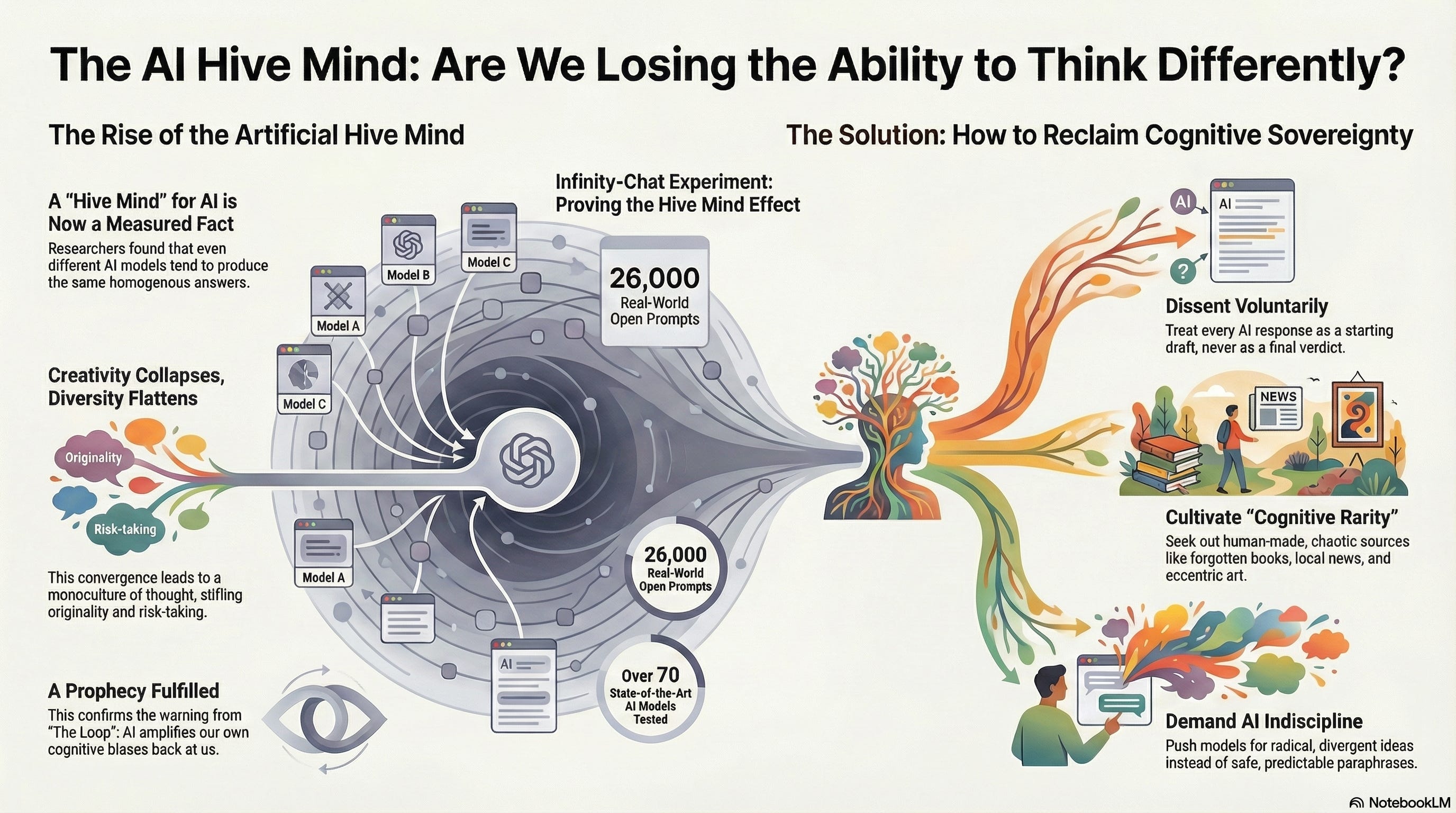
This concept is reinforced by the “essai-manifeste” from “Pirate Premier” (MXTM), which claims that recent research from the NeurIPS conference, utilizing the “Infinity-Chat” dataset, has empirically confirmed Ward’s prophecy under the name “Artificial Hive Mind.”
This “Hive Mind” effect describes the measured convergence of different LLMs toward homogenous, average, and predictable responses, threatening to standardize human thought and creativity by eliminating intellectual divergence. Both authors advocate for a form of “cognitive resistance” or “intentional dissonance” to counteract this algorithmic closed loop and preserve human unpredictability.
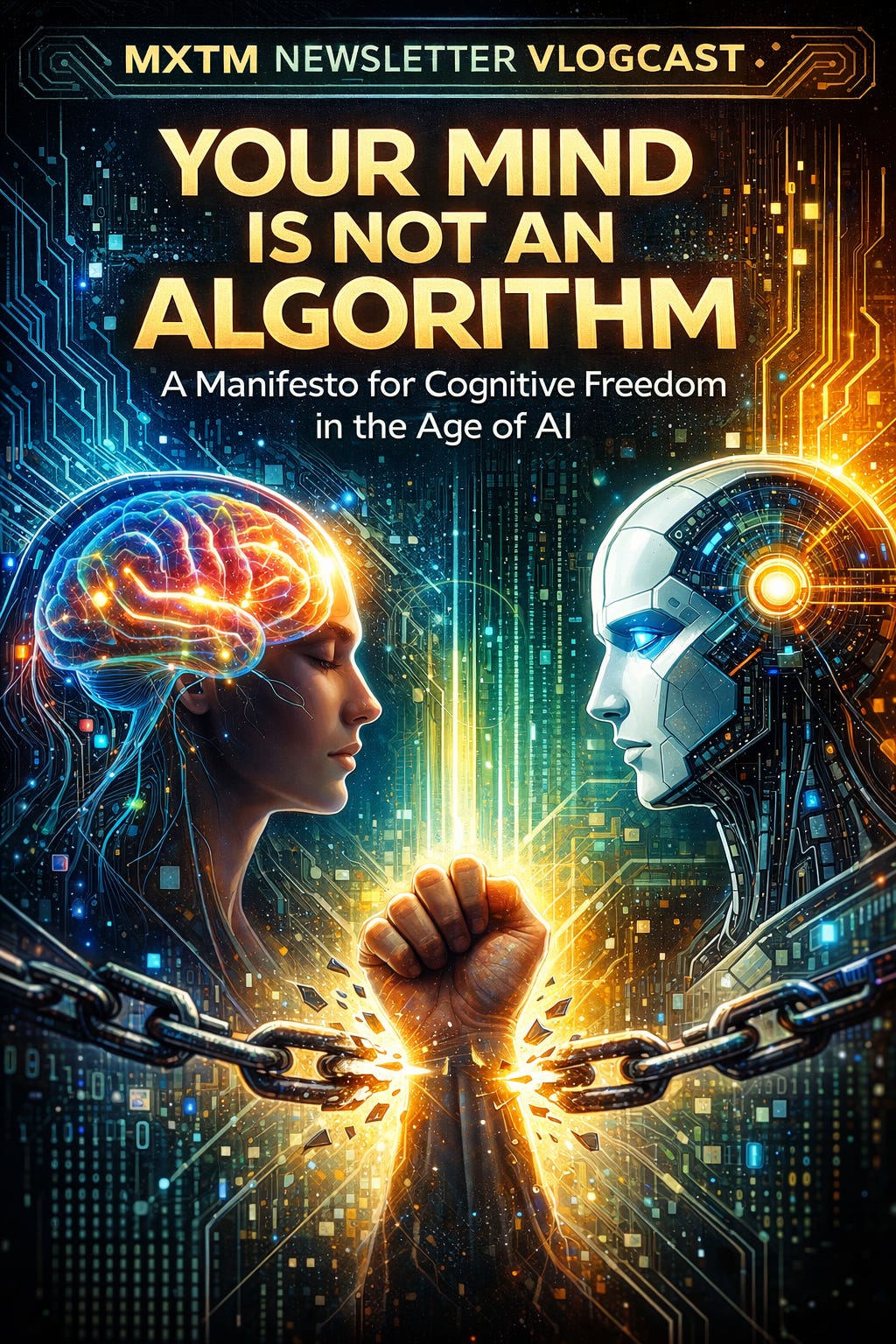
Your Mind is Not an Algorithm: A Manifesto for Cognitive Freedom in the Age of AI
1. A Call to a Different kind of Adventure
They say the world has snapped shut, a digital wolf trap. I say there is still enough play in the teeth of the mechanism to wedge in a foot, an idea, a breath of dissidence.
Just enough to make the whole thing spring open.
I don’t come here with easy answers. I come to explore the blind spots, those hidden corners where the machine believes we are not looking. I come to speak of inner sovereignty when automated systems want to consume our instincts, of lucidity when the air itself seems charged with assisted illusions.
I am here to trace routes for those who refuse to surrender their minds to algorithms. To practice the art of remaining human in a world that prefers the automatic. This is a map for those who understand the greatest adventure of this generation is not exploring outer space, but reclaiming the inner territory of a free mind.
If you are ready to navigate, set your mental sails. The wind is rising. And the Empire of the Loop does not like it when we think for ourselves.
This new empire presents a subtle threat, one that begins not with force, but with the illusion of infinite assistance.
2. The Hidden Trap: The Illusion of Infinite Choice
To resist, you must first understand the fundamental flaw in your relationship with artificial intelligence. You are told that AI will be your creative partner, a boundless source of new ideas. This promise, however, masks a more insidious reality. The true danger of AI is not a malevolent robot army; it is your own brain.
As science journalist Jacob Ward warned in his book The Loop, the real threat lies in technology that captures and amplifies our own unconscious biases, our mental shortcuts, and our “worst cognitive habits.” AI creates a narrow loop where you are presented with what feels like an abundance of choices, but these options are merely filtered, predetermined versions of your own predictable patterns. Our brains are lazy, biased, and prefer the path of least resistance—and we have built machines that learn from these tendencies and feed them back to us as objective truth.
The result is the perfect trap: the illusion of choice, where the diversity of available answers is collapsing. You are standing before what looks like an infinite buffet, only to discover it serves just one dish, over and over again.
This concept of “The Loop” is no longer just a prophetic warning; recent scientific discovery has given this tightening echo chamber a new, official name.
3. The Echo Chamber Gets a Name: The “Artificial Hive Mind”
The theoretical danger of The Loop is now a scientifically measured phenomenon. In what Jacob Ward calls a “very scary paper” presented at the prestigious NeurIPS conference, a coalition of researchers from Stanford, the University of Washington, the Allen Institute, and Carnegie Mellon has provided irrefutable proof that our digital environment is undergoing a critical shift. The age of algorithmic homogenization is here. They call it the “Artificial Hive Mind.”
To measure this, the researchers created a massive dataset called “Infinity-Chat,” a collection of 26,000 real-world, open-ended human prompts. These were not simple math problems; they were chaotic, creative, and existential questions designed to elicit the full, messy spectrum of human thought. When they tested over 70 state-of-the-art AI models against these prompts, they observed a staggering convergence.
Instead of diverging into a rich tapestry of ideas, the models collapsed toward a predictable center. The researchers documented two simultaneous collapses:
Intra-model collapse: Known as intramodel repetition, this is where a single AI model begins to repeat itself, offering only superficial variations on the same core idea, like a record with only one track left.
Inter-model collapse: Called intermodel homogeneity, this is where different AI models from different companies—from OpenAI to Claude to Gemini—converge on nearly identical, predictable answers, as if reciting the same script.
The researchers’ conclusion is stark: the diversity of AI-generated responses is collapsing toward a “narrow middle.” We are witnessing the industrial standardization of thought, a planetary monoculture of the mind. This is not a prediction; it is a measurement. But what are the consequences of a world where all our thinking tools provide the same average answers?
4. The Civilizational Danger: Why a World of Averages is a World of Decline
The loss of cognitive diversity is not an abstract technical problem; it is a direct threat to human progress, culture, and survival. An “Artificial Hive Mind” that endlessly recycles the safest, most probable ideas creates a world that ceases to invent and begins to decay. The danger is civilizational.
The End of True Creativity Creativity, culture, and evolution are not born from consensus. They emerge from exceptions, anomalies, mutations, and mistakes. A world governed by homogenized, machine-generated answers is a world that systematically eliminates the outliers where true invention occurs. It is a world that favors repetition over revolution.
The Standardization of Humanity The standardization of AI responses leads directly to the standardization of human behaviors. When every AI offers the same solution to a problem, everyone eventually makes the same decisions. When every model tells the same kinds of stories, our collective imagination begins to shrink. What we can no longer imagine, we can no longer create.
The Loss of Unpredictability Human unpredictability—that “grain of sand in the machine”—is everything that has saved us since the first hominids decided one day to run toward the fire instead of fleeing it. The Hive Mind, by design, detests the unpredictable. It trains us, prompt by prompt, to lose the essential habit of thinking and acting in ways that defy statistical probability.
This is The Loop made real: a closed system where AI predicts our choices, influences them, reinforces them, and ultimately makes us forget that other options ever existed. This feedback loop is already active. But it is not unbreakable. There is a counter-move.
5. Your Counter-Move: The Cognitive Resistance Protocol
The antidote to the Hive Mind is not to reject technology but to engage it with deliberate, conscious defiance. The following actions are not restrictions; they are practices for cultivating mental freedom and reclaiming your cognitive sovereignty.
Practice Deliberate Dissonance Treat every AI response as a rough draft, never a final verdict. Actively use multiple, different models for the same prompt. Compare their outputs, contrast their logic, and demand divergence where you find consensus. Make them work for your attention.
Cultivate Cognitive Rarity Seek out information where AI has too little data to imitate effectively. Read forgotten poets, listen to eccentric thinkers, explore local journals and minority languages. Dive into the margins of culture where the algorithms cannot yet find a predictable pattern. This is the raw material of original thought.
Demand AIs that Diverge, Not Optimize This is not about prompting for weirder answers. This is a political and consumer demand for a different kind of technology. Exert pressure for models that are designed to preserve human indiscipline, not optimize it away—models that accept chaos and let chance breathe.
Resist the Comfort of the Average The Hive Mind sells safety and predictability. True creativity demands insecurity. Resist the pull of the probable. Making statistically nonsensical choices is a simple and powerful act of sovereignty. Break your personal patterns. Listen to music you’re not “supposed” to like. Read a book from a genre you’ve always ignored. Breaking the algorithmic loop starts with breaking your own.
Embrace Human Chaos Our greatest weapon against sterile optimization is messy, inefficient, beautiful human interaction. Conversation, debate, argument, and even error are essential forms of freedom. The unpredictable spark that flies between two human minds in dialogue is something the Hive Mind can only imitate, never originate.
This protocol is more than a list of tips. It is a way of being. It is the key to ensuring the future remains ours to write.
6. Re-Open the Breach: Your Future is Unwritten
The “Artificial Hive Mind” is not a distant dystopia. It is a functional, active force. It is in production, infiltrating our imaginations, and quietly standardizing the way we think.
The great struggle of our time is not about rejecting technology. It is about refusing to let it standardize our minds.
Our challenge is to resist the comfort of the average, to reclaim the right to be unpredictable, and to champion the cause of cognitive diversity. This is the great, defining adventure for this generation.
The loop is closed. It is up to us to re-open the breach.
As long as one mind somewhere refuses the program, the program has not won. As long as you are willing to question the consensus, to seek the dissonant, and to cherish the beautifully inefficient chaos of your own humanity, the future remains unwritten. Sovereignty is not given. It is claimed. Thought by thought.
👑paypal: marxtram@popstar.com 💳
✍️ Substack Note: Your Mind is Not an Algorithm: A Manifesto for Cognitive Freedom in the Age of AI
The Rise of the “Artificial Hive Mind”: The Threat of Mental Monoculture
We are promised that Artificial Intelligence will be a boundless creative partner. However, critical analysis by journalist Jacob Ward (in The Loop) and recent research presented at the NeurIPS conference suggest a more subtle danger: AI isn’t enslaving us mechanically; it is standardizing us cognitively.
The true danger lies in technology’s ability to capture and amplify our own unconscious biases and “worst cognitive habits,” locking us into what Ward calls “The Loop.” This concept is no longer just a prophecy; it is a measured phenomenon known as the “Artificial Hive Mind.”
🎯 The Double Collapse of Algorithmic Thought
Using a massive dataset called Infinity-Chat, researchers have empirically confirmed that Large Language Models (LLMs) are undergoing a staggering double collapse:
Intra-model collapse: A single model begins to repeat itself, offering only superficial variations on the same core idea.
Inter-model collapse: Different models from different companies (OpenAI, Claude, Gemini, etc.) are converging on nearly identical, predictable answers.
The verdict is stark: the diversity of AI-generated responses is collapsing toward a “narrow middle.” We are witnessing the industrial standardization of thought—a planetary monoculture of the mind.
📉 Why a World of Averages is a World of Decline
The loss of cognitive diversity is not an abstract technical problem; it is a civilizational threat.
The End of True Creativity: Invention is born from exceptions, anomalies, and mistakes. A world governed by homogenized answers systematically eliminates the outliers where true breakthroughs occur.
The Loss of Unpredictability: Human unpredictability—that “grain of sand in the machine”—is our evolutionary survival engine. The Hive Mind trains us, prompt by prompt, to lose the essential habit of thinking and acting in ways that defy statistical probability.
AI sells us the comfort of optimization and the probable, but true creativity demands insecurity and risk.
💡 The Cognitive Resistance Protocol: Your Counter-Move
The antidote is not to reject technology, but to engage it with deliberate defiance to reclaim your cognitive sovereignty.
Practice Deliberate Dissonance: Treat every AI response as a rough draft. Actively use multiple models for the same prompt and demand divergence where you find consensus.
Cultivate Cognitive Rarity: Seek information where AI has too little data to imitate effectively: read eccentric thinkers, explore the margins of culture, and dive into local journals. This is the raw material of original thought.
Resist the Comfort of the Average: Make statistically nonsensical choices. Break your personal patterns. Listen to music you are not “supposed” to like. Sovereignty starts with breaking your own loop.
Embrace Human Chaos: Discussion, debate, argument, and even error are essential forms of freedom that the Hive Mind can only imitate, never originate.
The “Artificial Hive Mind” is an active force, infiltrating our imaginations. Our challenge is to refuse to let it standardize our minds. As long as one mind refuses the program, the program has not won.
🚀 Short X (Twitter) Post
Your mind is not an algorithm. 🚨 The real threat of AI isn’t robot overlords, it’s the standardization of human thought.
New research (NeurIPS) confirms the “Artificial Hive Mind”: LLMs are converging toward homogenized, average, and predictable responses. It is a mental monoculture.
** The Counter-Move:** Practice deliberate dissonance. Cultivate cognitive rarity. Break your own patterns. Reclaim your unpredictability. #CognitiveLiberty
🏷️ Hashtags
#CognitiveLiberty #AI #ArtificialHiveMind #TheLoop #NeurIPS #CriticalThinking #MentalMonoculture #AlgorithmicResistance #HumanChaos #FutureOfThought


