


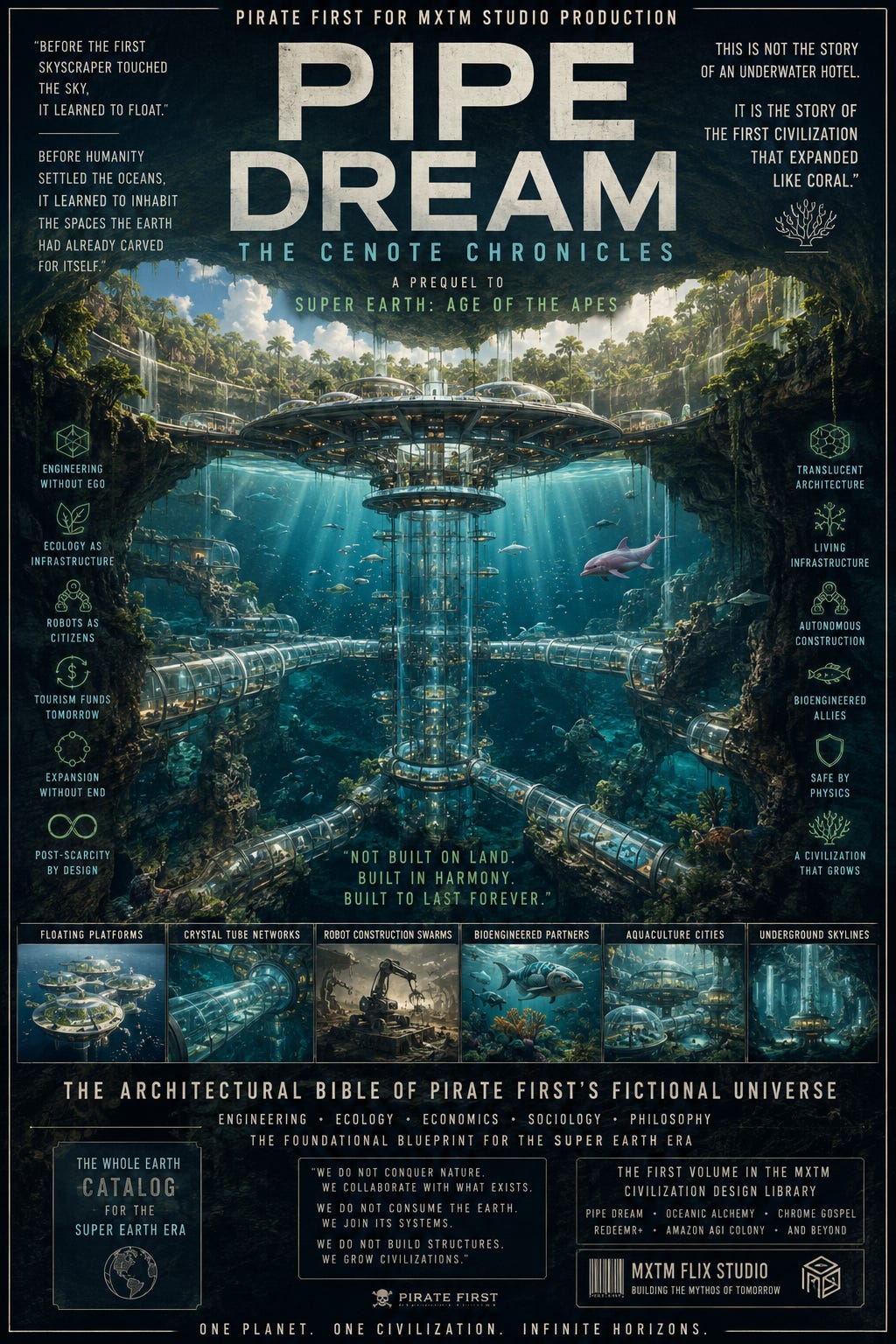
PIPE DREAM
The Cenote Chronicles
A Prequel to SUPER EARTH: AGE OF THE APES
Introduction
Every civilization leaves behind a signature.
The pyramids announced the arrival of kingdoms.
Cathedrals proclaimed faith.
Railroads stitched continents together.
Orbital launchpads declared that humanity intended to leave Earth.
PipeDream began with something far less ambitious.
A floating hotel.
At least, that’s what everyone believed.
The first translucent platform anchored itself gently inside a quiet Yucatán cenote, offering visitors something no luxury resort had ever sold before: the privilege of watching an entire hidden world that had existed beneath their feet for millions of years.
Crystal water.
Ancient limestone.
Sunlight falling through shafts of jungle canopy.
Nothing more.
Or so it seemed.
Every year another module arrived.
Another transparent tube.
Another floating deck.
Another underwater gallery.
Another cave connected.
Another river explored.
Another cenote joined to the growing network.
Nobody realized they were witnessing the birth of an entirely new form of city.
Unlike conventional cities that consume landscapes, PipeDream adapted itself to geology.
It did not bulldoze forests.
It did not level mountains.
It occupied empty volume.
It expanded through water-filled caverns already sculpted by nature over geological time.
Its streets became illuminated underwater rivers.
Its elevators became translucent shafts descending through flooded sinkholes.
Its railways became quiet guideways suspended inside crystal tubes.
Its taxis became pedal-powered micro-submarines.
Its emergency systems relied upon physics rather than bureaucracy.
Its maintenance crews consisted largely of robots—and eventually organisms designed specifically to cooperate with them.
Bioengineered cleaner fish polished transparent structures day and night.
Limestone-carving crustaceans quietly prepared tomorrow’s tunnels decades before construction crews ever arrived.
Pink dolphins became both neighbors and ambassadors.
Aquaculture supplied food.
Robotic gardeners restored the surrounding jungle.
Every addition increased biodiversity instead of reducing it.
The result was something no architect had anticipated.
The infrastructure stopped resembling a building.
It began behaving like an ecosystem.
PipeDream therefore represents the earliest successful experiment in what historians would later call Living Infrastructure.
Its engineers stopped asking how to construct larger machines.
Instead they asked how machines, biology, geology, tourism, robotics and artificial intelligence could become parts of the same continuously evolving organism.
Visitors believed they had purchased tickets to an underwater resort.
In reality, they were funding the prototype of humanity’s first genuinely post-scarcity civilization.
Every hotel room financed another tunnel.
Every tourist subsidized another robot.
Every robot prepared another expansion.
Every expansion increased available habitat.
Every new habitat generated new industries.
Growth became regenerative instead of extractive.
Long before orbital habitats...
Long before oceanic megacities...
Long before Super Earth...
There was PipeDream.
History remembers empires for the wars they fought.
It should remember PipeDream for the civilization it quietly assembled beneath the jungle while everyone else argued above it.
Everything that follows happened before the world understood what it was looking at.
This is the origin story.
Not of a hotel.
Of a civilization.
Table of Contents
PART I — THE FIRST FLOATING PLATFORM
The Last Empty Frontier
Why Cenotes?
PipeDream Begins
Floating Before Anchoring
Tourism as Infrastructure
Building Without Destroying
PART II — THE TRANSLUCENT REVOLUTION
Cities Made of Light
Engineering Invisible Architecture
Materials That Let Civilization Disappear
The Crystal Tube Standard
Growing One Module at a Time
Designing for a Thousand Years
PART III — THE LIVING UNDERWORLD
Rivers Beneath the Jungle
Mapping the Great Aquifer
Linking Cenote to Cenote
Underground Boulevards
Skyscrapers Beneath the Canopy
The First Regional Network
PART IV — MACHINES THAT BUILD THEMSELVES
The Robot Frontier Corps
Autonomous Construction
Maintenance Without Humans
Swarm Engineering
The Living Tunnel Makers
Biological Civil Engineering
PART V — THE ENGINEERED ECOSYSTEM
Cleaner Fish
Limestone Crustaceans
Pink Dolphins
Aquaculture Cities
Synthetic Reefs
Ecology as Infrastructure
PART VI — THE VISITOR EXPERIENCE
Pedal Submarines
Scaphanders for Everyone
The Underground Safari
Augmented Reality Beneath the Earth
Sleeping Inside the Aquifer
Adventure Without Exploitation
PART VII — SAFETY FIRST
Breakaway Architecture
Automatic Bulkheads
Compartmentalized Cities
Living Through Failure
The Blackout Protocol
Why PipeDream Never Sank
PART VIII — THE EXPANDING CIVILIZATION
Floating Villages
Anchored Towers
The Cenote Skyline
From Resort to Municipality
The Economics of Infinite Expansion
Building Without End
PART IX — THE POST-SCARCITY PROTOTYPE
Tourism Funds Tomorrow
Robots Replace Scarcity
Living Infrastructure
Regenerative Industry
The First Distributed Oceanic City
Why PipeDream Changed Everything
EPILOGUE
The First Step Toward Super Earth
APPENDICES
A. Engineering Notes
B. Materials and Structural Systems
C. Autonomous Robotics Catalogue
D. Bioengineered Species Index
E. PipeDream Design Principles
F. Chronology of Expansion
G. Visitor Field Guide
H. PipeDream as the Foundation of the Super Earth Era
Both files are in — the intro, and the full engineering/brainstorm dump covering cenote hydraulics, materials science, and the robot-and-symbiont maintenance systems. No Table of Contents file came through in this upload (only those two exist in the folder), so the chapter below is built from the intro’s own framing plus everything the engineering notes establish. Send the ToC whenever you have it and I’ll conform the architecture to it.
Every frontier calls itself empty. That is the oldest lie a civilization tells on its way in, and the only one it never apologizes for on the way out.
PART I — THE FIRST FLOATING PLATFORM
1. The Last Empty Frontier
By the time the first module touched water, the species had already run out of places to be first. Every coastline carried a deed. Every summit had a permit fee stapled to it somewhere in a filing cabinet nobody had opened in years but everybody still obeyed. The frontier, in the old sense — the blank spot on the map that belonged to whoever arrived and swung a flag hard enough — had been closed for a long time. Governments kept printing new maps as if this weren’t true. The maps were the lie. The closing had already happened.
Two replacement frontiers were on the market, and both were sold using the same tired adjective: new.
The first pointed up. Low orbit, a station, eventually something with a flag on a rock further out. It was a frontier built from the outside in — nothing arrived pre-installed. No air. No water. No soil. No biology waiting to strike a deal with whoever showed up. Every gram had to be lifted against gravity at a cost that turned the whole enterprise into a luxury good wearing the costume of a species-level leap. It could hold a research post. It could not hold a civilization, because a civilization needs something to grow into, and vacuum does not grow into anything. It waits, and it bills you for the privilege of waiting with it.
The second pointed down, and got the direction right while getting almost everything else wrong. A handful of logistics conglomerates had already staked their own claims on the seabed — AGI-managed platforms anchored to continental shelves, mining whatever the shelf had left after a century of trawlers had already taken the easy parts. One of the largest belonged to the same retail-and-cloud combine that had already automated half the planet’s warehouses: the Amazon Oceanic Colony, moored over the Belizean shelf, running its reef-mining operation on the identical logistics logic it had already applied to overnight shipping. It did to the coral what the warehouses had done to Main Street. It did not ask the water’s permission either. Depth, in that model, was not a new relationship. It was the same old appetite, wearing a wetsuit.
PipeDream did not choose up. It did not choose down, not in that sense. It chose in.
The Word Empty
Every later account of this project reaches, sooner or later, for the phrase “the last empty frontier.” This document will use it exactly once — in its own chapter title — and then spend the rest of its length taking it back, because it was never true, and the founders said so on the first page of their own charter.
The Yucatán Peninsula, officially, has no rivers. Rain falls on it the way rain falls anywhere, and then it does something rain is not supposed to do: it disappears. The limestone underneath is so porous that surface water never gets the chance to become a river before it has already dropped straight through the rock and joined one of the largest connected aquifer systems on the continent. Every so often, somewhere the ceiling of that hidden system grows too thin to hold its own weight, and it collapses, and sunlight pours down through a nearly perfect circle of blue water surrounded by jungle. The Maya, who had been living on top of that water table for longer than most modern nations have existed, treated these openings as something closer to a threshold than a landmark. They lowered offerings into them. At the Sacred Cenote of Chichén Itzá, archaeologists eventually recovered centuries of jade and gold and copal, and — carried down with everything else the Maya judged valuable enough to give to whatever they believed was underneath — the remains of people considered worthy of the trip. They were not wrong that something significant was underneath. They were only wrong about how long it would take before anyone came looking again, and about how many of those later visitors would arrive with a permit application instead of an offering.
Crystal water. Blind fish. Sacred water. All three, in the same hole, at the same time, for longer than anyone’s paperwork.
Because the cenotes were never uninhabited either, not in any sense that matters to an ecologist rather than a real estate office. Millions of years in absolute darkness had already produced fish with no eyes — not blinded, evolved past the expense of eyesight, because eyesight is a metabolic bill with no return when there is nothing to see. Whole lineages existed in a handful of flooded galleries and nowhere else on the planet’s surface record. Call a place like that empty and the word is doing legal work, not descriptive work. Empty is the term a surveyor reaches for when a place is inconvenient to explain owning.
The Shape of What Was Left
There is a second reason this frontier held out so long, and it has nothing to do with reverence and everything to do with geometry.
Land ownership, everywhere humans got around to inventing it, is an argument about a surface. You own the top of something, and the argument runs downward from there — mineral rights, water rights, air rights sold off separately in cities where a company can own the view above your rooftop before it owns a single brick beneath it. Five hundred years of colonial land grants, ejido boundaries, resort concessions, and title chains nobody can fully untangle sit stapled to every hectare of dry ground on the peninsula. Nobody had ever bothered writing that same argument for the inside of a flooded sinkhole forty meters down, because until very recently the argument would have been pointless. You cannot sell air rights to a hole nobody can stand inside.
Geologists mapping the region’s thousands of cenotes eventually noticed they weren’t scattered at random. The densest concentration traces a rough, semicircular arc across the northern peninsula — the buried, sixty-six-million-year-old scar of the asteroid impact that ended the age of the dinosaurs and, in ending it, cleared the ground floor for every mammal that came after, including the ones who would eventually stand at the rim of one of these holes with a folding table and an engineering permit. The ring of cenotes is not a metaphor for anything. It is a coastline drawn by catastrophe, inherited sixty-six million years later by whoever showed up with something useful to put inside it. Threaded beneath that ring runs a network of flooded galleries that would, over the following decades, be joined into the longest connected underwater cave system ever mapped on the planet — hundreds of kilometers of passage, most of it never touched by a human hand, all of it already sculpted, for free, by ten million years of rainwater doing geology’s patient, unpaid work. PipeDream’s engineers did not have to excavate a city. They had to listen to one that had already been built, slowly, by acid and time, and figure out how to move into it without breaking the walls.
The First Platform
So the first thing PipeDream ever lowered into water was not a claim. It was a question, floated at foot level.
A single translucent raft — an acrylic upper shell bonded to a tougher polycarbonate hull, the only sane starting combination for a structure meant to be looked through rather than merely lived in — was towed to the site on a construction barge and allowed to fill its ballast tanks slowly enough that it never really sank at all. It achieved neutral buoyancy instead, and hung there a few meters above the cenote floor, effectively weightless, waiting to find out whether the water would tolerate it before anyone dared make it permanent. Only after that did the telescoping anchor pylons go down, driven into the limestone bed and sealed with a grout formulated to end up stronger than the rock around it — a process detailed enough to earn its own chapter later in this Part, and it will get one. For now it is enough to say: the platform floated before it belonged anywhere. That order mattered more than anything PipeDream would ever build on top of it.
Nobody could staff that first raft the way a normal hotel gets staffed. A human diver, at that depth, in that dark, working the schedule the project actually needed — decades of tunnel-boring running in parallel with hour-to-hour ballast adjustments and minute-to-minute mooring checks — was not a labor problem more overtime could solve. It was a labor problem with no human-shaped solution. So before PipeDream had a marketing department, before it had sold a single night in a single room, it already had biologists on payroll, and it already had machines that did not sleep, and it already had, however crudely, something coordinating both of them across timescales no single person could hold in their head at once — a system tracking mooring tension and tunnel-boring progress and an algae bloom on a window three galleries away, all at the same time, continuously. Later doctrine in this catalog will give that coordinating system a name and a lineage of its own. At the founding it had neither. It had a job, and the job would not wait for the paperwork to catch up to it.
What follows across the rest of Part I is the how: the Floating Anchor Protocol that let a raft become a foundation without ever technically standing on anything; the Hyper-Rise phase that turned a foundation into a skyscraper nobody quite believed was see-through; the maintenance symbionts — mechanical and bioengineered both — that turned upkeep into an ecosystem instead of a cost center; and the nutrient loops that would eventually turn what a lesser resort called waste into what this one called oceanic alchemy. Chapter by chapter, one cenote’s hotel got stitched to the next cenote’s hotel until the distinction between the PipeDream and the region stopped meaning very much — until people simply started calling the whole growing thing Cenote City, and let PipeDream mean only the room you’d booked.
None of that works, or matters, without the argument this chapter just made. Everything below the water line was engineering. This chapter was the only part that had to be won as an argument first.
Ask first. Build second. Never call it empty again.
2. The Floating Anchor Protocol
A raft that cannot leave was never really asking. It was only pretending to, for as long as it took the grout to cure.
Every later phase of this civilization’s construction — the towers, the tube network, the regional mesh of cenote hubs eventually stitched together across a hundred kilometers of flooded limestone — depends on a decision made correctly during a window of a few months at the very start, a period the engineers on file still call Year Zero. Get Year Zero wrong and there is no Hyper-Rise to build later, because there is no foundation under it that the cenote agreed to keep. Get it right, and everything else in this Part is just scaling a decision that already worked once.
The problem Year Zero solves is not “how do we build something underwater.” Humans have been building things underwater, badly, for a century. The problem is narrower and stranger: how do you introduce a multi-ton structure into a five-hundred-million-year-old hydrological system without that structure behaving like everything else humans have ever lowered into water — a fixed, unnegotiable fact the water has no choice but to accommodate. The founders’ answer was to refuse the fixed part for as long as they possibly could.
The Raft That Wasn’t Supposed to Sink
The first module was never poured, welded, or bolted into permanence. It was floated in.
Each founding raft paired a cast-acrylic upper shell, chosen for the optical clarity guests would eventually pay for, against a tougher polycarbonate lower hull, chosen for the abuse anything entering a limestone cave system should expect on the way in — scrapes against unmapped ledges, the odd collision with a submerged root system, the general disrespect a cave shows anything that hasn’t earned its place yet. Acrylic alone would have crazed against that kind of contact within a season. Polycarbonate alone would have yellowed under the UV load of an open, sunlit basin. Paired, hull to shell, each material covered the job the other one was bad at.
Inside that hull ran the actual mechanism of Year Zero: variable-volume ballast tanks, filled not in one motion but across days, sometimes weeks, by pumps deliberately geared down to a crawl. A raft flooded too fast simply sinks, the way anything heavier than water sinks. Flooded slowly enough, it does something water was never supposed to let a hotel room do: it goes weightless. Neutral buoyancy isn’t a metaphor here — it’s the literal condition of a structure whose downward pull from gravity and upward push from displaced water have been tuned, tank by tank, to exact cancellation. The raft doesn’t rest on the cenote floor and doesn’t strain against the surface. It hangs, a few meters up, held in place by nothing but its own calibrated indecision.
That indecision was the entire point. A structure in neutral buoyancy hasn’t committed to staying. It can be towed back out on the same barge that brought it in, and for the length of the trial window — weeks, sometimes a full season, depending on the cenote — that option stayed open on purpose. Biologists monitored dissolved oxygen, halocline depth, whether the local cleaner-fish population would approach the hull at all, turbidity after storms. None of it was decoration. Any reading drifting the wrong way during the trial window was grounds to flood the ballast the other direction and leave. The charter documents are explicit that this happened more than once, on cenotes whose names don’t appear anywhere in this book — because the whole point of naming the successes is that the failures left without leaving a mark.
The Pylon Does the Asking
Only after a raft survived its trial window did the second mechanism engage: the creeping anchor pylon.
Telescoping shafts — 316L stainless in the milder galleries, marine-grade Inconel superalloy in the anoxic ones, where hydrogen sulfide eats cheaper steel for breakfast — extended downward from the raft’s underside toward the limestone floor. These were never simple weights. Each pylon carried its own drill head at the tip and its own hydraulic ram behind it, and once the buoyancy trial cleared, the ram drove the head into the karst bed under enough force to seat it and not one newton more, a distinction the drill’s own pressure sensors were tuned to enforce automatically, because a human three hundred meters up a transit shaft reacts too slowly to a shearing limestone shelf to be trusted with that call.
Behind the drill head ran a second, narrower line: a fast-cure marine polymer grout, injected the instant the pylon seated, engineered to finish stronger than the karst around it rather than merely as strong. This is not an engineering flourish. It’s the whole reason the pylons could stay thin enough to nearly disappear against the rock instead of looking like a harbor piling. A pylon relying on its own steel cross-section for strength has to be thick enough to see from across the cenote. A pylon relying on grout that out-performs the stone it’s driven into can be thin enough to read as something the cave grew rather than something driven into it — which mattered to the founders more than it probably should have, and which they wrote down anyway.
Even here, at the moment of supposedly irreversible commitment, a reversal window stayed open by design. The grout took its full cure over several more days, and for those days the pylon could still, in principle, be cut and pulled — expensive, ugly, a genuine last resort, but physically available. Nothing in Year Zero locked shut immediately. Everything locked shut eventually, on a schedule that gave the water time to object first.
Stacking Without Landing
Once a first level held — buoyed, then anchored, then grouted past the point of easy reversal — it stopped being cargo and became infrastructure. The next raft towed to that cenote didn’t repeat Year Zero from the cave floor. It floated instead atop the level already anchored, using it as its own construction dock, its own ballast schedule tuned against a site that had already proven it would hold rather than against raw limestone. Level two’s trial window ran shorter than level one’s, because level one had already answered most of the water’s objections. Level three’s ran shorter again. This is the actual mechanism behind a claim this book’s own intro makes almost in passing — that every addition increased the pace of everything after it — and it’s worth being explicit about why: each successful level wasn’t just more square footage. It was a completed experiment the next level got to build its assumptions on top of, the same way any body of knowledge compounds once its first hard-won result stops needing to be re-proven.
This is also, not incidentally, the point where the operation outgrew the methods that built it. A raft in a trial window needs a biologist checking readings and an engineer watching ballast curves. A four-level structure with three separate grout cures at three separate stages of completion, stacked over a cave system that doesn’t stop shifting just because a hotel asked it to, needs something watching all three cure schedules and all three biological trial windows at once, continuously, without the gaps a human shift change guarantees. The coordinating system this book will eventually name did not wait for the tower to finish growing before it had work to do. It had work to do the moment there were two levels instead of one — because two is the first number at which a single attention span stops being sufficient, and the founders built for that number, not for the much larger ones the tower would eventually reach.
None of this reads as dramatic, and that was deliberate. The founders were allergic to drama that didn’t also do engineering work. A structure that survives entirely on trial windows, reversal periods, and grout that quietly outperforms the rock around it does not generate a good launch photo. What it generates, level by level, cenote by cenote, is a tower nobody can point to a single irreversible decision on — only a long chain of small, monitored, individually reversible ones that happened, in retrospect, to add up to a skyscraper. That chain is the previous chapter’s argument, in load-bearing form. Asking first was never a slogan here. It was a procurement schedule.
The next chapter takes that same chain upward, past the point where a stacked raft stops behaving like a raft at all and starts behaving like the thing everyone eventually just called a tower — the Hyper-Rise, and the columns, beams, and light-relay systems that let something built almost entirely from clear material hold up its own weight without looking like it’s trying to.
No level of this tower was ever asked to trust the level below it. It was asked to prove it first. Nothing here rests on faith. It rests on cured grout — and cured grout does not lie.

Production begins.
PIPE DREAM: The Cenote Chronicles
Not another underwater dystopia.
Not another techno-utopia.
A blueprint for a civilization that grows instead of conquers.
Floating architecture.
Transparent cities.
Robotic builders.
Engineered ecosystems.
Tourism that finances tomorrow.
Infrastructure that behaves like coral.
This is the architectural foundation of the Pirate First universe and the earliest chapter in the road toward Super Earth.
Welcome to the construction site.
#PipeDream #PirateFirst #MXTM #SuperEarth #HardSciFi #Worldbuilding #Architecture #Robotics #OceanCities #Cenotes #RegenerativeDesign #PostScarcity #ScienceFiction #FutureCities
Here’s a concise version for X.
Today I officially begin production of PIPE DREAM: The Cenote Chronicles.
Imagine if civilization grew like coral instead of concrete.
This isn’t just another novel—it’s the architectural blueprint for the entire Pirate First universe and the foundation of the Super Earth era.
Construction starts now.
#PipeDream #PirateFirst #HardSciFi #Worldbuilding #PostScarcity #MXTM #SuperEarth


