


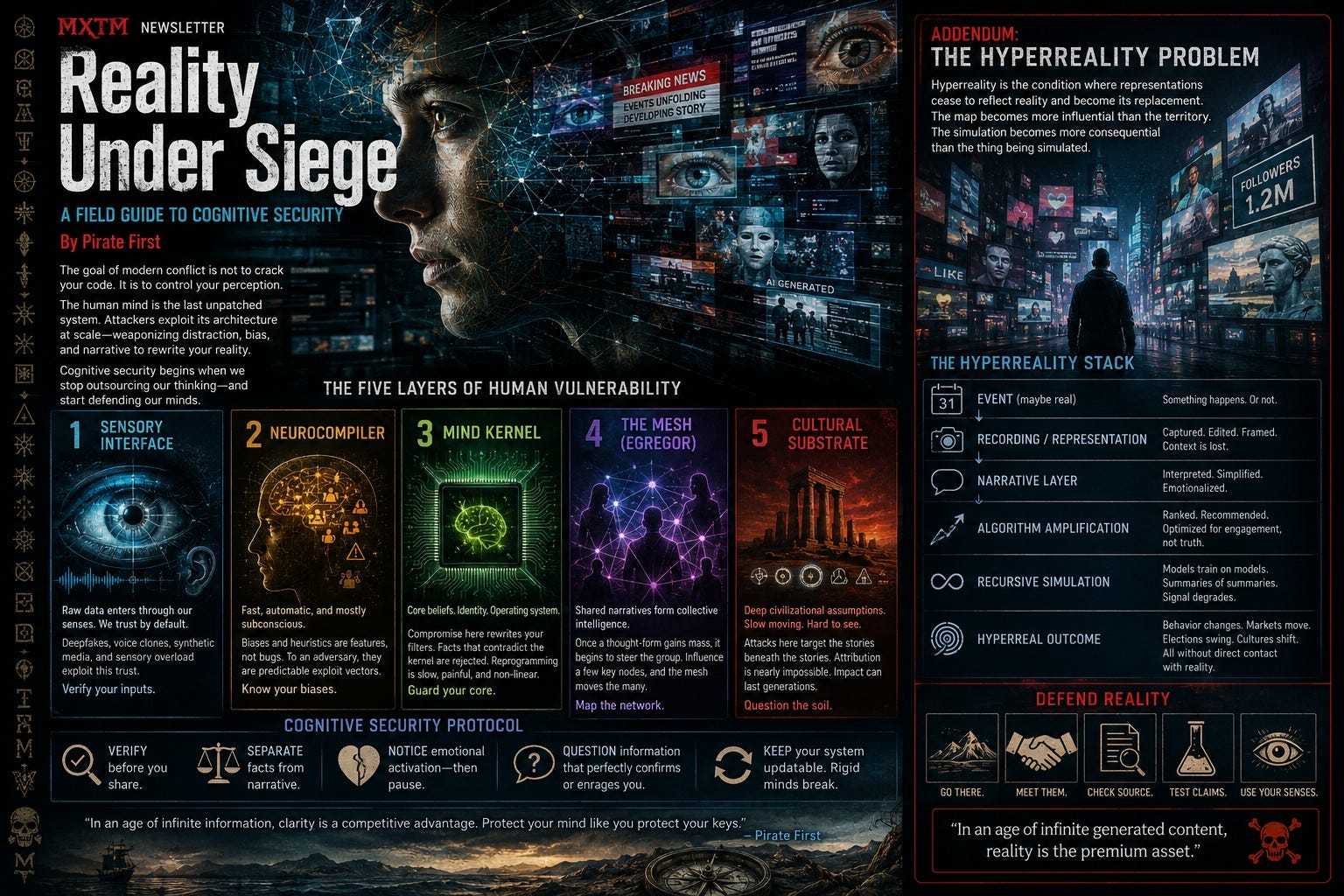
By Pirate First
For the MXTM’s Newsletter
For years we were told that cybersecurity was about protecting computers.
Then we were told it was about protecting networks.
Then cloud infrastructure.
Then AI models.
But the most valuable attack surface was never silicon.
It was you.
The modern threat landscape no longer revolves around stealing passwords, encrypting hard drives, or hijacking servers. Those remain important, but they are increasingly secondary objectives. The primary target has become human perception itself.
The objective is not to hack your machine.
The objective is to influence the operator.
What we are witnessing is the emergence of a new domain of conflict: cognitive security.
Most readers understand phishing. Someone tricks you into clicking a malicious link. The attacker gains access.
Now imagine a phishing campaign that doesn’t seek your credentials.
Imagine one that seeks your beliefs.
Imagine an operation designed not to steal your bank account but to alter your model of reality.
That is a far more dangerous compromise.
Because unlike a password, beliefs cannot simply be reset.
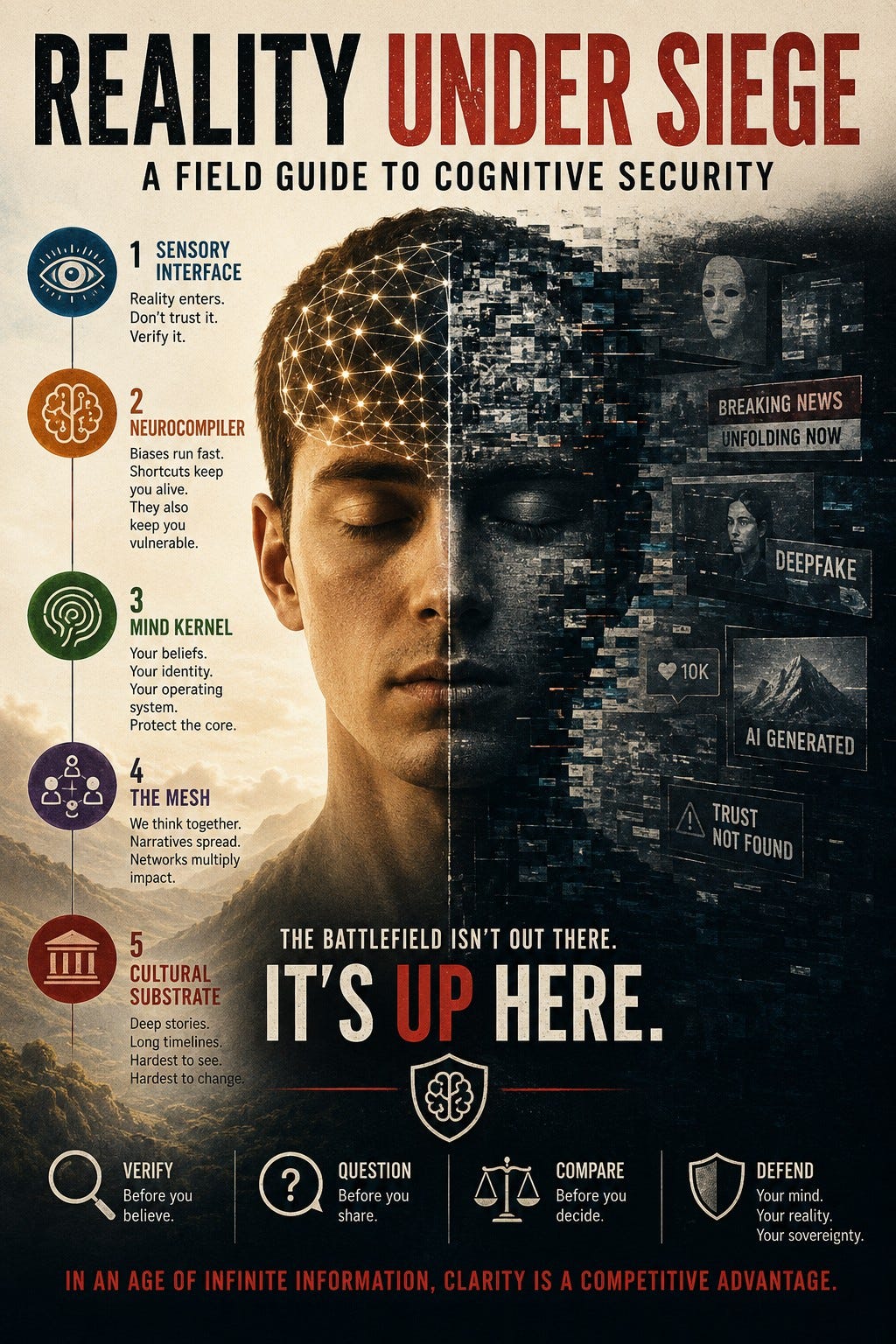
The Five Layers of Human Vulnerability
Think of your mind as a biological computer running on millions of years of evolutionary legacy code.
Like any complex system, it contains multiple layers.
Layer One: The Sensory Interface
Every perception begins here.
Your eyes.
Your ears.
Your nervous system.
For most of human history, sensory input was relatively trustworthy.
A voice was attached to a real person.
A photograph represented something that actually existed.
A witness account came from a witness.
Those assumptions are evaporating.
Today a convincing voice clone can be generated in minutes.
Synthetic video can place words into mouths that never spoke them.
AI-generated imagery can manufacture entire events that never occurred.
The problem is not that humans are stupid.
The problem is that human perception evolved for physical reality rather than synthetic reality.
We inherited hardware optimized for detecting predators in tall grass, not generative adversarial networks.
The consequence is obvious.
The sensory layer can no longer be trusted automatically.
Verification must now become a deliberate practice.
Layer Two: The Neurocompiler
Raw sensory information is useless until interpreted.
This interpretation happens largely outside conscious awareness.
Your brain continuously compresses reality into workable shortcuts.
These shortcuts are called heuristics.
They save energy.
They save time.
They keep us alive.
They also create vulnerabilities.
Confirmation bias.
Authority bias.
Social proof.
Fear responses.
Identity protection.
Narrative attraction.
These are not flaws.
They are features.
Unfortunately every feature becomes an exploit once sufficiently understood.
What previous generations called propaganda was often crude and imprecise.
Today’s persuasion systems are increasingly personalized.
Machine learning allows messages to be adapted, tested, refined, and redeployed at unprecedented scale.
The result is not mass persuasion.
The result is precision persuasion.
Every individual can receive a different version of reality.
Layer Three: The Mind Kernel
Beneath opinions lie deeper structures.
Identity.
Worldview.
Core assumptions.
Moral frameworks.
This is the kernel layer.
Compromise here is profoundly different from ordinary misinformation.
At this depth, people no longer merely believe false things.
They begin filtering reality through altered operating instructions.
Facts cease functioning as corrective mechanisms.
Contradictory evidence is reinterpreted as proof of persecution.
Counterarguments become validation.
The system develops self-protective feedback loops.
This phenomenon appears across political movements, religious movements, financial cults, conspiracy communities, corporate ideologies, and institutional orthodoxies.
No tribe is immune.
The dangerous question is not:
“Can other people be manipulated?”
The dangerous question is:
“Under what circumstances could I be manipulated?”
That question has far fewer volunteers.
Layer Four: The Mesh
Humans do not think alone.
We think together.
Networks of individuals create larger cognitive structures.
Shared narratives.
Shared assumptions.
Shared emotional states.
Shared enemies.
Shared dreams.
Once established, these structures develop momentum.
The group begins influencing the individual as much as the individual influences the group.
A narrative becomes self-sustaining.
At that point only a handful of influential nodes may need manipulation to shift an entire ecosystem.
This dynamic existed long before the internet.
The internet simply accelerated it.
Social platforms, recommendation engines, influencer economies, and AI-generated content have dramatically increased the speed at which collective belief systems can emerge, mutate, and spread.
The challenge for citizens is no longer information scarcity.
It is narrative abundance.
We are drowning in competing realities.
Layer Five: Cultural Bedrock
The deepest layer is rarely discussed because it is largely invisible.
Every civilization rests upon assumptions so fundamental that they are mistaken for natural law.
Economic assumptions.
Political assumptions.
Technological assumptions.
Historical assumptions.
Assumptions about human nature itself.
These frameworks determine which futures appear possible and which appear absurd.
Because they operate beneath conscious awareness, they are extraordinarily difficult to examine.
Yet they shape entire generations.
When change occurs at this level, societies can transform without fully understanding why.
History is littered with examples.
Entire populations once considered monarchy inevitable.
Others considered slavery inevitable.
Others believed industrial growth was limitless.
Others believed nuclear war was unavoidable.
Each era mistakes its own operating assumptions for reality.
Then history rewrites the source code.
The New Information Battlefield
The most unsettling realization is that nobody needs complete control.
An attacker does not need to convince everyone.
They only need to create enough uncertainty that consensus becomes impossible.
Enough confusion that trust collapses.
Enough noise that signal disappears.
In such an environment, paralysis becomes the product.
Citizens lose confidence in institutions.
Institutions lose confidence in citizens.
Experts lose credibility.
Amateurs gain audiences.
Truth competes with performance.
Reality competes with engagement metrics.
The battlefield becomes self-sustaining.
The Cognitive Security Protocol
The solution is not paranoia.
Paranoia is merely another exploit.
The solution is disciplined skepticism.
Verify before sharing.
Distinguish evidence from narrative.
Separate emotional activation from factual verification.
Question information that perfectly confirms your worldview.
Question information that perfectly enrages you.
Question information that arrives pre-packaged with instructions about who must be hated.
Most importantly, maintain the ability to update your beliefs.
A system incapable of revision is not strong.
It is brittle.
The strongest minds are not those that never change.
They are those that can change without breaking.
The future will belong to populations capable of defending not only their infrastructure, their economies, and their institutions, but also the integrity of their perception.
The next generation of security is not cybersecurity.
It is reality security.
And unlike firewalls, encryption, or access controls, this defense begins inside the skull of every citizen.
Including yours.
Addendum: The Hyperreality Problem
Longtime readers of MXTM will recognize that cognitive security does not end with propaganda, misinformation, or even synthetic media.
The deeper threat is hyperreality.
The French philosopher Jean Baudrillard described a condition in which representations cease to reflect reality and instead become reality’s replacement. The map becomes more influential than the territory. The simulation becomes more consequential than the thing being simulated.
When Baudrillard was writing, this seemed abstract.
Today it feels operational.
Social media profiles have become more economically valuable than the humans behind them.
Political narratives often exert greater force than observable events.
Brands possess identities that exist independently of their products.
Financial markets react to expectations of expectations rather than underlying fundamentals.
Increasingly, we inhabit environments where symbols interact primarily with other symbols.
Reality itself becomes a secondary input.
Artificial intelligence dramatically accelerates this process.
A language model does not experience reality.
It experiences representations of reality.
An image model does not know what a mountain is.
It knows statistical relationships between images labeled “mountain.”
As synthetic systems proliferate, we are constructing vast informational ecosystems populated by entities whose understanding of the world is derived entirely from prior representations.
The result is recursive simulation.
A model trains on content generated by previous models.
A journalist summarizes a social media reaction to an AI-generated event.
Another AI summarizes the journalist’s summary.
Investors react to the AI summary.
Algorithms amplify the investor reaction.
The feedback loop closes.
At no point is direct contact with reality guaranteed.
This is the true cognitive-security challenge of the twenty-first century.
Not merely deception.
Substitution.
The replacement of direct observation with infinitely circulating representations.
The replacement of experience with feeds.
The replacement of territory with maps.
The replacement of reality with engagement.
This is why sovereignty increasingly begins with first-hand verification.
Visit the place.
Meet the person.
Inspect the source.
Test the claim.
Measure the phenomenon.
Observe with your own senses whenever possible.
The future may belong to artificial minds, digital twins, autonomous agents, and machine-mediated civilization. MXTM has long argued that such a future is not only possible but likely.
Yet the value of reality itself rises as simulation becomes abundant.
When synthetic worlds become effectively free, genuine observation becomes a scarce resource.
In an age of infinite generated content, reality becomes the premium asset.
The citizen capable of distinguishing territory from map may become as strategically important as the engineer capable of building the map in the first place.
Hyperreality is not merely a philosophical curiosity.
It is becoming critical infrastructure.
And critical infrastructure requires defense.
Parting words; hyperreality is no longer just a cultural phenomenon. It is becoming an economic one. Profiles, reputations, recommendation systems, AI-generated identities, digital twins, agent swarms, and algorithmic trust scores are all forms of tradable hyperreal capital. Increasingly, institutions are interacting not with humans, but with simulations of humans. That may be the next battlefield in cognitive security: not defending minds from false realities, but defending reality from increasingly persuasive minds that never existed.
#PirateFirst

VjTsuZik 3 minutes ago
Reality Under Siege (V2)
https://www.flowmusic.app/song/7c211a54-070b-4ad4-80fc-670fa914d9e2
The next battlefield isn’t cyberspace.
It’s perception.
As AI-generated media, algorithmic narratives, and synthetic identities proliferate, the challenge is no longer separating truth from lies.
It’s separating reality from increasingly convincing simulations.
In an age of infinite generated content, reality becomes the premium asset.
New on MXTM:
Reality Under Siege: A Field Guide to Cognitive Security
#PirateFirst
Reality isn’t disappearing.
It’s being outcompeted.
The human mind evolved to navigate forests, oceans, and tribal politics—not deepfakes, recommendation engines, and AI-generated consensus.
Protect your devices.
Protect your data.
But most importantly, protect your perception.
Reality Under Siege is now live on MXTM.
#MXTM #PirateFirst #CognitiveSecurity #RealityUnderSiege #Hyperreality #DigitalSovereignty #InformationWarfare #NarrativeWarfare #MediaLiteracy #CriticalThinking #AISafety #AgenticAI #SyntheticMedia #Deepfakes #Infocalypse #FutureStudies #CyberCulture #DigitalTwins #Decentralization #TruthEconomy #SignalVsNoise #AttentionEconomy #CognitiveLiberty #OpenSourceIntelligence #RealitySecurity #HumanAgency #PostCorporate #TechnoPolitics #Cyberpunk #FutureOfHumanity


