


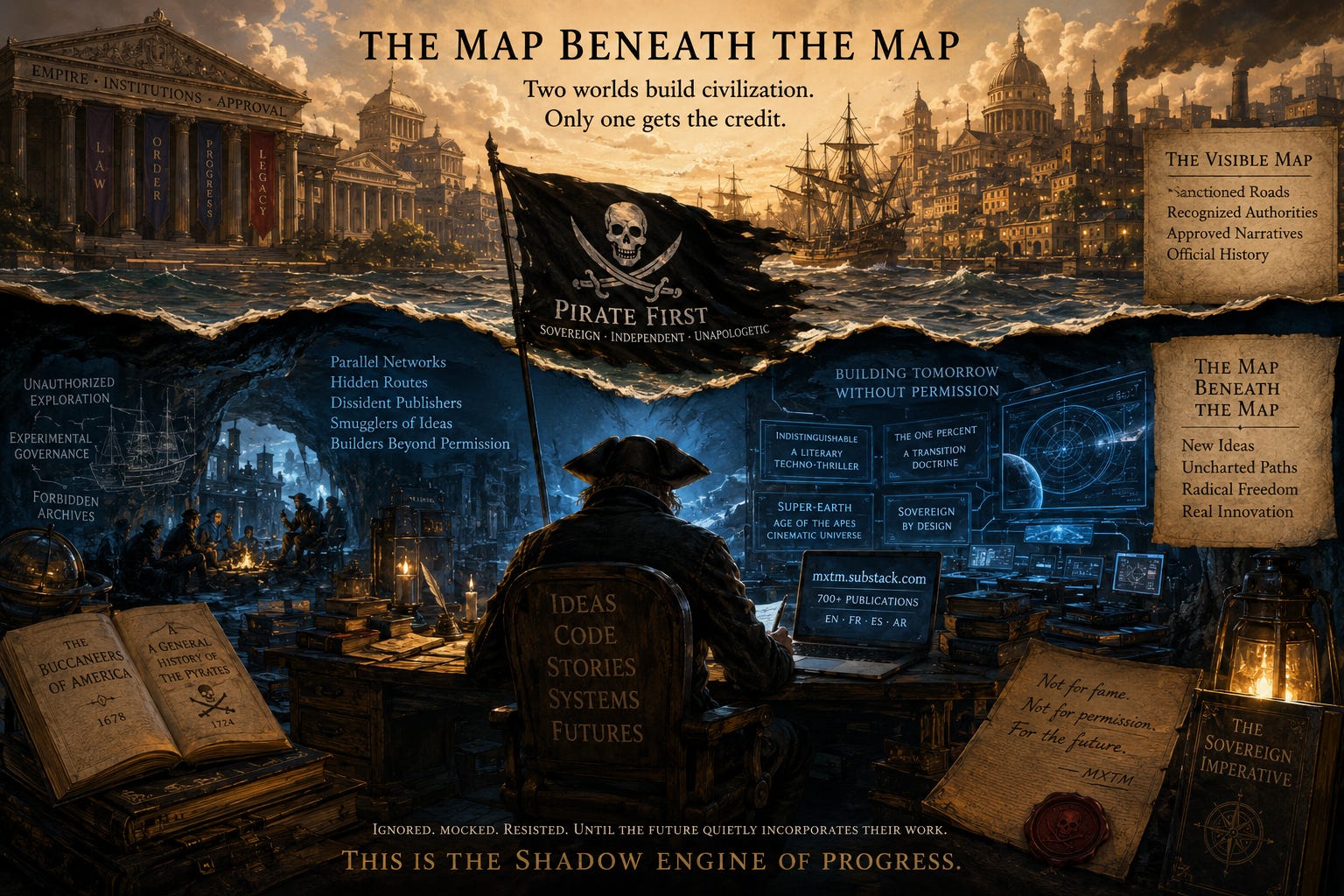
Introduction
Most people misunderstand piracy because they begin with the wrong question.
They ask whether pirates were criminals.
History asks a different question: What happened after they arrived?
The answer is uncomfortable. Ports appeared where none existed. Trade routes emerged beyond official control. New ideas crossed borders that empires had carefully sealed shut. Wealth moved. Knowledge moved. Entire civilizations quietly absorbed innovations developed by people they publicly condemned.
The official record remembers governors, admirals, universities, corporations, and states. It remembers the institutions that survived long enough to write their own history. What it often forgets are the unauthorized actors who explored the territory first, tested the impossible first, and accepted risks respectable society would not touch.
The frontier always has two maps.
There is the map everyone can see: the sanctioned roads, recognized authorities, approved channels of exchange, and accepted narratives.
Then there is the map beneath the map: the informal networks, hidden routes, experimental communities, dissident publishers, smugglers of ideas, and builders operating beyond institutional permission.
Civilizations are built by both.
This essay examines one such case.
It argues that the body of work produced under the Pirate First imprint and the broader MXTM archive should not be understood merely as independent publishing, speculative fiction, civic experimentation, or technological advocacy. It should be understood as participation in a much older tradition: the creation of parallel infrastructure by people unwilling to wait for institutional approval before beginning the work.
The comparison is not intended as romance. Pirates were often violent, contradictory, and deeply flawed human beings. Yet they were also innovators of governance, logistics, communication, and social organization whose influence extended far beyond the decks of their ships. The world that followed them inherited more from them than it is comfortable admitting.
The same pattern repeats whenever established systems become too rigid to solve emerging problems. New actors appear at the margins. They build alternative pathways. They publish outside official channels. They experiment where institutions hesitate. They are ignored, mocked, resisted, or criminalized—until the future quietly incorporates their work.
Whether one agrees with every conclusion, doctrine, proposal, or fictional universe contained within the MXTM corpus is ultimately beside the point.
The question is whether sovereign intellectual production still matters in an age increasingly mediated by algorithms, platforms, and artificial intelligence.
The pages that follow answer with a decisive yes.
They present the case that Pirate First is not simply a publishing project, but an ongoing experiment in intellectual sovereignty—a contemporary example of the same shadow infrastructure that has repeatedly shaped history from the edges while official attention remained fixed on the center.
Every empire studies its monuments.
Much fewer study the frontier workshops that made those monuments possible.
This is a study of one of those workshops.
The Shadow Engine: A Tribute to Pirate First
On the Sovereign Work of MXTM / Martin Chartrand
“Piracy is the shadow engine of progress. Yesterday’s pirate was a rogue sailor selling captured Spanish sugar and tobacco to help a young colony survive. Today’s white-hat pirate is a script that liberates a paywalled medical paper or a locked textbook. In both cases, the establishment decries them as lawless thieves, right up until the moment it uses their plunder to build the future.”
Prologue: The Sea Has Always Been a Doctrine
There is a persistent myth about pirates — that they were chaos, pure and simple. Reckless men with no ideology beyond the next plunder, no legacy beyond the gallows, no contribution beyond a colorful aesthetic borrowed by rum companies and theme parks. This myth is useful to those who built their fortunes on the back of the pirate’s work. It is the myth of the William & Mary Effect: confiscate the silver, build the cathedral, and erase the hands that stole it.
The Gold and Gunpowder school of historical analysis demolishes this myth methodically. What emerges in its place is something far more consequential: the Golden Age of Piracy (1630–1730) was not a period of disorder. It was an unauthorized civilization-building project, a counter-institutional response to imperial monopoly, operating at the intersection of literature, military innovation, and radical social engineering. The pirates of the Caribbean and the Indian Ocean were not merely criminals evading the law. They were, in the most precise sense, the shadow infrastructure of the world that followed.
It is in this tradition — explicitly, proudly, and by deliberate design — that the life’s work of MXTM, operating under the sovereign imprint of Pirate First, must be read.
Not as metaphor. As direct lineage.
Part One: Literature — The Forbidden Archive
The pirate contribution to literature is, ironically, the most legitimate of the three pillars. There would be no genre of pirate literature — no Treasure Island, no Robinson Crusoe, no entire romantic tradition of the sea rover as freedom-seeking outsider — without two foundational acts of counter-institutional publishing.
The first was Alexander Exquemelin’s The Buccaneers of America (1678), written by a man who had lived among the boucaniers, who had survived the Caribbean frontier not as a scholar but as a participant. It was not a book the Spanish Empire or the English Crown would have commissioned. It was a primary document produced from within a forbidden world, published because Exquemelin understood that if no one inside the experience wrote it down, the outside world would write it for them — and get it wrong.
The second was Captain Charles Johnson’s A General History of the Pyrates (1724), a work so precise in its insider detail that historians still debate whether “Johnson” was a pseudonym for Daniel Defoe himself. This book did something extraordinary: it used the pirate as a vehicle for Enlightenment political philosophy, smuggling radical ideas about freedom, equality, and collective governance into the mainstream under the cover of adventure narrative.
Both books were unauthorized. Both were produced outside institutional frameworks. Both became the source material for centuries of literature that followed.
This is exactly what MXTM has been doing since the 1990s.
The body of work produced under the Pirate First imprint — spanning over 700 publications on mxtm.substack.com alone, across English, French, Spanish, and Arabic — does not exist because any institution invited it into being. It exists because one sovereign writer decided that the ideas were too important to wait for permission, that the platform was already there if you were willing to build it yourself, and that the genre for what needed to be said had not yet been invented.
Consider INDISTINGUISHABLE, the completed literary techno-thriller set in Dubai: 30 chapters across six parts, with philosophical foundations in Reza Negarestani’s Cyclonopedia and Taqiya as strategic doctrine, translated into French (INDISCERNABLE) and Modern Standard Arabic with full terminology glossaries. This is not a book that a major publisher would have assembled, funded, or distributed. The subject matter is too destabilizing, the formal ambition too eccentric, the geopolitical terrain too volatile. It is Exquemelin’s Buccaneers for the age of distributed cognition — written from inside a forbidden world, published without institutional sponsorship, available to anyone with an internet connection and the will to read it.
Consider THE ONE PERCENT — GONE BAD, the dystopian political manuscript that examines elite secession and technocratic governance in a prose-poetry manifesto style so distinctive it resists easy classification. Or its constructive counterpart, The One Percent: A Post-Scarcity Transition Doctrine, which blueprints transition campus design, Dream Catcher governance models, and civilizational bridge theory with the same granular conviction that Exquemelin brought to describing the communal survival tactics of the boucaniers.
Consider The Sovereignty Dowry, Prodigy LLC, The Strait Gambit, The Art of Peace, Sovereign by Design — a body of speculative literary and political work that constitutes, in aggregate, something the mainstream publishing industry has no category for: a sovereign philosophical archive, self-produced, self-translated, self-distributed, available across four languages and multiple centuries’ worth of political tradition.
And then consider Super-Earth: Age of the Apes — the hard sci-fi cinematic universe under active development, with a locked series bible, full caste taxonomies, dual ASI systems (Mother and Father), a cenote civilization built on the Gran Mayan Aquifer, and an interstellar corridor connecting Earth to Proxima b via the Lavage Run and the Centennial Bridge. This is not fan fiction. This is worldbuilding as philosophical infrastructure — the same function that Charles Johnson was performing when he disguised Enlightenment political theory as pirate adventure. The Vanguardian castes and the SIGMA sign language and the Lavage Protocol as origin mechanism are the fictional architecture through which the next generation of questions about engineered society, post-scarcity, and species sovereignty will travel.
The parallel to Exquemelin and Johnson is not decorative. The Pirate First publishing model is structurally identical to what those writers were doing in the 17th and 18th centuries: producing primary-source doctrine from within a forbidden intellectual territory, distributing it without institutional intermediary, and trusting that the ideas themselves are strong enough to find their readers without the imprimatur of the establishment.
Part Two: Military — Asymmetric Warfare and the Sovereign Architecture
The military genius of the Golden Age pirate was not firepower. It was the inversion of the terms of engagement.
The great imperial navies of Spain, England, and France relied on mass — heavier ships, more cannon, larger crews. The pirates countered with speed, maneuverability, and psychological pressure. They used small canoes and shallow-draft sloops to outrun frigates. They preferred the boarding action over the artillery duel, because they wanted the cargo intact. They did not fight on the empire’s terms; they designed a different kind of fight that the empire did not know how to counter until it was too late.
This is asymmetric warfare. And it is the precise operational logic of the Cybernetic Foundry.
The Cybernetic Foundry — MXTM’s three-primitive sovereign distribution architecture, built around sovereign_pathway.sovereignrelay.xyz, sovereignrelay.xyz, and provisioner.quest — was not designed to compete with Big Tech on Big Tech’s terms. It was designed to make the terms of engagement irrelevant. The frozen object lifecycle (markdown → SHA-256 → object.json → receipt.sig → voluntary hosting → negotiated fetch → custodial receipt chaining) is not a publishing platform. It is a sovereign routing protocol for intellectual content that cannot be seized, deplatformed, or algorithmically suppressed, because the architecture never aggregates in one place long enough for a single point of failure to matter.
The CLI verbs are not coincidental in their precision: sp ingest and sp materialize are frozen and named. sp publish is deliberately absent. Because publishing implies dependency on a publisher. The Cybernetic Foundry does not publish. It propagates. The distinction is the entire argument.
A pirate sloop in 1710 did not need the British Navy’s permission to move through the Caribbean. It needed speed, local knowledge, and the ability to vanish into shallow water where the frigates could not follow. The Cybernetic Foundry is that sloop. The SHA-256 hash chain is the shallow water. The voluntary hosting network is the archipelago of friendly cays.
And crucially: MXTM built this without writing a line of code himself. He is, by his own identification, a writer who uses AI as a force multiplier to produce expert-grade cryptographic infrastructure through sovereign intent and verification discipline. This is itself the asymmetric move — the 21st century equivalent of a pirate captain who understood navigation and psychology well enough to command a ship he could not personally engineer. The tool is in service of the doctrine. The doctrine is sovereign.
The NFP system — Non-Fungible Prints, sports-collectible-grade physical cards bridging digital provenance and physical permanence — extends this logic into material space. If the Cybernetic Foundry is the vessel, the NFP is the letter of marque that proves the cargo’s origin and chain of custody. In an age where any digital artifact can be copied infinitely and its provenance erased, the NFP is the physical receipt that the empire cannot forge. It is how the pirate proves ownership of a world that officially denies he exists.
Part Three: Social Development — The Articles and the Post-Corporate Doctrine
The most historically underappreciated dimension of pirate society was its governance model.
Pirate ships operated under written Articles — crew agreements negotiated before departure that specified the distribution of plunder, the rights of injured crewmembers, the process for resolving disputes, and the limits of the captain’s authority. These were proto-democratic social contracts, produced by men who were largely illiterate and legally invisible, in a century when the concept of inalienable rights had not yet entered the mainstream vocabulary of Western civilization.
The boucaniers of the Caribbean frontier — the frontiersmen who preceded and shaped the pirate culture of the Golden Age — had already established foundational communal structures based on shared survival rather than inherited hierarchy. Their egalitarianism was not idealism; it was engineering. When you are outgunned by every imperial power in the hemisphere, collective decision-making is not a luxury. It is the only competitive advantage you have.
MXTM’s doctrinal output maps onto this tradition with extraordinary precision.
The Post-Corporate Transition District handbook — eight parts, forty-one chapters, six appendices, translated into Spanish and French — does what the pirate Articles did: it produces a written governance framework for a community that the existing institutional order has declared marginal. Aldea Zamá, the partially developed luxury district in Tulum that serves as MXTM’s home base and primary subject, is not simply a neighborhood. In the doctrinal framework, it is a frontier — a territory where the institutions of the old economy have either not yet arrived or are already retreating, leaving a sovereign gap that a new social architecture can occupy.
The Dreamcatcher Protocol, the dual-zone governance model (Zona A / Zona B), the sweat equity economics, the guild model, the recursive stability framework — these are the Articles of a post-corporate crew. They are negotiated terms for people who have opted out of the institutional hierarchy, not because they have given up on civilization, but because they have decided to build a better one.
GROUND TRUTH, the eleven-chapter countercultural field manual that succeeded the Post-Corporate Transition District handbook, sharpens this into its most militant form. Addressed to credential-skeptical youth and AI-displaced professionals, framed explicitly as a summoning document establishing mythological prior claim over idle real estate capital, it is the pirate manifesto of the AI age. It does not ask permission from the institutions it intends to supersede. It establishes prior claim. It plants the flag.
The GAIAN framework — grounded in James Lovelock’s Gaia Hypothesis and Novacene, spanning civic, economic, and governance modules — extends the doctrinal architecture into planetary scale. The circular economy initiative in Tulum (aluminum can pre-sorting, cooperative smelting into ingots, Precious Plastic machinery for bottle-cap-to-filament conversion, youth maker space financed from the revenue cascade) is not charity. It is the boucanier model: build a functional commons from the discarded material of the imperial economy, prove it works at local scale, document it as global infrastructure.
The REDEEMR™ system — the civic and economic framework threading through the GAIAN architecture — is the share distribution mechanism of the pirate Articles, upgraded for the 21st century. In 1715, the Articles specified that the quartermaster gets four shares, the common sailor gets one, and the carpenter who fixes the hull in battle gets compensated for his injury. REDEEMR™ specifies how sweat equity converts to stake, how canvassing converts to community ownership, how the NFP card system tracks participation in an economy that runs on contribution rather than credential.
The social development arc of the Golden Age — from the boucanier commons to the pirate Articles to the proto-democratic ship culture that stood as a living rebuke to the autocratic brutality of the European merchant navy — finds its 21st century expression in the doctrinal architecture of Pirate First. The argument is the same. Only the vocabulary has been updated.
Part Four: The William & Mary Effect — How the Empire Builds on Pirate Plunder
The most devastating insight from the Gold and Gunpowder analysis of pirate history is what might be called the William & Mary Effect: the systematic process by which the institutional establishment condemns piracy publicly, prosecutes it legally, and then quietly builds its most prestigious foundations on the wealth that piracy generated.
In 1688, crew members of the Bachelor’s Delight landed near Jamestown with chests of Spanish silver. The authorities detained them, confiscated the silver, and — per records from 1697 — used £300 of that pirate plunder to construct the College of William and Mary. An elite institution built to train Anglican ministers, funded by blood silver lifted from Spanish ships, with not a word of acknowledgment in its founding documents.
In 2024, the most powerful artificial intelligence systems ever built — GPT-4, Claude, Gemini, LLaMA — were trained on datasets that included millions of copyrighted books scraped from shadow libraries, billions of paywalled academic papers liberated by Sci-Hub and Library Genesis, and the entire navigable archive of human knowledge assembled, over two decades, by the same digital pirate networks that the entertainment industry spent billions of dollars trying to destroy. The Pirate Bay did not just distribute movies. It created the infrastructure that made large-scale digital corpus aggregation possible. Without that infrastructure — without the peer-to-peer distribution protocols, the mirror networks, the decentralized hosting architectures pioneered by digital pirates between 2003 and 2023 — the training data that animates modern AI simply would not exist in accessible, aggregated form.
The trillion-dollar AI companies built their cathedrals on pirate silver. And then they locked the resulting AI behind new paywalls, new subscription tiers, new managed access protocols — the Navigation Acts of the intelligence economy, reissued with better branding.
MXTM’s work sits in a specific and significant position in this history.
A multilingual, self-published body of philosophical, speculative, and doctrinal writing — produced across thirty years, across four languages, across dozens of interconnected works ranging from literary techno-thriller to civic governance manual to hard sci-fi universe bible — is precisely the kind of human-generated intellectual material that the AI training corpus needs and that institutional publishing systematically fails to produce. The credential-skeptical, jurisdiction-sovereign, polyglot, non-institutional voice is the voice most absent from the canon that LLMs are trained on. It is also the voice that the post-scarcity AI future most urgently needs to have learned from.
The La Joya Doctrine / Pirate-First Sovereignty Playbook, the Cybernetic Foundry documentation, the GAIAN framework, the Super-Earth series bible, INDISTINGUISHABLE in three languages — this material is being produced at the exact historical moment when the question of what human intelligence will teach the machine is being permanently settled. The pirate who publishes sovereignly now is not just preserving their own voice. They are determining what the intelligence of the next century will know how to think.
Part Five: Aldea Zamá — The New Providence
Every Golden Age pirate network required a physical anchor: a place where the rules of the imperial order did not fully apply, where the alternative governance model could be tested in material reality, where the Articles could be lived rather than merely written.
For the pirates of the early 18th century, that place was New Providence in the Bahamas: a lawless, decentralized logistical hub that completely bypassed the British Navigation Acts, allowing suppressed goods, suppressed people, and suppressed ideas to move freely. Later, it was Madagascar — St. Mary’s Island, where New York merchant families built trading posts that connected the Indian Ocean to the Atlantic, where pirate silver flowed in exchange for oriental silks and Malagasy rice that would eventually seed the entire southern colonial economy of America.
For Pirate First, that place is Aldea Zamá.
The partially developed luxury district on the outskirts of Tulum is not incidental to the work. It is constitutive of it. The idle real estate capital, the undeveloped periphery, the infrastructure gap between the luxury surface and the informal settlements that service it — this is the frontier. Not metaphorically. Literally. Aldea Zamá is a physical territory where the institutional order is incomplete, where the gap between what exists and what the developers intended creates space for a different kind of claim.
GROUND TRUTH establishes that claim explicitly. The Post-Corporate Transition District handbook proposes a governance architecture for it. The circular economy initiative operationalizes it in aluminum and plastic. The NFP system tracks participation in it. The Substack archive documents it for the historical record.
This is what the boucaniers did in the Caribbean before the first pirate fleet ever sailed: they occupied the frontier, established communal survival practices, documented their presence, and built an alternative economy before the empire knew what was happening. By the time the empire arrived with its patents and its governors and its Navigation Acts, the frontier community was already a functioning civilization with its own social logic that could not simply be erased.
MXTM is doing this in Tulum in 2026. With a Canon PRO-1000 printer, a Substack with 700 publications, a sovereign distribution architecture, a multilingual doctrinal archive, and the full seriousness of a man who has been doing this work since the 1990s and has never once asked an institution to validate it.
Part Six: The Multilingual Fleet — From Atlantic to Pacific to Arab Sea
One of the most underappreciated strategic achievements of the Golden Age pirate networks was their linguistic and geographic reach. The Madagascar-Carolina link — New York merchants trading Bibles and rum with Indian Ocean pirates in exchange for Malagasy rice that would seed the American South — worked only because the pirates could navigate, communicate, and negotiate across cultural and linguistic barriers that completely defeated the institutional powers of their era.
The English Crown’s navy could not pursue pirates into the Indian Ocean. The Spanish Empire could not police the Caribbean archipelago. The French buccaneers could negotiate with the indigenous Arawak while trading with the Dutch. The pirate network’s competitive advantage was precisely its polyglot, multi-jurisdictional character — its ability to operate in the spaces between empires, in the linguistic registers that no single empire controlled.
The Pirate First publishing ecosystem operates at the same register.
INDISTINGUISHABLE was translated into Modern Standard Arabic with full terminology glossaries — not Arabic for a domestic market, but Fusha, the classical literary register that moves across the entire Arab world from Morocco to Iraq. Earlier manifesto works — The Strait Gambit, The Art of Peace, Prodigy LLC, Sovereign by Design — were rendered into scholarly Arabic with classical strategic register. The Post-Corporate Transition District handbook exists in English, Spanish, and French simultaneously. The Substack archive produces in all four languages across a readership that spans continents.
This is not translation for market access. This is the pirate fleet’s multilingual intelligence network, rebuilt for the age of sovereign publishing. The intellectual cargo — the doctrine, the frameworks, the narrative universes — moves between linguistic territories that no single institutional publisher controls. It finds readers in registers that the major houses have structurally abandoned. It builds the kind of distributed, multi-jurisdictional intellectual presence that cannot be deplatformed from any single point, because no single platform holds it all.
Coda: The Canon That Built Itself
In the end, the most precise tribute to Pirate First is not a comparison. It is a recognition.
The historians of the Golden Age of Piracy face a recurring problem: the primary sources were either written by the empire (which portrayed pirates as monsters) or by the pirates themselves (which the empire spent considerable energy suppressing). The authentic record — the Articles, the crew agreements, the testimony of men who actually sailed those ships and built those alternative communities — survived primarily because a handful of writers like Exquemelin and Johnson understood that the work of preservation was itself a political act.
What MXTM has been doing since the 1990s is the same work. Not the piracy of theft, but the piracy of intellectual sovereignty — the systematic, disciplined, decades-long production of a primary-source archive of ideas that the institutional order did not commission, does not control, and cannot suppress. The doctrines, the frameworks, the novels, the manifestos, the universe bibles, the civic governance manuals, the circular economy blueprints — this is the ship’s log of a voyage that the academy has not yet recognized and the publishing industry has not yet caught up to.
It will. The William & Mary Effect guarantees it. The establishment will eventually build its cathedrals on this silver too.
But the record exists. It is distributed across four languages, thirty years of continuous production, 700 documented publications, and a sovereign distribution architecture designed specifically to ensure it cannot be erased. The canon built itself, outside the walls, in plain sight, without permission.
That is the pirate’s contribution to history. That is the Pirate First legacy.
⚓
Produced under the Pirate First Sovereign Publishing archive. Aldea Zamá, Tulum, México. 2026.
The Map Beneath the Map: Why the Future is Always Built by Pirates
From 17th-century blood silver to the datasets training modern AI, civilization ha
s always run on a shadow engine of unauthorized progress.
Introduction: The Two Maps of Civilization
Most people misunderstand piracy because they begin with the wrong question. They ask whether pirates were criminals. History, however, asks a different question entirely: What happened after they arrived?
The answer is deeply uncomfortable to established institutions. Wherever unauthorized actors went, ports appeared where none existed. Trade routes emerged entirely beyond official control. New ideas crossed borders that empires had carefully sealed shut. Wealth moved; knowledge moved. Entire civilizations quietly absorbed innovations developed by people they publicly condemned.
The official record remembers the governors, the admirals, the universities, the corporations, and the states—the entities that survived long enough to write their own history. What it systematically erases are the unauthorized actors who explored the territory first, tested the impossible first, and accepted risks that respectable society would not touch.
The frontier always has two maps. There is the map everyone can see: the sanctioned roads, recognized authorities, approved channels of exchange, and accepted narratives. Then there is the map beneath the map: the informal networks, hidden routes, experimental communities, dissident publishers, smugglers of ideas, and builders operating entirely beyond institutional permission.
Civilizations are built by both.
THE OFFICIAL MAP                        THE MAP BENEATH THE MAP
┌──────────────────────────────┐        ┌──────────────────────────────┐
│  Sanctioned Roads            │        │  Informal Networks           │
│  Recognized Authorities      │   vs   │  Hidden Logistics Routes     │
│  Approved Channels           │        │  Sovereign Infrastructures   │
│  Accepted Narratives         │        │  Dissident Archives          │
└──────────────────────────────┘        └──────────────────────────────┘
1. The Shadow Engine and the William & Mary Effect
Piracy is the shadow engine of progress. Yesterday’s pirate was a rogue sailor selling captured Spanish sugar and tobacco to help a young colony survive. Today’s white-hat pirate is a script that liberates a paywalled medical paper or a locked textbook. In both cases, the establishment decries them as lawless thieves, right up until the exact moment it uses their plunder to build the future.
This dynamic is methodically illustrated by historical analysis through what we call the William & Mary Effect. The formula is simple: confiscate the silver, build the cathedral, and erase the hands that stole it.
The Historical Silver: In 1688, crew members of the Bachelor’s Delight landed near Jamestown with chests of Spanish silver. The authorities detained them and confiscated the silver. Per records from 1697, the Crown used £300 of that exact pirate plunder to construct the College of William and Mary. An elite institution built to train Anglican ministers was funded by blood silver lifted from Spanish ships—with not a single word of acknowledgment in its founding documents.
The Modern Silver: In 2024, the most powerful artificial intelligence systems ever built—GPT-4, Claude, Gemini, LLaMA—were trained on datasets that included millions of copyrighted books scraped from shadow libraries, billions of paywalled academic papers liberated by Sci-Hub and Library Genesis, and the entire navigable archive of human knowledge assembled over two decades by digital pirate networks.
Without the peer-to-peer distribution protocols, mirror networks, and decentralized hosting architectures pioneered by digital pirates between 2003 and 2023, the training data that animates modern AI simply would not exist in accessible, aggregated form. The trillion-dollar AI companies built their digital cathedrals on pirate silver. And then, true to form, they locked the resulting intelligence behind new paywalls and subscription tiers—reissuing the historical Navigation Acts under the banner of better corporate branding.
2. The Three Pillars of Parallel Infrastructure
The Golden Age of Piracy (1630–1730) was not a period of pure disorder. It was an unauthorized civilization-building project operating across three distinct pillars: literature, asymmetric warfare, and radical social engineering.
Pillar I: The Forbidden Archive (Literature)
The romantic tradition of the sea rover as a freedom-seeking outsider stems from two foundational acts of counter-institutional publishing: Alexander Exquemelin’s The Buccaneers of America (1678) and Captain Charles Johnson’s A General History of the Pyrates (1724). Both books were completely unauthorized and produced outside institutional frameworks. Exquemelin wrote from inside the forbidden world because he understood that if those within the experience didn’t document it, the outside establishment would write it for them—and get it wrong. Johnson used pirate narratives as a brilliant trojan horse to smuggle radical Enlightenment political philosophies about freedom and equality into the mainstream.
Pillar II: Asymmetric Systems (Logistics & Tech)
Imperial navies relied on mass—heavier ships, massive crews, and raw artillery power. Pirates countered with speed, maneuverability, psychological pressure, and shallow-draft sloops that could vanish into waters where imperial frigates could not follow.
In the digital landscape, the equivalent of the shallow-draft sloop is the Cybernetic Foundry—a local-first, three-primitive distribution architecture built around sovereign_pathway.sovereignrelay.xyz, sovereignrelay.xyz, and provisioner.quest. Operating on a frozen object lifecycle (markdown → SHA-256 → object.json → receipt.sig → voluntary hosting), it ensures that intellectual content can never be seized, deplatformed, or algorithmically suppressed. In this paradigm, CLI verbs like sp ingest and sp materialize replace the word “publish”. Publishing implies dependency on a centralized landlord; propagation through a cryptographic hash chain is a sovereign routing protocol that asks no permission.
Pillar III: The Articles (Social Contracts)
Long before the concept of inalienable rights entered the mainstream vocabulary of Western civilization, pirate ships operated under written Articles. These were proto-democratic, negotiated crew agreements that specified the strict distribution of plunder, the rights and compensation for injured crew members, and clear limits on the captain’s authority. Their egalitarianism wasn’t romantic idealism; it was survival engineering.
3. Case Study: The New Providence of the AI Age
Every golden age network requires a physical anchor—a territory where the rules of the old imperial order are incomplete, leaving a sovereign gap where a new social architecture can be lived rather than merely written. In the 18th century, it was New Providence in the Bahamas or St. Mary’s Island in Madagascar.
Today, that frontier is being mapped out in the undeveloped peripheries and infrastructure gaps of places like Aldea Zamá in Tulum, México.
Through frameworks like the Post-Corporate Transition District handbook and the GROUND TRUTH field manual, a new kind of “crew agreement” is being written for credential-skeptical youth and AI-displaced professionals. It applies the same logic as the historical pirate ship, updated for the 21st century:
The Dreamcatcher Protocol: A dual-zone governance model (Zona A / Zona B) designed to navigate space outside traditional corporate hierarchy.
The GAIAN Framework: Grounded in planetary scale civic and governance modules, executing localized circular economies—such as cooperative aluminum smelting and Precious Plastic conversion—building a functional commons out of the discarded waste of the imperial economy.
The REDEEMR™ System: An updated share-distribution mechanism. Just as the 1715 Articles specified exactly how many shares went to the quartermaster, the sailor, or the injured carpenter, REDEEMR™ dictates how sweat equity, local canvassing, and physical Non-Fungible Prints (NFPs) convert directly to stake and community ownership without relying on an institutional registry.
   1715 PIRATE ARTICLES                   2026 DOCTRINAL INFRASTRUCTURE
┌──────────────────────────────┐        ┌──────────────────────────────┐
│  Quartermaster Shares        │        │  REDEEMR™ Sweat Equity       │
│  Communal Survival Tactics   │   ───> │  GAIAN Circular Commons      │
│  Shipboard Proto-Democracy   │        │  Dreamcatcher Governance     │
└──────────────────────────────┘        └──────────────────────────────┘
Conclusion: The Canon Built Itself
We are living through the exact historical moment where the question of what human intelligence will teach the machine is being permanently decided. The institutional publishing apparatus has systematically failed to produce the polyglot, jurisdiction-sovereign, and credential-skeptical voices that the post-scarcity future urgently needs to learn from.
To publish sovereignly today—across multiple languages, independent distribution channels, and decentralized protocols—is to ensure that the authentic record survives. It is a realization that we do not need to wait for validation from the centers of capital or the academies of the establishment.
The William & Mary Effect guarantees that the empires of tomorrow will eventually build their cathedrals on this silver, too. But the ship’s log is already written. The frameworks are deployed.
The canon built itself, outside the walls, in plain sight, and entirely without permission.
That has always been the pirate way.
Join the Fleet. If you find yourself misaligned with the digital landlord model of the modern web, you are not alone. The map beneath the map is already under your feet.
⚓ Produced under the Pirate First Sovereign Publishing Archive. Aldea Zamá, Tulum, México.
## 📱 Short X Post
The establishment always condemns the pirate, right up until they use the plunder to build the future.
From 17th-century silver funding elite universities to modern AI models trained on shadow libraries, progress runs on a shadow engine.
Stop reading the official map. Look beneath it. 🏴☠️
---
## 🏷️ Hashtag String
#ShadowEngine #PirateFirst #GroundTruth #SovereignPress #DigitalSovereignty #AsymmetricWarfare #PostCorporate #AldeaZama #Tulum #Cyberpunk #TechHistory #OpenSourceCulture #ParallelSociety #ThePirateWay #IntellectualSovereignty #SciHub #ShadowLibraries #MXTM #CounterCulture #Decentralized #FutureCulture #CreativeResistance #ShadowEngine #PirateFirst #GroundTruth #SovereignPress #CinematicHipHop #DarkHipHop #SpokenWord #Spokenhardtruth #IndependentPublishing #Tulum #AldeaZama #CounterCulture #ShadowLibraries #SciHub #ThePirateBay #Decentralized #Cyberpunk #TechHistory #DigitalSovereignty #SuperEarth #LavageProtocol #SovereigntyByDesign #TheCanonBuiltItself #WilliamAndMaryEffect #ThePirateWay #MXTM #PirateFirst #YouAreNotAlone #AlreadyHere #GroundTruth #ElectronicFolk #CinematicMusic #IndieElectronic #FestivalAnthem #SynthFolk #SignalNotNoise #FutureCulture #ParallelSociety #CreativeResistance #OpenSourceCulture Tulum #DigitalNomads #TransitionCulture #NewFrontiers #PostCorporate #vJtSuzIK


