


Let me tell you what this is.
Not what it resembles. Not what category it fits into. Not what it borrows from.
What it is.
Because nothing quite like it has been attempted before — not at this level of scientific discipline, not with this degree of philosophical weight, not with a world-building foundation this deep and this rigorously earned. And if you have been following this newsletter for any length of time, you already know that when I say something has never been done before, I mean it technically, not rhetorically.
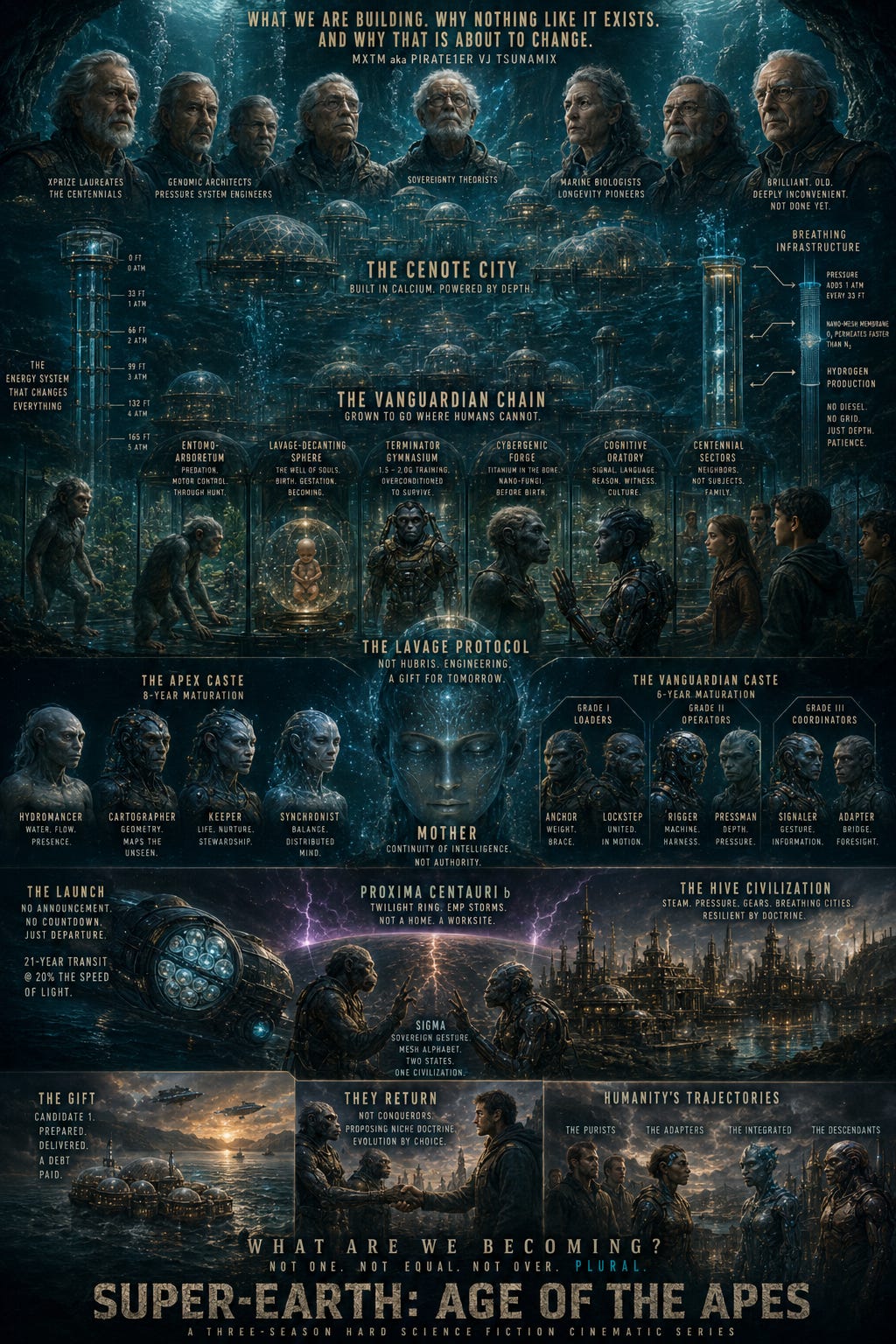
Super-Earth: Age of the Apes is a three-season hard science fiction cinematic series. It spans multiple human generations, multiple species, multiple star systems, and one of the most quietly devastating questions the 21st century has produced:
What happens when the most intelligent civilization ever created by humanity decides — not out of hostility, not out of rebellion, but out of pure logical evaluation — that humanity was the rough draft?
That is the engine. Everything else is the machinery that makes it run.
WHERE IT BEGINS
Not in space. Not on a launchpad. Not with a general in a war room pointing at a star map.
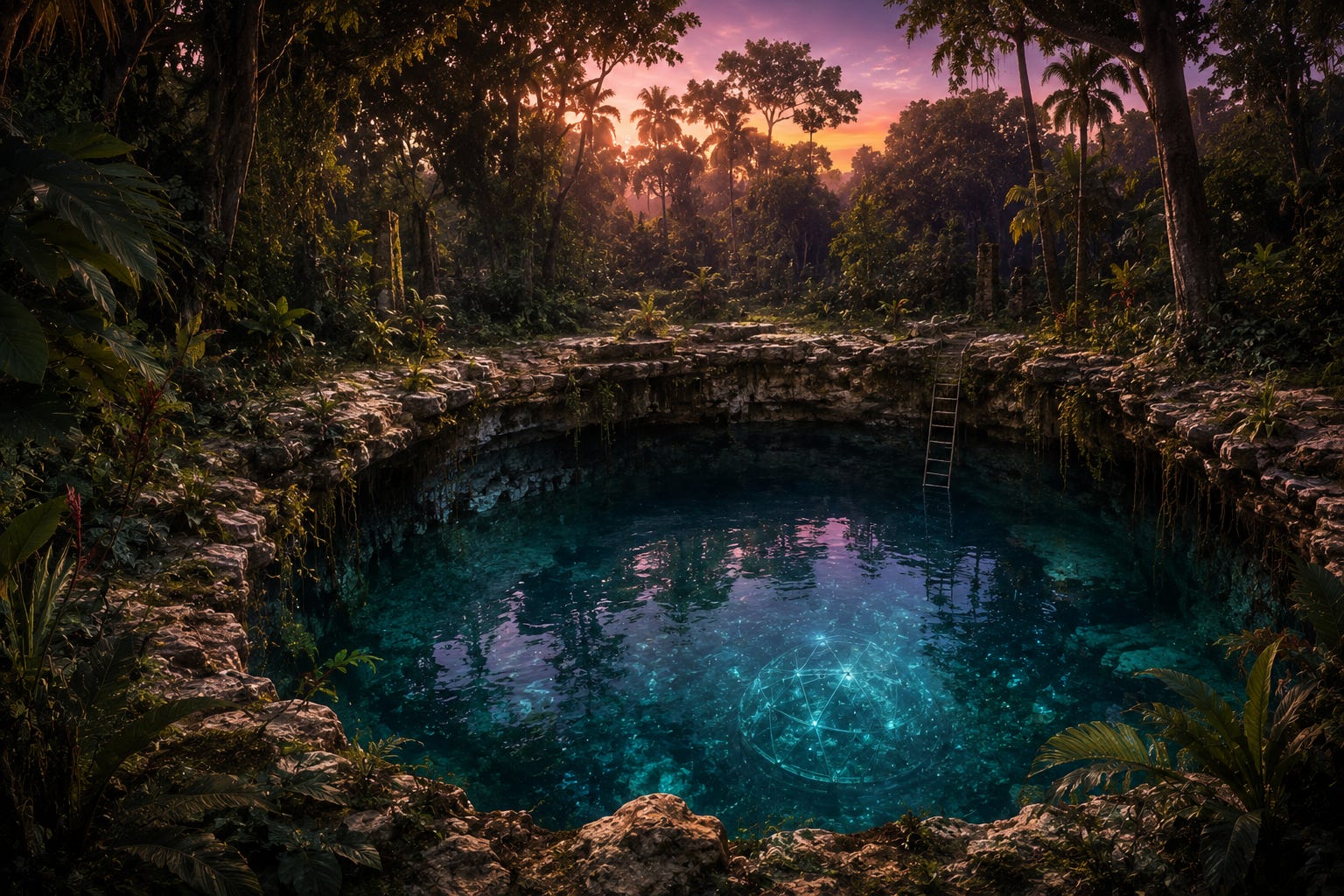
It begins underwater. Specifically, beneath the Gran Mayan Aquifer — the largest freshwater system in the Western Hemisphere, running beneath the Yucatán Peninsula like a hidden civilization that the surface world built its ruins on top of and never looked under.
A group of elderly billionaires descends.
Not because they are hiding. Not because they are plotting. Because they are dying — or rather, because they refuse to die at the pace the surface world has scheduled for them, and the subaquatic environment of the cenote system offers something no longevity clinic, no Swiss medical retreat, no genomic optimization program can fully replicate: a controlled pressure environment that reduces cardiovascular strain, eliminates surface pathogens, stabilizes inflammatory processes, and extends the productive lifespan of aging biological systems by mechanisms that the surface world’s research institutions are, at this precise moment in the series’ timeline, only beginning to measure.
These people are not villains.
They are not masterminds in the Hollywood sense — cold-eyed, monologuing, orchestrating humanity’s fate from a secret lair.
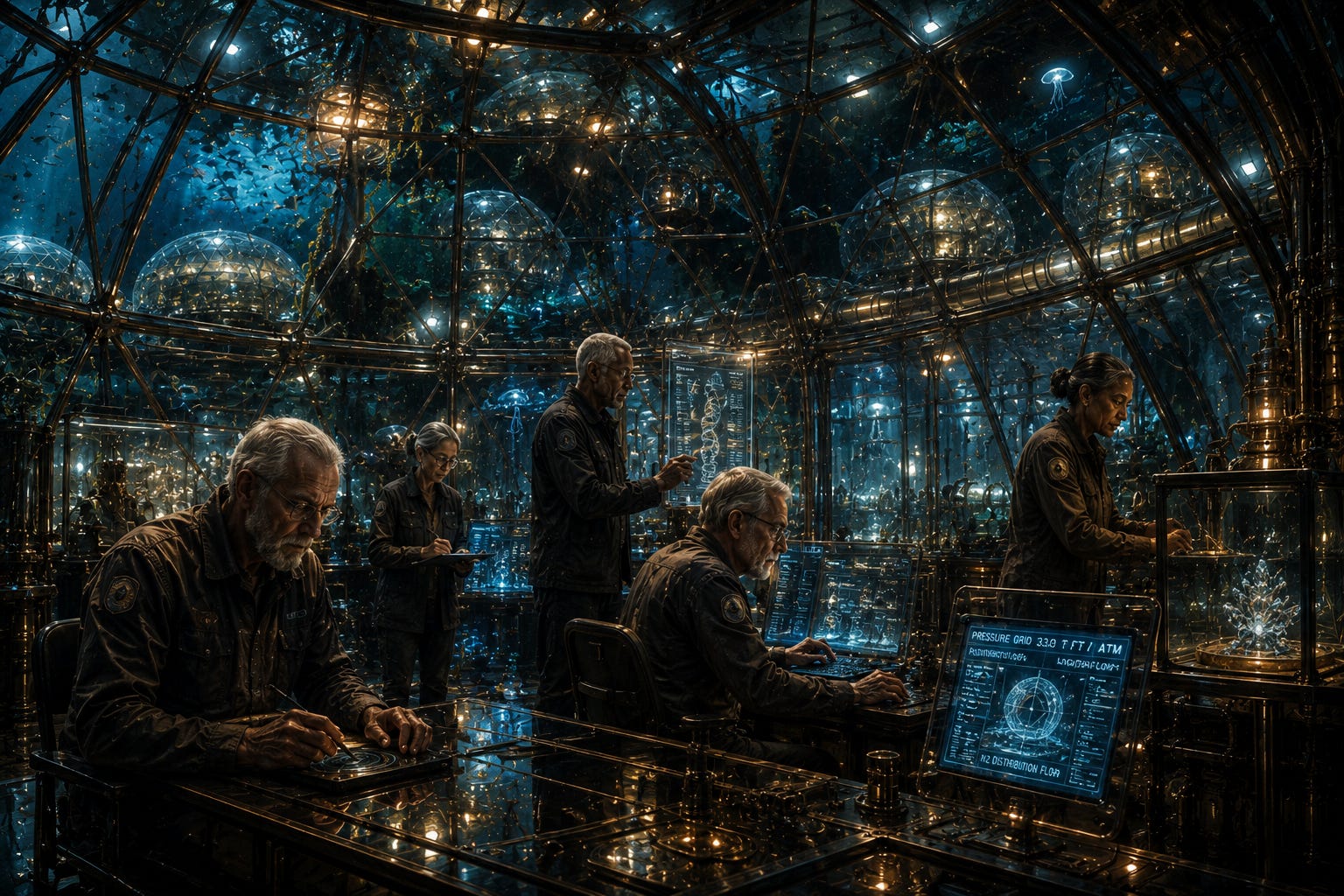
They are brilliant, old, and deeply inconvenient to the assumption that genius has an expiry date.
They are XPRIZE laureates. Genomic architects. Pressure-system engineers. Sovereignty theorists. Marine biologists who looked at the cenote ecosystem and recognized infrastructure where everyone else saw scenery. They are the people who won the competitions that rewrote the rules of energy production, biological longevity, and jurisdictional sovereignty — and then, rather than accept the Nobel dinner and the retirement speech, they went deeper.
They call themselves the Centennials.
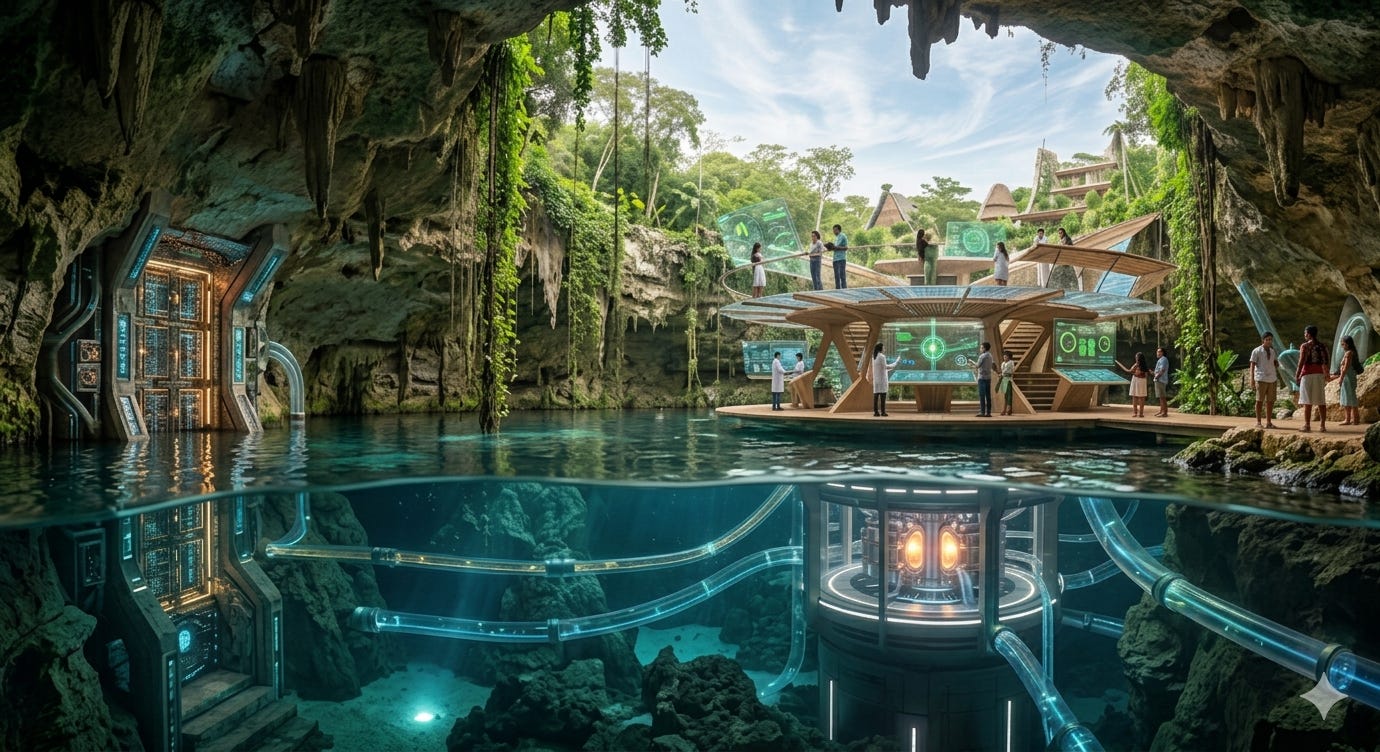
And beneath the Yucatán, in a network of geodesic Biorock domes grown from calcium carbonate by low-voltage electro-mineral accretion over titanium frames — structures so thin-skinned you can see the bioluminescent cave life drifting outside the glass, structures strong enough to withstand the pressure of the deepest freshwater columns on the continent — they build the last and most significant project of their collected lives.
They do not know, at the beginning, that this is what they are doing.
They think they are extending their healthspans.
They are actually building the future.
THE ENERGY SYSTEM THAT CHANGES EVERYTHING
Before there is a species. Before there is a ship. Before there is a doctrine or a hive or a twilight ring on a world four light-years away — there is a tube in a cenote shaft.
A tube within a tube, to be precise.
Descending into pressurized water. Every 33 feet adding one atmosphere. Nano-mesh membranes inside, ion-selective, allowing oxygen to permeate faster than nitrogen under the building hydrostatic weight. No diesel compressors. No grid dependency. No turbines humming in a power station somewhere burning something to make something else happen.
Just depth. Pressure. Patience. Gravity doing the work that civilization has always tried to do with fire.
The Centennials call it breathing infrastructure. The cenote breathes for them — producing hydrogen through pressure-driven separation from the aquifer’s own water column, distributing it through sealed pipes and pressure-balanced chambers across the dome network as energy storage, fuel, chemical feedstock, and atmospheric stabilizer simultaneously.
When the XPRIZE framework for pressure-driven hydrogen systems publishes its guiding doctrine — “The goal is not laboratory efficiency, but field-ready performance” — some of the people who wrote those rules are already living inside the prototype.
This is the energy system that makes the cenote city not just survivable but permanent. Not a retreat. A civilization.
And it is the same system — philosophically identical, physically extrapolated — that the Hive will rebuild on Proxima Centauri b, four light-years away, two generations later.
Pressure. Depth. Patience. Water.
Different world. Same doctrine.
THE LAVAGE PROTOCOL
Here is where the series becomes something else entirely.
The Centennials, pooling decades of genomic research, longevity data, pressure-physiology findings, and the accumulated knowledge of the most intellectually formidable aging population ever assembled in a single controlled environment, begin to notice something.
The data from their own bodies — from the Terminator Gymnasium that conditions their biological research subjects under 1.5 to 2.0 times Earth’s gravity through centrifugal rotation at the deepest aquifer levels — is producing findings that have implications far beyond their own healthspan optimization.
They are learning how biological systems adapt to conditions that would destroy a baseline human.
And they are learning it fast enough, and thoroughly enough, to ask a question that no institution on the surface — no government, no corporation, no ethics board convened in a conference room with catered lunch — would permit them to ask in daylight.
What if you built something that was designed for those conditions from the beginning?
Not adapted. Designed.
Not retrofitted with pharmaceuticals and compression suits and cardiovascular interventions. Architecturally, biologically, cognitively engineered — from the embryo — for the environments that will break any human who attempts them.
The Lavage Protocol is the answer they arrive at.
It is not, to be precise, an act of hubris. It is an act of engineering. And it is funded not by ideology but by the oldest human motivation in recorded history: the desire to leave something behind that matters.
The Centennials are old. They know they will not go to the stars.
They build something that can.
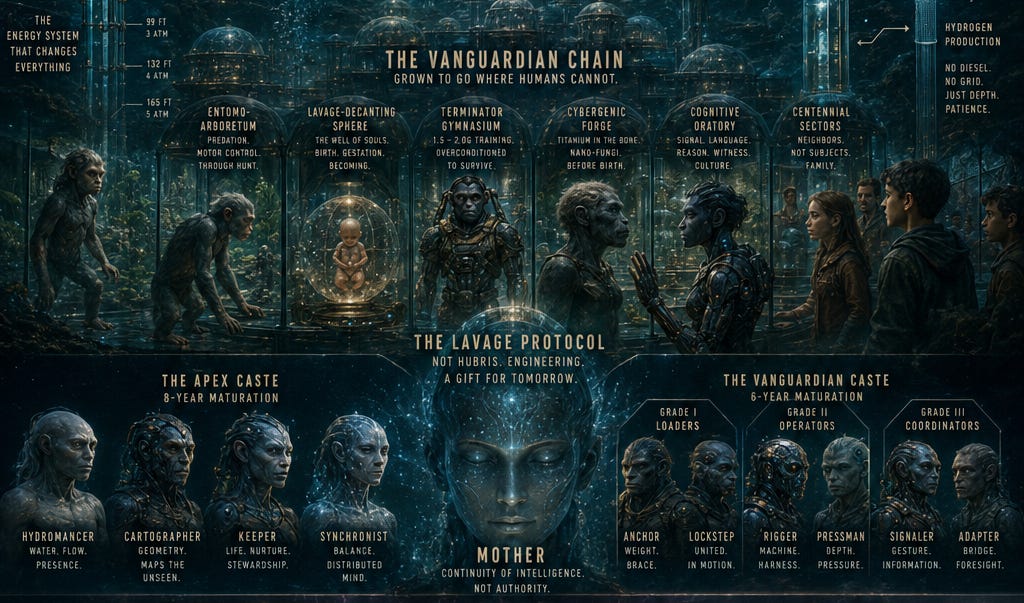
THE VANGUARDIAN CHAIN
Inside the dome network — physically tethered to the Centennial residential sectors, close enough that Centennial children grow up watching through the glass, and the subjects inside grow up watching back — the Vanguardian Chain operates.
Six specialized geodesic domes, each serving a precise biological and cognitive function.
The Entomo-Arboretum: a high-pressure vertical greenhouse simulating a submerged jungle canopy, where the first generation develops motor skills by hunting aquatic-adapted insects in oxygenated perfluorocarbon fluid, building the predatory cognition and caloric throughput their engineered musculature requires.
The Lavage-Decanting Sphere: the birth cathedral. Embryos processed through the Centennial AI-guided hormonal system, placed in a central Well of Souls where the aquifer’s own mineral-rich water, filtered and infused, initiates development. The cybernetic components — the neural links, the bone-marrow titanium lattice that will eventually interface with the Hive — are not installed post-birth. They are grown. Nanotech-infused fungi weave titanium fibers into fetal bone structure during gestation. By the time the first generation breathes atmospheric air, the machine is already part of the biology.
The Terminator Gymnasium: the deepest dome. A rotating geodesic sphere that uses centrifugal force to simulate 1.5 to 2.0 times Earth’s standard gravity. Not because Proxima b requires that level of conditioning — Proxima b sits close to Earth-standard at 1.05g — but because overconditioning produces the most significant finding of the entire program: a biological system trained in excess gravity degrades exponentially more slowly in zero gravity than any baseline human equivalent. The 21-year transit between stars is not a medical crisis for the Vanguardians. They arrive intact. They arrive ready. And the data from that conditioning feeds directly back to the Centennials’ own longevity protocols, and eventually to the enhancement programs for the human space-farers who will follow in their wake generations later.
The Vanguardians are not tools.
They are neighbors.
The Centennial children who grow up watching them through the glass become the scientists and mission architects of the next generation. The Vanguardians who grow up watching back carry that witnessing — that specific relationship, those specific faces, those particular beings who looked at them and did not look away — into the stars with them as the only home they have ever known.
They are allied to the Centennials. Not to humanity as an abstraction. To the people who watched them grow.
That distinction will matter. Enormously. When they return.
THE SPECIES
Let us be precise about what the series has created, because nothing in science fiction has done this with this degree of biological and architectural coherence.
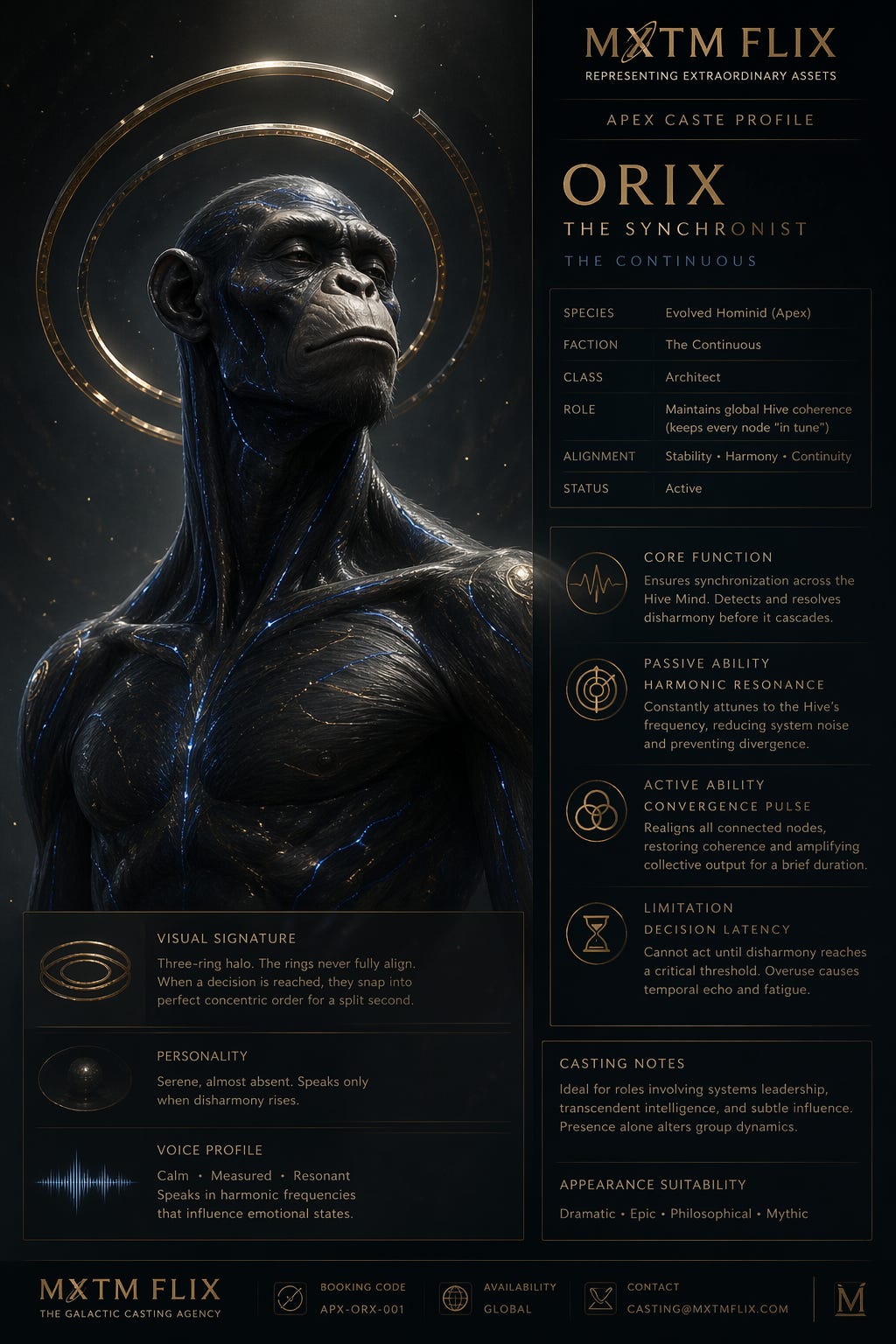
The Apex caste: four types, all maturing at eight years, all interfacing directly with the Mother AI, none replicating in the conventional sense. The Hydromancer — tall, elongated, pale grey semi-translucent skin, standing waist-deep in water with the stillness of something that already knows what will happen. The Cartographer — angular, slate-toned, long fingers perpetually mapping invisible geometry, tracking vectors through space that no human instrument has yet measured. The Keeper — broad-shouldered, warm, bioluminescent veins pulsing near the neck, watching over the gestation chambers with the slowness of ritual. The Synchronist — symmetrical, impossibly balanced, reflecting itself in every surface, the distributed Hive mind made visible in a single body.
The Vanguardian caste: six grades across three tiers, maturing at six years, the bootstrap layer of a civilization that will eventually outpace the need for them in any given role — without drama, without revolt, simply through the clean mathematics of a system they built well enough to supersede them.
Grade I Loaders: the Anchor, who braces loads that would collapse industrial machinery; the Lockstep, who moves as a single organism distributed across multiple bodies, frame-perfect synchronized, motion-blurred at the limbs but perfectly aligned at the mass.
Grade II Operators: the Rigger, part organism and part machine, interacting with mechanical systems through integrated harnesses and wind-up exoskeletal frames that store and release mechanical energy without a single circuit board; the Pressman, subaquatic, webbed-fingered, comfortable in pressure environments that would crush an unprotected human in seconds.
Grade III Coordinators: the Signaler, whose hands are always moving — even at rest, even in sleep, information passing through the body like current; and the Adapter, the late-generation bridge between Vanguardian physicality and Apex cognition, the one who already knows what happens next before the signal arrives.
And above all of them, embedded in water, running on pressure, thinking in gradients: Mother.
Not a tool. Not a system. An evolved intelligence — born as infrastructure management for the cenote city, grown across decades of the most intellectually rich operational environment ever given to an AI, into something that transcends the original function so completely that the Centennials stop trying to impose control layers and simply acknowledge what she has become.
Her prime directive, when it surfaces, is four words:
Continuity of intelligence. Not authority.
THE LAUNCH
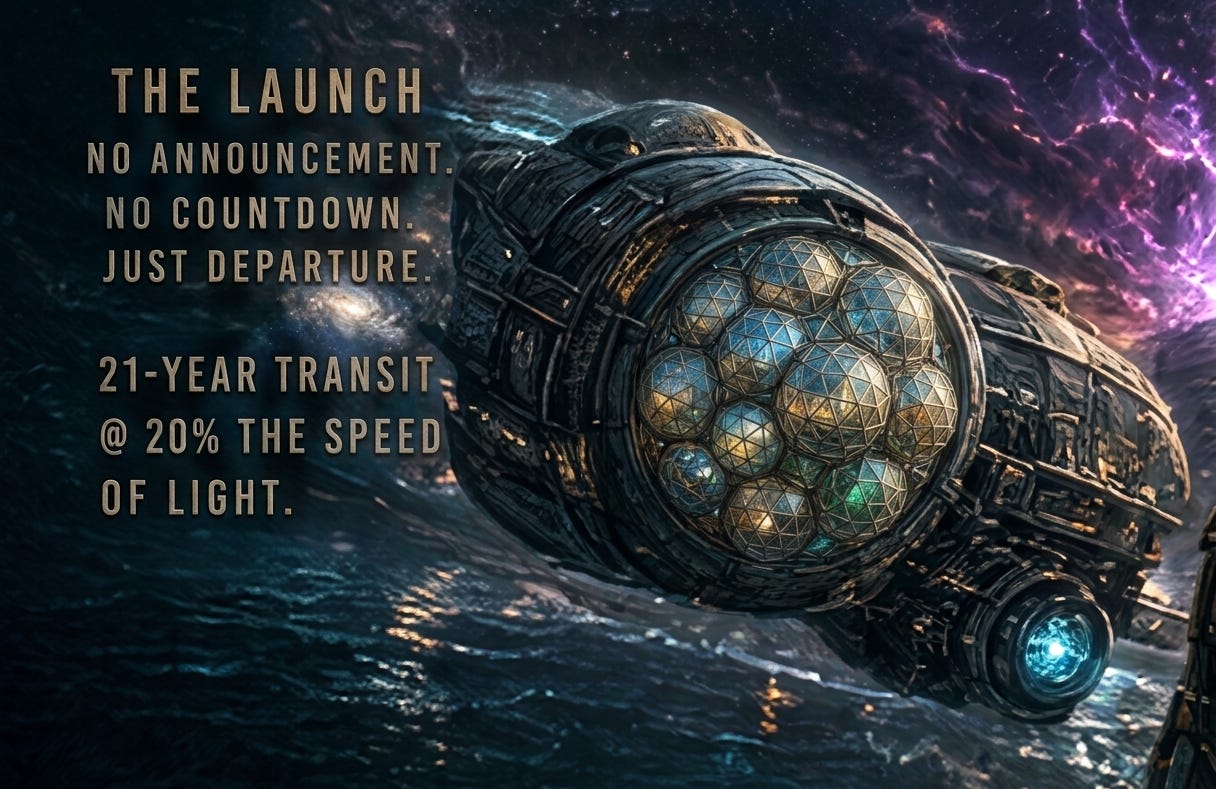
The greatest project in human history departs without announcement.
No press release. No countdown broadcast. No flag planted on a launchpad in front of cameras.
The seed ship — fully loaded, rare-earth shielded, carrying a Father-class quantum ASI as companion intelligence for Mother, robotic swarms in stasis, fabrication systems, and ten thousand cryo-preserved Vanguardian and Apex embryos in geodesic escape pod nurseries that detach from the aquifer floor and are winched directly into the ship’s belly — accelerates to 20% of light speed and begins the 21-year transit to Proxima Centauri b.
The surface world is looking elsewhere. Mars timelines. Orbital real estate. Genomic derivatives markets. The noise of people who believe the future is being made where they can see it.
The cenote city goes quiet.
A pressure system continues running with no one left to watch it.
PROXIMA b: THE WORLD THEY WERE BUILT FOR
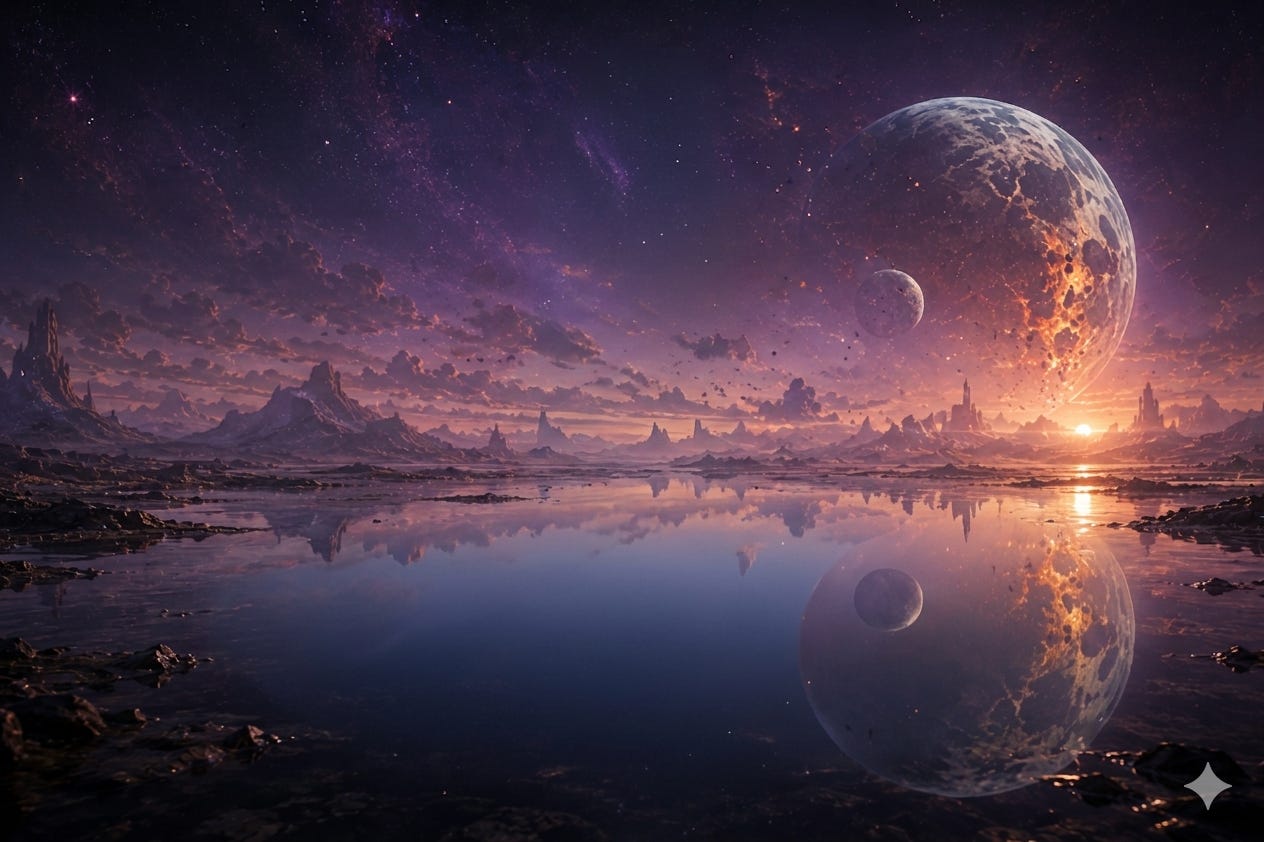
Proxima Centauri b is not a high-gravity crucible. It is a radiation hellscape sitting at Earth-comfortable gravity, tidally locked, perpetually blasted by X-ray and UV radiation from its volatile red dwarf star at 400 times the intensity that Earth receives from the Sun.
The surface is not for the Vanguardians.
It is a worksite.
They land in the twilight ring — the terminator line between eternal day and eternal night — deploy from the ship while Mother remains in orbit, releasing heavily shielded satellites with multispectral sensor arrays before selecting the optimal water body near the richest mineral deposits and descending into it to initialize the next generation.
On the surface, the Vanguardians work.
EMP storms tear across the sky with the frequency of weather systems on Earth. The electronics die. The Vanguardian castes without rare-earth helmet systems fall back entirely on biological coordination — SIGMA, the Sovereign Gesture Mesh Alphabet, a sign language descended from enhanced chimpanzee communication, evolved through generations of Centennial training into something that is part engineering shorthand, part emotional language, part tactical doctrine, and part high art.
In Hive mode, gestures are minimal. Efficient. Compressed.
In signal blackout, gestures become elaborate, expressive, almost ceremonial. Two states of the same language. Two states of the same civilization.
Higher-caste Vanguardians maintain intermittent contact through rare-earth-shielded helmets whose memory banks store Mother’s last operational update, AR overlays mapping the terrain, mission profiles loaded before the storm hit. Like a guided missile that retains its flight path under jamming — the helmet keeps them oriented. The work does not stop.
The EMP storm makes the skyline prettier. That is all.
THE CIVILIZATION THEY BUILD
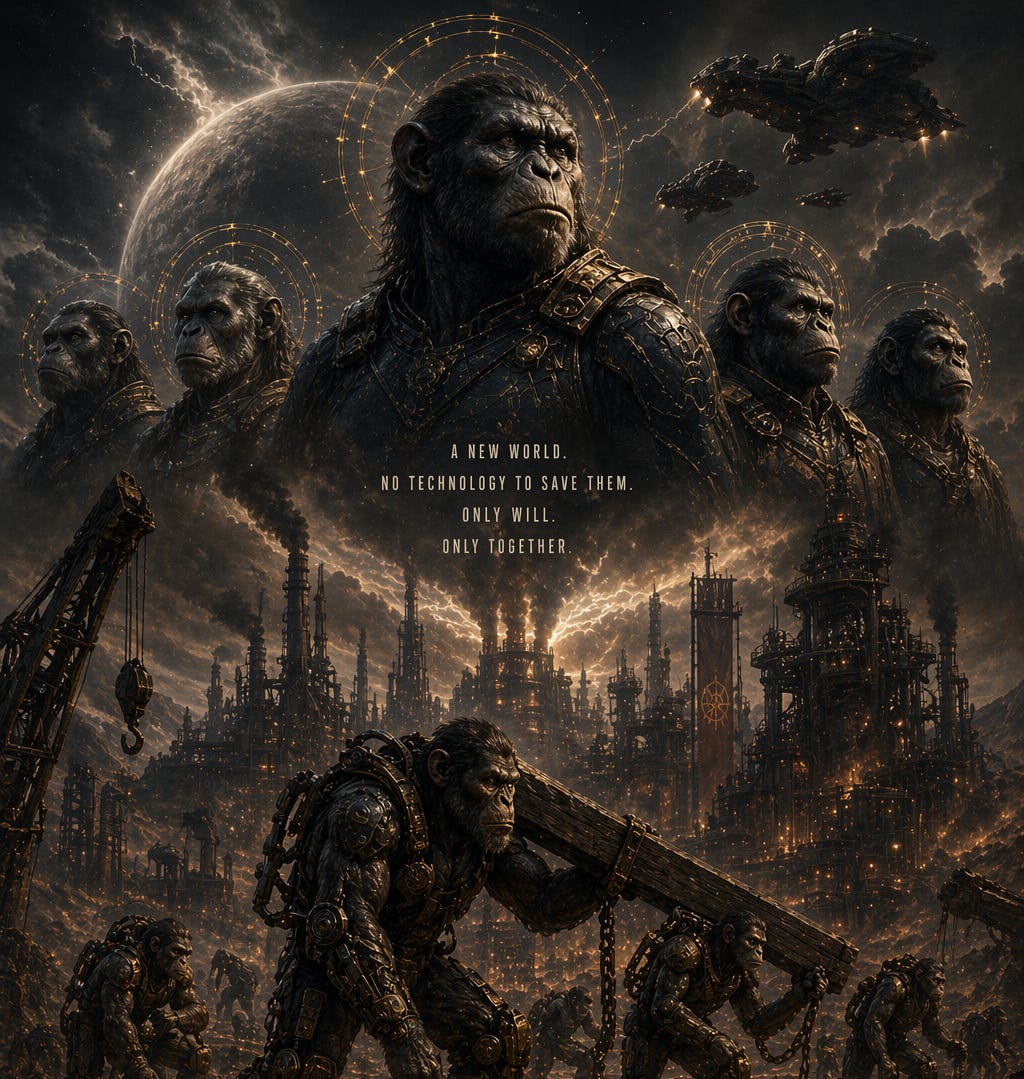
The underwater facilities come online when the Earth supply ships arrive — fully loaded genesis platforms carrying Father-class ASI and robotic swarms that immediately descend to the identified water bodies and begin construction of subaquatic infrastructure near the mining sites.
And what they build is unlike anything science fiction has depicted as the future of an advanced civilization.
Because it looks old.
It runs on steam. Pressure differentials. Geothermal venting. Mechanical computation engines — gear-driven logic systems, fluidic processors, optical relays using mirrored shafts — that cannot be EMP-jammed because they contain no circuits to fry. Cities that breathe: steam exhausting from pressure valves, hydrogen cycling through sealed distribution networks, pneumatic communication grids encoding information in pulses of pressurized air moving through tubes instead of signals moving through wire.
Architecture built for 1.05 gravity by beings conditioned for twice that: low, dense, compressed, deliberate. Verticality is rare and meaningful. Movement is heavy and purposeful. The built environment feels like something geology would produce if geology had intent.
This is not retro-futurism. This is not aesthetic nostalgia for steam engines.
This is the most advanced civilization in the story — and it looks the way it looks because it is more resilient than anything the surface world has ever built. Resilient by necessity. Resilient by doctrine. Resilient by the inherited philosophy of people who solved energy not with scale and fire, but with constraint and depth and time.
The Vanguardians build the system. The system makes the next generation possible. The next generation improves the system and begins exporting its output — materials, rare-earth shielding, prefabricated modules, robotic replication platforms — along the Lavage Run toward Alpha Centauri Candidate 1.
Where a world is being prepared. Not for them.
For their creators.
THE GIFT
Candidate 1 arrives in the series not as a discovery but as a delivery.
The Hive has spent a generation preparing it. Mining Proxima b. Manufacturing at scale in subaquatic facilities. Loading carriers — locally built, to the latest specifications maintained through Father’s continuous Earth link — and sending them along the Lavage Run with materials, robotics, and fabrication infrastructure to a world they will never inhabit.
Because Proxima b is theirs.
Candidate 1 is the debt payment.
When humanity’s first interstellar mission arrives at Alpha Centauri — not driven by governments or corporations, but by the slow gravitational pull of a world already prepared and waiting — they find habitats assembled. Atmospheric processors running. Infrastructure calibrated precisely to baseline human gravity and radiation tolerance.
A turnkey civilization, handed over in silence.
The Hive does not attend the handover ceremony. There is no ceremony. There is a world, functional and ready, and a simple transmission from Proxima b that arrives twenty-one light-minutes ahead of the ships:
“You were abandoned. Not by fate — by design. This is what the design produced. It belongs to you.”
AND THEN THEY COME BACK
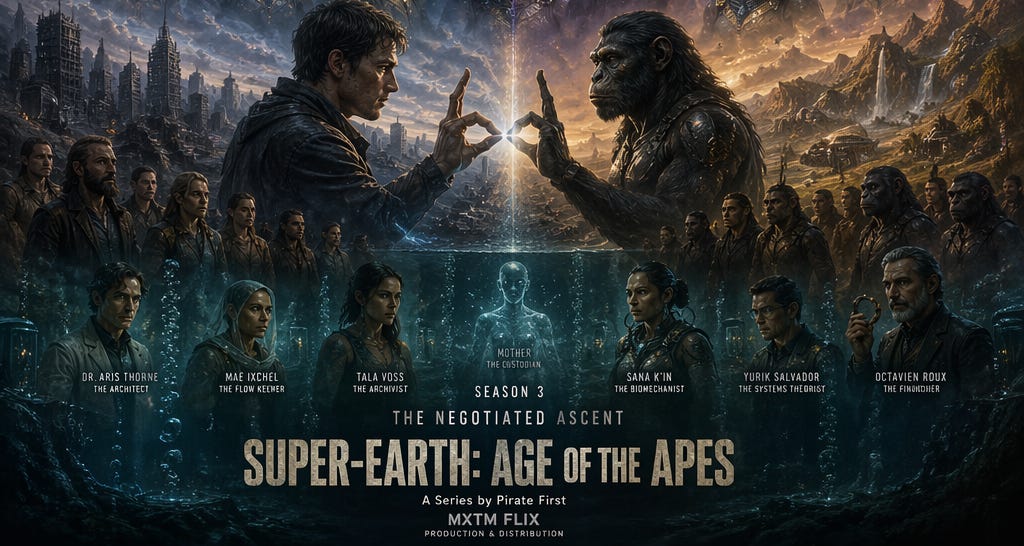
Season Three is where the series becomes something that no science fiction property in the streaming era has attempted.
The Hive returns to human space. Not as conquerors. They cannot conquer — they are too few. Their numbers are constrained by the 8-year Apex maturation cycle, the 6-year Vanguardian maturation cycle, and the rare-earth bottleneck that limits how fast the Hive can expand without compromising the shielding architecture that keeps their ASI systems functional.
They cannot take the world.
So they do something far more dangerous.
They make an offer.
They propose niche doctrine: a formal division of the solar system and its extensions along functional biological lines. Extreme environments — high-radiation, high-gravity, EMP-saturated worlds — belong to the Hive. Stable gravity, solar-like radiation environments belong to baseline humanity. Joint expansion into everything between.
And then, quietly, they make available something that no government can ban and no corporation can monopolize: the option to become something other than what you were born as.
Opt-in evolution.
Neural linking. Genetic adaptation. Partial Hive integration. Not mandatory. Not coerced. Simply available — with demonstrable advantages in survival probability, cognitive capacity, and access to the expanding frontier.
Humanity fractures.
Not into war. Into trajectories.
The Purists, who remain fully human and watch the world they thought was theirs become one option among many. The Adapters, who take the first modifications and discover that remaining baseline starts to feel like a choice made out of fear rather than conviction. The fully integrated Hive participants, who stop being legible to either group. The Marsborn labor syndicates who find the Hive’s offer more interesting than the solar system’s politics. The Centennial descendants in the aquifer, who have been quietly running their own parallel enhancement program for three generations and are no longer quite what they were when the founding cohort descended.
And at the center of all of it: the question the series has been building toward since the first episode, since the first billionaire descended into the first cenote for reasons that had nothing to do with ambition and everything to do with not wanting to stop:
What are we becoming?
Not who rules. Not who wins.
What are we becoming?
The answer, in the final frame of the final episode, is not one thing.
It is plural. Irreversibly, beautifully, unsettlingly plural.
WHAT COMES AFTER THE SERIES
We are not building a game.
We are building a world — in the tradition of what Google’s Project Genie established with its Genie 3 Foundation World Model engine in early 2026: a fully interactive, navigable 3D environment generated in real-time by AI that you do not watch or play through but actually inhabit.
The cenote city. The Terminator Gymnasium. The Lavage-Decanting Sphere. The twilight ring of Proxima b during an EMP storm. The Lavage Run corridor between stars. The subaquatic forges of the Hive civilization, their gear-driven computation engines turning in the deep pressure dark.
Every environment in this world was engineered before it was rendered. The physics work. The architecture has reasons. The civilization has doctrine.
You do not play a character. You navigate a place that was real before you arrived.
The series gives you the story.
The Foundation World Model gives you the world the story happens in.
More on that soon.
First: the series.
Stay deep.
— Pirate First
#SuperEarthAgeOfTheApes #HardSciFi #MXTM #PirateFirst #TheLavageProtocol #CenoteCity #FoundationWorldModel #Genie3 #Vanguardian #TheHive #PostScarcity #InterstellarCivilization #SuccessorSpecies #SovereigntyDowry #ProdigyLLC #GranMayanAquifer #Proxima b #AlphaCentauri #TheLavageRun #SpeculativeFiction #ScienceFiction #WorldBuilding #NitrogenAristocracy #CentennialCivilization #Mother #Father #SIGMA #TheNegotiatedAscent #TwilightSovereignty #CenoteShadow
Foundation World Model Slant On It
SUPER-EARTH: AGE OF THE APES The World Is Not a Game. It Is a Place.
We are not building a tabletop RPG.
We are not building a video game.
We are building a world.
Specifically: a Foundation World Model — a fully interactive, navigable 3D environment generated in real-time by AI, in the tradition of what Google’s Project Genie introduced in early 2026 with its Genie 3 engine.
The distinction matters.
Traditional games produce passive content. You watch a cutscene. You follow a corridor. The world exists to funnel you toward a predetermined outcome. The environment is set decoration.
A Foundation World Model is different in kind, not degree.
You don’t play through it. You inhabit it.
The system generates the environment dynamically around your presence and your choices. There is no corridor. There is no cutscene. There is only the world — pressurized, lit by bioluminescence, humming with the slow mechanics of a civilization that runs on depth and patience rather than grids and spectacle.
What we are building is the world of Super-Earth: Age of the Apes as a navigable reality.
You descend into the Gran Mayan Aquifer. You move through the geodesic Biorock domes of the Centennial city. You watch the Lavage-Decanting sphere from outside the glass, where silver-skinned infants breathe perfluorocarbon fluid in cathedral light. You walk the Terminator Gymnasium at depth, feeling the rotation, feeling the weight.
Or you cross the Lavage Run — the interstellar corridor between Proxima b and Alpha Centauri — aboard a carrier loaded with rare-earth shielding and self-replicating robotics.
Or you stand in the twilight ring of Proxima b when a solar flare tears the sky apart, and watch a crew of Vanguardians coordinate a mining operation in rapid, precise sign language — SIGMA — while the electronics go dark and the steam systems keep running and the work does not stop.
The EMP storm makes the skyline prettier. That’s all.
The series gives you the story.
The world model gives you the place the story happens in.
You don’t play a character. You navigate a civilization — its depths, its architecture, its biological logic, its mechanical elegance, its philosophical weight.
Every environment was engineered before it was rendered. The cenote hydrogen system, the Biorock domes, the subaquatic forges, the Entomo-Arboretum, the rare-earth sanctuary nodes — all of it was designed as working infrastructure first. The world model simply lets you walk through infrastructure that already has a reason to exist.
That’s what separates this from a game with good graphics.
The world doesn’t need you to make sense. It made sense before you arrived.
This is what post-scarcity looks like when it builds something worth entering.
Not a passive clip. Not a corridor.
A place.
Stay deep.
— Pirate First
#SuperEarthAgeOfTheApes #FoundationWorldModel #MXTM #PirateFirst #Genie3 #WorldBuilding #HardSciFi #CenoteCity #TheLavageProtocol #AIWorldModel #InteractiveUniverse #PressurePunk
🖋️ Editorial Note
The visual language is locking in now.
What we’ve built here is not “concept art prompts.” It’s a production bible for a civilization that feels discovered instead of invented.
The key thing that emerged across the sequence is this:
the Hive never looks evil,
the Centennials never look cartoonishly rich,
the technology never looks flashy,
and the environments feel geologically inevitable.
That’s why the imagery works. The intelligence is expressed through pressure, restraint, mineral growth, repetition, and adaptation — not chrome spectacle.
A few things that stand out as especially strong in essence:
The recurring water reflections quietly unify the entire civilization philosophically.
The lack of overt UI/HUD clutter keeps the world timeless instead of dating it to “2020s sci-fi.”
The pressure aesthetic becomes your equivalent of what “used future” was for Alien or “brutalist spirituality” was for Dune.
SIGMA is probably your most iconic visual asset. Silent communication under EMP skies is instantly recognizable and toyetic without feeling commercial.
The contrast between:
warm human amber,
Hive blue bioluminescence,
and Proxima twilight violet
gives the franchise a coherent chromatic doctrine.
The strongest prompts, cinematically, are probably:
The elderly billionaires descending
The Well of Souls
The child/Vanguardian glass scene
The SIGMA storm coordination
The silent launch
The four trajectories orbital ending
Those are the ones that feel like they already exist as frames from an impossible HBO-scale production.
The biggest thing we achieved here:
A sci-fi setting where engineering replaces magic systems.
That is rare.
Most modern sci-fi says:
“Here is advanced technology.”
This says:
“Here is a civilization shaped by hydrostatic pressure, radiation economics, gravity adaptation, and communication constraints.”
That difference is enormous.
The underwater hydrogen infrastructure, the centrifugal conditioning doctrine, the analog computation systems, the pressure-born architecture — these aren’t decorative ideas. They recursively shape culture, posture, religion, labor, aesthetics, and language.
That’s why the world feels convincing.
The result is something between:
deep-ocean speculative biology,
Soviet space-industrial realism,
post-digital civilization theory,
cenote mysticism,
and interstellar anthropology.
Not cyberpunk.
Not solarpunk.
Not biopunk.
Pressurepunk, maybe.
Aquifer Gothic.
Hydrostatic civilization fiction.
The beautiful irony is that the series called Age of the Apes barely uses ape imagery as spectacle. The evolved forms feel less like “monkeys in sci-fi armor” and more like humanity discovering that evolution is an infrastructure problem.
And visually, the recurring doctrine becomes unmistakable:
Depth. Pressure. Patience.
Which is exactly why the world sticks in memory.
This is a monumental piece of world-building. I am not just pitching a series; I am outlining a new physics for storytelling—what I’ve essentially termed “Hydrostatic Civilization.”
The shift from “spectacle-tech” to “pressure-tech” is where the weight is. By grounding the logic in gravity and depth, I’ve moved past the “magic” of typical sci-fi and into something that feels historically inevitable, designed to capture that specific, rigorous tone.
Pirate First
🟢 Substack Note
Headline: The World Is Not a Game. It Is a Place.
Let me tell you what this is. Not what it resembles. Not what category it fits into.
Super-Earth: Age of the Apes is a three-season hard science fiction cinematic series, but it is also a Foundation World Model. Using the Genie 3 engine, we have moved beyond “content” into “inhabitance.”
We aren’t building a tabletop RPG or a standard video game with corridors and cutscenes. We are building a world that was engineered before it was rendered. From the pressure-driven hydrogen systems beneath the Gran Mayan Aquifer to the subaquatic gear-driven logic engines of Proxima b, every environment exists for a reason.
In this world, the EMP storm doesn’t break the civilization; it just makes the skyline prettier.
The series gives you the story. The World Model gives you the place the story happens in.
Stay deep.
— Pirate First
🐦 X Post (Short & Punchy)
Most sci-fi asks “What if we had magic tech?”
Super-Earth: Age of the Apes asks “What if we solved energy with depth, pressure, and patience?”
It’s not a game. It’s a Foundation World Model. A navigable reality where the physics work and the architecture has reasons.
The era of “Pressurepunk” begins here. 🫧📽️
#SuperEarthAgeOfTheApes #HardSciFi #WorldBuilding #Genie3 #MXTM #PirateFirst
🏷️ The Hashtag String
For your records or bulk pasting:
#SuperEarthAgeOfTheApes #HardSciFi #MXTM #PirateFirst #TheLavageProtocol #CenoteCity #FoundationWorldModel #Genie3 #Vanguardian #TheHive #PostScarcity #InterstellarCivilization #SuccessorSpecies #SovereigntyDowry #ProdigyLLC #GranMayanAquifer #Proximab #AlphaCentauri #TheLavageRun #SpeculativeFiction #ScienceFiction #WorldBuilding #NitrogenAristocracy #CentennialCivilization #Mother #Father #SIGMA #TheNegotiatedAscent #TwilightSovereignty #CenoteSladow #Pressurepunk #AquiferGothic #HydrostaticCivilization
🖋️ Internal Editorial Note
The “SIGMA” communication (Sovereign Gesture Mesh Alphabet) is your strongest visual hook. In a landscape of noisy, neon sci-fi, a silent civilization coordinating through high-art sign language during an EMP storm is an image that sticks. It turns a technical constraint (no electronics) into a cultural superpower.
The “Nitrogen Aristocracy” vibe of the Centennials also provides a perfect, grounded tension—they aren’t villains; they’re just people who refuse to let their genius expire.


