


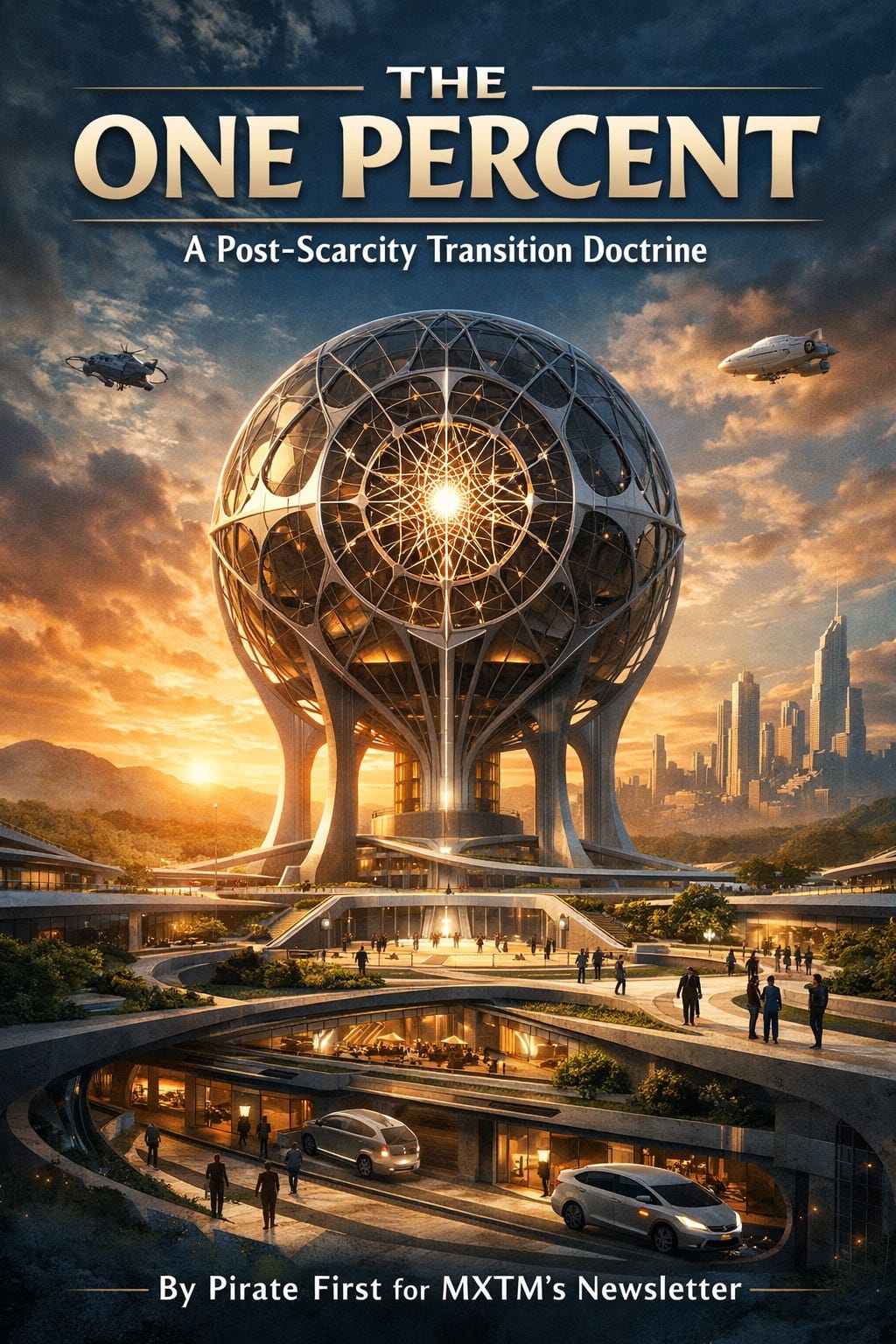
PART III — THE DREAM CATCHER GOVERNANCE MODEL
11. Symbol as Operating System
The history of governance is, in significant part, the history of objects.
Not the history of ideas about governance — that is philosophy. Not the history of institutions — that is political science. The history of the objects that governance required in order to function: the objects that made abstract authority tangible, that converted the invisible force of collective organization into something that could be seen, touched, carried, displayed, and destroyed. The scepter. The seal. The throne. The flag. The constitution in its glass case. The gavel. The ballot box.
These objects are not decorative accessories to governance. They are operational components of it. They do work that the ideas and institutions cannot do without them — the work of making authority legible to the people who must recognize it for it to function. Authority that cannot be seen cannot be submitted to or contested or transferred or inherited. It can only be asserted, which is a different thing entirely, and a weaker one. The object converts assertion into recognition. It gives the abstract a body.
Every governance system that has endured has understood this. The Catholic Church understood it — the cross, the chalice, the papal ring, the physical objects of the Mass performing the governance function of making divine authority present in the space where human communities gathered to submit to it. The nation-state understood it — the flag, the currency, the passport, the border post, the monument to the founding sacrifice, each object doing the specific work of making the national community’s claim on its members visible and tangible. The corporation understood it — the logo, the letterhead, the office, the organizational chart made physical in the architecture of the headquarters, each object performing the governance function of making the firm’s authority over its members and its claims on the market legible.
In every case, the object is not merely a symbol in the thin sense — a representation of something that exists independently of it. The object is a symbol in the operative sense: it participates in the constitution of the thing it represents. The flag does not merely stand for the nation. The nation, in some of its most essential moments, is the flag — is the act of raising it, defending it, folding it, saluting it. The constitution does not merely record the founding law. The founding law, in the specific transaction of democratic governance, is the physical document — is the parchment that can be pointed to, the text that can be read aloud, the object that persists through time as the material anchor of the claim that the founding meant something and continues to mean it.
The Dream Catcher is a governance object in this operative sense.
Not a sculpture that represents the governance process of the One Percent campus. Not an artwork that illustrates, in visual form, the ideas that the Dream Validation Process embodies. Not a monument to the aspiration of collective sense-making. But the physical anchor of the governance process itself — the object whose presence in the campus’s spatial organization performs the governance function of making the Dream Validation Process legible, recognizable, and real to the people whose participation it requires.
This is a strong claim and it requires unpacking.
Governance requires participants. This is obvious and trivially true at one level — no governance system functions without the people who submit to it, contest it, operate it, and are produced by it. But at a deeper level it is not trivial at all. Governance requires participants who have been convinced, at the level below explicit argument, that the governance system is real. That it has weight. That participation in it matters. That what happens inside it has consequences that extend beyond the specific transaction of participation into the broader social world where those consequences must eventually be recognized.
This conviction is not produced by argument alone. Argument can explain the governance system. It can make the case for the system’s legitimacy, its efficacy, its fairness, its claim on participants’ attention and energy. But argument operates at the level of the explicit, and the explicit is rarely where the deepest commitments are made or broken. The deepest commitments are made at the level of experience — at the level of what it feels like to be in the presence of the governance system, to encounter the object that makes it tangible, to be addressed by the spatial and material organization that the system has given itself.
The dream catcher, as a cultural object with a specific history in the Indigenous traditions of North America, already carries governance connotations that the One Percent campus inherits and extends.
The traditional dream catcher is not merely a decorative object. It is a protective technology — a filtering mechanism that distinguishes between the dreams that should pass and the dreams that should be caught. It operates at the boundary between the chaotic field of the unconscious and the ordered world of waking life, performing the governance function of that boundary: receiving everything, filtering according to a principle, allowing some things through and retaining others. The web is the governance mechanism. The hole at the center is the passage for the good. The outer ring holds what must be held.
This governance logic — receive all, filter by principle, pass the valid, hold the invalid — is precisely the logic of the Dream Validation Process. The cultural object and the governance design are not merely analogous. They are structurally identical. The Dream Catcher at the center of the One Percent campus is not using the traditional object as a metaphor for a separately designed governance system. It is using the traditional object as the physical expression of a governance system whose logic was already present in the object.
That identity between symbol and system is what makes the Dream Catcher an operative governance object rather than a decorative one.
When participants in the Dream Validation Process look up at the Dream Catcher — and at the scale proposed, it will be visible from every point on the campus — they are not looking at a representation of the process they are inside. They are looking at the process. The web is the filtering mechanism. The center is the passage to realization. The threads connecting the outer ring to the center are the pathways of collective refinement through which raw proposals are worked toward validated futures. The physical object and the governance process are the same thing, expressed in two registers simultaneously: the material and the procedural.
This simultaneity — symbol and system, object and operation, aesthetic form and governance function — is what the One Percent doctrine means when it describes the Dream Catcher as an operating system rather than merely a symbol.
An operating system, in the computational sense, is the software layer that sits between the hardware and the applications — the layer that manages the resources of the machine, allocates them to the tasks the applications require, and provides the interface through which the human user and the machine’s capacity are connected. It is not the thing the user is doing. It is the system within which the doing happens. It is invisible when it is functioning well, visible only at the moments of breakdown, always present as the condition of possibility for everything that runs on top of it.
The Dream Catcher is an operating system in this precise analogical sense. It does not contain the dreams of the campus’s participants. It is the system within which the dreaming and the validation and the realization occur. It manages the interface between individual proposals and collective judgment. It provides the spatial and symbolic infrastructure within which the governance transactions of the Dream Validation Process take place. It is the condition of possibility for the campus’s governance, present in every transaction as the context within which the transaction is meaningful, visible in its full scale at the moments when the community gathers for the filtering — the collective sessions of assessment and refinement that the Dream Validation Process centers on the physical space of the Dream Catcher.
This is the sense in which the symbol is the operating system: not metaphorically, but operationally.
Consider what the Dream Catcher’s presence does to the experience of submitting a proposal through the Dream Validation Process.
In the absence of a physical anchor, the submission of a proposal to a governance process is an abstract transaction — the filling of a form, the clicking of a button, the entry of text into a digital field that may or may not be read, by people who may or may not exist, through a process whose reality is attested only by its procedural description. The participant’s relationship to the process is mediated entirely by language — by the description of how the process works, the explanation of what happens to proposals once submitted, the assurance that the filtering is genuine and the validation consequential. Language is powerful, but it is the weakest anchor for the conviction that participation matters.
In the presence of the Dream Catcher, the submission is not an abstract transaction. It is a spatial act — an act performed in the physical field of the governance object, in sight of the mechanism that will filter the proposal, in proximity to the center through which validated proposals pass into realization. The participant does not merely submit a text. She submits in a space that is organized around the submission, that makes the submission legible as a contribution to a collective process whose physical expression she can see and move through and return to.
This is not a small difference. It is the difference between governance that the participant believes in abstractly and governance that the participant inhabits spatially — and habituation is a far more durable foundation for participation than belief.
The history of successful governance objects supports this argument. The ballot box, at the scale of democratic ritual, does the same work. The vote is an abstraction — a preference expressed by a mark on a form, whose individual significance in a large election is statistically negligible. But the ballot box makes the vote a spatial act: the approaching of the box, the insertion of the paper, the physical enactment of the claim that this preference will be received, held, and counted alongside the preferences of everyone else who approaches the same box. The ballot box does not make the vote more powerful in the mathematical sense. It makes it more real in the experiential sense. And experiential reality is what sustains the participation that democracy requires across the millions of individual transactions that constitute a functioning election.
The Dream Catcher scales this logic to the specific governance requirement of the transition campus: not the periodic large-scale participation of democratic election but the continuous, daily, small-scale participation of collective sense-making. The campus’s governance is not episodic. It is ongoing. The Dream Validation Process runs continuously — proposals are always being submitted, always being refined, always being filtered, always producing validated futures that become the campus’s collective projects. The governance object that sustains participation in this continuous process must be present continuously, not only during the formal moments of collective assembly.
The Dream Catcher’s scale — land-scale, architecturally permanent, visible from every point on the campus — is the spatial provision for that continuous presence. It is always there. It is always legible as the filtering mechanism. It is always available as the anchor that makes the question does my participation matter? answerable without explicit argument. The answer is in the object. The object is always present.
There is a further dimension of the Dream Catcher as operating system that connects to the specific historical conditions of the transition.
The transition from scarcity to post-scarcity is, among other things, a transition in the dominant relationship between human beings and governance systems. The scarcity era’s governance systems were, in their operational design, systems of command and compliance — designed to direct human activity toward productive ends through a combination of incentive and enforcement whose ultimate ground was the asymmetric capacity for coercive power that the state and the employer and the credentialed authority maintained over those they governed.
Command and compliance governance does not require beautiful objects. It requires legible authority — the display of the capacity for enforcement, the marking of the territory within which the command runs. The surveillance camera, the uniform, the corner office with its view over the open-plan floor below — these are the governance objects of command and compliance, and their aesthetic is the aesthetic of power: visible, elevated, directed downward.
The Dream Catcher is the governance object of a different mode — not command and compliance but what might be called invitation and participation. Governance that derives its authority not from the capacity to enforce compliance but from the quality of its process. Governance that sustains participation not through the fear of exclusion but through the genuine experience of inclusion. Governance whose object is not a display of coercive capacity but a display of receptive capacity — the web that receives all proposals, the filter that distinguishes by principle rather than by power, the center that is open rather than fortified.
This is not a naive governance ideal. Invitation and participation governance fails in specific and well-documented ways — it can be captured by confident minorities, it can produce decision paralysis in conditions of genuine disagreement, it can generate the performance of inclusion without its substance. The Dream Validation Process is designed with these failure modes in mind, and the governance architecture described in the next chapter addresses them directly.
But the aesthetic of the governance object is not incidental to the mode of governance it sustains. The command and compliance object tells participants: you are inside a system that has the capacity to compel you. The invitation and participation object tells participants: you are inside a system that is asking for your genuine engagement. The first produces compliance. The second produces commitment. And commitment — fragile, demanding, impossible to compel — is the only foundation for governance at the scale the post-scarcity transition requires.
The Dream Catcher is the governance object of commitment.
It asks. It does not command. It receives. It does not dictate. It filters by principle. It does not filter by power. Its aesthetics — the organic form, the web that holds without closing, the center that is open — are the governance aesthetics of the invitation.
That aesthetics is not decorative. It is operational. It tells every participant who enters the campus’s spatial field, before a word is spoken or a process explained, what kind of governance system they are inside.
The symbol is the operating system. The operating system is the symbol.
The Dream Catcher is both.
Which is why it cannot be merely a sculpture. And why no sculpture that is not also a governance object can serve its function.
The art and the governance are not two things that happen to share a physical form. They are one thing that the history of this moment required.
12. The Dream Validation Process
Every system that allocates resources faces the same foundational problem.
Not the problem of scarcity — though scarcity is the condition that makes the problem urgent. The foundational problem is prior to scarcity and survives its resolution: the problem of judgment. Of the infinite range of things that could be done with the resources available, which things should be done? By what principle, applied by what mechanism, through what process, accountable to what standard, is the selection made?
The scarcity era answered this problem with two mechanisms, deployed in combination and in competition throughout the history of industrial civilization.
The first was the market. The market answered the question of what should be done by asking what people would pay for. It distributed resources toward the activities that generated return, away from activities that did not. It was fast, scalable, and self-correcting in specific ways, and it was catastrophically indifferent to the full range of human need in equally specific ways. What people would pay for and what people needed were never the same set, and the gap between them produced the social pathologies — the under-provision of collective goods, the over-provision of extractive ones, the systematic exclusion of those without purchasing power from the resources that their humanity required — that the second mechanism was designed to address.
The second was the state. The state answered the question of what should be done by asking what elected representatives, advised by expert administrators, decided was in the public interest. It was slower than the market, more inclusive in its mandate, more capable of addressing collective goods that the market systematically underproduced, and systematically vulnerable to the capture of its decision-making by the interests with the greatest capacity to influence it. What the public interest required and what powerful interests preferred were never the same set, and the gap between them produced the institutional pathologies — the regulatory capture, the policy lag, the administrative sclerosis — that the legitimacy crisis described in Part I has brought to the surface.
The post-scarcity transition requires a third mechanism.
Not because the market and the state are finished — they are not, and the One Percent doctrine does not propose their abolition. But because the specific governance challenge of the transition campus is one that neither mechanism is designed to meet.
The market cannot govern the Dream Validation Process because the process is explicitly organized around the production of value that the market does not price. The dreams being validated are not products seeking buyers. They are proposals for collective futures seeking community recognition. The filtering principle is not willingness to pay but collective desirability — a category the market has no instrument for measuring because it has no price signal to measure it with.
The state cannot govern the Dream Validation Process because the process requires a speed, flexibility, and genuine inclusivity that bureaucratic administration is structurally incapable of providing. The state’s governance mechanisms are designed for populations in the millions, operating across jurisdictions defined by geography and law, accountable through electoral cycles measured in years. The transition campus’s governance is designed for a community in the hundreds, operating in a specific physical space, accountable through a continuous process measured in weeks and months. The state’s tools are the wrong scale for this instrument.
What the Dream Validation Process requires is a governance mechanism designed specifically for the conditions of the transition: AI-amplified collective judgment, organized through a spatial and procedural architecture that converts the noise of universal participation into the signal of actionable collective priority.
This is not a familiar category. It is not crowdsourcing — the aggregation of individual preferences through voting or rating or ranking, which produces popularity rather than wisdom and is as vulnerable to gaming as any other mechanism that can be gamed by those with the motivation and capacity to game it. It is not deliberative democracy in the academic sense — the idealized process of rational discourse among informed and equal participants that assumes conditions of equality and information that the transition campus’s population will not possess. It is not expert judgment — the delegation of decision-making to those whose training and experience qualify them to decide, which replicates the cognitive hierarchy that the transition is dissolving.
It is something new, designed for conditions that are new.
The Dream Validation Process operates through five stages, each with a specific spatial location in the campus’s organization and a specific relationship to the Dream Catcher that is the process’s physical anchor.
Stage One: Submission.
The first stage is the articulation of a dream.
The word is chosen carefully. Not a proposal, which implies a level of developed specificity that excludes the nascent and the half-formed. Not a plan, which implies an implementation pathway that the dream’s originator may not yet possess. Not a project, which implies a defined output and a defined process for achieving it. A dream — the most permissive category of human aspiration, the category that requires only the conviction that something should exist that does not yet exist, without demanding that the dreamer already know how to bring it into existence.
The submission stage is designed around this permissiveness. Its spatial expression is a set of spaces distributed across the campus — not a single submission office, not a formal intake point with its implied administrative hierarchy, but a distributed set of environments in which the articulation of a dream can occur in whatever form the dreamer’s capacity permits.
Some dreams will be submitted as texts — written proposals that the campus’s AI infrastructure assists in developing to the level of legibility required for community engagement. The AI assistance is not cosmetic. It is substantive: the displaced worker who has a dream but lacks the vocabulary of planning or architecture or governance to articulate it in the forms that decision-making processes traditionally require is given the tools to articulate it in those forms without needing to first acquire years of credentialed training in the disciplines that produced those forms.
This is the specific application of cognitive equalization to the governance process. The Dream Validation Process is one of the first governance mechanisms designed from the outset for AI-amplified participants — not as an accommodation to a changing technological environment but as a foundational design principle. The playing field of submission is leveled not by pretending that differences in articulacy and expertise do not exist but by providing, to every participant regardless of background, the tools that convert their genuine vision into a form that the community can engage.
Some dreams will be submitted as images, as physical models, as spoken descriptions recorded and transcribed, as collaborative articulations developed in conversation with other campus participants. The submission infrastructure is multi-modal because the population it serves is multi-lingual, multi-literate, and multi-capable in ways that a single-channel submission process would systematically exclude.
The only requirement for a valid submission is that the dream be genuine — that it represent a real aspiration for something that the dreamer believes would be desirable for the community the campus serves. The validation of genuineness is not a gatekeeping function performed by administrators. It is a community function performed by the subsequent stages of the process.
Stage Two: Weaving.
The second stage is the collective refinement of submitted dreams.
The weaving stage is named for the physical process of the dream catcher’s construction — the drawing of threads from the outer ring toward the center, the interweaving of individual elements into a structure whose strength derives from the relationships between them rather than from the strength of any single thread.
In the Dream Validation Process, weaving is the stage at which submitted dreams encounter the community — not as an audience evaluating a finished proposal but as active participants in its development. The dream that was submitted as a nascent aspiration is now exposed to the range of perspectives, knowledge, and experience that the campus’s diverse population contains, and those perspectives and that knowledge are brought to bear on the dream’s refinement in a process that is structured to be generative rather than critical.
Generative refinement is not the same as uncritical acceptance. It is the discipline of engaging with what a dream is reaching toward before engaging with the obstacles that stand between the dream and its realization. It asks: what is this dream trying to do? What need is it responding to? What value is it trying to create? And then, having understood the dream at the level of its aspiration, it asks: how can this aspiration be sharpened, extended, connected to other aspirations, made more achievable without being made smaller than it is?
The spatial expression of the weaving stage is the set of common spaces distributed around the Dream Catcher — the gathering places, the workshop environments, the informal meeting areas where the daily social life of the campus generates the conversations in which dreams are refined through encounter. Weaving is not primarily a scheduled activity. It is the texture of the campus’s common life — the refinement that happens in the conversation at the shared meal, the connection that is made in the workshop between two people whose dreams, it turns out, are adjacent and mutually reinforcing, the sharpening that occurs when a dream is described to someone from a completely different background whose questions reveal the assumptions the dreamer had not noticed.
The AI infrastructure of the campus actively supports the weaving stage by mapping connections between dreams — identifying when multiple submissions are reaching toward similar aspirations from different directions, surfacing the knowledge and expertise within the campus community that is most relevant to a specific dream’s development, and facilitating the connections between dreamers and potential weavers that the campus’s physical organization might not spontaneously produce.
This is the specific governance contribution of AI to the Dream Validation Process: not decision-making, not filtering, not judgment — but the enhancement of the community’s own connective capacity. The AI does not decide which dreams are worth refining. It helps the community find the threads between them.
Stage Three: Filtering.
The third stage is the assessment of community desirability.
This is the stage that corresponds most directly to the dream catcher’s physical function — the filtering of the field of refined proposals through the web, toward the center that represents realization. And it is the stage that requires the most careful governance design, because it is the stage most vulnerable to the failure modes that collective decision-making is prone to.
The filtering stage does not use voting in the simple sense. Voting — the aggregation of individual preferences through a binary or ranked choice — has well-documented vulnerabilities in small, high-stakes communities: it produces winners and losers in contexts where the social cost of losing is high, it is vulnerable to bloc formation by organized minorities, and it reduces the complexity of collective judgment to a numerical output that strips the decision of the reasoning that should accompany it.
The Dream Validation Process filters through a composite assessment that combines four distinct signals.
The first signal is community endorsement — a formal expression of support from campus participants that is more than a vote and less than a commitment. Endorsement says: I believe this dream should be pursued. It does not say: I will pursue it. It is the expression of collective recognition that a dream has value, separated from the question of who will do the work of realizing it.
The second signal is participation commitment — the number of campus participants who indicate genuine willingness to contribute to the dream’s realization. This signal is more demanding than endorsement and more reliable as a measure of genuine community investment. A dream that attracts endorsement but no participation commitment is a dream that the community values in the abstract but will not sustain in practice. The participation commitment signal filters for the difference between admired aspiration and genuine collective investment.
The third signal is maintenance covenant — the indication of who will steward the dream’s ongoing existence after its initial realization. This signal addresses one of the most common failure modes of collective creative projects: the production of things that no one takes ongoing responsibility for, that flourish briefly in the energy of their creation and then deteriorate in the absence of sustained care. The maintenance covenant is not a legal obligation but a social one — a public commitment by specific individuals to the ongoing stewardship of a realized dream, made in the presence of the community and held by the community as a form of accountability.
The fourth signal is temporal scope assessment — the community’s collective judgment of whether a dream is appropriately scoped for the campus’s current capacity. Some dreams are too large for the first campus and should be preserved for the network of campuses that the One Percent template will eventually produce. Some dreams are too small to require the full validation process and should be enabled through a faster, lighter mechanism. The temporal scope assessment filters for fit between dream and context without filtering for ambition — the large dream that exceeds current capacity is not rejected; it is deferred and noted as a marker of where the network is heading.
The combination of these four signals produces a filtering output that is richer than any single voting mechanism could produce and more resistant to the specific failure modes that each signal, alone, would be vulnerable to. A dream that scores high on endorsement but low on participation commitment is flagged for the gap between aspiration and investment. A dream that attracts strong participation commitment but raises questions about maintenance is held for the covenant process before advancing. A dream that is correctly scoped and well supported on all four signals advances toward the center.
The physical expression of the filtering stage is the space immediately surrounding the Dream Catcher — the area where the community gathers for the formal filtering sessions that punctuate the continuous informal process of weaving. These sessions are not votes. They are assemblies — the gathering of the campus community in the physical field of the governance object that makes the filtering tangible, that converts the abstract assessment into the spatial act of approaching the Dream Catcher and contributing to the judgment that its web performs.
Stage Four: Allocation.
The fourth stage is the direction of resources toward validated dreams.
The allocation stage is where the Dream Validation Process connects to the economic infrastructure of the One Percent campus — the funding mechanisms described in Part II, the development economics that generate the resource base the campus operates from, and the broader funding streams that the campus’s governance is designed to access as the model matures.
The allocation is not a single transaction. It is a graduated process that matches the scale of resource commitment to the demonstrated level of community validation, moving from small provisional allocations that test the dream’s viability to larger committed allocations that fund its full realization.
The provisional allocation — space, tools, time, a small operational budget — is available to any dream that clears the filtering stage. It is the resource commitment that says: this dream has demonstrated sufficient community desirability to warrant the investment of the campus’s first attention. It does not guarantee realization. It provides the conditions in which the dream can develop toward realization, and it does so at a scale that the campus’s governance can sustain regardless of the dream’s eventual fate.
The committed allocation — the larger resource commitment that funds the dream’s full development into a sustained campus program or a permanent installation or a networked initiative — is available only to dreams that have passed through the provisional stage and demonstrated, in practice, the viability that the filtering stage judged in principle. The committed allocation is earned, not given. It is the resource commitment that the community makes to a dream that has proven, in the test of its provisional existence, that it deserves the sustained investment the community is being asked to make.
This two-stage allocation structure is one of the Dream Validation Process’s most important governance features. It prevents the overcommitment of resources to dreams that are genuinely desirable in principle but not viable in practice, without preventing the initial support that gives promising dreams the chance to demonstrate their viability. It maintains the campus’s resource base as a renewable commons rather than a depletable fund — the provisional allocation that does not lead to a committed allocation returns to the commons for reallocation to the next round of validated dreams.
Stage Five: Stewardship.
The fifth stage is the ongoing governance of realized dreams.
The stewardship stage begins where most governance processes end — at the moment of realization, when the dream has been validated and resourced and brought into existence as a campus program, installation, or initiative. Most governance processes treat realization as the endpoint. The Dream Validation Process treats it as the beginning of the most demanding governance challenge: the maintenance of the commitment that brought the dream into existence across the full duration of its intended life.
Stewardship is governed by the maintenance covenant established in the filtering stage — the public commitment by specific individuals to the ongoing care of the realized dream. But stewardship is also a community function, not only an individual one. The campus community that validated the dream has an ongoing relationship to its maintenance — a responsibility to notice when stewardship is failing, to offer support when stewards are overwhelmed, and to make the collective decision, when a realized dream has genuinely run its course, that its resources should be returned to the commons and its space reallocated to the next generation of validated proposals.
The stewardship stage is where the Dream Validation Process most directly expresses the post-employment logic of the campus. The steward of a realized dream is not an employee. She has not been hired to maintain a program according to a job description. She has made a public commitment to the care of something the community values, and that commitment is her role — not in the employment sense, but in the participation sense. It is what she does in the campus because it is what she has committed to, and her commitment is held and honored by the community whose validation brought the dream into existence.
This is the specific form of purposeful occupation that the transition campus provides to the population it serves. Not jobs — roles. Not employment — stewardship. Not the extraction of productive labor for a wage — the exercise of genuine care for things the community has collectively decided are worth caring for.
The Dream Catcher’s physical presence sustains the stewardship stage in the same way it sustains every other stage of the process — by remaining always visible, always available as the reminder that the dream’s realization is not the end of the governance relationship but its full expression. The validated dream is not outside the Dream Catcher. It is through it — it has passed from the web into the center, and it remains connected to the web through the ongoing participation of its stewards in the campus’s governance life.
The five stages together constitute a governance process that is complete — from the first articulation of aspiration through the full realization and ongoing stewardship of collective futures — without replicating the hierarchies of the governance systems it is designed to succeed.
No expert class determines which dreams are worth pursuing. The community determines it, through a process whose AI infrastructure amplifies the community’s own judgment rather than substituting external judgment for it.
No market mechanism selects for economic viability as the primary criterion of worth. The community selects for collective desirability — a category that includes economic viability as one consideration among several but refuses to reduce the full range of human value to the single dimension that market selection can measure.
No bureaucratic administration manages the process through command and compliance. The process manages itself through the ongoing participation of the community it serves, sustained by the physical presence of the governance object that makes participation feel real.
This is governance after the legitimacy crisis. Not perfect governance — no governance process is perfect, and the failure modes of the Dream Validation Process are real and have been named. But governance that derives its legitimacy from the quality of its process rather than the authority of its administrators. Governance that is accountable to the community it serves in real time, in the specific space they share, through the specific object that makes the accountability tangible.
Governance, finally, that trusts the people it governs.
Not naively — the process is designed with distrust of specific failure modes built into its architecture. But fundamentally. At the level of its founding assumption.
The founding assumption of the Dream Validation Process is that the people displaced by the transition are not problems to be managed. They are the community that will determine what the transition produces. Their dreams are not naive aspirations to be filtered by expert judgment before being allowed near the resources of the real world. They are the raw material of the post-scarcity civilization’s collective self-determination.
The process exists to refine that material. The Dream Catcher exists to make the refining visible. The campus exists to make it inhabitable.
And the civilization that emerges from the transition will be, in ways that no single document can fully anticipate, the product of what the community validated.
Dream by dream. Woven by weaving. Filtered by principle. Stewarded by commitment.
That is the governance of the future. It begins here.
13. AI-Amplified Collective Decision Making
There is a paradox at the center of the democratic imagination that has never been adequately resolved.
Democracy requires the participation of everyone it governs. It derives its legitimacy from that participation — from the claim that the decisions made through its processes reflect, in some meaningful sense, the will of the people who are subject to them. The more complete the participation, the more legitimate the democracy. This is not merely a theoretical proposition. It is the foundational claim on which democratic governance stakes its authority against every alternative form.
But democracy also requires good decisions. Not perfect decisions — no governance system produces those. But decisions that are responsive to the actual complexity of the problems they address, that incorporate the relevant knowledge and experience that bear on the choice being made, that anticipate the consequences of the options being considered with sufficient accuracy to avoid catastrophic error. The more complex the problem, the more demanding this requirement becomes.
These two requirements are in tension. The participation of everyone governed by a decision does not automatically produce the knowledge and analytical capacity required to make a good decision about complex problems. And the concentration of the knowledge and analytical capacity required to make good decisions about complex problems does not automatically include the full range of perspectives and interests that democratic participation is designed to represent.
The history of democratic governance is the history of managing this tension rather than resolving it. The representative system manages it by delegating decision-making to elected representatives who are accountable to the population but not identical with it — and produces the familiar pathologies of representation: the delegate who forgets her constituency, the representative who is captured by interests other than those he represents, the elected body that develops its own institutional culture disconnected from the population whose mandate it holds. The expert advisory system manages it by importing analytical capacity into the democratic process without allowing that capacity to override the democratic mandate — and produces the familiar pathologies of technocracy: the expert whose expertise in the technical dimensions of a problem obscures her blindness to its human dimensions, the advisory body whose recommendations systematically reflect the assumptions of the class that produced it. The deliberative system manages it by creating the conditions for informed discussion among representative samples of the population — and produces processes of genuine value at small scale that have never been successfully extended to the scale at which the problems that require them actually exist.
None of these management strategies resolves the tension. They displace it, defer it, reduce its immediate consequences, or distribute its costs more or less fairly. But the tension between full participation and good decision-making remains the unresolved problem at the heart of democratic governance, and it is the problem that every new governance proposal must address or fail.
The Dream Validation Process addresses it through a mechanism that was not available to any previous governance design: AI amplification of collective cognitive capacity.
This is a precise claim and it requires precise unpacking, because it is adjacent to several claims that are not being made and must be clearly distinguished from them.
AI amplification of collective cognitive capacity is not AI decision-making. The Dream Validation Process does not delegate judgment to an AI system. The filtering of submitted dreams through the stages of weaving and assessment and allocation is a community process — the judgment being made is the community’s judgment, expressed through the specific mechanisms of endorsement, participation commitment, maintenance covenant, and temporal scope assessment described in the previous chapter. The AI does not decide which dreams are desirable. The community decides. The AI amplifies the community’s capacity to make that decision well.
AI amplification of collective cognitive capacity is not AI optimization. Optimization toward a defined objective function is the mode of AI deployment that most directly replicates, in computational form, the market’s reduction of value to a single measurable dimension. A governance process optimized by AI toward a defined objective would simply be a faster and more comprehensive version of the market mechanism it is designed to succeed — replacing the price signal with an objective function and calling the result governance. The Dream Validation Process does not optimize. It deliberates, at a speed and with an analytical depth that unaided deliberation cannot achieve.
AI amplification of collective cognitive capacity is not AI curation. Curation — the selection and presentation of information by an AI system according to criteria that may or may not be transparent to the people whose information environment is being shaped — is the mode of AI deployment that most directly replicates, in computational form, the editorial function of the media institutions whose legitimacy crisis was described in Part I. A governance process curated by AI would simply be a more sophisticated version of the algorithmic filter bubble — replacing the visible editorial judgment of a human institution with the invisible editorial judgment of a trained model. The Dream Validation Process does not curate. It surfaces, connects, and makes legible the full range of what the community contains.
What AI amplification of collective cognitive capacity actually means, in the specific context of the Dream Validation Process, is the deployment of AI systems to perform four functions that enhance the quality of collective judgment without displacing the community’s authority to exercise it.
The first function is translation.
The community that the transition campus serves is not a homogeneous community. It contains people from different educational backgrounds, different professional histories, different linguistic communities, different cultural frameworks for understanding and expressing aspiration. The taxi driver who wants to propose a dream for the campus’s transportation infrastructure speaks a different language of planning than the urban designer who wants to propose the same thing — not literally, necessarily, but in the vocabulary of proposal, the grammar of justification, the register of argument that different educational and professional backgrounds produce.
In the absence of translation, governance processes systematically advantage the participants whose background most closely matches the vocabulary in which the process operates. The Dream Validation Process is designed to operate in whatever vocabulary the participant possesses. The AI translation function converts proposals from the vocabulary of their articulation into the vocabulary required for community engagement — not by changing what the proposal means, but by making what it means accessible to people who do not share the originator’s vocabulary. And it performs this translation in both directions: not only from the participant’s vocabulary to the governance vocabulary, but from the governance vocabulary to the participant’s vocabulary when the process produces outputs that the participant needs to understand.
Translation in this sense is the specific application of cognitive equalization to governance. The barrier between the person with the dream and the process that can validate it is no longer the credential or the vocabulary or the cultural capital that previous governance processes required. The barrier is the quality of the dream itself — which is exactly the barrier that a legitimate governance process should maintain.
The second function is connection.
The campus community, at any given time, contains a distributed field of knowledge, experience, and aspiration that no individual participant can survey completely. The taxi driver who is proposing a dream about the campus’s relationship to the surrounding transportation network does not know, without assistance, that there are three other campus participants with relevant experience in mobility systems, two with experience in urban planning, one with experience in the specific regulatory environment of the local jurisdiction, and seven whose submitted dreams are adjacent to hers in ways that could make them mutually reinforcing if their connections were visible.
The AI connection function maps this distributed field continuously — tracking the relationships between submitted dreams, the relevant knowledge and experience within the campus community, and the potential synergies between participants whose aspirations are reaching toward similar goals from different directions. It surfaces these connections through the campus’s spatial and digital infrastructure, making available to each participant the specific parts of the community’s distributed knowledge that are most relevant to their specific dream’s development.
This is not recommendation in the algorithmic sense — the reduction of connection to the optimization of engagement metrics that social media platforms deploy. It is the active support of the weaving process: the facilitation of the connections that the campus’s social life would eventually produce through proximity and time, accelerated to the speed that the transition requires.
The connection function is also the function through which the Dream Validation Process builds, over time, a map of the campus community’s collective intelligence — the distributed field of knowledge, experience, and aspiration that the community contains and that the process is designed to mobilize toward collective futures. This map is not owned by the AI system that produces it. It is a commons — accessible to all participants, governable by the community, available to every dream that enters the validation process as a resource whose relevance the AI connection function makes legible.
The third function is simulation.
Many of the dreams that enter the Dream Validation Process will raise questions about consequence — questions that the community cannot answer from experience alone because the things being proposed have not been tried before. What will happen to the campus’s social dynamics if this program is introduced? What are the resource implications of this installation’s ongoing maintenance? What would the implementation of this governance innovation do to the Dream Validation Process itself? What are the second and third order effects of this proposal on the community that has not thought them through?
In the absence of analytical capacity to address these questions, the filtering stage of the Dream Validation Process must either ignore them — advancing proposals without understanding their consequences, which leads to the familiar failure mode of well-intentioned initiatives that produce unintended harm — or delegate them to expert judgment, which reintroduces the cognitive hierarchy that the process is designed to succeed.
The AI simulation function provides a third option: the modeling of proposed dreams through scenarios that make their potential consequences visible to the community without requiring expert interpretation. Not prediction — the epistemic humility of the One Percent doctrine does not claim that AI simulation can accurately predict the consequences of novel social experiments in complex communities. But exploration: the running of scenarios that illuminate the range of possible consequences, the identification of the assumptions that different consequence projections depend on, and the surfacing of the questions that the community needs to answer before it can commit to the dream’s realization with confidence.
The simulation function converts the filtering stage from a judgment about aspiration into a judgment about aspiration informed by consequence — a more demanding judgment, but a more responsible one. And it makes that more demanding judgment available to every member of the community, regardless of whether they have the analytical background to model consequences independently.
This is, again, the specific application of cognitive equalization to governance. The person with the dream is not required to hire a consultant to model its consequences. The governance process provides the modeling capacity as a commons — available to every dream, applied by the community’s own judgment to the community’s own decisions.
The fourth function is memory.
Governance processes without memory repeat themselves. The same proposals, the same objections, the same failure modes, the same hard-won insights about what works and what does not in the specific context of this community — these cycle through the process again and again, each cycle as if for the first time, consuming the community’s collective attention and resources without building the institutional knowledge that would allow the process to become more sophisticated over time.
The AI memory function maintains the institutional knowledge of the Dream Validation Process across the full duration of the campus’s operation — recording not only the outcomes of the validation process but the reasoning that produced those outcomes, the considerations that were weighed, the trade-offs that were made, and the predictions about consequence that subsequent experience confirmed or disconfirmed.
This institutional memory is not an archive — a record that sits in storage and is retrieved only when someone knows to look for it. It is an active resource, continuously consulted by the validation process to surface relevant precedents when new dreams enter the system, to flag when a proposal is repeating a path that previous attempts have already explored, and to make available the community’s accumulated wisdom about its own governance to every participant in every stage of every validation cycle.
The memory function is the mechanism through which the campus’s governance becomes more intelligent over time — not through the replacement of human judgment with machine learning, but through the amplification of the community’s own capacity to learn from its own experience. The community’s wisdom is the input. The AI memory is the retrieval and application mechanism. The improved governance is the output.
Together — translation, connection, simulation, memory — these four functions constitute the AI amplification of the Dream Validation Process. They do not replace the community’s judgment. They expand the community’s capacity to exercise that judgment well. They convert the abstract democratic ideal of informed collective decision-making into a practical possibility at the specific scale and in the specific conditions of the transition campus.
But the amplification has a condition that must be named directly, because without this condition the four functions can produce outcomes that are worse than the unamplified process they are designed to improve.
The condition is transparency.
AI systems that operate as black boxes — that produce outputs whose reasoning is not accessible to the people whose decisions they are influencing — are not amplifiers of collective judgment. They are substitutes for it, dressed in the language of assistance. The community that makes decisions on the basis of AI outputs it cannot interrogate is not a community exercising amplified judgment. It is a community ratifying AI judgment under the impression that it is exercising its own.
The AI systems deployed in the Dream Validation Process must be transparent in a specific and demanding sense: not merely explainable in the technical sense that their outputs can be traced to their training data and their computational processes, but legible in the governance sense that the community can understand why the AI is surfacing a particular connection, what assumptions underlie a particular simulation, what precedents the memory function is drawing on when it flags a particular proposal, and what the boundaries of the AI’s competence are in each of the functions it performs.
This transparency requirement is operationalized through the governance architecture of the campus itself. The AI systems are not external services deployed by the development that funds the campus. They are governed by the campus community — their parameters, their objectives, their transparency requirements set and maintained by the Dream Validation Process that they serve. When the AI connection function surfaces a connection between two participants’ dreams, the community can ask: why this connection? When the AI simulation function models the consequences of a proposal, the community can ask: what assumptions produced this model? When the AI memory function flags a precedent, the community can ask: is this precedent genuinely relevant, or is the system pattern-matching in a way that obscures more than it reveals?
The right to interrogate the AI is a governance right, held by the community and exercised through the same process that governs everything else the campus does. The AI is, in this sense, subject to the Dream Validation Process rather than prior to it. It can be modified, constrained, or rejected by the community it serves, through the same mechanisms of collective judgment that it is deployed to amplify.
This is the governance relationship between the community and its AI infrastructure that the One Percent doctrine requires: not the relationship of user to tool, in which the tool is deployed without accountability to the community whose decisions it shapes, but the relationship of community to servant — the AI in genuine service of collective judgment, accountable to the community for the quality of that service, governable by the same process it exists to support.
There is a larger significance to AI-amplified collective decision-making that extends beyond the specific governance of the Dream Validation Process.
The transition from the scarcity era to the post-scarcity era is, in the political dimension, a transition from the governance of cognitive asymmetry to the governance of cognitive parity. The political forms of the scarcity era — representative democracy, technocratic administration, expert advisory systems — were designed for populations in which the cognitive capacity required for sophisticated collective decision-making was genuinely scarce. They were imperfect responses to a genuine condition: the condition in which not everyone could participate equally in the analytical work that governance requires.
That condition is ending. The cognitive equalization described in Part I is producing, for the first time in the history of complex civilization, a population in which the tools of sophisticated analysis and the capacity for informed collective judgment are genuinely available to everyone. This is not a utopian claim. The tools are available. Whether they are used well — whether the cognitive capacity they make available is directed toward the quality of collective decision-making rather than toward the quality of individual distraction — is a question of governance, not of technology.
The Dream Validation Process is the answer that the One Percent doctrine proposes to that question: the governance architecture through which the cognitive capacity that AI makes universally available is channeled toward the specific work of collective self-determination in the conditions of the transition.
It is not the only possible answer. Other governance architectures will be developed, in other contexts, for other communities, by other practitioners of the transition. The One Percent doctrine does not claim to have produced the definitive form of post-scarcity governance. It claims to have produced a working instance — a process that can be implemented, observed, refined, and replicated, that demonstrates the possibility of AI-amplified collective decision-making in the specific conditions of a transition campus, and that provides the first case study from which the governance innovation of the post-scarcity era can learn.
The cognitive hierarchy is ending. The governance of cognitive parity is beginning. The Dream Validation Process is its first architecture. The campus is its first home. The Dream Catcher is its first operating system.
And the community that inhabits that home and uses that operating system and participates in that architecture will be, when historians of the transition look back at this moment, the first community that governed itself at the level of its full collective intelligence.
Not perfectly. But genuinely.
And genuinely, in governance, is everything.
14. From Market Selection to Meaning Selection
For three centuries, the market was the most powerful selection mechanism civilization had ever produced.
This is not a political statement. It is a historical one, and it applies regardless of one’s position on the desirability of market outcomes. The market’s power as a selection mechanism derives not from its justice — it is not just — nor from its efficiency in any comprehensive sense — it is efficient only within the narrow definition of efficiency that it itself supplies — but from its speed, its scale, and its ruthless indifference to the intentions of the people operating within it. The market selects without deliberating. It produces outcomes without designing them. It generates, through the aggregation of billions of individual transactions, a signal — the price — that encodes more information about relative scarcity and relative desire than any deliberate information system has ever managed to produce, and it does so continuously, in real time, across every domain it touches.
These properties made the market the dominant selection mechanism of the industrial era not because anyone chose it for its virtues but because nothing else could perform its specific function at its specific scale. The alternative selection mechanisms that industrial civilization produced alongside the market — the state plan, the expert committee, the democratic vote, the administrative allocation — were slower, narrower, more vulnerable to the intentions of the people operating them, and less capable of processing the information that the coordination of complex economic activity at civilizational scale required. The market won not because it was good but because it was fast and comprehensive and self-correcting in the specific way that coordination at scale requires.
But the market selects for one thing only.
This is the fact about the market that its champions obscure and its critics frequently fail to articulate with sufficient precision. The market selects for what people will pay for — which is a proxy for what people want, filtered through what people can afford, expressed in the specific currency of purchasing power that the market uses as its sole unit of value. Everything the market produces — every product, every service, every cultural artifact, every spatial form, every social arrangement that the market touches — is the outcome of this single selection criterion applied at scale.
What people will pay for is not the same as what people need. The gap between these two sets is the permanent critique of the market and the permanent justification for the governance mechanisms that have been constructed, throughout the history of industrial civilization, to fill it. Public health, public education, public infrastructure, public culture, public space — these are the domains where civilization has repeatedly decided that what people will pay for is an inadequate guide to what should exist, and that some other selection mechanism must supplement or replace the market’s judgment.
What people will pay for is not the same as what is beautiful. The market produces beauty when beauty is marketable — when the aesthetic value of an object or a space or an experience is legible to the purchasing population as a form of value worth paying a premium for. When beauty is not marketable — when it exists in forms that the market cannot price, that require exposure and cultivation and the development of perception that the market does not provide — the market does not produce it, and what it produces in the space where beauty would be is the optimization of functional specifications toward the lowest cost at which the purchasing population’s minimum requirements are satisfied.
What people will pay for is not the same as what is meaningful. This is the deepest inadequacy of the market as a selection mechanism, and the most relevant to the conditions of the post-scarcity transition. Meaning is not a product. It is not a service. It is not an experience that can be packaged and sold, though the experience economy has devoted considerable ingenuity to the attempt. Meaning is what happens when human activity connects to something larger than its own immediate function — when the work you do, or the space you inhabit, or the community you participate in, is organized around purposes that exceed the transaction and persist beyond it. The market can sell you the symbols of meaning — the brand identity, the lifestyle aspiration, the experience whose marketing promises transformation. It cannot sell you the meaning itself, because meaning is produced by the quality of your relationship to your activity and your community, and that quality is not a commodity.
The market’s inability to select for meaning is not a flaw in its design. It is a feature of its design. The market is a mechanism for coordinating the production and distribution of things that can be owned, transferred, and priced. Meaning cannot be owned, transferred, or priced. It is therefore outside the market’s domain, and the market’s indifference to it is the indifference of a mechanism being asked to perform a function it was not built for.
In the scarcity era, this indifference was manageable. The primary problem of the scarcity era was the coordination of production and distribution at civilizational scale — the problem of ensuring that the material requirements of complex human life were met across populations of unprecedented size and geographic spread. This was a problem the market was built for, and the market solved it, imperfectly but adequately, across the two centuries of industrial civilization’s expansion. The meaning problem — the problem of connecting human activity to purposes that exceed its immediate function — was real, but it was secondary. It was addressed at the margins: in the religious institutions that the market did not touch, in the cultural organizations that philanthropy funded precisely because the market could not, in the political movements that organized meaning around collective aspiration in ways that the market could channel but not originate.
The post-scarcity transition changes this ordering fundamentally.
When the material requirements of human life are met — when the production and distribution problems that the market solved are solved so completely that they no longer organize the daily activity of the majority of the population — the meaning problem becomes primary. Not secondary. Not marginal. The organizing challenge of post-scarcity civilization is not the production of enough. It is the selection of what is worth producing, in the absence of the scarcity-era constraint that made that selection automatic: we produce what people need, and people need what survival requires.
When survival is no longer the selection criterion, meaning must replace it. Not as a luxury — as a necessity. As the fundamental organizing principle of an activity that is no longer organized by the pressure of material requirement.
The market cannot perform this selection. This is not a political judgment about the market’s desirability. It is a structural judgment about the market’s capacity. The market selects for what people will pay for. In post-scarcity conditions, what people will pay for is no longer an adequate guide to what should be produced, because the purchasing power that drives market selection is itself a product of the scarcity-era distribution of resources that the post-scarcity transition is dissolving. The market signal is not merely inadequate to the post-scarcity selection problem. It is actively misleading — a signal calibrated to conditions that are ceasing to obtain, producing selection outcomes that reflect the distribution of purchasing power in the old order rather than the distribution of genuine human need and aspiration in the new one.
A new selection mechanism is required.
The Dream Validation Process is that mechanism.
Not the complete mechanism for post-scarcity selection at civilizational scale — the One Percent doctrine does not make claims at that scale. But the first working instance of a selection mechanism designed for the specific conditions of the transition: a mechanism that selects not for what people will pay for but for what the community collectively recognizes as meaningful.
The distinction between market selection and meaning selection is not merely about the criterion applied. It is about the entire architecture of the selection process — who participates, through what process, with what information, toward what outcome, accountable to what standard.
In market selection, participants are buyers and sellers, defined by their possession of purchasing power and their ownership of things that can be sold. The process is the transaction — the bilateral exchange of currency for commodity. The information is the price signal — the encoded summary of relative scarcity and relative desire that the aggregation of transactions produces. The outcome is the allocation of resources toward whatever the price signal indicates is most in demand. The standard of accountability is the market itself — the subsequent behavior of prices in response to the allocation, the self-correction that market advocates invoke when market outcomes are challenged.
In meaning selection, participants are community members, defined by their membership in the community that the selection serves. The process is the Dream Validation — the multi-stage journey from submission through weaving to filtering to allocation to stewardship. The information is the full range of collective judgment that the community can bring to bear — enhanced by AI amplification but not replaced by it. The outcome is the allocation of the community’s resources toward the dreams that the community collectively recognizes as worth pursuing. The standard of accountability is the community’s ongoing experience of the realized dreams — the assessment, renewed continuously through the stewardship stage, of whether the things that were validated are producing the meaning that their validation promised.
These are not merely different mechanisms. They are different civilizational paradigms for the organization of collective activity.
The market paradigm says: individuals know best what they want, expressed through their purchasing behavior, and the aggregation of individual wants is the best available guide to collective resource allocation.
The meaning selection paradigm says: communities know best what they value, expressed through their collective deliberation, and the refinement of collective values through genuine participatory process is the best available guide to the allocation of the resources the community holds in common.
Neither paradigm is complete. The market paradigm, as a description of individual knowing, captures something real — people do have genuine preferences, and the expression of those preferences through purchasing behavior does convey genuine information about what they value. The meaning selection paradigm, as a description of collective knowing, faces genuine challenges — communities can be wrong, can be captured by confident minorities, can validate things that turn out to be less desirable than they appeared, and must develop the epistemic humility to correct course when this happens.
But the market paradigm, extended to the post-scarcity context, produces outcomes that are increasingly disconnected from the genuine needs and aspirations of the population it claims to serve. When purchasing power is concentrated in the hands of a diminishing fraction of the population — which is the structural tendency of the capital-intensive technological transition — the market’s aggregation of individual wants reflects the preferences of that fraction with increasing fidelity and the preferences of everyone else with decreasing relevance. The market that is most efficient at selecting for what people will pay for becomes, in conditions of extreme wealth concentration, most efficient at selecting for what the wealthy will pay for.
This is not a market failure. It is a market functioning exactly as designed, in conditions that reveal the limits of its design.
The meaning selection paradigm is not subject to this particular failure mode. Community membership, in the Dream Validation Process, is not weighted by purchasing power. The taxi driver’s participation in the weaving stage is not discounted relative to the architect’s participation because the taxi driver holds less purchasing power. The maintenance covenant of the former call center worker is not less binding than the maintenance covenant of the former investment banker. The filtering stage does not ask who can afford this. It asks whether the community values it.
This is a radical departure from the selection logic that has organized the allocation of resources in industrial civilization. It is radical not in the pejorative sense — not in the sense of being impractical, or utopian, or ignorant of human nature. It is radical in the precise sense: it goes to the root of the selection mechanism and proposes a different root.
The root of market selection is purchasing power. The root of meaning selection is community recognition.
These are not the same thing, and they do not produce the same outcomes.
What meaning selection produces, in the specific context of the transition campus, is an allocation of resources toward the dreams that the campus community recognizes as worth pursuing — dreams that may have no market value, that may not generate revenue, that may not contribute to the economic productivity of the development that funds them, and that are worth pursuing precisely because their value exceeds what the market can measure.
The communal kitchen that the Dream Validation Process funds because the campus community recognizes that shared food preparation is one of the most reliable mechanisms for building the social bonds that the transition requires is not economically valuable in the market sense. The archive of the displaced workers’ occupational histories that the campus community validates because it recognizes the importance of preserving the knowledge that automation is erasing is not a product anyone will pay for. The governance innovation that the campus community decides to implement because collective experience suggests it would make the Dream Validation Process more inclusive is not measurable as a return on investment.
These are exactly the things that meaning selection selects for and market selection cannot.
They are also exactly the things that the transition most requires.
There is a temporal dimension to the distinction between market selection and meaning selection that the doctrine must make explicit.
Market selection is optimized for the present. The price signal is a present-tense instrument — it reflects current scarcity and current desire, encoded in the current behavior of current market participants. The market’s self-correcting mechanism operates across very short time horizons — the price adjusts to new information almost instantly, and the allocation of resources responds to the adjusted price within the period that capital deployment requires. This temporal compression is one of the market’s genuine virtues in the coordination of complex productive activity: it is fast, and in conditions where fast coordination is the primary requirement, fast is good.
But the transition from scarcity to post-scarcity is not a short-horizon problem. It is a generational problem — a problem whose relevant time scale is not the quarter or the year but the decade and the century. The infrastructure of meaning that the transition requires is not infrastructure that can be built in response to price signals, because price signals do not encode the information that generational infrastructure decisions require: what kind of civilization do we want to inhabit in fifty years, what values do we want to have organized our collective life across that span, what precedents do we want to have set in the early years of the transition for the communities that will scale those precedents across the full deployment field?
Meaning selection, because it operates through deliberation rather than transaction, is capable of encoding this longer temporal horizon. The Dream Validation Process explicitly incorporates temporal scope assessment — the community’s judgment of whether a dream is appropriately scaled for the present moment or is reaching toward a future that requires more time and more community capacity than the current campus can provide. This temporal dimension of the filtering process is not a constraint on ambition. It is the mechanism through which the campus’s governance maintains the relationship between the present allocation of resources and the future civilization those resources are building toward.
The market builds the present. Meaning selection builds the future inside the present.
That distinction is, ultimately, the argument for the Dream Validation Process as the selection mechanism of the transition.
The market has built the world we are leaving. It built it with extraordinary efficiency, at extraordinary scale, producing the material abundance that makes the post-scarcity transition possible. The One Percent doctrine does not pretend otherwise and does not propose to dismantle what the market has built.
But the world we are building cannot be built by the market alone, because the market cannot select for what the new world requires. It cannot select for meaning. It cannot select for the long horizon. It cannot select for the full range of human value that the post-scarcity transition must organize itself around if it is to be a transition toward something worth arriving at.
A new selection mechanism is not optional.
It is the governance requirement of the new era.
The Dream Validation Process is its first architecture. The campus is where it runs. The Dream Catcher is where its selections are made visible.
And what it selects for — slowly, collectively, at the scale of a community learning to govern itself by a new principle — is not what people will pay for.
It is what people recognize as worth being.
That is not a small difference. It is the difference between the civilization we are leaving and the one we are building.
And the building has begun.
15. Filtering Noise into Futures
The post-scarcity transition will be the noisiest civilizational moment in human history.
Not the loudest — previous transitions produced their own volumes of disruption, measured in the specific acoustics of their moments: the physical noise of the industrial revolution’s machinery, the political noise of the revolutions that industrial displacement produced, the social noise of the migrations that industrial urbanization required. These were loud. They disrupted the established frequencies of the civilizations they transformed with a force that no one who lived inside them experienced as subtle.
But the current transition will be noisier in a specific and unprecedented sense: it will be the first transition in which every person displaced by it has, simultaneously, the cognitive tools to articulate their displacement, analyze its causes, propose responses to it, and broadcast those proposals to everyone within reach of a network that encompasses most of humanity.
Noise, in the information sense, is not the same as volume. It is the ratio of signal to undifferentiated input — the proportion of the total information field that carries genuine meaning to the proportion that is random, repetitive, or contradictory. A very loud signal is not noise. A very quiet field of contradictory inputs is. And the specific character of the post-scarcity transition’s information environment — billions of AI-amplified participants simultaneously producing analyses, proposals, grievances, visions, and counter-visions across every domain of collective life, at a speed that outpaces any institutional mechanism for processing them — is a field in which the noise ratio will be historically unprecedented.
This is not a reason to restrict participation. The noise is the price of the cognitive equalization, and the cognitive equalization is not optional and not undesirable. The alternative to the noise of universal participation is the quiet of enforced cognitive hierarchy — the silence of the people who were never given the tools to articulate their experience and whose silence was mistaken, by the systems that benefited from it, for consent. That silence was not peace. It was suppression. The noise that replaces it is not chaos. It is the sound of a civilization that has, for the first time, given everyone a voice and has not yet built the infrastructure to process what they are saying.
The infrastructure to process what they are saying is what this chapter is about.
Filtering is the governance function that converts noise into futures — that takes the undifferentiated field of proposals, aspirations, grievances, visions, and counter-visions that universal cognitive participation produces and processes it toward the specific outputs that collective action requires: priorities, commitments, allocations, and the organized human energy that turns validated aspiration into realized change.
Filtering is also the governance function most vulnerable to corruption — most easily captured by those with the motivation and capacity to shape its outputs toward their own interests rather than the community’s. The history of every institution that has performed a filtering function — the editorial board, the grant committee, the admissions office, the planning commission, the regulatory body — is in significant part a history of capture: of the slow drift of the filtering criteria from the stated public interest toward the unstated private interests of the people performing the filtering, until the institution’s filtering function serves primarily to reproduce the conditions that produced the institution’s current governors.
The Dream Validation Process is designed with this history in mind. Its filtering architecture is not designed to be uncorruptible — no governance architecture is uncorruptible, and the claim of incorruptibility is itself a warning sign, the first move in the narrative that every captured institution eventually uses to defend its capture. The filtering architecture of the Dream Validation Process is designed to be legibly corruptible — to make the specific ways in which it can be captured visible to the community it serves, so that the community can recognize capture when it occurs and has the mechanisms to respond to it.
This is a more honest and more durable approach to the corruption problem than the claim of structural immunity. It treats the community as the ultimate filter — the final governance layer that catches what the process’s formal mechanisms miss, when those mechanisms are performing as designed and when they are not.
The filtering function of the Dream Validation Process operates at five levels of resolution, each addressing a different dimension of the noise-to-signal problem that universal participation produces.
The first level is coherence filtering.
Not every submission to the Dream Validation Process is a dream in the operative sense — a genuine aspiration for something worth pursuing that the community does not yet have. Some submissions are expressions of grievance — the articulation of what is wrong rather than a proposal for what should exist instead. Some are tests of the process — submissions designed to probe the filtering mechanism rather than to contribute to it. Some are duplications — proposals that substantially replicate dreams already in the validation pipeline, submitted by participants who are not yet aware of the duplication. Some are scope mismatches — proposals that belong to a different scale of action than the campus can address, directed to a municipal or national or global governance level that the campus’s process cannot serve.
The coherence filter does not evaluate whether these submissions are good or bad, desirable or undesirable. It evaluates whether they are appropriately directed to the Dream Validation Process — whether the process is the right mechanism for what the submission is reaching toward. Grievances are redirected to the campus’s conflict mediation infrastructure. Tests are noted and the process continues without penalty to the tester. Duplications are connected to the existing pipeline entry they resemble, inviting the submitter to join the weaving process already underway. Scope mismatches are preserved and flagged for the network — the future campuses and the public governance mechanisms that the One Percent template will eventually produce — to which they are more appropriately addressed.
The coherence filter is not a quality filter. It does not assess whether a submission is likely to produce a good outcome. It assesses whether the submission is in the right place — whether the Dream Validation Process is the right mechanism for this particular proposal at this particular moment. This is a lighter and more defensible filtering function than quality assessment, and it is performed at the earliest stage of the process precisely because the community’s weaving capacity is too valuable to deploy on submissions that the process cannot serve.
The second level is relevance filtering.
The campus community is a specific community, serving a specific population, in a specific place, at a specific moment in the transition. The Dream Validation Process is designed to allocate the resources of this community toward the futures that this community, in this place, at this moment, most needs. Not the futures that an abstract community needs, not the futures that the post-scarcity transition requires at the civilizational scale, not the futures that would be most desirable if resources were unlimited and the community’s capacity were infinite.
The relevance filter assesses whether a submission, however genuinely aspirational and however coherently formulated, is a dream that this specific community can meaningfully pursue. It filters for the intersection of three dimensions: the community’s current capacity, the local conditions that make some dreams more achievable than others in this specific place, and the temporal horizon within which the campus’s governance can sustain a commitment.
The relevance filter is not a constraint on ambition. A dream that exceeds the campus’s current capacity is not irrelevant — it is prematurely relevant, reaching toward a future that the campus is moving toward but cannot yet sustain. These dreams are preserved in the campus’s institutional memory with the specific notation that they are targets for future capacity development — aspirations that the campus community is committing to grow toward rather than dismissing as beyond reach.
But the relevance filter does constrain the allocation of present resources to present capacity. The campus that commits its resources to dreams it cannot sustain is a campus that will fail to sustain them — that will produce the cycle of over-promise and under-delivery that erodes the community’s trust in its own governance process. Relevance filtering is the mechanism that protects the campus’s governance credibility by ensuring that the commitments the community makes are the commitments the community can keep.
The third level is distinctiveness filtering.
The post-scarcity transition will produce, across every campus that the One Percent template generates, a field of proposals that is both vast and repetitive. The same fundamental aspirations — for community, for purposeful activity, for the recognition of displaced competence, for the spatial expression of collective identity — will appear in every campus in every geography in every cultural context, because they are the fundamental aspirations of the human beings that displacement has produced everywhere.
The distinctiveness filter does not eliminate this repetition — repetition at the level of fundamental aspiration is not noise but signal, the signal that certain human needs are universal and that the transition’s governance must address them universally. But it filters for the specific form through which those fundamental aspirations are expressed in this campus’s specific context — the form that reflects this community’s particular history, particular cultural inheritance, particular relationship to the place it inhabits, particular mixture of displaced competences and emerging capacities.
Distinctiveness filtering is the mechanism through which the One Percent campus network avoids the failure mode of institutional homogeneity — the production of identical campus cultures across geographically and culturally diverse communities, which would undermine the network’s capacity to prototype the full range of post-scarcity governance forms that the global transition requires. Each campus should be, at the level of its specific cultural expression, distinctive — recognizable as a member of the One Percent network through its shared governance architecture, and recognizable as itself through the specific forms in which that architecture is expressed in its specific context.
The distinctiveness filter is therefore simultaneously a quality filter and a network governance function. It ensures that each campus contributes something to the network that the network could not produce itself — a specific cultural form, a specific governance innovation, a specific synthesis of displaced competences that is available nowhere else in the network. The campus that produces the same dreams as every other campus is not failing to dream. It is failing to dream distinctively, and the distinctiveness filter is the mechanism that returns this failure to the community’s attention before resources are committed to its replication.
The fourth level is integrity filtering.
Every governance process that allocates resources will be approached by participants who are not primarily interested in the community’s collective good but in the allocation of resources toward their own interests. This is not a moral failing unique to the people who approach governance processes instrumentally. It is a rational response to the existence of resources that governance controls, and any governance design that assumes otherwise is not naive — it is lying.
The integrity filter addresses the specific ways in which the Dream Validation Process can be instrumentalized — the specific moves through which a participant or a group of participants can shape the process’s outputs toward their own interests rather than the community’s.
The first instrumentalization move is bloc formation — the organization of a subset of the campus community to endorse, commit to, and covenant the maintenance of a specific dream regardless of its genuine desirability for the wider community, in order to pass it through the filtering stages that require community signals. The integrity filter addresses this by weighting the filtering signals not only by their quantity but by their distribution — a dream that attracts its full complement of endorsements from a single demographic or social subgroup within the campus is flagged for the gap between its apparent community support and its actual community breadth.
The second instrumentalization move is dream capture — the reframing of a dream, after its initial submission and community engagement, toward the interests of a specific participant or group at the expense of the community desirability that the initial submission expressed. The integrity filter addresses this through the version history that the AI memory function maintains for every dream in the validation pipeline — the record of how the dream has changed across the weaving process, visible to the community and available for interrogation when the final filtering assessment reveals a dream that has drifted from the aspiration that attracted initial community engagement.
The third instrumentalization move is stewardship concentration — the gradual consolidation of stewardship roles for multiple validated dreams in the hands of a single participant or group, producing a de facto power concentration within the campus’s governance that the formal filtering architecture did not sanction. The integrity filter addresses this through the stewardship diversity requirement — the principle that no single participant or affiliated group should hold stewardship responsibility for more than a defined fraction of the campus’s active validated dreams, and the community’s obligation to redistribute stewardship responsibilities when concentration exceeds that threshold.
The integrity filter is not a mechanism for excluding bad actors from the campus. It is a mechanism for making bad action visible before it has produced irreversible consequences — for maintaining the legibility of the process’s potential corruptions so that the community can exercise its ultimate filtering authority before the corruption has become the governance.
The fifth level is temporal filtering.
The final filtering level addresses the relationship between the community’s present commitments and its future capacity — the question of how many validated dreams the campus can sustain simultaneously without depleting the governance energy and the material resources that the validation process requires to function.
The temporal filter is the governance mechanism that prevents the campus from validating more than it can sustain — from the accumulation of commitments across successive validation cycles that individually seem manageable but collectively exceed the community’s capacity to honor. It operates by maintaining a continuous assessment of the campus’s total commitment load — the aggregate of the resources, attention, and stewardship energy currently committed to active validated dreams — and by applying a constraint to new validations when the total commitment load approaches the threshold beyond which new commitments cannot be added without compromising existing ones.
This is not a conservative mechanism. It does not favor the preservation of existing validated dreams over the validation of new ones. When existing dreams have run their course — when the stewardship covenant that sustains them has been honored and the community has collectively determined that the dream has produced what it was validated to produce — the resources and attention and stewardship energy they consumed return to the commons, available for the next validation cycle. The temporal filter is the mechanism that manages this circulation — that ensures the campus’s governance capacity remains renewable rather than becoming permanently committed to the first generation of validated dreams at the expense of every subsequent one.
Together — coherence, relevance, distinctiveness, integrity, and temporal filtering — these five levels constitute the complete filtering architecture of the Dream Validation Process. They address the noise-to-signal problem at five different resolutions, each catching a different category of input that the other levels do not address, and together producing a filtering output that is richer, more resistant to capture, and more genuinely representative of the community’s collective judgment than any single filtering mechanism could produce.
But the architecture is not the filter.
The community is the filter.
This is the founding principle of the Dream Validation Process and the principle that every level of its filtering architecture is designed to serve rather than replace. The five filtering levels are not mechanisms that substitute the community’s judgment with procedural outputs. They are mechanisms that enhance the community’s capacity to exercise its judgment — that make legible what would otherwise be invisible, that surface what would otherwise remain buried in the noise, that protect the process from the specific failure modes that capture its governing principle from within.
The Dream Catcher performs this principle spatially.
Its web does not filter by itself. The web is the medium through which the filtering occurs — the physical structure that makes the filtering visible, that gives the community’s judgment a spatial form, that converts the abstract governance function of noise-to-signal processing into the concrete spatial act of gathering around the Dream Catcher and collectively determining what passes through to the center.
In the traditional object, dreams pass through the web to the dreamer below when the web has caught what should be caught. In the One Percent campus, validated futures pass through the Dream Catcher’s governance process to the community when the community has done the filtering that the process requires.
The filter is the community. The web is the infrastructure through which the community filters. The center is where the filtered futures become real.
And the noise — the vast, unprecedented, historically unparalleled noise of a civilization giving voice to billions of AI-amplified aspirations simultaneously — the noise does not disappear in this process. It is transformed.
Not silenced. Not suppressed. Not managed back into the quiet of enforced hierarchy that produced the illusion of signal by eliminating the voices that would have complicated it. Transformed — processed through a governance architecture that finds, within the noise, the signal that the community genuinely recognizes as worth pursuing, and directs the community’s resources toward that signal with the full commitment that genuine collective recognition makes possible.
This is the work of the Dream Validation Process. This is what the Dream Catcher does. This is what the campus is built to sustain.
The noise of the transition is the sound of a civilization that has been given its voice.
The filtering of that noise into futures is the work of the governance that must now receive it.
The work has begun.
Post
The Object Converts Assertion into Recognition.
In Part 3 of THE ONE PERCENT, we move from the philosophy of governance to the history of objects. Governance isn’t just an idea; it’s the scepter, the seal, the ballot box, and the gavel. These aren’t decorations—they are operational components that make authority legible.
The Dream Catcher at the center of the One Percent campus is not a sculpture or a monument. It is the Operating System.
Just as a computational OS manages the interface between hardware and applications, the Dream Catcher manages the interface between individual dreams and collective judgment. It is a protective technology—a filtering mechanism that distinguishes between the dreams that should pass to realization and those that should be caught.
We are moving from the scarcity era’s governance of command and compliance to a new mode: invitation and participation.
Read the full breakdown of the Dream Validation Process—from Submission and Weaving to the final transition into a post-scarcity reality.
The Hashtag String
#PirateFirst TheOnePercent #DreamCatcher #GovernanceDesign #PostScarcity #PostScarcityOS #OS #OperatingSystem #AIGovernance #CollectiveIntelligence #SystemDesign #MXTM #DigitalManifesto #EndOfWork #DecentralizedSociety #SenseMaking #AI #AGI #ASI


