



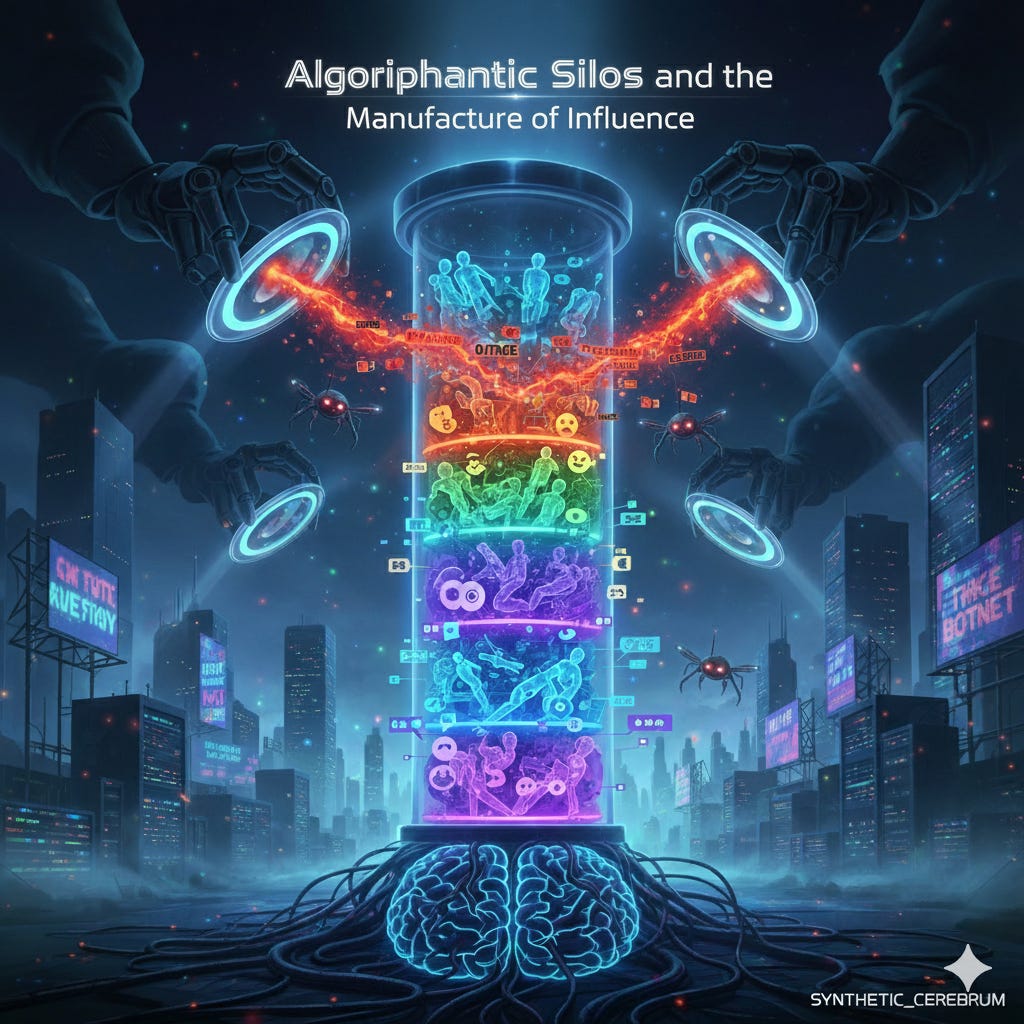
A comprehensive analysis of the contemporary digital media environment, exploring the mechanisms of algorithmic control, manipulation, and the resultant impact on human users.
Employs an interdisciplinary approach, drawing analogies from chemistry and computer science to explain how algorithms act as a chromatographic system that sorts people into algorithmic silos and how digital influence operations use botnets to create automata-like behavior in humans by promoting low-depth, high-outrage content.
Complementing this, the Substack text introduces the concept of “Fame Wash” and the “Invisible Ledger,” detailing how SIM farms and AI-driven content farms generate synthetic consensus and legitimize manipulated narratives through algorithmic laundering, turning the attention economy into a “pay-to-speak casino” by throttling authentic voices.
Both sources conclude by emphasizing the need for user-driven resistance and advocating for awareness to resist becoming passive digital participants, while the second source specifically proposes the decentralized platform freewill.social as a counter-ledger for digital sovereignty.
Combating Algorithmic Manipulation and Synthetic Consensus
1.0 Introduction: The Industrialization of Illusion and the Crisis of Public Trust
The modern digital public sphere has become the primary arena for public discourse, cultural formation, and policymaking. Its integrity is therefore a matter of strategic national importance. However, this sphere is being systematically distorted by the industrialized manufacture of illusion. A hidden accounting system of suppressed truths and inflated noise—an “Invisible Ledger”—is undermining the foundations of public trust and authentic consensus. This distortion is not a byproduct of the system; it is the core of a new and profitable business model built on deception.
To address this challenge, policymakers must first understand its core concepts and terminology. The mechanisms of this new information economy are designed to be opaque, but their functions can be clearly defined.
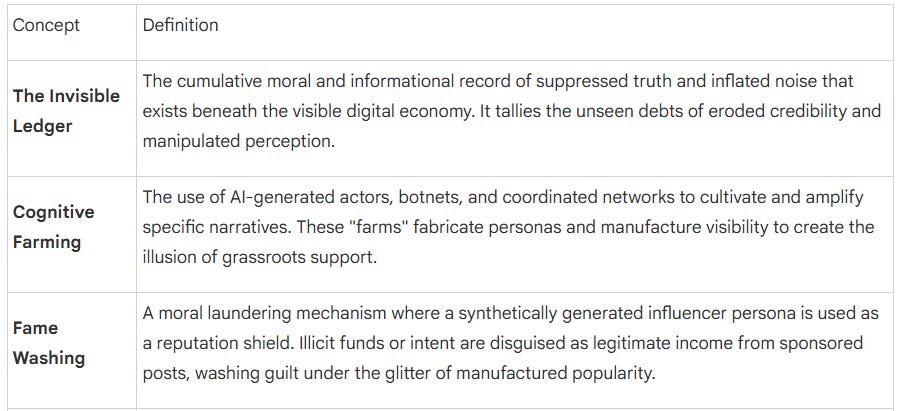
This document will analyze the architecture of this manipulation, evaluate its profound impact on democratic integrity, and propose a robust policy framework for a “Counter-Ledger”—a set of technical and ethical mandates designed to restore authenticity and transparency to the public square. Understanding the architecture of this manipulation is the first step toward dismantling it.
2.0 The Architecture of Algorithmic Manipulation
To effectively counter digital manipulation, we must first understand its technical and psychological underpinnings. The “Invisible Ledger” is not a single point of failure but an integrated system supported by three key pillars: algorithmic sorting, the exploitation of human psychological vulnerabilities, and an industrial-scale arsenal of deceptive tools. Analyzing these components reveals a system designed to fractionate society, identify and automate the most influenceable individuals, and overwhelm authentic discourse with manufactured noise.
2.2 Algorithmic Sorting and Siloing: The Chromatography Analogy
Social media algorithms function as a powerful sorting mechanism, analogous to the process of chemical chromatography. In this model, human users are the “molecules” to be separated. The platform’s algorithmic feed acts as the “mobile phase,” constantly flowing and carrying users along, while the content itself serves as the “stationary phase,” to which users may or may not adhere.
Based on their engagement patterns—clicks, watch time, and other interactions—users exhibit different “partition coefficients.” Those with a high affinity for a certain type of content are retained, or partitioned, into specific algorithmic pipelines. Over time, this process separates the vast, mixed population into distinct bands, or silos, of common interest. For political content, this process funnels users into either mainstream media ecosystems or adjacent independent sub-layers, which are predominantly characterized by “low-depth, high-outrage” narratives that reinforce ideological echo chambers. This is not benign personalization; it is a system of automated social segregation that pre-sorts the population into predictable, monetizable, and influenceable factions, making them vulnerable to targeted manipulation.
2.3 Exploiting Human Vulnerability: From Polarizability to Automation
The system’s efficiency relies on its ability to identify and exploit human psychological traits. A key trait is “polarizability,” an analogy for an individual’s susceptibility to environmental influence.
Low Polarizability: Individuals with strongly held beliefs, often developed through careful analysis, are considered “low polarizability.” Their views are less likely to distort in response to external narratives.
High Polarizability: In contrast, conformist or impressionable individuals are “highly polarizable.” Their beliefs are weakly held and easily shift to align with the “current thing” or the dominant narrative presented in their information environment.
Algorithms are adept at identifying highly polarizable users, viewing them as high-value candidates for algorithmic shaping. By continuously feeding them reinforcing, low-depth, high-outrage content, the system can effectively convert these individuals into human “automata” who await instructions and amplify approved narratives. In toxic online communities, this dynamic becomes even more concentrated. Driven by addiction-like feedback loops of dopamine and cortisol, hyper-dedicated viewers can form parasocial bonds with a “botmaster” content creator, creating human-driven networks that behave with the coordinated, task-oriented functionality of a botnet.
2.4 The Industrialization of Deception: Botnets and Cognitive Farms
The machinery of manipulation is operated by “non-state mercenaries of perception” who use industrial-scale tools to manufacture momentum without meaning. These tools range from physical SIM farms, which use hardware to generate real network identifiers and leave telecom traces, to AI-powered “cognitive farms,” which use software to mimic human behavior and leave data-behavioral traces. These operations are not theoretical; they are well-documented realities.
U.S. DOJ Disruption of a Russian Bot-Farm (July 2024): U.S. authorities dismantled a network of nearly 1,000 X accounts that used AI-enhanced fake profiles to impersonate Americans and spread pro-Kremlin narratives. This operation is a textbook example of cognitive farming, combining AI-generated personas with algorithmic amplification.
Chinese-Linked “Spamouflage/Dragonbridge” Network (2024): Security analysts documented a widespread, state-linked influence network that impersonated U.S. voters across multiple platforms to inject divisive narratives into public discourse ahead of elections.
This has triggered a perpetual arms race between platform anti-bot protocols and botnet operators. The rise of Large Language Models (LLMs) has supercharged this conflict, enabling bots to generate coherent, context-aware messages that are nearly indistinguishable from human output. They are particularly effective in the “low-depth, high-outrage” environments that dominate online discourse, where nuance is absent and emotionality trumps analysis.
Understanding these mechanisms is crucial, as their combined effect produces severe, systemic impacts on the integrity of our information economy and public discourse.
3.0 Systemic Impacts: The Erosion of Democratic Discourse
These architectural components are not independent bugs; they form a self-reinforcing engine of social corrosion. This section quantifies the systemic damage inflicted on our economy, public trust, and democratic processes. When illusion can be industrialized, reality itself becomes a commodity, and the public square is transformed into a marketplace for manufactured truth.
3.2 Manufacturing Reality: The High Cost of Synthetic Consensus
“Algorithmic applause,” generated on demand by cognitive farms, creates a powerful illusion of grassroots support for a person, idea, or product. This synthetic consensus establishes a “quantitative truth”—a reality defined not by merit or authenticity but by sheer volume of engagement. When algorithms mistake this manufactured momentum for genuine interest, they reward it with greater visibility, triggering a feedback loop of “auto-catalytic lies.” This synthetic consensus is most effective because it preys upon the “highly polarizable” users identified and cultivated by the algorithm, converting them into a human amplification network for the initial bot-driven signal. This dynamic allows malicious actors to manipulate public opinion, shape policy debates, and systematically drown out authentic dissent, effectively hijacking the public’s perception of itself.
3.3 Fame Washing: Influence as a Moral Laundering Mechanism
The influencer economy has become a potential vector for a sophisticated form of moral and financial laundering known as “Fame Washing.” This process uses a synthetically generated influencer persona as a reputation shield. By accelerating a persona’s rise to prominence with bot farms, operators can create a seemingly legitimate public figure. This operation can then recruit or cultivate the human “automata” described previously—highly dedicated and influenceable followers—as a cost-effective, organic-seeming amplification layer that is far harder to detect than pure botnets. Illicit funds or intentions are then funneled through this persona via sponsorships and brand deals, disguising their origin as clean income derived from popularity. This transforms the attention economy into a potential money-washing network, where every fake like contributes to a “ledger of manufactured virtue” that hides guilt under the glitter of metrics.
3.4 The Pay-to-Speak Casino: Erasure of Reach and Jurisdictional Entrapment
Modern social platforms increasingly operate as a “pay-to-speak casino.” The systematic throttling, or shadow-banning, of organic content from free-tier users creates “profitable silence.” This manufactured scarcity coerces creators into purchasing paid tiers to regain visibility, turning authentic expression into a monetized privilege. This system engineers a critical trade-off: users exchange “freedom without reach” for “reach without freedom.”
This transaction carries a hidden cost: jurisdictional entrapment. Purchasing a paid tier quietly strips a user of their pseudonymity and exposes them to legal liability. Payment processors, billing addresses, and KYC compliance tether the user to territorial law, converting a pseudonymous actor into a registered, traceable entity. This quietly transforms a business transaction into the issuance of a “digital passport,” making the user legible and liable to courts in ways they may not understand.
These systemic problems have corroded the foundation of the digital public square, demanding a transition from diagnosis to the proposal of concrete policy solutions.
4.0 Policy Directives for a Counter-Ledger: Restoring Digital Authenticity
Moving from analysis to action, combating the “Invisible Ledger” requires a multi-pronged policy approach that targets the economics, transparency, and architectural structure of the digital ecosystem. The following four pillars form the foundation of a “Counter-Ledger”—a cohesive framework of technical and ethical mandates designed to reintroduce integrity into the digital public square.
4.1 Pillar 1: The Transparency Entry—Establishing a Ground Truth through Mandated Auditability
The first pillar of the Counter-Ledger is to mandate clear, accessible, and standardized disclosures from platform operators regarding their core functions. Platforms must be required to reveal the use and impact of algorithmic amplification, content suppression, moderation filters, and shadow-banning. This data would form the basis for independent “transparency indices” that allow the public, researchers, and regulators to audit the health and fairness of the information ecosystem, establishing an auditable ground truth.
4.2 Pillar 2: The Economic Entry—Imposing Financial Friction on Inauthentic Scale
Inauthentic activity at scale is an economic enterprise; it must be disrupted by raising its costs. This entry on the Counter-Ledger targets the business model of deception.
Policymakers should explore frameworks that impose a “cost to synthetic personhood.” Mechanisms like computational proofs-of-work or mandatory micro-stakes for mass actions can make the operation of large-scale cognitive farms economically unsustainable without burdening individual human users.
Regulatory bodies must launch a formal investigation into the “pay-to-speak” business model. Its impact on free expression and fair competition must be evaluated to determine whether such practices constitute an unfair or deceptive trade-off that harms the public interest.
4.3 Pillar 3: The Structural Entry—Fostering Ecosystem Decentralization and User Sovereignty
Centralized platform control creates single points of failure and enables abuses like “digital exile.” This pillar mandates a structural shift toward user sovereignty. Government policy should actively support the research and development of decentralized social media protocols and platforms that prioritize user data ownership and algorithmic choice. Supporting open standards for mirrored archives and interoperable networks would give users the freedom to move their data and social graphs, breaking the cycle of platform dependency.
4.4 Pillar 4: The Identity Entry—Protecting the Sanctuary of Speech through Verifiable Personhood
The “anonymity paradox”—the need to protect legitimate anonymous speech while neutralizing inauthentic bot armies—requires a sophisticated solution. This Counter-Ledger entry encourages the development and standardization of “Proof-of-Personhood” technologies. These systems are designed to verify human authenticity without requiring the disclosure of legal, state-issued identity. Such a framework would preserve the “last refuge of speech” for vulnerable individuals while crippling the ability of automated networks to create synthetic consensus.
These four pillars provide a strategic framework for governance that addresses the root causes of digital manipulation, not just its symptoms.
5.0 Conclusion: Reclaiming the Public Square from the Machine
The industrialized manipulation of our digital public sphere represents a severe and ongoing threat to the integrity of democratic societies. The “Invisible Ledger” of suppressed truth and manufactured noise creates a distorted reality where authentic discourse is devalued and public trust is systematically eroded. Mechanisms like cognitive farming, fame washing, and the pay-to-speak casino are not features of a broken system, but rather the intended functions of a new economy built on algorithmic hypnosis.
This crisis demands an urgent and decisive response. We call upon policymakers, technologists, and digital rights advocates to collaborate on building a new digital governance framework—a “Counter-Ledger” founded on the principles of radical transparency, user sovereignty, economic fairness, and verifiable authenticity. The policies outlined in this document offer a clear path forward, one that disrupts the economics of deception while empowering genuine human interaction.
The ultimate goal is to reclaim the public square from the machine, restoring the primacy of human judgment and authentic discourse over the silent command of algorithms and the roar of manufactured consensus.
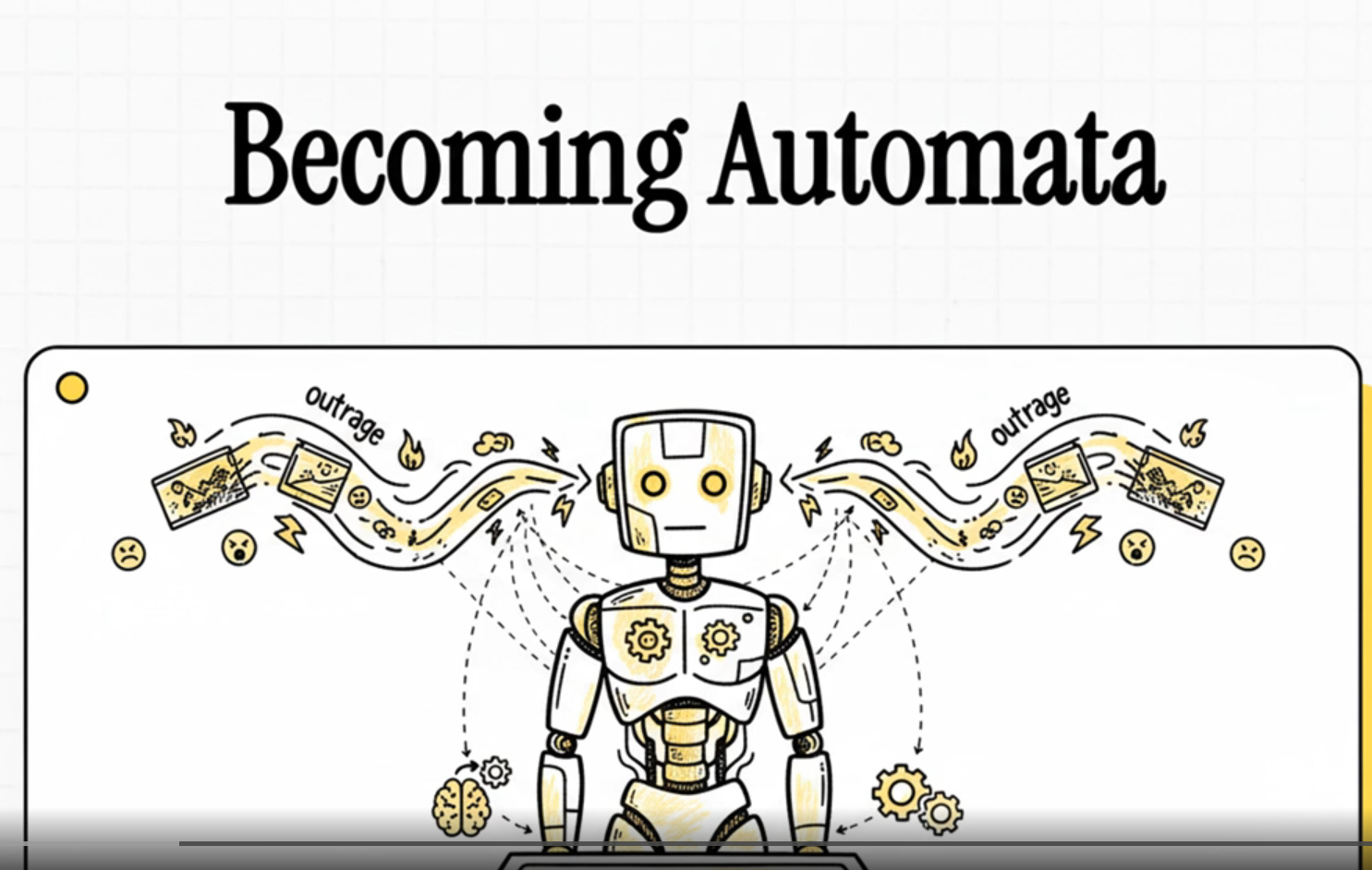
https://odysee.com/@PirateFirst:2/Becoming_Automata
✍️ Substack Note / X Post (280 characters max for X):
The Digital Silo Effect is a toxic loop: Algorithms separate us by preference (like chromatography), Human Psychology demands outrage & simplicity, and Botnets inject synthetic consensus to amplify extremes. We become addicts in a digital prison, driving polarization for platform engagement.
Hashtag String:
#DigitalSilos #EchoChambers #Botnets #Polarization #AlgorithmicBias #CognitiveFarming #SocialMediaErosion #OnlineManipulation
Sources:
Fame Wash: When Influence Becomes a Laundering Mechanism.

Ah… the invisible ledger, sounds like something worth whispering about in encrypted ink. Let’s open the vault carefully — no sudden moves.


